NEW
Font size
 Worksheets
Moon practice
Total questions: 62
Worksheet time: 50mins
About how long does it take the moon to make one complete cycle around the earth?
65 days
29.5 days
365 days
27.3 days


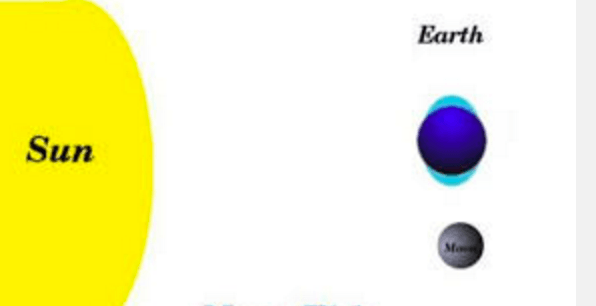


What causes sunrise and sunset and moonrise and moonset?
Earth revolving on its axis
Earth rotating on its axis
The moon rotating on its axis
Earth revolving around the sun

We do we always see the same side of the moon?
the moon's rate of rotation is equal to its rate of revolution
the moon does not rotate it only revolves
the moon rotates once in 27.3 days and it takes 29.5 days to go through the cycle of phases
The Earth rotates at a rate of 15 degrees per hour

Higher at high tide and lower at low tide
(more extreme)
Lower at high tide and higher at low tide (less extreme)
higher than normal
Why do we not have an eclipse every new and full moon?
We always see the same side of the moon
The moon rotates at the same speed it revolves
The moon's orbit is inclined 5 degrees compared to Earth's plane of orbit
Earth's revolution around the sun prevents this from happening


The graph shows the observed water levels, in feet (ft), for a tide gauge located at Montauk, New York, on the easternmost end of Long Island, from January 24, 2008 to noon on January 25, 2008.What was the height of the water above average low tide level at noon on January 24?
1.2 ft
1.6 ft
2.2 ft
2.6 ft

These changing water levels at Montauk can best be described as
cyclic and predictable
cyclic and not predictable
noncyclic and not predictable
noncyclic and predictable

What causes the water-level variation pattern shown by the graph?
changes in wind velocity produced by coastal storms
changes in magnetic orientation of the North American Plate
Earth's revolution and the distance from the equator
Earth's rotation and the gravitational pull of the Moon

Which diagram best represents the sequence of Moon phases, as seen by an observer in New York State, when the Moon travels from position A to position D in its orbit around Earth?


The diagram represents Earth and the Moon as viewed from above the North Pole. Points A, B, C, and D are locations on Earth's surface. According to the diagram, where will high ocean tides and low ocean tides most likely be located?
High tides at A and B; low tides at C and D
high tides at B and D; low tides at A and C
high tides at A and C; low tides at B and D
high tides at C and D; low tides at A and B

The graph shows the change in tide heights of the Hudson River at Newburgh, New York. According to the graph, the time difference between high tide and the next low tide is approximately
2 hours
3 hours
6 hours
12 hours

The table shows tide data for a location on the north shore of Long Island, in New York State. Based on these data, what is the most likely time of the next high tide?
1:53 a.m.
1:53 p.m.
7:40 a.m.
7:40 p.m.

Which table correctly matches each type of eclipse with the orbital position of the Moon and the cause of each eclipse?


The time it took for the Moon to go from this supermoon to the next full moon phase was
15 days
27.3 days
29.5 days
365 days

During which Moon phase could an observer on Earth see a lunar eclipse occur?


At which two Moon positions would an observer on Earth most likely experience the highest high tides and the lowest low tides?
A and B
B and C
C and A
D and B

The table below shows the times of ocean high tides and low tides on a certain date at a New York State location.
At approximately what time on the following day did the next high tide occur at this location?
4:40 a.m.
5:40 a.m.
4:40 p.m.
5:40 p.m.

Which diagram correctly shows the position of the Moon with respect to Earth on March 9, 2001 (FULL MOON)?
1
2
3
4

A student drew the pictures below to show how the Moon looked from Earth over a two-week period. The differences shown in the student’s drawings are mostly due to the changing:
distance between Earth and the Moon
speed of the Moon in its orbit
position of the Moon in its orbit
position of the observer on Earth
The Moon is visible to observers on Earth because of:
reflected sunlight
absorbed light from Earth's atmosphere
gases in the Moon's interior
volcanic eruptions on the Moon's surface

The diagram below shows four Moon phases observed during July. On which date would the next New Moon occur?
August 5
August 19
August 29
August 10

The graph below shows tide levels for two days at an ocean location. Approximately how many hours are between the high tide on Tuesday and the first high tide on Wednesday?
6 hours
12 hours
9 hours
18 hours
Approximately how long does it take to cycle from one new Moon to the next new Moon?
a day
a month
a week
a year
The Moon has the greatest effect on Earth’s:
year
seasons
ocean tides
daylight hours

The diagram below shows the positions of the Sun, Earth, and the Moon as seen from space. Which event is caused by the Moon passing through Earth’s shadow?
a meteor shower
an eclipse
a change of seasons
an earthquake
The Moon’s gravitational force has a greater effect on ocean tides on Earth than the Sun’s gravitational force. What is the reason for this?
The Moon has a greater mass than the Sun.
The Moon is closer to the Earth than the Sun.
The Moon is solid.
The Moon rotates around the Earth.