wayground logo

Free Printable Worksheets

NEW

Font size

S
M
L
XL
Worksheets

Predators and Preys

Total questions: 43

Worksheet time: 24mins

Name
Class
Date
1.

A predator is __________________.

a)

an animal that is eaten by another animal

b)

an animal that eats another animal

c)

a plant

d)

a producer

2.

An animal that is eaten by another animal is called a ____________.

a)

prey

b)

consumer

c)

producer

d)

predator

3.

An example of a producer is _________________.

a)

a bird

b)

a grasshopper

c)

an owl

d)

a tree

4.

Barn owls hunt shrews. In this example what is a barn owl?

a)

Herbivore/Predator

b)

Carnivore/Prey

c)

Carnivore/Predator

d)

Herbivore/Prey

5.
Which of the following would be considered to be prey?
a)
an animal that has to hunt for its food
b)
an animal that is eaten by another animal
c)
an organism that makes it own food
d)
an organism that feeds on the blood of another animal
6.
A consumer that hunts is called:
a)
a producer.
b)
an omnivore.
c)
a predator.
d)
a herbivore.
7.
How do consumers get their energy? 
a)
laying in the sun
b)
eating other organisms 
c)
providing food for other organisms
d)
surviving in an ecosystem 
8.

If a hawk eats a snake, the snake is the ____________.

a)

predator

b)

consumer

c)

prey

d)

producer

9.

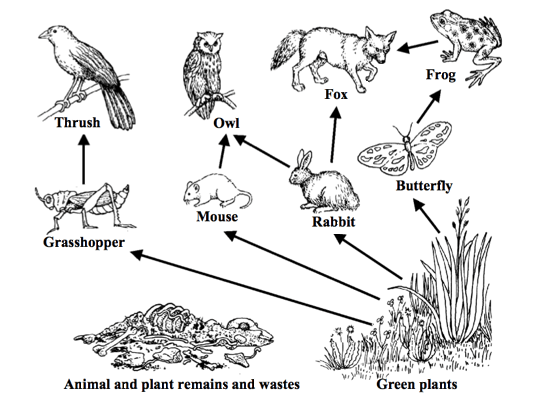
What role does the mouse play?

a)

Predator

b)

Prey

c)

Producer

d)

Consumer

10.

Which of the following is a herbivore?

a)

cricket

b)

frog

c)

hawk

d)

shrew

11.
How many carnivores are shown in this food web?
a)
6
b)
4
c)
5
d)
3
12.
A food web can be broken down into several seperate
a)
food chains
b)
food pyramids
c)
producers
d)
consumers
13.
The owl receives energy from which organisms?
a)
grasshopper and mouse
b)
mouse and rabbit
c)
rabbit and butterfly
d)
butterfly and frog
14.
What might happen if you remove a primary consumer from the ecosystem?
a)
There would be more food for secondary consumers.
b)
The number of primary consumers would increase.
c)
The number of plants would increase.
d)
The number of secondary consumers would increase.
15.

A consumer that hunts is called:

a)

a producer.

b)

a prey.

c)

a predator.

d)

a herbivore.

16.
How many herbivores are in this web?
a)
1
b)
2
c)
3
d)
4
17.

What is this called?

a)

Food Web

b)

Food Chain

c)

Life Cycle

d)

Life Span

18.
If a frog is the prey, what could be the predator?
a)
Grass
b)
Insect
c)
Snake
d)
Snail
19.

What does a primary consumer eat?

a)

animals

b)

secondary consumers

c)

producers

d)

their prey

20.

Lions only eat buffalo, antelopes, zebras and crocodiles. They are called __________.

a)

Omnivores

b)

Herbivores

c)

Carnivores

d)

Producers

21.

Bears eat fish, insects, plants, seeds, nuts and young elk. They are called __________.

a)

Producers

b)

Carnivores

c)

Herbivores

d)

Omnivores

22.
If the grasshopper were to be removed completely from the food web, what organism would be most effected?
a)
The squirrel
b)
The shrew
c)
The deer
d)
The rabbit
23.
The rabbit in this food web would be considered a:
a)
Decomposer
b)
Producer
c)
Secondary Consumer
d)
Primary Consumer
24.

The mouse in this food web would be considered a:

a)

Primary Consumer

b)

Producer

c)

Decomposer

d)

Secondary Consumer

25.
All energy on Earth ultimately comes from what source?
a)
Water
b)
Sun
c)
Consumers
d)
Oxygen
26.
Base your answer on the diagram below and on your knowledge of science. The diagram shows some organisms living together. The baby birds in the nest are competing for
a)
food 
b)
mates 
c)
predators
d)
camouflage
27.
Which two organisms in this diagram are producers? 
a)
blue jay and woodpecker
b)
 beetle and squirrel 
c)
worm and leaves
d)
tree and grass
28.
Which characteristic helps some animals defend themselves against predators? 
a)
strong odor
b)
poor hearing
c)
weak eyesight
d)
shivering
29.
Green plants get the energy they need to make food from
a)
water
b)
air
c)
soil
d)
sunlight
30.
Look at the picture. If the number of frogs decreases, which population will most likely increase?
a)
crickets
b)
hawks
c)
snakes
d)
plants
31.
Two predators shown in the diagram are
a)
hawks and snakes
b)
hawks and plants
c)
frogs and crickets
d)
frogs and plants
32.

Base your answer on the diagram of a food chain and on your knowledge of science.


Which organisms are producers?

a)

crickets

b)

eagles

c)

frogs

d)

green plants

33.

Base your answer on the diagram of a food chain and on your knowledge of science.


If the number of frogs decreases, which population will most likely increase?

a)

eagles

b)

snakes

c)

crickets

d)

green plants

34.

Base your answer on the diagram of a food chain and on your knowledge of science.


In which order is energy transferred through a food chain?

a)
b)
c)
d)
35.
What is a decomposer?
a)
a living thing that breaks down dead organisms
b)
a living thing that makes its own food
c)
an animal that eats live plants
d)
an animal that hunts other animals
36.
 Which organism in this food chain is both predator and prey?
a)
A
b)
B
c)
C
d)
D
37.
If the population of organism A decreases, the population of organism B would most likely
a)
decrease
b)
increase
c)
remain the same
38.
Which type of organism helps return nutrients from dead plants and animals to the soil?
a)
producer
b)
prey
c)
predator
d)
decomposer
39.
Look at the picture. If the number of frogs suddenly increases, which population will most likely decrease first?
a)
hawks
b)
snakes
c)
crickets 
d)
plants
40.
What is the main source of energy for all the organisms in this food chain?
a)
sun
b)
plants
c)
frogs
d)
hawks
41.
Large birds have been eating small animals in an area. If all of the large birds died from a disease, the number of small animals in the area would probably
a)
decrease
b)
increase
c)
remain the same
42.
Which organism in the food chain in this picture is a producer?
a)
cricket
b)
frog
c)
green plant
d)
snake
43.
Which organism in this food chain is both predator and prey?
a)
cricket
b)
frog 
c)
green plant
d)
snake