Wayground logo

Free Printable Worksheets

Font size

S
M
L
XL
Worksheets

Chemical reactions, acids and bases, and variables

Total questions: 82

Worksheet time: 3hrs 45mins

Name
Class
Date
1.
Which of the following is a base?
a)
orange juice
b)
water
c)
vinegar
d)
dishwashing detergent
2.

The variable that changes based on what the scientist is changing and testing in the experiment is the

a)

open variable

b)

dependent variable

c)

control variable

d)

independent variable

3.
Which of the following word pairs correctly completes the sentence below?
_______ are corrosive substances characterized as having a strong smell, a sour taste, and a _______.
a)
Acids; pH less than 7
b)
Acids; pH greater than 7
c)
Bases; pH greater than 7
d)
Bases; pH less than 7
4.
 Which of the following is an acid?
a)
shampoo
b)
baking soda
c)
orange juice
d)
water
5.
Which of the following statements is correct?
a)
Blue litmus paper turns red when placed in a base.
b)
Red litmus paper turns blue when placed in a base.
c)
Blue litmus paper stays blue when placed in an acid.
d)
Red litmus paper stays red when placed in a base.
6.
The pH of a solution is tested, and it is found to be a basic solution. Of the following choices, what could the pH have been?
a)
3
b)
9
c)
7
d)
5
7.
Human blood has a pH between 7.35 and 7.45. Which of the following best describes human blood?
a)
strongly acidic
b)
slightly acidic
c)
strongly basic
d)
slightly basic
8.

Any change that alters a substance without making it into a new substance is called a

a)

physical change

b)

chemical change

c)

chemical formula

d)

chemical equation

9.
What would be considered the weakest base? 
a)
8
b)
14
c)
7.8
d)
11.6
10.
Many cleaning solutions are bases. Which of the following is a property of most bases?
a)
feels slippery
b)
white color
c)
can only be liquid
d)
tastes sour
11.

A chemical reaction where energy is absorbed and heat goes down is called a(n)

a)

chemical reaction

b)

endothermic reaction

c)

exothermic reaction

d)

chemical equation

12.
Pure water has a pH of 7. Pure water _______.
a)
is a base
b)
is a neutral substance
c)
could be either an acid or a base
d)
is an acid
13.

A substance present after a chemical reaction is called a

a)

product

b)

yield

c)

reactant

d)

coefficient

14.
Which of the following is true about acids and bases?
a)
The lower the pH, the stronger the acid
b)
the higher the pH, the stronger the acid
c)
The lower the pH, the more neutral the acid
d)
The higher the pH, the weaker the base
15.
Which food is the most acidic?
a)
bananas
b)
lemon juice
c)
orange juice
16.
Have a sour taste
a)
acid
b)
base
c)
neither
d)
both
17.
Have a bitter taste
a)
acid
b)
base
c)
neither
d)
both
18.
Turns blue litmus paper red
a)
acid
b)
base
c)
neither
d)
both
19.

The pH scale is

a)

numbered 1 - 12

b)

measures the concentration ions that make acids

c)

measures the concentration of ions that make bases

d)

is completely random and doesn't mean anything

20.
Feel slippery
a)
acid
b)
base
c)
neither
d)
both
21.

The number in front of a chemical formula that tells how many molecules or atoms of each reactant take part in a reaction is called a

a)

chemical symbol

b)

coefficient

c)

subscript

d)

concentration

22.
What is the range of pH values in a basic solution?
a)
0-6
b)
8-14
c)
7
d)
0-14
23.

A chemical change is also referred to as a

a)

chemical equation

b)

chemical symbol

c)

chemical formula

d)

chemical reaction

24.

pH of 0-7

a)

Base

b)

Acid

25.

Chemical equations must be balanced because chemical reactions obey the law of

a)

activation

b)

decomposition

c)

conservation of mass

d)

coefficients

26.
What are properties of acids?
a)
Bitter, slippery, ph above 7
b)
Sour, reacts with metals, ph below 7
c)
Sour, reacts with metals, ph above 7
d)
Bitter, ph of 7, does not react with metals
27.

Which of the following pH values indicates a solution with the highest concentration of ions that make an acid?

a)

pH = 1

b)

pH = 7

c)

pH = 2

d)

pH = 14

28.

turns red litmus paper blue

a)

Acid

b)

Base

29.
In a chemical equation, is it true that -
a)
the reactant side and product side can have different numbers of atoms for each element
b)
there can be different elements on the reactant side and the product side
c)
an element or compound must be accompanied by a phase change
d)
the coefficients indicate the number of molecules of each reactant used and the number of molecules of each product made
30.

When a chemical reaction takes place where the reactants and products can mix with the environment around them, it is called a(n)

a)

closed system

b)

open system

c)

default system

d)

chemical equation

31.

Which of the following is an example of a physical property?

a)

ability to tarnish

b)

freezing point

c)

ability to burn

d)

ability to react with metals

32.
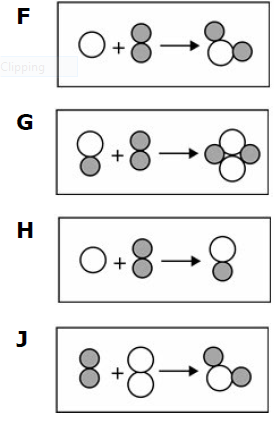
Which of the following models best demonstrates a balanced chemical equation?
a)
F
b)
G
c)
H
d)
J
33.
The reactants are on the left side of the chemical equation.
a)
True
b)
False
34.
Two clear colorless solutions were combined.
The student observed that the temperature changed from 25 •C to 23 •C when the solutions were combined and that a white substance rapidly formed and settled to the bottom of the container. What most likely happened to produce these results?
a)
One of the original compounds came out of solution
b)
The solutions reacted chemically
c)
Some of the water froze into ice crystals
d)
Rapid evaporation of water occurred, leaving a solid
35.
What is a coefficient?
a)
The small number on the right of the chemical symbol.
b)
The large number to the left of a formula.
36.

There can be _____ independent variable(s) in a well-designed experiment.

a)

one

b)

two

c)

three

d)

any number of

37.

Why must chemical equations be balanced?

a)

So that the equation doesn't explode

b)

The reaction won't happen until it is balanced

c)

Based on the Law of Conservation of Matter, matter cannot be created or destroyed.

d)

Based on the Law of Conservation of Energy, energy cannot be created or destroyed.e

38.

What must go in the blank space to balance the equation?

4Fe + ____O2 --> 2Fe2O3

a)

1

b)

2

c)

3

d)

4

39.
_________________ are the elements and compounds that enter into a chemical reaction.
a)
Polymers
b)
Bonds
c)
Reactants
d)
Products
40.

The _______ states that matter is not created or destroyed in a chemical reaction.

a)

Law of conservation of mass

b)

Law of conservation of energy

c)

Law of gravity

d)

Law of motion

41.
___________________ are the elements are compounds that leave (are formed in) a chemical
reaction.
a)
Polymers
b)
Bonds
c)
Reactants
d)
Products
42.

In an experiment, the only variable being purposely changed to test the hypothesis is the

a)

open variable

b)

independent variable

c)

dependent variable

d)

control variable

43.

A factor that can change in an experiment is called a

a)

variable

b)

hypothesis

c)

conclusion

d)

question

44.
Is this balanced?
2HgO → 2Hg + O2
a)
Yes
b)
No
45.

The variables that a scientist purposely leaves the same in an experiment are the

a)

open variables

b)

dependent variables

c)

control variables

d)

independent variables

46.
Is this balanced?
Al + O2 → 2Al2O3
a)
Yes
b)
No
47.
To balance a chemical equation, you should change ONLY the...
a)
subscripts
b)
coefficients
c)
chemical formulas
d)
direction of the arrow
48.

A substance that is present before a chemical reaction is a

a)

product

b)

reactant

c)

chemical equation

d)

chemical formula

49.
Which of the following is NOT a sign of a chemical reaction? 
a)
Color changes
b)
Cutting into fourths
c)
Light is produced
d)
Gas is formed
50.
Is burning wood a chemical or physical change?
a)
chemical
b)
physical
51.
Which of the following is NOT an example of a physical change?
a)
crumpled paper
b)
pencil sharpening
c)
shrunken clothing
d)
sour milk
52.
Which is a chemical change?
a)
freezing fruit juice
b)
slicing a potato
c)
boiling water
d)
copper metal turning green
53.

A chemical reaction in which heat appears (temperature goes up) is called

a)

exothermic

b)

endothermic

c)

combustion

d)

synthetic

54.
How many F atoms are in this compound?
6MgF2 
a)
2
b)
6
c)
8
d)
12
55.
How many Al atoms are in this compound?         4Al2O3
a)
2
b)
8
c)
6
d)
4
56.
In an endothermic reaction, heat is ,,,
a)
taken in
b)
given out
57.

A student mixed two chemicals to allow them to react. The temperature before the reaction was 25 ° C. The temperature after the reaction was 18° C. Which of the following is true?

a)

The temperature changed

b)

It is an endothermic reaction

c)

It is an exothermic reaction

d)

There was no chemical reaction

58.

This uses symbols and formulas to show chemical reactions.

a)

chemical equations

b)

open systems

c)

endothermic reactions

d)

exothermic reactions

59.
What is a Chemical Reaction?
a)
When two liquids hit each other
b)
When a liquid has foam
c)
When two substances mix and produce new products
d)
When a reaction forms with soda and candy
60.

A neutral solution has a pH of

a)

3

b)

5

c)

7

d)

9

61.
If a chemical reaction is EXOTHERMIC, the temperature would....
a)
Stay the same
b)
Increase
c)
Decrease
62.
the starting materials in a chemical reaction
a)
Products
b)
Reactants
c)
Starters
d)
Enders
63.
An experiment is performed on plants to see how different liquids affect plant growth. Each plant in the experiment is given a different liquid; water, apple juice, or milk. Each plant has the same amount of soil, sunlight, and listens to the same music. In this investigation, the independent variable is ...
a)
The type of plant
b)
The amount of sunlight
c)
The type of music
d)
The type of liquid
64.

A change in matter that produces a new substance is called a

a)

chemical reaction

b)

physical change

c)

mixture

d)

solution

65.
An experiment is performed on plants to see how different liquids affect plant growth. Each plant in the experiment is given a different liquid; water, apple juice, or milk. Each plant has the same amount of soil, sunlight, and listens to the same music. In this investigation, what are the controlled variables?
a)
Type of plant, amount of music, and sunlight
b)
Water, apple juice, milk
c)
Plant growth
66.
An experiment is performed on plants to see how different liquids affect plant growth. Each plant in the experiment is given a different liquid; water, apple juice, or milk. Each plant has the same amount of soil, sunlight, and listens to the same music. In this investigation, what is the dependent variable?
a)
Type of plant
b)
Water, apple juice, milk
c)
Plant growth
67.
A student is planning an experiment to find out how the height from which he drops a ball affects how high the ball bounces. The dependent variable is the _____.
a)
Diameter of the ball
b)
Force acting on the ball
c)
Height that the ball bounces
d)
Height from which the ball is dropped
68.
A student is planning an experiment to find out how the height from which he drops a ball affects how high the ball bounces. What is the control variable?
a)
The ball used
b)
The height the ball bounces
c)
Height of the ball being dropped
69.
Mr. S set up an experiment to see how the mass of a ball affects the distance it rolls off a ramp. Identify the independent variable.
a)
Distance traveled by the ball
b)
Height of the ramp
c)
Mass of the ball
70.
Mr. S set up an experiment to see how the mass of a ball affects the distance it rolls off a ramp. What is the dependent variable?
a)
Distance traveled by the ball
b)
Height of the ramp
c)
Mass of the ball
71.
Mr. S set up an experiment to see how the mass of a ball affects the distance it rolls off a ramp. What is the controlled variable?
a)
Distance traveled by the ball
b)
Height of the ramp
c)
Mass of the ball
72.
Any factor that can change in an experiment
a)
variable
b)
constant
c)
independent
d)
dependent
73.
The variable that is being tested or changed
a)
independent variable
b)
dependent variable
c)
control variable
74.
The variable that is being measured
a)
independent variable
b)
dependent variable
c)
control variable
75.
the variable that is kept the same to make sure results are caused by the thing being tested
a)
independent variable
b)
dependent variable
c)
control variable
76.
the variable that is changed by the scientist at the beginning of the experiment
a)
independent variable
b)
dependent variable
c)
control variable
77.

A compound that changes color when it contacts and acid or base is called a(n)

a)

solvent

b)

indicator

c)

salt

d)

corroder

78.

Which of the following is an example of a chemical change?

a)

meat spoiling

b)

mercury rising

c)

water freezing

d)

butter softening

79.
the variable that is observed at the end of the experiment
a)
independent variable
b)
dependent variable
c)
control variable
80.
Scientific Question:  Does being tardy impact test scores?
What is the independent variable?
a)
test scores
b)
the time a study arrives to class
c)
amount of time to complete test
81.
Scientific Question:  Does being tardy impact test scores?
What is the dependent variable?
a)
test scores
b)
the time a study arrives to class
c)
amount of time to complete test
82.
Scientific Question:  Does being tardy impact test scores?
What is the control?
a)
test scores
b)
the time a study arrives to class
c)
amount of time to complete test