wayground logo

Free Printable Worksheets

NEW

Font size

S
M
L
XL
Worksheets

Earth Space Midterm Review 2

Total questions: 45

Worksheet time: 33mins
Name
Class
Date
1.
How do we name air masses?
a)
Water and temperature
b)
Air pressure
c)
Humidity and temperature
d)
Cold and warm
2.
How do we characterize an air mass that forms over the ocean?
a)
Dry
b)
Wet
c)
Cold
d)
Warm
3.
How do we characterize an air mass that forms over land?
a)
Dry
b)
Wet
c)
Cold
d)
Warm
4.
What types of air masses form over oceans?
a)
Maritime
b)
Continental
c)
Polar
d)
Tropical
5.
What's the humidity and temperature of a continental tropical air mass?
a)
Wet and cold
b)
Dry and warm
c)
Wet and warm
d)
Dry and cold
6.
A wet and cold air mass would be a...
a)
Maritime polar
b)
Continental polar
c)
Maritime tropical
d)
Continental tropical
7.
A dry and cold air mass would be...
a)
Maritime polar
b)
Continental polar
c)
Maritime tropical
d)
Continental tropical
8.
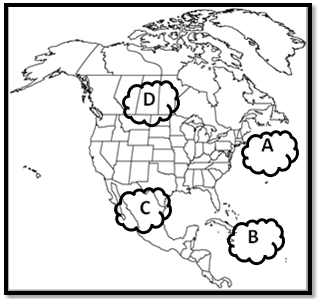
Which type of air would you find at air mass A?
a)
cold, dry
b)
warm, humid
c)
warm, dry
d)
cold, humid
9.
Which type of air would you find at air mass B?
a)
cold, dry
b)
warm, humid
c)
warm, dry
d)
cold, humid
10.
Which abbreviation of an air mass can be identified as dry and hot?
a)
cP
b)
mP
c)
cT
d)
mT
11.
Which abbreviation of an air mass can be identified as cold and moist?
a)
cP
b)
mP
c)
cT
d)
mT
12.
Surface currents are a result of
a)
Global Wind Patterns
b)
Earth's Rotation
c)
Density
d)
All of the above
13.
Deep Ocean currents are a result of
a)
Global Wind Patterns
b)
Earth's Rotation
c)
Density
d)
All of the above
14.
The Coriolis Effect is caused by
a)
Earth rotating around the sun
b)
Earth rotating on its axis
c)
The tides
d)
Gravity
15.
The Gulf stream carries _____________ water from the east coast of The United States to the West coast of Europe.
a)
Cold
b)
Warm 
c)
Freezing
d)
Fresh
16.
What happens to a current when it comes in contact with a continent or landmass?
a)
It continues over the continent
b)
It stops
c)
It changes direction
d)
It is absorbed by the land
17.
As you go deeper in the ocean, the water is colder and less salty.
a)
True
b)
False
18.
Due to the Coriolis Effect, water in the northern hemisphere moves
a)
clockwise
b)
counter clockwise
c)
both
d)
neither
19.
Due to the Coriolis Effect, water in the southern hemisphere moves
a)
clockwise
b)
counter-clockwise
c)
both
d)
neither
20.
Warm ocean currents generally come from
a)
The North Pole
b)
The South Pole
c)
The Equator
d)
Both A and B
21.

Cold ocean currents generally come from

a)

A. The North Pole

b)

B. The South Pole

c)

C. The Equator

d)

Both A and B

22.
Two types of water currents are
a)
local and global
b)
sea and land
c)
surface and deep
d)
warm and cold
23.
Ocean currents have an affect on which two things
a)
climate and weather
b)
temperature and density
c)
land and sea
d)
equator and poles
24.
The large, circular surface-current pattern found in each ocean.
a)
California Current
b)
Surface Current
c)
Gyre
d)
Global Conveyor Belt
25.
What process brings the deep cold ocean currents up to the surface?
a)
Conduction
b)
Global Wind Patterns
c)
Convection Currents
d)
Temperature and salinity
26.

The ozone layer helps life on Earth because ozone

a)

modifies the normal El Niño weather pattern

b)

reflects insolation from the Sun

c)

deflects winds from a straight line to a curved path

27.
Which source provides the most energy for atmospheric weather changes?
a)
radiation from the Sun
b)
radioactivity from Earth's interior
c)
heat stored in ocean water
d)
heat stored in polar ice caps
28.
The factor that contributes most of the seasonal temperature changes during one year is the changing
a)
speed at which the Earth travels in its orbit around the Sun
b)
angle at which the Sun’s rays strike the Earth’s surface
c)
distance between the Earth and the Sun
d)
energy given off by the Sun
29.
Deposited material at the end of a river is called?
a)
landform
b)
delta
c)
canyon
30.

Name this river feature

a)

ox-bow lake

b)

meander

c)

mouth

d)

estuary

31.

Where would there be more deposition?

a)

At the top of a mountain

b)

Half way down a mountain

c)

At sealevel

d)

None of these

32.

How does physical weathering and erosion effect the beach?

a)

Changes the elevation

b)

Increases the amount of water

c)

Changes the type of sand

d)

Changes the amount of rocks

33.

When do river deltas form?

a)

When the rate of deposition and erosion are equal

b)

When the rate of deposition is less than the rate of erosion

c)

When the rate of erosion is greater than the rate of erosion

d)

When the rate of deposition is greater than the rate of erosion

34.

The Appalachian mountains are older than the Rocky Mountains.

a)

True

b)

False

35.
The ability of a liquid to flow through a substance is:
a)
Porosity
b)
Permeability
36.
The amount of space between soil is:
a)
Porosity
b)
Permeability
37.

What type of rock is common in the cavernous region and is the rock needed to create Karst topography because it can be dissolved by the weak acid of Carbon Dioxide dissolved in water

a)

Sandstone

b)

Granite

c)

Basalt

d)

Limestone

38.
The name of the area that is the upper level of the zone of saturation:
a)
Zone of Saturation
b)
Zone of Aeration
c)
Water Table
39.

What is karst topography?

a)

Land masses with elevations over 1,000 ft

b)

The chemical dissolution of limestone bedrock

c)

Deposition from streams and rivers

d)

Erosion from the strong ocean currents

40.
A student wants to test the effects of type of exercise on heart rate.  What is the dependent variable?
a)
heart rate
b)
type of exercise
c)
amount of exercise
d)
time of day exercise occurs
41.
An experiment is performed on plants to see how different liquids affect plant growth. Each plant in the experiment is given a different liquid; water, apple juice, or milk. Each plant has the same amount of soil, sunlight, and listens to the same music. In this investigation, what is the dependent variable?
a)
Type of plant
b)
Water, apple juice, milk
c)
Plant growth
42.

Find the Independent Variable: You experiment to see if a bouncy ball or a tennis ball bounces higher.

a)

Type of ball

b)

Same drop height

c)

Height of Bounce

d)

Same surface

43.

Find the Independent Variable: You experiment to see how the noise level in a room affects your ability to memorize random numbers and letters.

a)

Ability to memorize

b)

Noise level in room

c)

Amount of sleep

d)

Age of person

44.
The independent variable is the ONE thing you _____.
a)
change
b)
keep the same
c)
experiment with
d)
investigate
45.
How many variables can be tested in a controlled experiment?
a)
one
b)
two
c)
three
d)
as many as possible