
Font size
 Worksheets
PBMF Fall Review
Total questions: 100
Worksheet time: 1hrs 18mins
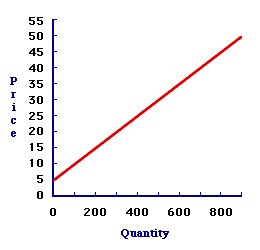
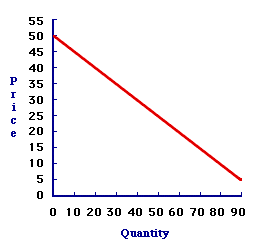
What might happen if the demand for a new type of sneaker began rising quickly?
The manufacturer would begin making fewer sneakers
The sneaker company would raise the price of the sneakers
People would refuse to pay more money for the sneakers
The sneaker company would lower the price of the sneakers
According to the laws of supply and demand, when will companies produce more of a product?
When the price people will pay for it goes down
When demand decreases
When they can sell it for a higher price
When the economy turns downward
What is likely to happen if the price of a new pair of sneakers went up?
Demand for the sneakers would increase
Demand for the sneakers would decrease
Merchants would begin offering sales on the sneakers
It would be impossible to find a pair in stores
Which condition would lead to the highest prices?
Low supply, high demand
High supply, high demand
High supply, low demand
Low supply, low demand



There are four types of economic systems. Most economies are _____.
Traditional
Command
Market
Mixed


Choose a want


Choose a need


Choose a want
Clothes
Food
Shelter
Toys
Choose a need
Food
Cat
Car
iPad
Which is not one of the three types of business ownership?
Sole Proprietorship
Company
Corporation
Partnership
A sole proprietorship can have more than one owner
True
False
McDonalds has which type of ownership
Sole proprietorship
Company
Partnership
Corporation
If you were to start a business and be the only owner which type of ownership would you display
Corporation
Partnership
Selfish
Sole Proprietorship
Two Brothers Pizza would most likely show which type of ownership
Partnership
Corporation
Stock and Bonds
Single Ownership
Which type of business ownership has the most risk
Partnership
Sole Proprietorship
Corporation
LLC
Partnerships always have the largest number of owners
True
False
A Net Profit occurs if:
Gross Profit is greater than expenses
Expenses greater than Gross Profit
None of the listed choices
Which of the following choices lists the elements of the distribution channel in the correct order?
Manufacturer, Wholesaler, Retailer, Customer
Wholesaler, Customer, Manufacturer, Retailer
Retailer, Manufacturer, Customer, Wholesaler
Manufacturer, Retailer, Wholesaler, Customer
Ashley Furniture is an example of what type of retailer?
Direct selling
Wholesale club
Specialty store
Convenience store
Which of the following terms describes wholesale?
Individually selling products directly to the customer
The sale of products in bulk directly from the manufacturer
Locations where manufacturers distribute and sell their goods
Large self-service grocery stores
Which of the following terms describes retail?
Individually selling products directly to the customer
The sale of products in bulk directly from the manufacturer
Locations where manufacturers distribute and sell their goods
Large self-service grocery stores
Which of the following is NOT an example of distance retailing?
Websites
Infomercials
Catalogs
Door-to-door retailing
Which of the following is an example of an accessory store?
An auto parts store
A shoe store
An electronics store
A bridal alterations store
Which of the following retail outlets often sells in bulk?
Supermarkets
Department stores
Warehouse clubs
Chain stores
Which of the following is an example of a distance retailer which does NOT have a physical location?
Kohl’s.com
Amazon.com
Wal-Mart.com
Target.com
Sale of products in bulk directly from the manufacturer; often to retailers who then re-sell the product to the customer.
Franchise
Retail Outlet
Wholesale
Street Market
Locations where manufacturers distribute and sell their goods through retailers.
Street Market
Franchise
Retail Outlet
Department Store
Large stores offering a variety of goods; often broken into departments with separate managers.
Supermarket
Retail Outlet
Department store
Street Market

The government discourages competition among businesses.
True
False

Common law is based on precedents established by judges’ decisions.
True
False

The Sherman Antitrust Act of 1890 did which of the following?
Established the Federal Trade Commission
Established the Federal Reserve Bank
Allowed the government to break up companies with control of a market

What is the term for the removal or relaxation of the rules affecting businesses within certain industries?
Regulation
Deregulation
Exertion
Inexertion

When union representatives and management come together to discuss issues arising between employees and employers this is known as which of the following? A.
Featherbedding
Uionizing
Striking
Collective bargaining
percentage of total income deducted from a paycheck; graduated tax
Featherbedding
Property Taxes
Corporate Income Tax
Personal income Tax
more money made, the higher percentage of taxes will need to be paid
Property Taxes
Corporate Income Taxes
graduated tax
Collective Bargaining
paid by businesses on land, structures and other property they own
Corporate Income Taxes
Property Taxes
Personal Income Taxes
Excise Taxes
Budgeting provides a guide for efficient business decisions.
True
False
The two basic parts of a budget are __________ and __________.
Wants; Needs
Equity; Debt
Income; Expenses
Resources; Consumption
Which of the following is NOT a step involved in creating a budget?
Gather financial records
Track spending
Expand earning avenues
Balance the budget
Which of the following is NOT an example of an asset?
Children
Cash
Equipment
Buildings
Which of the following is NOT an example of a liability?
Cash
Equipment loans
Charge accounts
Rental fees
Net worth = assets - liabilities
True
False
Net Income Ratio
Sales / Net Income
Gross Profit / Sales
Net Profit / Gross Profit
Net Profit / Owner's equity
Return on Owner's Equity
Net Profit / Owner's Equity
Net Profit / Opening Owner's Equity
Average Owner's Equity / Net Profit
Net Profit / Closing Owner's Equity
Debt to Equity Ratio
Total Liabilities / Owner's Equity
Gross Profit / Sales
Net Profit / Gross Profit
Net Profit / Owner's equity
Current Ratio
Current Assets / Current Liabilities
Gross Profit / Sales
Current Liabilities / Current Assets
Net Profit / Owner's equity

