wayground logo

Free Printable Worksheets

NEW

Font size

S
M
L
XL
Worksheets

Earth Science Final Exam

Total questions: 60

Worksheet time: 51mins

Name
Class
Date
1.

What is transpiration?

a)

Excess water being released from the leaves as water vapor

b)

Excess sugar being released from the leaves

c)

The way a plant makes its food

d)

When the plant uses sugar for energy

2.

Heat transfer through electromagnetic waves

a)

Conduction

b)

Radiation

c)

Convection

3.

Heat Transfer through density differences

a)

Conduction

b)

Convection

c)

Radiation

4.

Where would the most dense air be found in a room?

a)

At the ceiling

b)

In the middle of the room

c)

At the floor

5.

What phase changes absorb heat?

a)

melting and freezing

b)

melting and evaporation

c)

freezing and condensation

d)

sublimation and deposition

6.

What is the scientific definition of Temperature?

a)

How hot or cold something is

b)

The average kinetic energy of the particles.

c)

How much heat is in something

7.
Which moon phase is when you can't see the moon at all?
a)
Waning crescent
b)
Full moon
c)
Waxing gibbous
d)
New moon
8.
About how long does it take the moon to make one complete cycle around the earth?
a)
65 days
b)
8 days
c)
365 days
d)
28 days
9.
Phases of the moon in which the moon appears to be getting larger are referred to as _.
a)
waxing
b)
waning
c)
new
d)
eclipse
10.
What Moon phase is this?
a)
Waxing Crescent
b)
Waning Gibbous
c)
Waning Crescent
d)
Waxing Gibbous
11.
What Moon phase is this?
a)
Waxing Crescent
b)
Waning Gibbous
c)
Waxing Gibbous
d)
Waning Crescent
12.

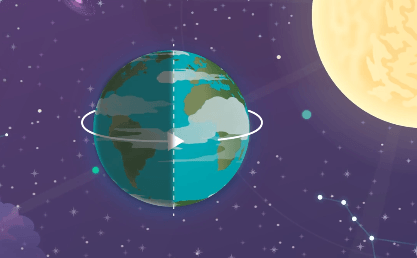
Day and night is caused by

a)
Global Wind Patterns
b)
Earth's Rotation
c)
Density
d)
All of the above
13.
Heat is the _______ of energy.
a)
Transfer
b)
Measure
14.
Temperature is the ________ of energy.
a)
Transfer
b)
Measure
15.
Water held underground in the soil; may be a source of drinking water in springs and wells.
a)
Ground water
b)
Surface water
c)
Porosity
d)
Permeability
16.
Able to allow water to pass through
a)
Accumulation
b)
Runoff
c)
Porosity
d)
Permeability
17.
Approximately how much of Earth's water is held in the oceans?
a)
50%
b)
97%
c)
76%
d)
99%
18.

Where is most of the freshwater on Earth found?

a)

in underground aquifers

b)

in low salt oceans

c)

in groundwater

d)

locked up in ice, snow, and glaciers
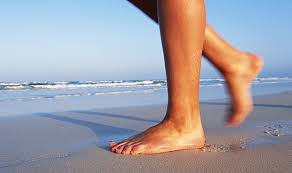
19.
What part of the water cycle does this picture show?
a)
condensation
b)
precipitation
c)
evaporation
20.
What is it called when WATER is FORMED from an LIQUID to a WATER VAPOR Oor an [GAS]?
a)
EVAPORATION
b)
PRECIPITATION
c)
TRANSPIRATION
21.
What is the percentage of oxygen in Earth's atmosphere?
a)
1%
b)
21%
c)
78%
d)
90%
22.
Which gas in our atmosphere is most abundant?
a)
Argon
b)
Oxygen
c)
Nitrogen
d)
Carbon Dioxide
23.
What decreases as you go up in the atmosphere?
a)
Altitude
b)
Atmosphere
c)
Meteors
d)
Air Pressure
24.
In which layer of the atmosphere does weather occur?
a)
Mesosphere
b)
Thermosphere
c)
Stratosphere
d)
Troposphere
25.
Describe how the ozone layer protects the earth.
a)
Absorbs solar radiation, Protects Earth from UV Rays,  and emits heat
b)
Ozone in the lower atmosphere is a pollutant
26.
Walking on the warm sand sand with your bare feet demonstrates this type of heat transfer. 
a)
conduction
b)
convection
c)
radiation
27.
How does heat from thermal energy move?
a)
move from hot to cold
b)
moves from cold to hot  
c)
moves up and never down
d)
moves from side to side
28.
Which is the best example of conduction?
a)
hot air blow drying hair
b)
sun heating up a car
c)
water boiling on the stove
d)
ice cube melting in your hand
29.
Thermal energy always moves:
a)
From a high temperature object to a lower temperature object.
b)
From a lower temperature object to a higher temperature object.
c)
From an object with lower kinetic energy to an object with higher kinetic energy.
d)
From an object of higher mass to an object of lower mass.
30.
What causes warm air to rise?
a)
the fact that it's less dense than cold air 
b)
The fact that it weighs more than cold air 
c)
The fact that it has higher pressure than cold
d)
the fact that its more dense than cold air 
31.
The Earth is rotating on its axis, creating _____
a)
the 12 months
b)
the years
c)
the seasons
d)
day and night
32.
As the Earth travels around the Sun, it creates a pattern that makes _____
a)
the months
b)
the years
c)
the seasons
d)
day and night
33.
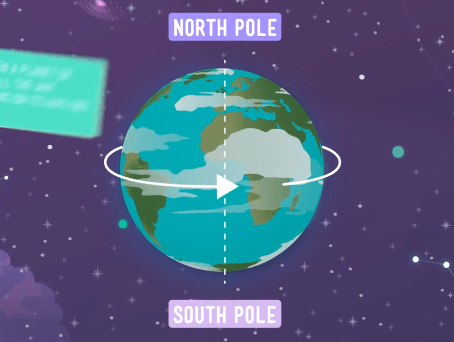
The spinning movement of the Earth about its axis is called the Earth's _____
a)
revolution
b)
rotation
c)
precession
d)
orbit
34.
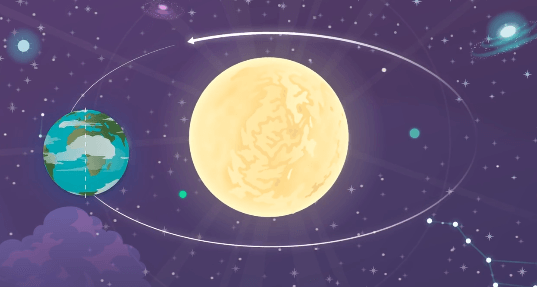
The movement of the Earth around the Sun is called its _____
a)
revolution
b)
rotation
c)
precession
d)
gyration
35.
What are the reasons for the seasons?
a)
Earth's tilt and rotation.
b)
Earth's rotation and revolution.
c)
Earth's tilt and revolution.
d)
Earth's tilt and resolution
36.
When the Northern Hemisphere of Earth is Leaning away from the Sun, What season is the Southern Hemisphere experiencing?
a)
Summer
b)
Winter
c)
Spring
d)
Fall
37.
In the summer many people enjoy going to the beach. There is a beautiful beach in Argentina, which is located in the Southern Hemisphere. Which diagram shows the position of Earth when it is summer in Argentina?
a)
A
b)
B
c)
C
d)
D
38.

What causes an eclipse of the moon?

a)

When the sun is between moon and earth

b)

When the moon is in between earth and sun

c)

When the earth is in between moon and sun

d)

When sun, moon and earth creates a right angle position

39.
Caleb is holding a metal cup and a plastic cup both filled with warm water. Which of the following will he most likely observe?
a)
The metal cup feels warmer because it absorbs heat faster.
b)
The plastic cup feels warmer because it is a poor conductor of heat.
c)
The metal cup feels colder because it conducts heat slower than plastic.
d)
The plastic cup feels colder because it conducts heat away from Caleb’s hand.
40.
What is it called when plants give off water vapor as a waste product?
a)
condensation
b)
evaporation
c)
sublimation
d)
transpiration
41.
What word describes when water is attracted to other substances?
a)
cohesion
b)
adhesion
c)
capillary action
d)
surface tension
42.

Molecules with ___ have electrical charges, one end-and one end +, similar to a magnet.

a)

dissolve

b)

polarity

c)

universal solvent

d)

Duracell

43.

Water is called the______

a)

polar

b)

liquid

c)

universal Solvent

d)

cohesion

44.

Which state of matter requires the greatest amount of energy to change from the liquid state?

a)

liquid

b)

gas

c)

solid

d)

water

45.

_____________ causes water to stick to other polar substances.

a)

solubility

b)

surface tension

c)

cohesion

d)

adhesion

46.

Elevation or distance away from sea level is called:

a)

Air Pressure

b)

Altitude

c)

Photochemical Smog

d)

Gravity

47.

Harmful substances in the air, water, and on land are called:

a)

Pollutants

b)

Photochemical smog

c)

Water Vapor

d)

Ozone

48.

Which layer of the atmosphere is at the bottom and we live in it?

a)

Exosphere

b)

Troposphere

c)

Mesosphere

d)

Stratosphere

49.

The layer with the MOST air density is:

a)

Troposphere

b)

Mesosphere

c)

Ionosphere

d)

Exosphere

50.

How does the ozone layer protect Earth?

a)

Protects from falling meteors

b)

Protects from UV radiation

c)

Protects from pollution

d)

Protects from smog

51.

As one increases elevation through the ENTIRE atmosphere what characteristic of the atmosphere steadily decreases?

a)

Electric potential

b)

Air Pressure

c)

Air Temperature

d)

Air Composition

52.

Earth's atmosphere contains nitrogen and oxygen that helps to control the _________ of our planet.

a)

water cycle

b)

temperature

c)

magnetic field

d)

radiation

53.

The property that holds molecules of different substances together is called...

a)

Solvent

b)

Polarity

c)

Cohesion

d)

Adhesion

54.

What does H2O represent?

a)

1 atom of Hydrogen and 2 atoms of Oxygen

b)

2 atoms of Hydrogen and 1 atom of Oxygen

c)

2 atoms of Hydrogen and 2 atoms of Oxygen

d)

1 atom of Hydrogen and 1 atom of Oxygen

55.

The energy required to heat a substance by a specific amount is called...

a)

Specific Heat

b)

Polarity

c)

H2O

d)

Adhesion

56.

Ice floats on liquid water because...

a)

the molecules are closer together in ice than in liquid water, making it more dense

b)

the molecules are farther apart in ice than in liquid water, making it less dense

57.

A material that conducts thermal energy poorly

a)
metal
b)

thermal insulator

c)
heat sink
d)

thermal conductor

58.

A material through which thermal energy flows easily

a)
resistor
b)
semiconductor
c)

thermal conductor

d)
insulator
59.

The AVERAGE kinetic energy of particles in a material.

a)
Pressure
b)
Volume
c)
Temperature
d)
Density
60.

The TOTAL kinetic energy of all particles of an object

a)

kinetic energy

b)

thermal energy

c)

WRONG ANSWER