wayground logo

Free Printable Worksheets

NEW

Font size

S
M
L
XL
Worksheets

The Earth

Total questions: 50

Worksheet time: 13hrs 30mins

Name
Class
Date
1.
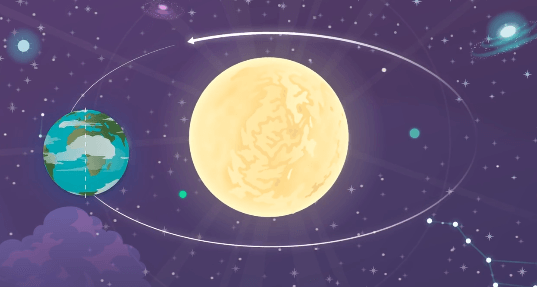
The spinning of an object on its axis is called______
a)
orbit
b)
rotation
c)
revolution
d)
tide
2.

How long does it take the Earth to make one orbit around the Sun?

a)

12 hours

b)

24 hours

c)

365 days

d)

365 1/4 days

3.
The movement of the Earth around the Sun is called its _____
a)
revolution
b)
rotation
c)
precession
d)
gyration
4.
What Seasons has the shortest amount of light during the day?
a)
Summer
b)
Fall
c)
Winter
d)
Spring
5.

What are the two characteristics of winter solstice

a)

Winter solstice marks the first day of full moon; the length of the daylight is the shortest

b)

Winter solstice has equal period of light and darkness

c)

Winter solstice marks the first day of winter; the length of the daylight is the shortest

d)

Winter solstice marks the first day of winter; the length of the daylight is the longest

6.

On spring and fall equinoxes

a)

the length of the daylight and darkness (night time) equals

b)

the length of the daylight is longer than darkness

c)

the length of the daylight is shorter than the length of nightime

d)

The length of the night time is longer than the length of daylight

7.

Which seasons will have have a day when there will be the same amount of daylight hours as nighttime hours?

a)

spring an winter

b)

spring and fall

c)

fall and winter

d)

fall and summer

8.
Which season is taking place in the Southern Hemisphere in Position 1?
a)
Winter
b)
Spring
c)
Summer
d)
Fall
9.
Which season is taking place in the Northern Hemisphere in Position 1?
a)
Winter
b)
Spring
c)
Summer
d)
Fall
10.
Which season is taking place in the Northern Hemisphere in Position 3?
a)
Winter
b)
Spring
c)
Summer
d)
Fall
11.
If its ____ in the Northern hemisphere, then its fall in the Southern hemisphere. 
a)
spring
b)
summer
c)
fall
d)
winter
12.
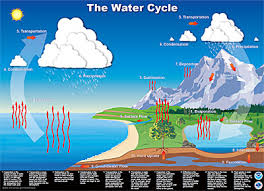
During which stage do clouds form?
a)
condensation
b)
evaporation
c)
precipitation
13.
What is it called when plants give off water vapor as a waste product?
a)
condensation
b)
evaporation
c)
sublimation
d)
transpiration
14.
What is the water cycle?
a)
the 3 forms of water
b)
the movement of water on, above, or below the surface of the Earth
c)
when water melts
d)
when clouds form
15.

The ________ is the driving force of the earth's surface.

a)

sun

b)

moon

c)

stars

d)

oceans

16.
What is the process during which water cools and turns from a gas to a liquid?
a)
Codensation
b)
Runoff
c)
Precipitation
d)
Evaporation
17.

What is the top layer of groundwater?

a)

well

b)

estuary

c)

watertable

d)

natural spring

18.
97% of the Earth's water is  located in....
a)
ground wat
b)
the ocean
c)
lakes, rivers, and streams
d)
glaciers
19.

Identify this picture

a)

Watershed

b)

estuary

c)

tributary

d)

confluence

20.

A ___________________ is the area of land that collects runoff and channels it into a main river.

a)

estuary

b)

canyon

c)

lake

d)

watershed

21.
Which letter on the map represents a tributary?
a)
A
b)
B
c)
C
d)
D
22.

Source of a stream or a river

a)

tributary

b)

starting point

c)

headwater

d)

estuary

23.

What makes up the borders of a watershed?

a)

Rivers and streams

b)

Roadways

c)

State/Country lines

d)

Ridges/high elevation

24.
A large oil truck overturns and spills its contents in the location marked by the star. Which watershed(s) would be affected by this spill?
a)
12
b)
14
c)
18
d)
All of the above
25.

The red arrow is pointing to the ....

a)

continental slope

b)

continental shelf

c)

coastline

d)

trench

26.

The accepted definition of WETLAND is land that is wet...

a)

all the time

b)

some of the time

c)

none of the time

d)

all or some of the time

27.
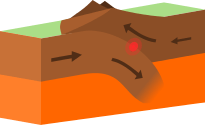
What type of plate boundary is this?
a)
Plate
b)
Divergent
c)
Convergent
d)
Transform
28.
What type of event will occur at this boundary?
a)
Earthquake
b)
Volcano Eruption
c)
Tornado
d)
Mountain Building
29.

Which of the following is the name of the ancient supercontinent formed 28 Million Years ago.

a)

Pangea

b)

Gondwanda

c)

Laurasia

d)

Neverland

30.

Which of the following is NOT evidence to support the theory of plate tectonics?

a)

Fossils

b)

Mountains

c)

earthquakes

d)

erosion

31.
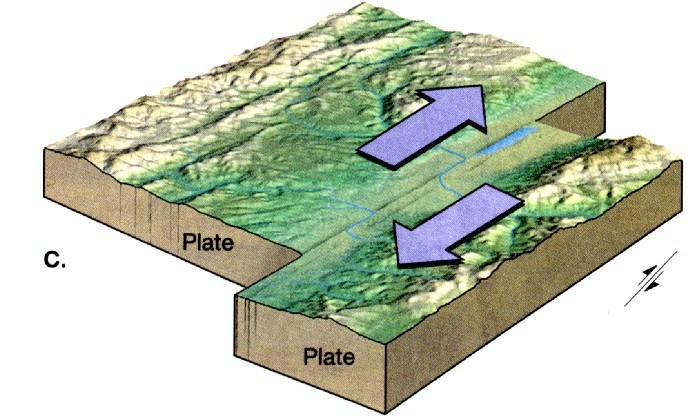
What type of plate boundary is this?
a)
Transform
b)
Convergent
c)
Divergent
d)
Plate
32.

Islands can form from magma which is pushed up at a __________ plate boundary

a)

Divergent

b)

Convergent

c)

Transform

33.

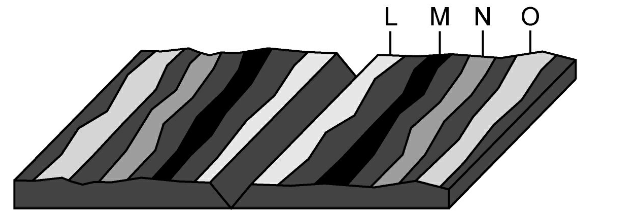
Where would the oldest rock be found on this mid-ocean ridge?

a)

L

b)

M

c)

N

d)

O

34.
The _________ is the thinnest layer of Earth.
a)
outer core
b)
inner core
c)
mantle
d)
crust
35.
The theory of continental drift was first proposed by __________.
a)
Thomas Edison
b)
Alfred Wegener
c)
Benjamin Franklin
d)
Harry Hess
36.
What is the correct order (starting from the surface) of Earth’s layers?
a)
mantle, outer core, inner core, crust
b)
crust, mantle, outer core, inner core
c)
outer core, inner core, crust, mantle
d)
crust, outer core, inner core, mantle
37.
The _______ is the thickest layer of the Earth at 1800 miles thick.  This layer contains most of the mass of the Earth.
a)
crust
b)
mantle
c)
outer core
d)
inner core
38.

_________ currents carry heat from the hot inner core to the cooler outer mantle and back again.

a)

River

b)

Radiation

c)

Convection

d)

Conduction

39.
Plates move apart at _________ boundaries.
a)
volcanic
b)
divergent
c)
convergent
d)
transform
40.
The San Andreas Fault in California is an example of a ________.
a)
divergent boundary
b)
convergent boundary
c)
transform fault
d)
subduction zone
41.

WHY does an ocean plate go beneath a continental plate when the 2 plates collide?

a)

the oceanic crust is more dense

b)

the oceanic crust is less dense

c)

the oceanic crust is hotter

d)

the oceanic crust is cooler

42.
True or false: The Atlantic Ocean is getting bigger as the plates move slowly away from each other. 
a)
True
b)
False
43.
When an explosive eruption  forms a mixture of hot rock, ash, and gas, this material is called a...?
a)
Land slide
b)
Lava
c)
Eruption trail
d)
Pyroclastic flow
44.
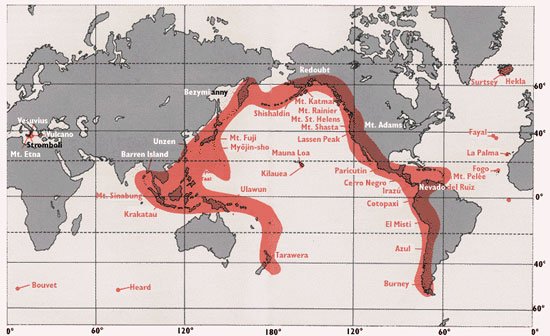
This is the name for the chain of volcanos around the edge of the Pacific Plate.
a)
Circle of Fire
b)
Ring of Lava
c)
Ring of Fire
d)
Circle of Magma
45.
Dormant volcanoes might erupt in the future.
a)
True
b)
False
46.

Volcanoes are found...

a)

on land

b)

under water

c)

on islands

d)

all answers are correct

47.

River of ash and debris that can form several days after an eruption.

a)

lahar

b)

conduit

c)

tempest

d)

land slide

48.

What is the major cause of erosion to form canyons?

a)

wind

b)

ice

c)

glaciers

d)

moving water

49.

How does vegetation in the soil affect the rate of erosion?

a)

It doesn't affect erosion.

b)

It decreases erosion.

c)

It increases erosion.

50.

Which agent causes the most erosion?

a)

water

b)

wind

c)

glaciers

d)

chemicals