wayground logo

Free Printable Worksheets

Font size

S
M
L
XL
Worksheets

Unit 1 Test Review - Measurement, Matter, & Thermochemistry

Total questions: 100

Worksheet time: 3hrs 34mins

Name
Class
Date
1.
240 cm = ___________ m
a)
2400
b)
24
c)
2.4
d)
0.24
2.
1000 m = ___________ km
a)
100
b)
10
c)
1
d)
0.1
3.
15.6 L = ___________ mL
a)
15,600
b)
156,000
c)
1,560,000
d)
15,600,000
4.
0.57 mL = ___________ L
a)
5.7
b)
0.057
c)
0.0057
d)
0.00057
5.
0.932 g = ___________ mg
a)
9.32
b)
93.2
c)
932
d)
9,320
6.

How do you write 8.317 x 10⁶ in standard form?

a)

8, 371, 000

b)

83, 170, 000

c)

837, 100

d)

8, 317, 000

7.

Express the following in standard notation: 8.025 x 10⁻⁸

a)

.00000008025

b)

.000000008025

c)

802,500,000,000

d)

80,250,000,000

8.
How would you write -5.6 x 10⁻³ in standard form?
a)
0.0056
b)
-5,600
c)
0.00056
d)
-0.0056
9.
Which one of these is in scientific notation?
a)
8.987000
b)
8.98 x 10⁶
c)
80.987 x 10
d)
8.986
10.

How do you write 1001 in scientific notation?

a)

1.0001 x 10⁴

b)

1.01 x 10⁵

c)

1.001 x 10³

d)

10.1 x 10³

11.
Is 20 g greater than, less than, or equal to 2 kg?
a)
greater than
b)
less than
c)
equal to
12.
The smallest particle of any particular type of matter is known by which of the following terms?
a)
Compound
b)
Atom
c)
Chemical
d)
Element
13.
42in = ____ft
a)
3ft
b)
3.5ft
c)
3.6ft
14.
4 lbs = ____oz
a)
16oz
b)
32oz
c)
64oz
d)
128oz
15.
____qt = 6 gal
a)
4qt
b)
10qt
c)
20qt
d)
24qt
16.
Ms. Martinez bought 36 pint sized containers of strawberry yogurt. How many gallons is that?
a)
4gal
b)
4.5gal
c)
9gal
d)
40gal
17.
Convert:
9 gal = _______ pt
a)
72
b)
64
c)
81
d)
9
18.

Which is bigger? 72 inches OR 55 ft

a)

55 ft

b)

72 inches

19.
 _?_  is the amount of energy required to raise the temperature of 1 gram of any substance 1oC.
a)
Specific heat
b)
A calorie
c)
Thermal energy
d)
Conduction
20.
Chemical reactions that absorb energy are called
a)
endothermic
b)
fast
c)
slow
d)
exothermic
21.

What is meant by the Law of Conservation of Energy'?

a)

Energy lost can not be conserved

b)

Energy can neither be destroyed or created

c)

Temperature at start of reaction = Temperature at end of reaction

d)

Energy = Mass of products - Mass of Reactants

22.
A material was cooled from 100ºC to 40ºC.  What is the temperature change?
a)
60ºC
b)
40ºC
c)
-60ºC
d)
-40ºC
23.

How much energy must be absorbed by water with a mass of 500 g in order to raise the temperature from 30 oC to 65 oC? (water has a specific heat of 4.18 J/goC

a)

2,095 J

b)

73,325 J

c)

7,325 J

d)

O J

24.

20 g of water. specific heat of water is 4.18 J/g°C. temperature changes from 25° C to 20° C, how much heat energy (q) moves from the water to the surroundings?

a)

400 J

b)

210 J

c)

80 J

d)

4.18 J

25.
In an exothermic process, the surroundings are are gaining energy.
a)
True
b)
False
26.
What letter represents a liquid being heated?
a)
A
b)
B
c)
C
d)
D
27.
If a 8.50g ice cube at -10o C sits out on the counter, completely melts, and then warms to room temperature (25o C) how much energy did the ice cube absorb? Use C = 2.108 J/goC for ice, C = 4.184 J/goC for water, and Hf = 334 J/g.
a)
179.18 J
b)
2839 J
c)
889.1 J
d)
3907.3 J
28.
What is the condensation point for this substance?
a)
60 °C
b)
40 °C
c)
120 °C
d)
100 °C
29.
What is the freezing point for this substance?
a)
60 °C
b)
40 °C
c)
80 °C
d)
100 °C
30.
A pot of 2400g of water at a temperature of 25˚C is heated on a stove until the water boils (100˚C).  The specific heat of water is 4.18 J/(g˚C).
Determine the heat energy needed to heat the water in the pot to boiling.
a)
133.76J
b)
43,062.2J
c)
752,400J
d)
1,003,200J
31.
A copper penny turning greenish after a few years is an example of ...
a)
Chemical Change
b)
Physical Change
32.
A change in which NEW substances are formed.
a)
Chemical change
b)
Physical change
c)
Casual change
d)
Formal change
33.
Which of the following is NOT an example of chemical change?
a)
sour milk
b)
burning wood
c)
breaking a pencil
d)
rust
34.
Which of the following is NOT an example of a physical change?
a)
crumpled paper
b)
pencil sharpening
c)
shrunken clothing
d)
sour milk
35.
Which of the following IS a physical change?
a)
Getting a haircut
b)
Rusty metal
c)
sour milk
d)
A compound
36.
Is melting butter for popcorn a chemical or physical change?
a)
chemical
b)
physical
37.
Is a rusting bicycle a chemical or physical change?
a)
chemcial
b)
physical
38.
Ripping up paper ...
a)
Chemical Change
b)
Physical Change
39.
A change in phase ...
a)
Chemical Change
b)
Physical Change
40.
Bubbles form when two or more substances are combined ...
a)
Chemical Change
b)
Physical Change
41.
Change in size ...
a)
Chemical Change
b)
Physical Change
42.
An explosion occurs ...
a)
Chemical Change
b)
Physical Change
43.
Causes a change in temperature ...
a)
Chemical Reaction
b)
Physical Reaction
44.
Causes a change in odor ...
a)
Chemical Reaction 
b)
Physical Reaction
45.
Blue Color: Chemical or Physical Property
a)
Chemical Property
b)
Physical Property
46.
Flammability (burns): Chemical or Physical Property
a)
Chemical Property
b)
Physical Property
47.
Solubility (dissolves): Chemical or Physical Property
a)
Chemical Property
b)
Physical Property
48.
Reacts with Acid: Chemical or Physical Property
a)
Chemical Property
b)
Physical Property
49.
By looking at the molecules below, what state of matter is shown?
a)
Solid
b)
Liquid
c)
Gas
d)
Matter
50.
What is matter?
a)
a pure substance
b)
anything that occupies space and possesses mass
c)
an element
d)
a compound
51.
Which of the following is a chemical property?
a)
how something tastes
b)
ability to explode
c)
ability to float in water
d)
size of an object
52.
Physical properties are
a)
properties that can be observed without changing the identity of the substance
b)
properties that describe how a substance changes into a completely different substance
c)
properties that we can only observe with our eyes
d)
properties that we need special tools to observe
53.
Which of the following is a chemical property of water?
a)
Reacts with pure sodium
b)
Boils at 100 oC
c)
Is liquid at room temperature
d)
Has a density of 1 gm/mL
54.
What kind of properties can only be observed when a substance changes into a different substance?
a)
physical properties
b)
chemical properties
c)
liquid properties
d)
real properties
55.

What is 77777 in scientific notation?

a)

7.777 x 10⁴

b)

7.7777 x 10⁻⁴

56.

What is 909900 in scientific notation?

a)

9.09900 x 10⁵

b)

9.09900 x 10⁻⁶

57.

What is 10203040 in scientific notation?

a)

1.0203040 x 10⁷

b)

1.0203040 x 10⁻⁷

58.

How many sig figs are in 890?

a)

3

b)

2

c)

1

d)

0

59.

How many sig figs are in 3456?

a)

4

b)

3

c)

2

d)

1

60.

How many sig figs are in 20980?

a)

2

b)

4

c)

5

d)

3

61.

How many sig figs are in 7548290?

a)

7

b)

5

c)

1

d)

6

62.

How many sig figs are in 6420.90?

a)

5

b)

3

c)

6

d)

1

63.

What is 0.986 in scientific notation?

a)

.0986 x 101

b)

9.86 x 101

c)

9.029 x 10¹¹

d)

9.86 x 10⁻¹

64.

How many sig figs are in 0908763.00?

a)

8

b)

6

c)

9

d)

0

65.

Nug has a rock; the rock has a mass of 14g and a volume of 2mL. What is the density of Nug's rock?

a)

7 mL

b)

7 g/mL

c)

28 g/mL

d)

1/7 g/mL

66.
Which lab tool might you use to measure the volume of a liquid?
a)
electric scale
b)
bunsen burner
c)
test tube
d)
graduated cylinder
67.
What is the volume of Object X?
a)
10.0 cm3
b)
15.0 cm3
c)
20.0 cm3
d)
25.0 cm3
68.

Connor has an eraser, it has a mass of 4g and a volume of 2mL. What is its density?

a)

8 g/mL

b)

2 g/mL

c)

1/2 g/mL

d)

24 g/mL

69.

Olive has a paper clip, it has a mass of 9g and a volume of 3mL. What is its density?

a)

3 g/mL

b)

1/3 g/mL

c)

27 g/mL

d)

39 g/mL

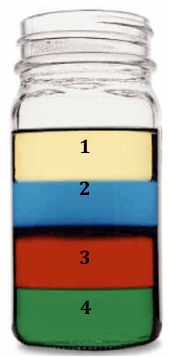
70.
Put the liquids in order from most dense to least dense?
a)
4, 3, 2, 1
b)
1, 2, 3, 4
c)
3, 4, 2, 1, 
d)
4, 3, 1, 2
71.

A piece of copper has a mass of 89g and a volume of 10mL. What would be the density of the copper?

a)

0.89 g/mL

b)

89 g/mL

c)

8.9 g/mL

d)

890 g/mL

72.
A student knows the mass of an object. What other variable does the student need to know to calculate the object's density?
a)
Color
b)
Weight
c)
Volume
d)
Length
73.
Volume is ...
a)
Mass/Volume
b)
The amount of matter in an object.
c)
The amount of space an object occupies.
d)
Anything that has mass and occupies space.
74.
Density is...
a)
the amount of mass in an object
b)
the amount of space an object takes up
c)
the amount of mass in a given space
d)
the weight of an object
75.
A crayon has a mass of 10g and volume of 5 mL. What is the density?
a)
30 g/mL
b)
15 g/mL
c)
1 g/mL
d)
2 g/mL
76.
A substance that contains only one type of atom is a(n)
a)
compound
b)
element
c)
heterogeneous mixture
d)
homogeneous mixture
77.
A mixture that appears to be evenly mixed throughout:
a)
an atom
b)
a compound
c)
a homogeneous mixture
d)
a heterogeneous mixture
78.

A mixture that does NOT appear to be evenly mixed throughout:

a)

an atom

b)

a compound

c)

a homogeneous mixture

d)

a heterogeneous mixture

79.
This picture represents which of the following?
a)
Element
b)
Compound
c)
Mixture
80.
This picture represents which of the following?
a)
element
b)
compound
c)
mixture
81.
This picture represents which of the following?
a)
element
b)
compound
c)
mixture
82.
a)

Element

b)

Compound

c)

Homogeneous Mixture

d)

Heterogeneous Mixture

83.

Sweet Tea, everything is mixed evenly and looks the same.

a)

Heterogeneous Mixture

b)

Homogeneous Mixture

84.

H2 is an example of a(n)...

a)

Element

b)

Compound

c)

Molecule

d)

Heterogeneous Mixture

85.
a)

Element

b)

Compound

c)

Homogeneous Mixture

d)

Heterogeneous Mixture

86.
a)

Element

b)

Compound

c)

Homogeneous Mixture

d)

Heterogeneous Mixture

87.

A molecule is created when the same _________ is bonded together. For example: C10

a)

Element

b)

Compound

c)

Homogeneous Mixture

d)

Heterogeneous Mixture

88.
a)

Element

b)

Compound

c)

Homogeneous Mixture

d)

Heterogeneous Mixture

89.
a)

Element

b)

Compound

c)

Homogeneous Mixture

d)

Heterogeneous Mixture

90.

2 or more different elements that are bonded together is called...

a)

A. element

b)

B. compound

c)

C. mixture

d)

D. solution

91.

Addie combines water, sugar, and lemon juice to form lemonade. What type of substance did she make?

a)

Element

b)

Molecule

c)

Mixture

92.
Which of the following is an example of a heterogenous mixture?
a)
soap
b)
a salad with lettuce, olives, and tomatoes
c)
cup of coffee
d)
water
93.

Which one of the following techniques would best be used to separate soil and water?

a)

crystallization

b)

distillation

c)

Filtration

d)

Chromatography

94.

Name the separation technique used to recover the salt from seawater.

a)

evaporation

b)

distillation

c)

filtration

d)

decanting

95.
Which one of the following would you use to separate sand from iron filings?
a)
a bar magnet
b)
filter paper
c)
chromatography paper
d)
alum
96.
To separate noodles from water what method should you use?
a)
filtration with a strainer
b)
boiling while it is cooking
c)
magnet for the noodles
97.
One of the signs of a chemical reaction taking place is:
a)
Bubbles are produced 
b)
Reactants are not combining
c)
Products are not forming
d)
Color is not changing
98.
Which is NOT an indication of a chemical change?
a)
temperature change
b)
formation of a precipitate
c)
shape change
d)
production of light
99.
You know you a chemical reaction has occurred if 
a)
there is a precipitate.
b)
there is a color change.
c)
there is a temperature change.
d)
All of these answers are evidence.
100.
A clear liquid from a flask is poured into another clear liquid in a beaker. Which of the following results of this procedure would indicate a new substance was formed?
a)
The level of the substance in the beaker is higher after the other liquid is added.
b)
A yellow solid forms and then settles to the bottom of the beaker.
c)
Small white crystals are left behind in the flask that held the first liquid.
d)
The mass of the combined liquids is greater than either original liquid.