
 Worksheets
Molecular compounds practice
Total questions: 98
Worksheet time: 3hrs 32mins
What is the formula for tetraphosphorous decasulfide?
PS10
P10S4
P4S10
P6S5
Molecular compounds are usually _________.
composed of two or more transition elements
composed of positive and negative ions
composed of two or more nonmetallic elements
exceptions to the law of definite proportions

NaCl is a/an
Ionic compound
molecular compound
Metallic compound
Ionic compounds are formed between
What formula is created when Calcium and Chlorine form an ionic bond?
CaCl
CaCl2
Ca2Cl
Ca2Cl
What is the correct name of MgCl2?
magnesium chlorine
magnesium dichloride
magnesium chloride
magnesium (II) chloride
If the atoms that share electrons have an unequal attraction for the electrons, the bond is called
nonpolar
polar
ionic
dipole
A neutral group of atoms held together by covalent bonds is a
molecular formula
chemical formula
molecule
monoatomic ion
Why do most atoms form bonds?
to be more stable by completing the octet
to be less stable
to add more electrons
to carry out physical changes
If two covalently bonded atoms are identical, the bond is
coordinate covalent
polar covalent
dipole covalent
nonpolar covalent
What are shared in a covalent bond?
ions
Lewis structures
dipoles
electrons
The C-H bond in CH3 (electronegativity for C is 2.55 and for H is 2.2) is
polar covalent
ionic
nonpolar covalent
metallic

Which of the following occurs in an ionic bond?
valence electrons are shared
Two atoms share two electrons.
Oppositely charged ions attract.
Like-charged ions attract.

Which is the correct molecular structure for carbon dioxide?


How many double bonds are in CHCl3 ?
0
1
2
3


How many valence electrons are available in the sulfate ion (SO4-2)?
What is the goal of the Lewis Dot Structure?
To determine the electron position.
To show the element's valence electrons & bonding capabilities.
To find the atomic mass of an element.
To search for the number of electrons in an individual atom.
What is the correct Lewis structure for NH3?


Why is this Lewis Structure incorrect? Select all that appy.
There should be a single bond between H and C.
There should be a triple bond between C and N.
Carbon has too many bonds around it.
Hydrogen needs more electrons.

How many total valence electrons are participating in bonding in the molecule below?
8
4
2
3


Which of these is the correct Lewis structure for SiBr4?
A
B
C
D


A diatomic molecule like O2 is always_______ because electrons are shared ________.
The geometry of CH4 molecule is:
tetrahedral
Trigonal planar
bent
trigonal pyramidal
In a polar covalent bond, electrons are shared _________________.
between two metals
equally
unequally
between a metal and a non metal
Using your electronegativity handout and the types of atoms involved predict. What type of bond would form between F and Cl?
Non polar Covalent
Polar Covalent
Ionic
Metallic
The bond between O and F is polar covalent. Which direction will the arrow be pointing to show the direction that electrons are moving in this bond?
The arrow will point towards O, which will be partially positive
The arrow will point towards O, which will be partially negative
The arrow will point towards F, which will be partially positive
The arrow will point towards F, which will be partially negative
What type of bond contains cations and anions?
Polar Covalent
Non-Polar Covalent
Ionic
The bond between O and F is polar covalent. Which direction will the arrow be pointing to show the direction that electrons are moving in this bond?
The arrow will point towards O, which will be partially positive
The arrow will point towards O, which will be partially negative
The arrow will point towards F, which will be partially positive
The arrow will point towards F, which will be partially negative
The bond between C and H is non-polar covalent. That means
there is a pair of electrons shared equally between them
there is a pair of electrons shared unequally between them
an electron will be stolen from one and given to the other
The bond between K and N is ionic. Which atom will steal the electrons from the other?
K will steal electrons from N and become (+)
K will steal electrons from N and become (-)
N will steal electrons from K and become (+)
N will steal electrons from K and become (-)
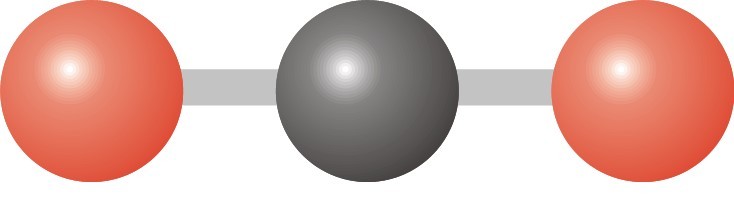
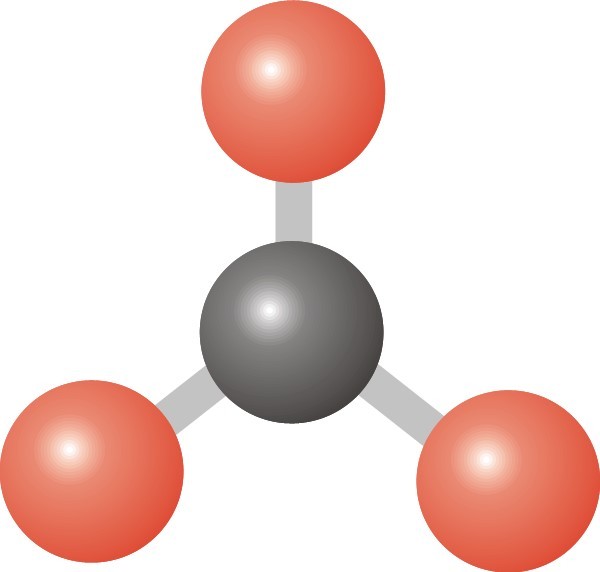
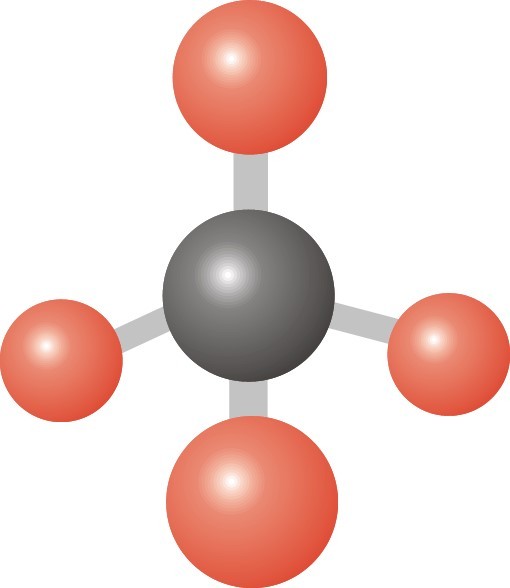
Which molecule could have the following structure?
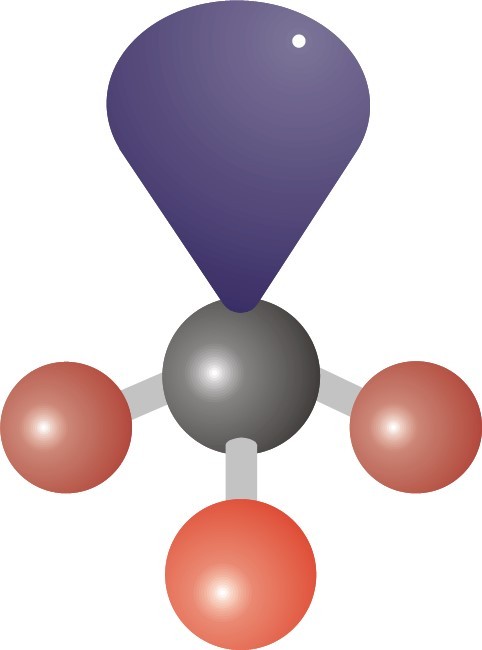
Which molecule could have the following geometry?
How many lone pairs of electrons are on the P atom in PF3?
How many unshared pairs of electrons will a bent molecule have?
0
2
3
4

Will this molecule be polar or nonpolar? PH3

What is the AXE formula of a molecule with 3 shared pairs and 1 lone pair?
AX3
AX4
AX2E2
AX3E

Polar molecule
Nonpolar molecule
BF3

CO2 has polar bonds but is a NON POLAR molecule. Why?
it has an asymmetrical shape
bond polarity or dipole moment between C and O atoms cancel
there is net dipole moment between C and O atoms in molecule
bond polarity does not exist between C+ and O- atoms

For polarity to occur in a bond, you need two elements with a difference in their electronegativities of ___
less than 0.5
between 0.5 and 1.7
less than 1.7
greater than 1.7

A little lowercase delta plus (δ+) or delta minus (δ–) by the individual atoms signify ___
partial charges
the magnetic poles
a difference in electronegativities
nonpolar molecules
What kind of molecule is water
polar, bent, asymmetrical
symmetrical, bent, non-polar
linear, symmetrical, polar
symmetrical, polar and pyramidal
CF4 is
a polar molecule because it has polar bond
non-polar molecule because it has symmetrical shape
non-polar molecule because it has asymmetrical shape
polar molecule because it has non-polar bond
In metallic bonds electrons are:
shared
move around the nuclei randomly
transferred
Malleability and ductility are characteristics of compounds with
covalent bonds
metallic bonds
ionic bonds
alloy bonds
Alloys are important because
their properties are often superior to the component elements
their properties are a blend of the component elements
they never corrode
they are less expensive than their component elements.
Malleability means
the ability to be drawn into a wire
the electrons of metals are mobile
the ability to be hammered into a shape
the ability to be a conductor of electricity
Metals are hard because metals have a
sea of electrons that tightly hold the nuclei together
they form triple bonds
low melting point
high luster
Metals conduct electricity because
the metal ions are free to move
their electrons are free to move
the bonds between metal atoms can easily be broken
they have a positive charge
Which of the following would be held together by the metallic bond?
Atoms of iron (Fe)
Molecules of CH4
Atoms of sulfur (S)
Units of NaCl
What is the formula for chromium (II) hydroxide?
CrOH
Cr(OH)1
Cr(OH)3
Cr(OH)2

