wayground logo

Free Printable Worksheets

Font size

S
M
L
XL
Worksheets

Honors Chemistry Tri A Review

Total questions: 103

Worksheet time: 2hrs 2mins

Name
Class
Date
1.

Which of the following is not evidence of a new substance?

a)

temperature change

b)

liquid disappears when poured into another

c)

gas production

d)

solid formation

2.
How many sig figs are there?
100.00
a)
1
b)
3
c)
4
d)
5
3.
How many sig figs are there?
0.000008
a)
1
b)
2
c)
6
d)
7
4.
How many significant figures does the following number have: 0.002040
a)
6
b)
4
c)
3
d)
2
5.
The teacher reported that she has 15 girls in her class. How many significant figures does the number reported by the teacher have?
a)
infinite
b)
2
c)
15
d)
1
6.
Calculate 12.34 + 1.234 + 0.1234 and give your answer with the correct number of significant figures.
a)
13.6974
b)
13.697
c)
13.70
d)
13.7
7.
Calculate 345.009 g - 23.00 g and give your answer with the correct number of significant figures.
a)
322.01 g
b)
322 g
c)
322.009 g
d)
322.0
8.
Calculate 1.23 m x 0.89 m and give your answer with the correct number of significant figures.
a)
1.0 m2
b)
1.1 m2
c)
1.0947 m2
d)
1.095 m2
9.
Calculate 0.020 cm x 50 cm x 11.1 cm and give your answer with the correct number of significant figures.
a)
10 cm3
b)
11.1 cm3
c)
11 cm3
d)
11. cm3
10.

How close a measurement is to the accepted value is called..

a)

Accuracy

b)

Precision

c)

Significant

d)

Estimate

11.

Which is the more precise measurement?

a)

4 mL

b)

4.3 mL

c)

4.30 mL

d)

4.300 mL

12.

How close a measurement is to the true value is called..

a)

Accuracy

b)

Precision

c)

Significant

d)

Estimate

13.
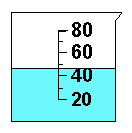
volume?
a)
48 mL
b)
48.2 mL
c)
48.25 mL
d)
4 mL
14.
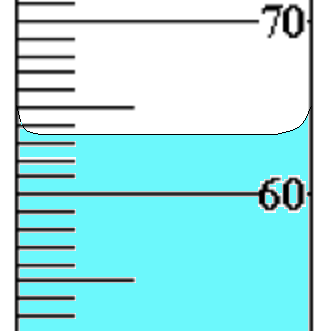
Volume?
a)
63.5 mL
b)
63 mL
c)
63.55 mL
d)
6 mL
15.
A set of data are all close to each other, and they are close to the actual value.  This set of data can be described as...
a)
accurate
b)
precise
c)
both precise and accurate
16.
A set of data are all close to each other, but they are not close to the actual value.  This set of data can be described as...
a)
accurate
b)
precise
c)
both precise and accurate
17.
98 dm = ________mm
a)
98
b)
0.98
c)
980
d)
9800
18.
A neutral atom of the isotope 2612Mg would consist of
a)
12 protons, 26 neutrons, 26 electrons
b)
26 protons, 12 neutrons, 26 electrons
c)
26 protons, 14 neutrons, 14 electrons
d)
12 protons, 14 neutrons, 12 electrons
19.
An atom is electrically neutral when
a)
protons and neutrons are the same
b)
protons and electrons are the same
c)
neutrons and electrons are the same
d)
neutrons balance the protons and electrons
20.
Isotopes of the same element have the same number of 
a)
protons
b)
neutrons
c)
electrons
d)
not enough information
21.
Four isotopes of lead include lead-204, lead-206, lead-207, and lead-208.  The average atomic mass of lead is 207.2.  Which isotope of lead is likely to be the most abundant.
a)
204
b)
206
c)
207
d)
208
22.
If the number of electrons in an atom changes you make a(n) __________________.
a)
ion
b)
isotope
c)
new element
d)
isomer
23.

What is the mass number of bromine?

a)

35

b)

45

c)

80

d)

79.904

24.

How many neutrons does this bromine atom have?

a)

35

b)

45

c)

80

25.

What type of atom is this?

a)

Neutral atom

b)

Cation

c)

Anion

d)

Isotope

26.

How many electrons does this magnesium ion have?

a)

24

b)

12

c)

10

d)

14

27.

Where is most of the mass in an atom?

a)

electron cloud

b)

nucleus

c)

it's equally distributed among the whole atom

d)

there is no mass in an atom

28.
Which answer choice describes the subatomic particles and their respective charges?
a)
p-    e+    n
b)
p+    e     n-
c)
p+    e-    n
d)
p-     e+    n
29.
4.35% of all X atoms have a mass of 39.946 amu. 83.79% have a mass of 41.941 amu, 9.50% have a mass of 42.941 amu, and 2.36% have a mass of 43.939 amu. What is the average atomic mass of atom X?
a)
41.97 amu
b)
42.19 amu
c)
10.43 amu
d)
40.04 amu
30.

Magnesium exists as three isotopes shown above. What is the average atomic mass?

a)

18.39 amu

b)

20.74 amu

c)

22.56 amu

d)

24.31 amu

31.

What charge does an atom have when it GAINS electrons?

a)

Positive

b)

Negative

c)

Neutral

32.

Valence electrons are the number of

a)

protons in the atom

b)

electrons in the atom

c)

protons + neutrons in the nucleus

d)

electrons in the outside shell of the atom

33.

Atoms of elements that are in the same group have the same number of

a)

protons.

b)

neutrons.

c)

valence electrons.

d)

protons and neutrons.

34.

Which of the following elements is an alkali metal?

a)

calcium

b)

magnesium

c)

mercury

d)

sodium

35.

Each column of the periodic table is

a)

an element.

b)

a group.

c)

an isotope.

d)

a period.

36.

The order of elements in the modern periodic table is based on an element's

a)

atomic number.

b)

name.

c)

chemical symbol.

d)

atomic mass.

37.

Which color on the image of the periodic table corresponds with the halogens.

a)

red

b)

black

c)

blue

d)

orange

38.

Which color on the image of the periodic table corresponds with the noble gases.

a)

red

b)

black

c)

blue

d)

orange

39.

Which color on the image of the periodic table corresponds with the transition metals.

a)

red

b)

black

c)

blue

d)

orange

40.

Which color on the image of the periodic table corresponds with the alkaline earth metals.

a)

yellow

b)

dark yellow

c)

blue/green

d)

teal

41.

Horizontal rows on the periodic table are called ___?

a)

groups

b)

periods

c)

rows

d)

families

42.
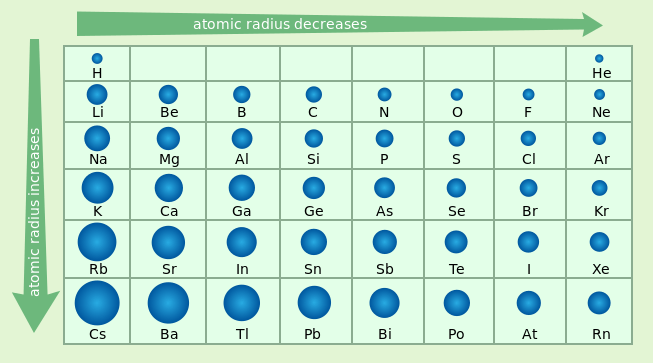
Atomic Radius is...
a)
the relative size of the atom's nucleus
b)
the relative size of the atom's electron cloud
c)
the energy required to shield the outer electrons from the nucleus
d)
a measure of the ability of an atom to attract electrons
43.
As you move down the periodic table atoms get bigger.  This is because ____________.
a)
The atoms have more mass.
b)
The atoms have more protons.
c)
The atoms have more energy levels
d)
The atoms have more nuetrons
44.
As you move across the periodic table atoms tend to get smaller because, ______________.
a)
the atoms have more mass.
b)
the atoms have less mass
c)
the atoms have more protons.
d)
the atoms have less electrons.
45.
Which periodic group has the smallest atomic radius?
a)
Alkali metals
b)
Halogens
c)
Noble Gases
d)
Transition metals
46.
Ionization energy is...
a)
the energy required to add an electron to a specific atom
b)
how much energy it takes to remove an electron from an atom
c)
the energy required to shield the outer electrons from the nucleus
d)
a measure of the ability of an atom to attract electrons
47.
What term is used to describe "an atom's tendency to attract electrons to itself when is is chemically combined with another element"
a)
electronation
b)
electron affinity
c)
electronegativity
d)
electrolysis
48.
Which element has the smaller atomic radius: potassium (K) or bromine (Br)?
a)
potassium (K)
b)
bromine (Br)
49.
Which element has the greatest ionization energy: Aluminum (Al)    or    Chlorine (Cl)?
a)
Aluminum (Al)
b)
Chlorine (Cl)
50.

The common charge on an atom in group 17 would be....

a)

+1

b)

+7

c)

-7

d)

-1

e)

17

51.
What is the noble gas shorthand electron for Sulfur atom?
a)
[Ar] 3p4
b)
[He] 3s23p4
c)
[Ne] 3s23p4
d)
[Na] 3s23p4
52.
What atom matches this electron configuration?
1s22s22p63s2
a)
Neon
b)
Magnesium
c)
Aluminum
d)
Potassium
53.
Which element is depicted from this orbital diagram
a)
Fluorine
b)
Neon
c)
Chlorine
d)
Argon
54.
Which is associated with more energy? 
a)
2p
b)
2s
c)
3p
d)
1s
55.
Anions are _______ that form ____________ ions and __________ electrons.
a)
nonmetals, positive, lose
b)
nonmetals, negative, gain
c)
metals, positive, gain
d)
metals, positive, lose
56.
What is the electronic configuration of iron?
a)
1s22s22p63s23p64s23d6
b)
1s22s22p63s23p63d8
c)
1s22p63s23p64s23d6
d)
1s22s22p63s23p64s13d6
57.

When naming compounds that contain a nonmetal bonded to a nonmetal, _____ must be used.

a)

parenthesis

b)

prefixes

c)

ionic charges

d)

Lewis structures

58.

When writing the chemical formula of a compound that contains more than one of a particular polyatomic ion, _____ must be used.

a)

ionic charges

b)

parenthesis

c)

Greek prefixes

d)

lower case letters.

59.

What is the correct formula for Ammonium phosphate?

a)

NH4PO4

b)

NH43PO4

c)

(NH4)3PO4

d)

NH4(PO4)3

60.

_______ is an ion that contains more than one atom.

a)

monatomic ion

b)

complex ion

c)

polyatomic ion

d)

diatomic ion

61.
What is the NAME of....
Na2S
a)
sodium (II) sulfide
b)
sodium sulfide
c)
disodium sulfide
d)
sodium sulfur
62.
What is the NAME of....
Mg3N2
a)
magnesium (III) nitride
b)
magnesium (II) nitride
c)
magnesium (II) nitrogen
d)
magnesium nitride
63.
What is the NAME of...
CrN
a)
chromium (II) nitride
b)
chromium (III) nitride
c)
chromium nitride
d)
chromium (I) nitride
64.
What is the FORMULA for...
calcium arsenide
a)
Ca3As2
b)
CaAs2
c)
Ca3As
d)
Ca3Ar2
65.
The name of Fe(OH)₂ is
a)
iron oxide
b)
iron hydroxide
c)
iron (II) hydroxide
d)
iron dihydroxide
66.

The formula for sulfur hexafluoride is

a)

S6F

b)

SF6

c)

SuF5

d)

SFl6

67.
C3O8
a)
Tricarbon Octoxide
b)
Carbon Octoxide
c)
Carbon Oxide
d)
Carbon (VIII) Oxide
68.
Ti(SO4)2
a)
Titanium (IV) Sulfate
b)
Titanium (II) Sulfate
c)
Titanium Sulfate
d)
Titanium Sulfide
69.
BaCr2O7
a)
Barium Dichromate
b)
Barium (II) Dichromate
c)
Barium Chromate
d)
Barium Chromium Oxide
70.
What type of elements will form an ionic bond?
a)
Metals + Metals
b)
Nonmetals + Nonmetals
c)
Metals + Nonmetals
d)
None of the above
71.
In an ionic compound, the total positive charge of all the positive ions ___________ the total negative charge of all the negative ions.
a)
equals
b)
is more than
72.
Covalent bonds are between...
a)
two or more nonmetals
b)
sodium and chlorine
c)
metals and metals
d)
metals and nonmetals
73.
How many valence electrons in this structure?
a)
6
b)
5
c)
4
d)
7
74.
How are covalent bonds formed?
a)
Sharing of electrons
b)
Transfer of electrons
75.
The following statements are true for ionic bonding EXCEPT
a)
bonding between metal and non metal
b)
electrostatic forces between opposite charges
c)
transferring of electrons
d)
sharing of electrons
76.
Ionic bonds happen because of the ____ of valence electrons.
a)
sharing
b)
transfer
77.
How many electrons are needed in the outer energy levels of an atom to be stable?
a)
2
b)
4
c)
6
d)
8
78.
 A lone pair is defined as
a)
A pair of bonding electrons
b)
One non-bonding electron
c)
A pair of non-bonding electrons
d)
A pair of electrons on the central atom
79.
What is the VSEPR theory used to predict?
a)
Bond Strength
b)
Polarity
c)
Molecular Shape
d)
Electronegativity
80.

What is the molecular shape of a molecule with 2 bonded atoms and 2 lone pairs?

a)

Linear

b)

Bent

c)

Tetrahedral

d)

See-Saw

81.

What is the molecular shape of a molecule that has 2 bonded atoms 1 lone pair?

a)

Trigonal Planar

b)

Linear

c)

T-shape

d)

Bent

82.
According to VSEPR, molecules adjust their shapes to keep which of the following as far away as possible?
a)
Pairs of valence electrons
b)
Inner shell electrons
c)
Mobile Electrons
d)
Electrons closest to the nucleus
83.
*
a)
linear
b)
trigonal planar
c)
trigonal pyramid
d)
bent of angular
84.
What is the molecular shape of CH3Cl?
a)
trigonal pyramidal
b)
trigonal bipyramidal
c)
tetrahedral
d)
not enough information
85.
Which statement correctly describes NaCl?
a)
Its charge is evenly distributed
b)
It is a polar molecule
c)
It is ionic, and its charges are distributed unevenly
86.
Which formula represents a nonpolar molecule?
a)
HBr
b)
H2S
c)
CBr4
d)
PCl3
87.
Which of the following molecules, based on the elements present, would be most polar?
a)
HF
b)
H2
c)
HCl
d)
HBr
88.
A molecule containing polar covalent bonds is always polar.
a)
True
b)
False
89.
How many molecules of sugar (C6H12O6) are in a mole?
a)
24 molecules
b)
180 molecules
c)
180 g
d)
6.02 x 10²³ molecules
90.
How many atoms of carbon are in 6.00g of carbon?
a)
1.20x1024atoms C
b)
6.02x10²³atoms C
c)
3.01x10²³atoms C
d)
1.50x10²³atoms C
91.
How many grams are in 1.2 x 1024 molecules of CO?
a)
28 grams
b)
56 grams
c)
6.02 grams
d)
1.2 grams
92.
What are the units for molar mass?
a)
grams
b)
amu
c)
grams/mole
d)
liters
93.
What is the mole used for? 
a)
To measure the amount of grams in a substance
b)
To measure the amount of atoms or molecules in a substance
c)
To measure the amount of energy in a substance
d)
To measure the amount of bonding in a substance 
94.

(0902) The mass of one mole of substance is called...

a)

molecular mass

b)

mole constant

c)

molar mass

d)

atomic weight

95.

What is the relative mass of one molecule of Nitrogen, N2?

a)

14.01 amu

b)

14.01 g

c)

28.02 g

d)

28.02 amu

96.
Avogadro's number of representative particles is equal to one_____.
a)
kilogram
b)
gram
c)
kelvin
d)
mole
97.
A container with a volume of 893 L contains how many moles of air at STP?
a)
20003.2 L
b)
39.9 L
c)
22.4 L
d)
none of the choices
98.
Hydrogen bonding occurs when hydrogen is bonded to N, O, or F.  Which of the following has hydrogen bonding?
a)
CBr4
b)
NO2
c)
H2S
d)
NH3
99.
Does H2O have hydrogen bonding?
a)
yes
b)
no
100.
Does HCl have hydrogen bonding?
a)
yes
b)
no
101.
Does CH4 have hydrogen bonding?
a)
yes
b)
no
102.

All molecules have dispersion (London) forces between them, but dipole-dipole and hydrogen bonding are so much stronger that when they are present we can ignore London forces. Which of these has ONLY London forces?

a)

I2

b)

NH3

c)

OCl2

d)

SH2

103.
Which is the second strongest intermolecular force, after hydrogen bonding?
a)
dipole-dipole attraction
b)
London forces