wayground logo

Free Printable Worksheets

Font size

S
M
L
XL
Worksheets

Chemistry Summer Final Exam

Total questions: 100

Worksheet time: 2hrs 40mins

Name
Class
Date
1.

What is the smallest unit of matter? It is composed of protons and neutrons, held together in the nucleus, and electrons around the nucleus in different electron orbitals, which form an electron cloud.

a)

cell

b)

nucleus

c)

atom

d)

electron

2.

What is the smallest unit of matter? It is composed of protons and neutrons, held together in the nucleus, and electrons around the nucleus in different electron orbitals, which form an electron cloud.

a)

cell

b)

nucleus

c)

atom

d)

electron

3.

What is a subatomic particle with a positive charge that is in the nucleus of an atom?

a)

neutron

b)

proton

c)

electron

d)

valence electron

4.

What is a subatomic particle without an electric charge, located in the nucleus of an atom?

a)

neutron

b)

proton

c)

electron

d)

valence electron

5.

What is a subatomic particle with a negative charge? It is found in the electron cloud surrounding the nucleus.

a)

neutron

b)

proton

c)

electron

d)

electron cloud

6.
Which subatomic particles are found in the nucleus of an atom?
a)
Protons and Electrons
b)
Protons and Neutrons
c)
Neutrons and Electrons
d)
Protons, Neutrons and Electrons
7.
What electrical charge does a proton have?
a)
+1
b)
0
c)
-1
d)
+2
8.

What mass does a neutron have?

a)

1 amu

b)

0 amu

c)

-1 amu

d)

+2 amu

9.
Which particle is negatively charged?
a)
proton
b)
atom
c)
neutron
d)
electron
10.
In order for an atom to be neutral what has to be true?
a)
The atom has more protons than neutrons
b)
The atom has more neutrons than protons
c)
The atom has the same number of protons and neutrons
d)
The atom has the same number of protons and electrons
11.
What subatomic particles would you find in the nucleus of an atom?
a)
Protons only
b)
Protons and Neutrons
c)
Neutrons and Electrons
d)
Protons and Electrons 
12.

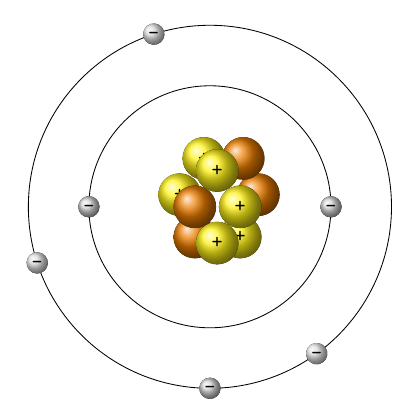
How many electrons does this atom have?

a)

2

b)

4

c)

6

d)

10

13.
Where is most of the mass in an atom located?
a)
in the nucleus
b)
in the protons
c)
in the neutrons
d)
in the electrons
14.

The smallest piece of an element:

a)

quark

b)

electron

c)

shell

d)

atom

15.

The electron is not included in the calculations for the atomic mass because

a)

It has negative charge

b)

It is located in the outer energy levels of the atom

c)

Its mass is basically zero

d)

It attracts neutral particles

16.
What is the number of protons that the element in this image contain?
a)
14
b)
7
c)
15
d)
18
17.
The mass number of an isotope is equal to the number of ______ in an atom.
a)
Protons
b)
Neutrons
c)
Protons + Neutrons
d)
 Electrons
18.
Most of the mass in an atom is made up of _____________________?
a)
protons and electrons
b)
protons and neutrons
c)
neutrons and electrons
d)
electrons and quarks
19.

Why the "Atomic Mass: in the periodic Table is different than the "Mass Number" of an Atom ?

a)

It is the average mass of all the isotopes

b)

Because atoms can have different masses

c)

I have no Idea

d)

All answers are correct

20.

How many electrons can fit on the 1st shell (orbital) for any Bohr Model?

a)

2

b)

6

c)

8

d)

10

21.
How many electrons does Si contain? (click to see image)
a)
14
b)
28
c)
2
d)
None of these
22.
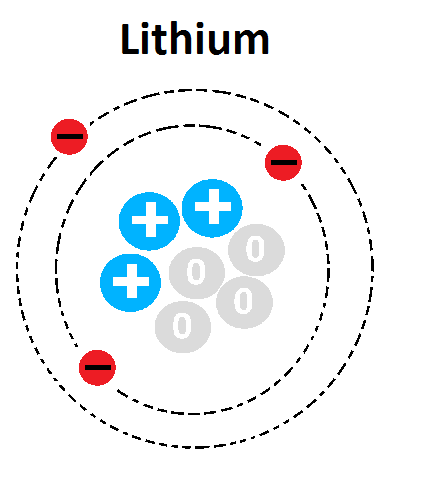
What element is represented in this Bohr Model? 
a)
Carbon
b)
Hydrogen
c)
Aluminum
d)
Lithium
23.
What is the mass number of this atom?
a)
1
b)
3
c)
4
d)
7
24.
What group does this element belong to?
a)
Group 1: Alkali metals
b)
Group 18: Noble Gases
c)
Group 2: Alkaline-Earth Metals
d)
Group 17: Halogens
25.
Carbon-12 has 6 protons and 6 neutrons. How many electrons will orbit the nucleus?
a)
12
b)
6
c)
3
d)
18
26.
What's a valence electron?
a)
electrons in the second energy level
b)
electrons in the outermost energy level
c)
the atomic number
d)
electrons in the first level
27.

How many neutrons does this element have?

a)

11

b)

12

c)

33

d)

34

28.
How many valence electrons does nitrogen have?
a)
3
b)
2
c)
5
d)
1
29.
2H2   +   O2  →  2H2O
How many moles of water can be produced if 8 moles H2 are used?
a)
4 moles
b)
8 moles
c)
16 moles
d)
2 moles
30.
In the reaction 2 H2 + O2 → 2 H2O what is the mole ratio of oxygen to water?
a)
1:2
b)
2:1
c)
3:4
d)
4:3
31.

Which is the correct balanced reaction for N2 + Cl2 --> NCl3

a)

N2 + Cl2 --> NCl3

b)

N2 + 3Cl2 --> 2NCl3

c)

N2 + 2Cl2 --> 3NCl3

d)

2N2 + 3 Cl2 --> NCl3

32.

What is the molar mass of NCl3 ?

a)

about 14 g/mol

b)

about 119 g/mol

c)

about 49 g/mol

33.

How many grams of NH3 can be produced from 28g of N2 in the reaction


N2 + 3H2 --> 2NH3 ?

a)

28 g

b)

62 g

c)

34 g

d)

17 g

34.
How many grams is 1.2 moles of Neon?
a)
0.05 grams
b)
16.6 grams
c)
21.2 grams
d)
24 grams
35.
Change 7.00 moles of Na2SO4 into grams.
a)
20.3 grams
b)
994 grams
c)
770 grams
d)
0.0493 grams
36.

H2OH_2O  What's the molar mass of water (H = 1g/mol) and (O=16g/mol)

a)

14 g/mol

b)

18 g/mol

c)

20 g/mol

d)

33 g/mol

37.
What formula results when Ca+2  and  Br- ions bond?
a)
Ca2Br2
b)
CaBr
c)
Ca(br)2
d)
CaBr2
38.
What would be the proper chemical formula for combining Al3+ and Cl- :
a)
AlCl3
b)
Al3Cl
c)
AlCl
d)
Al3Cl3
39.

In a chemical reaction, atoms (a)   and form new bonds.

40.

Look at the chemical equation.


How many atoms of oxygen (O) are in the reactants?

(a)  

41.

Look at the chemical equation.


How many atoms of mercury (Hg) are in the products?

(a)  

42.

Look at the chemical equation.


How many atoms of oxygen (O) are in the products?

(a)  

43.

Look at the chemical equation.


Is it written correctly to show the Law of Conservation of Mass?

a)

Yes

b)

No

44.

The name of FeCl₂ is

a)

iron chloride

b)

iron (II) chloride

c)

iron (I) chloride

d)

iron dichloride

45.
The modern periodic table is arranged by the
a)
atomic mass
b)
alphabetically
c)
element name
d)
atomic number
46.
Name the family that consist of ~40 elements
a)
Alkali Metals
b)
Noble Gases
c)
Transition Metals
d)
Halogens
47.
Name the family that is used in cleaning supplies, toothpaste, and swimming pools
a)
Alkaline Earth Metals
b)
Transition Metal
c)
Halogens
d)
Noble Gases
48.
Name the family that is made of the most reactive metals
a)
Alkali Metals
b)
Alkaline Earth Metals
c)
Transition Metals
49.
Name the group that is extremely reactive in water
a)
Alkali Metals
b)
Alkaline Earth Metals
c)
Transition Metals
d)
Halogens
50.
Name the family that is made of only gases that are colorless and odorless.
a)
Halogens 
b)
Transition Metals
c)
Alkali Metals
d)
Noble Gases
51.
Name the family that is made of the most reactive nonmetals 
a)
Halogens
b)
Noble Gases
c)
Transition Metals
d)
Alkaline Earth Metals
52.
The substances listed on the right side of a chemical equation are the
a)
Yields
b)
Reactants
c)
Products
d)
Precipitates
53.
In chemical reactions, what does the principle of conservation of mass mean?
a)
Matter is not created or destroyed.
b)
The total mass of the reactants is greater than the total mass of the products.
c)
The total mass of the reactants is less than the total mass of the products.
d)
Matter is not changed.
54.
Is the following equation balanced or unbalanced?
Fe + S --> FeS
a)
balanced
b)
unbalanced
55.
 Fill in the blank to balance the chemical equation. 
2KI  +  ____Cl  2KCl  +  I2
a)
1
b)
2
c)
3
d)
4
56.
When the temperature of matter increases the particles...
a)
speed up and move closer
b)
speed up and move farther apart
c)
slow down and move closer together
d)
slow down and move farther apart
57.
When Pressure increases then the Volume must...
a)
Increase
b)
decrease
58.
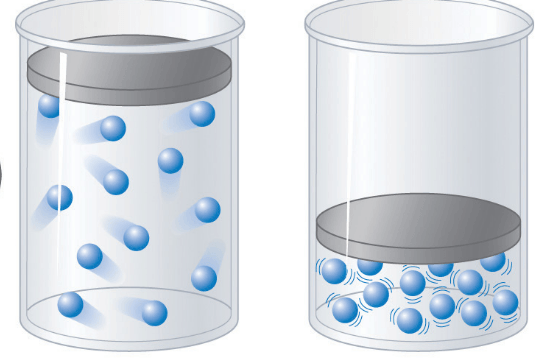
Which container will have a lower pressure?
a)
left
b)
right
c)
they both have the same pressure
d)
I don't know
59.
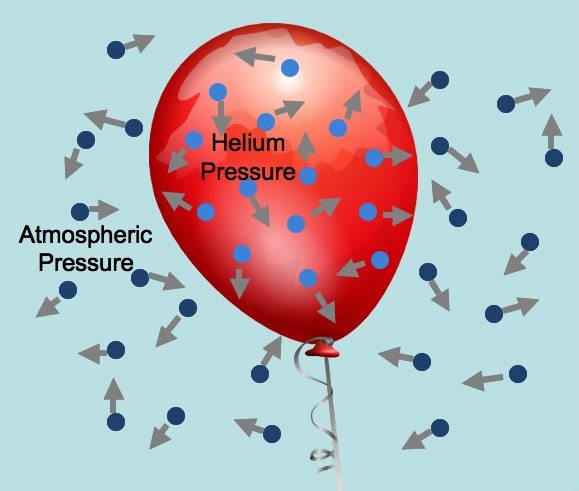
What causes pressure?
a)
The walls of the container
b)
The vacuum in the container
c)
The collisions of the particles
d)
Atmospheric pressure acting on the outside walls
60.

Find the mass of 11.37 mol of BaO. Round to the nearest whole number.

a)

1,354 g

b)

1,740 g

c)

17.40 g

d)

1,684 g

61.

Determine the amount of moles in CuBr that are in 276.9 g of the compound.

a)

3.2 mol

b)

1.7 mol

c)

2.1 mol

d)

1.9 mol

62.

LiBr is called

a)

lithium bromine

b)

lithium (I) bromine

c)

lithium bromide

d)

lithuim (I) bromide

63.
What is the atomic number for carbon?
a)
12
b)
6
c)
24
d)
2
64.
How many protons are there in oxygen?
a)
24
b)
32
c)
16
d)
8
65.
If the mass number of fluorine is 19, how many neutrons are in the nucleus?
a)
10
b)
9
c)
29
d)
5
66.
Which conversion factor should be used to solve the following, "How many moles of argon atoms are present in 11.2 L of argon gas at STP?"
a)
1 mol = 22.4 L 
b)
1 mol = 39.95 g
c)
1 mol = 6.02x10²³ atoms
d)
More than 1
67.
What is the volume of 2 moles of gas at STP?
a)
22.4 L
b)
44.8 L
c)
11.2 L
d)
2 L
68.

The first postulate of the KMT is that all matter is made up of

a)

tiny particles

b)

molecules

c)

cells

d)

mass

69.

According the KMT, the particles are in

a)

different states

b)

organized patterns

c)

constant motion

d)

various containers

70.

According to the KMT, increasing the temperature of particles will

a)

give off energy

b)

increase motion

c)

decrease volume

d)

increase pressure

71.

Which characteristics describe an acid?

a)

tastes sour, litmus indicator turns red

b)

tastes bitter, litmus indicator turns blue

c)

tastes sweet and sour, litmus indicator turns red

d)

tastes sour and bitter, litmus indicator turns blue

72.

Which characteristics describe a base?

a)

tastes sour, litmus indicator turns blue

b)

tastes bitter, litmus indicator turns blue

c)

tastes bitter sour, litmus indicator turns blue green

d)

tastes bitter sour, litmus indicator turns green

73.

The pH scale is a range from

a)

1 to 7

b)

0 to 14

c)

1 to 14

d)

1 to 20

74.

A very strong acid would have a pH of

a)

1

b)

7

c)

9

d)

14

75.
A solution is made up of
a)
solute
b)
solvent
c)
solute in a solvent
d)
solute in a solution
76.

To prepare 1 Liter of a 2.5M solution of NaOH, you will need a mass of ______g NaOH (and enough water to make 1 Liter.)

a)
10g
b)
100g
c)
40g
d)
80g
77.
How does a solution become supersaturated?
a)
dissolve lots of solute in it.
b)
dissolve a little solute in it. 
c)
dissolve more solute than you should be able to. 
d)
dissolve a super amount of solvent in it. 
78.

Find the concentration of 186.55 g of sugar (C12H22O11 Molar mass of 342 g/mol) in 0.250 Liters of water.

a)

2.18 molL-1

b)

2.17 molL-1

c)

1.18 molL-1

d)

.00218 molL-1

79.

What type of reaction involves the breaking down of a substance into simpler substances?

a)

Single Replacement Reaction

b)

Double Replacement Reaction

c)

Synthesis Reaction

d)

Decomposition Reaction

80.

What type of reaction involves 2 substances combining to form 1 new compound?

a)

Decomposition Reaction

b)

Single Replacement Reaction

c)

Double Replacement Reaction

d)

Synthesis Reaction

81.

What type of reaction involves one element replacing another element in a compound?

a)

Single Replacement Reaction

b)

Double Replacement Reaction

c)

Synthesis Reaction

d)

Decomposition Reaction

82.

What are the reactants in the chemical equation pictured?

a)

CH4 and CO2

b)

CH4 and O2

c)

CO2 and H2O

d)

O2 and H2O

83.
CxHy +O--> H2O + CO2
a)
Decomposition
b)
Double replacement
c)
Combustion
d)
Single Replacement
84.
___C3H8 +___O2 --> ___CO2 + ___H2O
a)
1,5,3,4
b)
2,10,6,8
c)
already balanced
d)
1,5,5,4
85.
__Na + __Cl2 --> __NaCl
a)
1,1,2
b)
2,1,2
c)
2,1,1
d)
already balanced
86.
__NaClO--> __NaCl + __O2
a)
2,2,2
b)
2,2,3
c)
3,2,2
d)
1,2,3
87.
_P4+_O  _P2O3
a)
3 P4+1 O→ 2 P2O3
b)
1 P4+1 O→ 2 P2O3
c)
1 P4+ 3 O→ 2 P2O3
d)
1 P4+ 2 O→ 3 P2O3
88.
The amount of matter in an object is a measure of the object's ________________.
a)
volume
b)
density
c)
mass
d)
solubility
89.
If you had a sealed bottle of water, how would the mass of the water bottle change after a 5 day period?
a)
Mass would increase. 
b)
Mass would stay the same. 
c)
Mass would decrease. 
d)
None of the above.
90.

Any reaction that involves the particles in the nucleus of an atom are called ________?

a)

Fission

b)

Nuclear Reaction

c)

Fusion

d)

Particle Accelerator

91.

The process of combining the nuclei of atoms to make different atoms is called _________?

a)

Fission

b)

Nuclear Reaction

c)

Fusion

d)

Particle Accelerator

92.

Breaking up the nucleus of an atom is called _________?

a)

Fusion

b)

Nuclear Reaction

c)

Fission

d)

Particle Accelerator

93.
During this step of the scientific method, a scientist would gather background information. 
a)
Hypothesis
b)
Research
c)
Observation
d)
Experiment 
94.
An experiment is performed on plants to see how different liquids affect plant growth. Each plant in the experiment is given a different liquid; water, apple juice, or milk. Each plant has the same amount of soil, sunlight, and listens to the same music. In this investigation, what is the dependent variable?
a)
Type of plant
b)
Water, apple juice, milk
c)
Plant growth
d)
Color of the plant's leaves
95.
What is a hypothesis?
a)
A hypothesis is the right answer to an experiment.
b)
A hypothesis is the wrong answer to an experiment.
c)
A hypothesis is an educated guess.
d)
I don't know.
96.
True or False: Your hypothesis can never be wrong.
a)
True
b)
False
97.

If the half life of a radioactive element is 100yrs, how long would it take for the radioactivity to reduce by one half?

a)

200yrs

b)

100yrs

c)

50yrs

d)

300yrs

98.
_______________ is the process by which unstable atoms emit radiation until they become stable.
a)
Radiation
b)
Chemical Reaction
c)
Radioactive Decay
d)
Isotopes
99.

A certain radioactive sample has a half life of 2 years. After 6 years, how much of the sample is left?

a)

1/2

b)

1/3

c)

1/16

d)

1/8

100.
Where does radioactivity have application in our lives?
a)
Medicine
b)
Energy (electricity)
c)
Agriculture
d)
All of the above