wayground logo

Free Printable Worksheets

Font size

S
M
L
XL
Worksheets

Chemistry Final Exam S24

Total questions: 100

Worksheet time: 3hrs 24mins

Name
Class
Date
1.

Label the atomic number

2.

Label the element symbol

3.

Label the element name

4.

Label the atomic mass

5.
What is an isotope?
a)
An atom with a charge
b)
The same elements that have different masses
c)
An atom with more protons than electrons
d)
Two elements with the same number of neutrons
6.
An atom has 56 protons, 81 neutrons, and 54 electrons.  What is the mass of this atom?
a)
137
b)
110
c)
81
d)
56
7.
An atom has 17 protons, 18 electrons, and 18 neutrons.  What is the charge of this atom?
a)
0 (neutral)
b)
+1
c)
-1
d)
+18
8.
An atom has 16 protons and 18 electrons.  What is the charge on the atom?
a)
0 (neutral)
b)
+2
c)
-2
d)
-18
9.
How many neutrons does this atom contain?
a)
63
b)
34
c)
29
d)
92
10.
How many neutrons does this atom of krypton contain?
a)
84
b)
36
c)
48
d)
120
11.
In order for lithium to reach an octet, lithium will...
a)
Gain 2 electrons
b)
Lose 2 electrons
c)
Gain 1 electron
d)
Lose 1 electron
12.
Which of the following will always have a +1 charge as an ion?
a)
Silver
b)
Zinc
c)
Cadmium
d)
Nitrogen
13.

Click on the atom symbol of the two elements that are isotopes of one another.

14.

Click on the atom symbol for any element that is an atom.

15.

Click on the atom symbol for any element that is an ion.

16.

Match the following

a)

the mass of the atom is found here

1.

nucleus

b)

these are in the nucleus

2.

protons & neutrons

c)

if you change the number of protons you get a different...

3.

element

d)

if you change the number of neutrons you get a different...

4.

mass

e)

an isotope has the same number of protons but a different number of...

5.

neutrons

17.

An atom of Aluminum-27 has:

​ (a)   protons

​ (b)   neutrons

a mass number of ​ (c)  

Choose from the below words
13
14
27
15
12
28
26
18.

What is the weighted average atomic mass of an element?

a)

The average mass of the element's isotopes, weighted by their natural abundance

b)

The sum of the masses of the element's isotopes

c)

The mass of the most abundant isotope of the element

d)

The average mass of the element's isotopes, divided by the number of isotopes

19.

Why do isotopes of the same element have different mass numbers?

a)

Because they have different numbers of protons

b)

Because they have different numbers of electrons

c)

Because they have different numbers of neutrons

d)

Because they are found in different parts of the periodic table

20.
What atom matches this electron configuration?
1s22s22p63s23p64s23d10
a)
Zinc
b)
Copper
c)
Nickel
d)
Germanium
21.
The electron configuration of an atom is 1s22s22p6.  The number of electrons in the atom is 
a)
3
b)
6
c)
8
d)
10
22.
Which electron configuration belongs to Chlorine (Cl)?
a)
1s2s2p3s3p5
b)
1s2s2p3s3p6
c)
1s2s2p3s3p7
23.
What atom matches this electron configuration?
1s22s22p63s2
a)
Neon
b)
Magnesium
c)
Aluminum
d)
Potassium
24.

Choose the correct shortcut configuration for iodine.

a)

[Ar]4s24d104p5

b)

[Kr]5s24d105p5

c)

[Xe]5s25d105p5

d)

none of the above

25.

Each row on the periodic table represents:

a)

an energy level

b)

a sublevel

c)

an electron

d)

an orbital

26.

Which area on the periodic table represents the electrons in the "d" sublevel?

a)

representative elements

b)

columns 3-8

c)

rare earth elements

d)

transition elements

27.
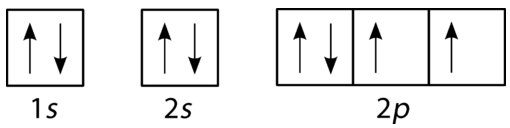
This orbital diagram represents:  
a)
C
b)
B
c)
N
d)
O
28.
This orbital diagram represents:  
a)
C
b)
B
c)
N
d)
O
29.
What is incorrect about this orbital diagram?
a)
Both arrows in the 2p box should be pointing up
b)
There is nothing incorrect with this diagram
c)
In the there should only be 1 orbital in the first 2p box and one in the 2nd 2p box
d)
All the arrows should be pointing up.
30.
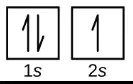
 The diagram above represents two electrons with 
a)
a. opposite spins.
b)
 b. the same spin.
c)
c. different energies.
d)
d. different energy levels.
31.

Which of the following is written correctly?

a)

A

b)

B

c)

C

d)

D

32.

What element's orbital notation is pictured here?

a)

Ar

b)

Br

c)

Cu

d)

Cl

33.

Reorder the following elements by increasing atomic radius.

a)

Hydrogen

b)

lithium

c)

sodium

d)

Potassium

e)

Rubidium

1)
2)
3)
4)
5)
34.

What do elements in the same group have in common?

a)

# of valence electrons

b)

energy level

c)

charge

d)

size

35.

What do elements in the same period have in common?

a)

same # of valence electrons

b)

same energy level

c)

same size

d)

same charge

36.

Which of the following is the correct abbreviated noble gas electron configuration for chlorine?

a)
[Ne]3s23p5
b)
[He]2s22p63s23p5
c)
[Mg]3p5
d)
[Ne]1s22s22p63s23p5
37.

Anions ____ electrons, becoming _____ charged.

a)

Gain; positively (+)

b)

Gain; negatively (-)

c)

Lose; positively (+)

d)

Lose; negatively (-)

38.

A cation is ________

a)

a metal that gains electrons

b)

a nonmetal that gains electrons

c)

a metal that loses electrons

d)

a nonmetal that loses electrons

39.

A(n) _____ is an atom that has a positive or negative charge.

a)

isotope

b)

plasma

c)

ion

d)

coefficient

40.

What is the element with the highest electronegativity value?

a)

Fluorine

b)

Copper

c)

Magnesium

d)

Francium

41.
Which sub-shell can be present in the third energy level?  Choose the most correct answer.
a)
s
b)
s,p
c)
s,p,d
d)
s,p,d,f
42.
Which sub-shell can be present in the first energy level?  Choose the most correct answer.
a)
s
b)
s,p
c)
s,p,d
d)
s,p,d,f
43.

Which of the following is most likely the resulting ion after it BONDS WITH the element shown?

a)

O2-

b)

O

c)

Mg2+

d)

Ne

44.

Which of the following is most likely the resulting ion after it BONDS WITH the element shown?

a)

Li1+

b)

Li1-

c)

He

d)

F1-

45.

Match the following particle to it's property.

a)

proton

1.

identity; gives element name

b)

valence electrons

2.

chemical behaviors

c)

neutrons

3.

mass and "Glue"

46.
Question Image

Match the following concerning electrons in atoms when energy is gained or lost

a)

atom gains energy, electrons

1.

move from lower to higher energy level

b)

atom loses energy, electrons

2.

move from higher to lower energy level

c)

energy is released in the form of a

3.

photon

d)

highest energy

4.

energy level farthest from the nucleus

e)

lowest energy

5.

energy level closest from the nucleus

47.

Match the element (X) written correctly in a formula

a)

X has one valence electron

1.

XCl

b)

X has two valence electron

2.

XCl2

c)

X has three valence electron

3.

XCl3

d)

X has 6 valence electrons

4.

Na2X

e)

X has 7 valence electrons

5.

NaX

48.

Label the three parts of an electron configuration:

49.

Where would the electrons be located?

50.

An electron configuration is like an element's address. It tells you 3 things about the element: the ​ (a)   tells you what period its in, ​ (b)   tells you what block its in, and ​ (c)   tells you how many ​ (d)   are in the orbital. Every configuration starts the same, with ​ (e)   .

Choose from the below words
big number in front
the letter
the exponent
electrons
1s2
small number
neutrons
1s1
2s2
51.

​ (a)   form a ​ (b)   structure because of their opposite charges while ​ (c)   form ​ (d)   from shared valence electrons.

Choose from the below words
Ionic bonds
crystal lattice
covalent bonds
lewis structures
metallic bonds
Van Der Walls
52.

Ionic bonds are formed by transferring an electron from a ​​ (a)   to a ​ nonmetal.

Choose from the below words
metal
metalloid
nonmetal
53.

The 2,8,8 rule means the first shell is filled with ​ (a)   electrons, the second is filled with 8 ​ (b)   , and the third is filled with 8.

Choose from the below words
2
8
electrons
protons
54.

Match the following

a)

Proton

1.

Positive

b)

Neutron

2.

Neutral

c)

Electron

3.

Negative

55.

If a compound is ​ ionic, it will be between ​ (a)   .

If a compound is ​ covalent, it will be between ​ (b)   .

Choose from the below words
two nonmetals
a metal and a nonmetal
two metals
56.

Match the element to the configuration that will be SIMILAR to it's configuration:

a)

magnesium

1.

1s2 2s2 2p6 3s2 3p6 4s2

b)

lithium

2.

1s2 2s2 2p6 3s1

c)

boron

3.

1s2 2s2 2p6 3s2 3p1

d)

nitrogen

4.

1s2 2s2 2p6 3s2 3p6 4s2 3d10 4p3

e)

iodine

5.

1s2 2s2 2p6 3s2 3p5

57.
Which of the following is the correct Lewis dot structure for the molecule fluorine (F2)?
a)
A
b)
B
c)
C
d)
D
58.
What is the correct structure for BF3?
a)
Option A.
b)
Option B. 
c)
Option C.
d)
Option D.
59.
When writing Lewis Structures, only __________ electrons are used.
a)
Inner shell
b)
Core 
c)
Valence
d)
Stable
60.

What is the correct Lewis Dot Structure for ammonia NH3

a)
b)
c)
d)
61.

Is this the correct structure for CH2O?

a)

Yes

b)

No

62.

Which is the correct molecular structure for carbon dioxide?

a)
b)
c)
d)
63.
Which of the following is an acceptable Lewis structure for CH3Cl?
a)
Option A
b)
Option B
c)
Option C
d)
Option D
64.
Which of the following is the correct Lewis structure for water?
a)
A
b)
B
c)
C
65.
What is the correct formula for this molecule?
a)
Si4F
b)
SiF4
c)
SiF
d)
Si4F4
66.
Three pairs of electrons are shared in a
a)
Single bond
b)
Double bond
c)
Triple bond
67.

By replacing the element symbol, this could be a diagram of which element?

a)

Li

b)

Al

c)

C

d)

Be

68.

NH3 has how many lone pairs?

a)

0

b)

1

c)

2

d)

3

69.

CCl4 has how many double bonds?

a)

0

b)

1

c)

2

d)

3

70.
What explains the very high melting and boiling point of water
a)
Strong dipole-dipole bonds between water molecules
b)
Strong hydrogen bonds between water molecules
c)
Dispersion forces which are present in all molecules
d)
Asymmetrical shape of the polar bonds.
71.
Does HCl have hydrogen bonding?
a)
yes
b)
no
72.
Does CH4 have hydrogen bonding?
a)
yes
b)
no
73.
All molecules have London forces between them, but dipole-dipole and hydrogen bonding are so much stronger that when they are present we can ignore London forces.  Which of these has ONLY London forces?
a)
I2
b)
NH3
c)
OCl2
d)
SH2
74.

Which substance would have the weakest intermolecular forces of attraction?

a)

CH4

b)

NaCl

c)

H2O

d)

MgF2

75.

Intermolecular forces for: NH3

a)

Dispersion Force

b)

Dipole dipole

c)

Hydrogen bonding

76.
Ionic Bonding involves...
a)
The transfer of protons
b)
The transfer of nuetrons 
c)
The transfer of electrons
d)
None Of the above
77.

Which substance has the weakest intermolecular forces?

a)

Substance A, boiling point of 75 °C

b)

Substance B, boiling point of 105 °C

c)

Substance C, boiling point of 25 °C

d)

Substance d, boiling point of 45 °C

78.

Intermolecular forces for: CO2

a)

Dispersion Force

b)

Dipole dipole

c)

Hydrogen bonding

79.
Rank these in order of strength:
covalent bond
London forces
hydrogen bond
dipole-dipole attraction
a)

covalent bond

b)

hydrogen bond (H-B)

c)

dipole-dipole (D-D)

d)

London dispersion (LD or LDF)

1)
2)
3)
4)
80.

How many Sulfur atoms are present in the reactants of the following equation: 2SO2 + 2H2O2 ----> 2H2SO4

a)

2

b)

3

c)

4

d)

8

81.
What is the law of conservation of mass?
a)
The amount of matter changes when reacted or changed.
b)
The mass of all reactants are changed during a physical or chemical change
c)
The mass of the reactants equals the mass of the products
d)
The mass of the products is different than the mass of the reactants.
82.
24 g of magnesium reacts with 38 g of fluorine to produce _____ g magnesium fluoride
a)
62 
b)
38
c)
24
d)
14
83.

Match the following to their type of chemical reaction

a)

1.

single replacement

b)

2.

double replacement

c)

3.

combustion

d)

4.

synthesis

e)

5.

decomposition

84.

Predict the products for the this Double Replacement reaction:

AgNO3 + KCl →

a)

AgCl + KNO3

b)

AgK + ClNO3

c)

KAg + NO3Cl

d)

AgCl + 3 KNO

85.

Predict the products for the this Single Replacement reaction:

K + HCl →

a)

KCl + H2

b)

KHCl

c)

KH + Cl2

d)

HCl + K2

86.
B2H6 + 3O2 -->2 HBO2 + 2 H2O
 What mass of O2 will be needed to burn 36.1 g of B2H6?
a)
13.8 g O2
b)
3.86 mol of O2
c)
124 g O2
87.

2CO + O2 → 2CO2

How many moles of carbon dioxide are produced from 10 moles of carbon monoxide?

a)

10

b)

20

c)

1

d)

5

88.
What is the limiting reactant if 10 moles of NH3  react  with 30.0 moles of NO?
4NH3+6NO --> 5N2 + 6H2O
a)
NH3
b)
NO
c)
N2
d)
water
89.
CH4 + 2H2O --> CO+ 4H2
What is the limiting reactant when 20g CHreact with 15g H2O?
a)
CH4
b)
H2O
c)
CO2
d)
H2
90.
How many moles are 98.3 grams of aluminum hydroxide, Al(OH)3?
a)
1.26 moles
b)
0.8 moles
c)
7,673.4 moles
d)
150 moles
91.
Which of the following dimensional analysis setups will correctly convert 4.00x10²³ atoms of cobalt to moles of cobalt? How many moles of colbalt are there?
a)
B : 0.664mol Co
b)
A: 2.41x1047mol Co
c)
A : 0.664 mol Co
d)
B: 2.41x1047mol Co
92.
How many grams are in 1.2x1024 molecules of carbon monoxide?
a)
28 grams
b)
56 grams
c)
6.02 grams
d)
1.2 grams
93.
A container with a volume of 893 L contains how many moles of air at STP?
a)
20003.2 L
b)
39.9 L
c)
22.4 L
d)
none of the choices
94.
How do you convert Celsius to Kelvin?
a)
Add 273
b)
Subtract 273
c)
You can't convert those
d)
They are the same thing
95.
A sample of oxygen at 28.0°C has 340.0 kPa. What will its temperature be at 150.0 kPa?
a)
132.8 K
b)
132.8 °C
c)
682.2 K
d)
12.35 K
96.

Match the following units to their names.

a)

Pressure

1.

kPa

b)

Volume

2.

L

c)

Temperature

3.

K

d)

Pressure

4.

atm

e)

Moles

5.

mol

97.

An 18.0 liter container holds 16.0 grams of oxygen gas (O2) at 45 °C. What is the pressure in the container?

a)

0.725 atm

b)

11.0 atm

c)

23.2 atm

d)

1.45 atm

98.

Why is the enthalpy (ΔH) higher for heat of vaporization than heat of fusion for most substances? ​

a)

MORE energy needed to break intRAmolecular bonds during vaporization

b)

MORE energy needed to break intERmolecular bonds during vaporization

c)

LESS energy needed to break intRAmolecular bonds during vaporization

d)

LESS energy needed to break intERmolecular bonds during vaporization

99.
What is the specific heat of an unknown substance if 100.0 g of it at 200.0 °C reaches an equilibrium temperature of 27.1 °C when it comes in contact with a calorimeter of water.  The water weighs 75. g and had an initial temperature of 20.00 °C?  (Specific heat of water is 4.18 J/g°C) (show your work)
a)
0.111 J/g°C
b)
1.29 J/g°C
c)
0.129 J/g°C
d)
22225.85 J
100.

A 0.125L solution of NaOH is neutralized by 0.0425L of a 0.65 M H2SO4 solution. What is the concentration of the NaOH solution?

a)

0.1 M

b)

1.6 M

c)

0.44 M

d)

None of the above