
 Worksheets
Gas Law Review
Total questions: 102
Worksheet time: 9hrs 30mins


Which is NOT a unit of Pressure
atm
mmHg
Liters
kPa

The following graph illustrates what kind of RELATIONSHIP between pressure and temperature?
Direct
Inverse
Indirect
Negative Slope

The following graph illustrates what kind of Relationship between Pressure and Volume?
Direct
Positive Slope
Indirect
As pressure increases, volume increases

A sample of oxygen under 2.5 atm pressure occupies 1.5 Liters. What volume will it occupy at 7 atm? (2 decimal places)
(a)

A gas has a pressure of 500 mmHg at 200 K. What is the temperature at 750 mmHg?
(a)

What change in volume results if 65 mL of gas is cooled from 353 K to 323 K? (2 decimal places)
(a)
Convert 30 degree Celsius to Kelvin
303 K
-243 K
8190 K
9.1 K
On a cold day near the ocean, it was found that 8g of an unknown gas occupies a volume that is little less than 6L. based on this information, which if the most likely identity of the unknown gas?
CO2
Ne
O2
CH4
Which of the following gases is expected to behave most ideally at a given temperature and pressure?
H2O
NH3
Xe
He
An experiment is performed to measure the pressure of chlorine gas with in a 2.00L container at 273K. The student calculates the pressure using the ideal gas law to be 67.2atm. They calculated the pressure again using the van der Waals equation for real gases to be 22.5atm. What is the major factor that accounts for the difference between these two values?
Chlorine is a halogen
Diatomic nature of chlorine
Volume of the chlorine particles
Forces of attraction between chlorine molecules
A sample of gas is heated from 35oC to 70oC. Which statement correctly describes what happens to the volume?
The volume increases by a factor of less than 2
The volume increases by a factor of 2
The volume decreases by a factor of less than 2
The volume decreases by a factor of 2

What is the total pressure produced in this explosion?
25.0atm
52.0atm
179atm
435atm

In a second experiment, the total pressure is observed to be 58atm. What is the partial pressure of the water vapor produced?
10atm
20atm
30atm
40atm

Two gases are removed from their original containers and placed into a third container, where they react with each other. All three containers have identical volumes, and all gases are at the same temperature. Which container has the lowest pressure?
Container A before the reaction
Container B before the reaction
Container C after the reaction
they all have the same pressure
Which of the following is a reasonable estimate for the volume of a balloon that has been filled with 300g of oxygen gas at STP?
1 L
10 L
50 L
200 L
CH4 --- N2 --- CO --- SO2 --- From the gases listed, 1.00 mol of each of two different gases are placed simultaneously into a container with a small pinhole. Which combination of gases would result in the greatest difference rate of effusion and why?
SO2 and CH4 because their molar masses are the largest and smallest, respectively
CO and SO2 because sulfur's 3p electrons are further from the nucleus than the 2p electrons in carbon.
N2 and CO because they both have pi bonding which results in a shorter bond length between the atoms of each molecule.
CO and SO2 because the linear shape of CO allows it to pass through the pinhole easily while the bent shape of SO2 prohibits it from effusing.
Two identical railroad tank cars are evacuated and each is then filled with 1.2x10³ moles of a gas at 27oC. Tank car #1 is filled with sulfur dioxide, which Tank car #2 is filled with carbon monoxide. Initially the pressures in the tanks are equal. During a train derailment, identical pin-sized holes are made in each tank car; the decrease in pressure of each tank car is monitored. One of the tank cars has a much more rapid decrease in pressure than the other. Which statement best explains this?
The pressure in Tank car #1 decreases more rapidly because the heavier molecules of SO2 have a greater velocity than that of CO molecules.
The pressure in Tank car #1 decreases more rapidly because there are more molecules of SO2 than molecules of CO.
The pressure in Tank car #2 decreases more rapidly because CO molecules are lighter and have a higher velocity than SO2 molecules
The pressure in Tank car #2 decreases more rapidly because there are more molecules of CO than molecules of SO2
According to the Kinetic Molecular Theory a liquid's (SELECT ALL THAT APPLY)
particles are held close together by intermolecular forces
particles are in constant motion
particles are vibrating in place and closely packed
particles are not moving
The properties of liquids include (SELECT ALL THAT APPLY)
definite volume
take the shape of the container
can flow
are relatively incompressible
can diffuse and have surfacre tension
Which of the following is an assumption of the kinetic-molecular theory of gases?
Collisions between gas particles are inelastic.
Gases consist of closely spaced particles.
Gas particles move around in an orderly manner.
The temperature of a gas depends on the average kinetic energy of the gas particles.
Which of the following is the equation needed to calculate the kinetic energy, KE, of a moving particle?
KE = 1/2 mv2
KE = 2mv
KE = mv
KE = 1/2 m2v
If a gas has the same temperature throughout, which gas molecule has the highest average velocity?
O2
H2O
H2
Xe
Which condition is necessary for most gases to behave nearly ideally?
high pressure
high temperature
low compressibility
low expansion
Which of the following is not a physical property of gases?
absence of definite volume
large density
high compressibility
fluidity
Which states of matter are fluid?
gases and liquids
liquids and solids
gases only
liquids only
Which gas deviates the most from ideal behavior?
CH4
H2O
Cl2
He
The pressure exerted by a gas does not depend on
temperature.
volume.
number of moles present.
the identity of the gas.
The energy of motion is known as ___.
potential energy
kinetic energy
mechanical energy

The pressure of each flask is given in atmospheres (atm). Flask 1 has the lowest pressure, and Flask 4 has the highest. Knowing what causes gas pressure, which of the following statements is true?
Flask 1 contain the most molecules
Flask 2 contain the most molecules
Flask 3 contain the most molecules
Flask 4 contain the most molecules

Which of the following statements is true?
Gases do not move in straight line
Gas particles are spaced so far apart that most of the volume of gas is empty space
Gas particles are not in constant motion
Gas particles attract each other
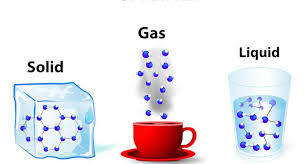
Adding heat to a solid makes the particles move...
Particles in a solid are not moving
Slower
At the same rate as before the heat was applied
Faster
The particles in a gas are ______ away from each other than the particles in a solid
farther
closer
the same distance
Which among the following is NOT true regarding the Kinetic Molecular Theory of gases?
Gases particles move in straight lines.
Gas particles are closely packed and their motion is orderly.
Gas particles are in constant motion.
Gas particles do not attract or repel each other.
Gas pressure is caused by ______.
gravity.
gas molecules colliding with each other.
gas molecules colliding with surfaces of the container.
gas molecules reacting with each other.
the forces that hold atoms together within a molecule.
Velcro
Intermolecular forces
Intramolecular forces
Polarity
It is a type of chemical bond that generates two oppositely charged ions.
Ionic bond
Covalent Bond
Dipole
Ion-dipole
These forces occur when the partially positively charged part of a molecule interacts with the partially negatively charged part of the neighboring molecule.
Dipole-dipole interaction
Hydrogen bonding
London Dispersion Forces
ion-dipole interaction
These are the weakest of the intermolecular forces and exist between all types of molecules, whether ionic or covalent—polar or nonpolar.
Dipole-Dipole interaction
London Dispersion
Hydrogen Bonding
Ion - dipole interaction
The temperature of a substance is a measure of the average kinetic energy of the particles.
True
False
Diffusion is the movement of particles from a high concentration to a low concentration.
True
False
Hydrogen gas exerts a pressure of 466 torr in a container. What is this pressure in atmospheres?
0.217 atm
0.466 atm
0.613 atm
1.63 atm
"The total pressure in a mixture of unreacting gases is equal to the sum of the partial pressures of the individual gases" is a statement of __________________ Law.
Graham's
Boyle's
Avogadro's
Dalton's

Which of the lines on the figure is the best representation of the relationship between the volume of a gas and its pressure, other factors remaining constant?
a
b
c
d
e

Which of the lines on the figure is the best representation of the relationship between the volume of a gas and its absolute temperature, other factors remaining constant?
a
b
c
d
e

Which of the lines on the figure below is the best representation of the relationship between the volume and the number of moles of a gas, measured at constant temperature and pressure?
a
b
c
d
e

How many moles of oxygen are produced when 6.7 moles of KClO3 decompose completely?
How many grams of hydrogen are produced if 120 g of Na are available?
How many grams of aluminum sulfate would be formed if 250g H2SO4 completely reacted with aluminum?
How many liters of carbon dioxide are produced from 10L of carbon monoxide?
4NH3+6NO --> 5N2 + 6H2O
2Al + 6HCl --> 2AlCl3 + 3H2
Aluminium reacts with hydrochloric acid. How many grams of aluminum are necessary to produce 11 L of hydrogen gas at STP?
13
8.8
0.99
1.0
1Mg + 2H2O --> Mg(OH)2 + H2
What volume of hydrogen will be produced at STP by the reaction 67.3 g of magnesium?
62.0 L
0.12 L
2.77 L
1.15 L
2CO + O2 → 2CO2
Fe2O3(s) + 3H2(g) → 2Fe(s) + 3H2O(l)
How many moles of iron (Fe) can be made from 6 moles H2?
How many liters of N2, at STP, will react with 53.0 g H2 to form ammonia?
N2 + 3H2 --> 2NH3
396 L
17.6 L
196 L
588 L
How many liters of SO2 will be produced from 55.0 L of O2 at STP?
2H2S + 3O2 --> 2SO2 + 2H2O
55.0 Liters
36.7 Liters
18398 Liters
2.45 Liters
A sample of 3.0 grams of an ideal gas at 127°C and 1.0 atm has a volume of 1.5 L. What is the molar mass of this gas
7.3 g/mol
0.015 g/mol
0.00092 g/mol
66 g/mol
If 0.20 mol of sulfur dioxide gas combines with 0.10 mol of oxygen gas to produce sulfur trioxide gas, what will the overall pressure in the flask be if the temperature is 25°C and the total volume is 4.0 L?
0.61 atm
1.2 atm
0.051 atm
0.10 atm
At approximately what temperature will 40. g of argon gas at 2.0 atm occupy a volume of 22.4 L?
1200 K
1100 K
550 K
280 K
A 1.00 L sample of a gas has a mass of 1.25 g at STP. What is the mass of 1.00 mol of this gas?
0.855 g
22.4 g
1.25 g
28.0 g
A gas sample with a mass of 12.8 g exerts a pressure of 1.2 atm at 15°C and a volume of 3.94 L. What is the molar mass of the gas?
19 g/mol
32 g/mol
64 g/mol
128 g/mol
A butane-fueled (combustion of C4H10) torch has a mass of 876.2 g. After burning for some time, the torch has a mass of 859.3 g. What volume of CO2 , at STP, was formed while the torch burned?
1.63 L CO2
9.93 L CO2
9.93 L O2
26.0 L CO2
Aqueous sodium chloride, liquid water, gaseous carbon dioxide, and gaseous ammonia can be combined to form solid sodium bicarbonate and aqueous ammonium chloride. What volume of carbon dioxide compressed in a tank at 5.50 atm and a temperature of 42°C, will be needed to produce 100.0 kg of sodium bicarbonate?
5.60 L CO2
5.60 x 10³ L CO2
0.746 L CO2
7.46 x 10² L CO2

Hydrogen and oxygen react under a specific set of conditions to produce water according to the follwoing: 2H2(g) + O2(g) --> 2H2O(g). How many moles of hydrogen would be required to produce 5.0 mol of water?
5.0 mol H2
4.0 mol H2
7.0 mol H
5.0 mol of H

If 4.50 mol of ethane, C2H6, undergo combustion according to the unbalanced equation C2H6 + O2 --> CO2 + H2O, how many moles of oxygen are required?
16.8 mol O2
15.8 mol O2
16.0 mol O2
15.9 mol O2

Convert the following in a pressure reading expressed in torr: 1.25 atm
1.25 torr
608 torr
126.65625 torr
905 torr

Convert the following into the unit specified: 125 mm Hg into atm.
95000 atm
0.165 atm
6.08 atm
950 atm

Convert the following into the unit specified: 3.20 atm into Pa
3.24 x 10⁴ Pa
3.2424 Pa
3,242.4 Pa
3.24 x 10⁵ Pa

Convert the following into the unit specified: 5.38 kPa into torr
4088.8 torr
141.26 torr
40.4 torr
131.03 torr

A sample of gas at 47 degrees C and 1.03 atm occupies a volume of 2.20 L. What volume would this gas occupy at 107 degrees C and 0.789 atm?
3.41 L
5.01 L
17.8 L
0.09 L

The pressure exerted on a 240. mL sample of hydrogen gas at consatnt temperature is increased from 0.428 atm to 0.724 atm. What will the final volume of the sample be?
142 L
142 mL
0.1419 L
141.878453 mL

At standard temperature, a gas has a volume of 275 mL. The temperature is then increased to 130 degrees C, and the pressure is held constant. What is the new volume?
305 mL
186 mL
406 mL
400 mL

