wayground logo

Free Printable Worksheets

Font size

S
M
L
XL
Worksheets

S2 Chemistry Review 2019

Total questions: 107

Worksheet time: 2hrs 7mins

Name
Class
Date
1.
AB + CD →AD + CB
a)
Double Replacement
b)
Single Replacement
c)
Synthesis
d)
Decomposition
2.
Identify this type of reaction,
Cl2 + 2KI -->  I2 + 2KCl
a)
Synthesis
b)
Single displacement
c)
Double displacement
d)
Decomposition
3.
2 C5H5 + Fe --> Fe(C5H5)2 
a)
single displacement
b)
double displacement
c)
decomposition
d)
synthesis
4.
2 RbNO3 + BeF2 --> Be(NO3)2 + 2 RbF
a)
single displacement
b)
double displacment
c)
decomposition
d)
synthesis
5.
Which chemical reaction breaks down into 2 substances?
a)
Double displacement
b)
Single displacement
c)
Synthesis
d)
Decomposition
6.
Which of the following is the general formula for a decomposition reaction?
a)
A + B  → AB
b)
AB → A + B
c)
AB + C → AC + B
d)
AB + CD → AC + BD
7.
2 AgNO3 + Cu --> Cu(NO3)2 + 2 Ag 
a)
single displacement
b)
double displacement
c)
decomposition
d)
synthesis
8.
A + BC →B + AC
a)
Single Replacement
b)
Decomposition
c)
Double Replacement
d)
Synthesis
9.
NO2 →N2 + O2
a)
Synthesis (combination)
b)
Decomposition
c)
Single replacement
d)
Combustion
10.
Mg + N2 →Mg3N2
a)
Synthesis (combination)
b)
Decomposition
c)
Single replacement
d)
Combustion
11.
2NaCl →2Na +Cl2
a)
Synthesis Reaction
b)
Decomposition Reaction
c)
Single Displacement Reaction
d)
Double Displacement Reaction
12.
 C + O→ CO2
a)
Synthesis Reaction
b)
Decomposition Reaction
c)
Single Displacement Reaction
d)
Double Displacement Reaction
13.
The following is what type of reaction:
NH3 + HCl  → NH4Cl
a)
Synthesis
b)
Decomposition
c)
Single Replacement Replacement
d)
Double Replacement Replacement
14.
Which of the following is a sign that a chemical reaction has occurred?
a)
change in shape
b)
melting
c)
formation of a gas
d)
dissolving
15.
Is burning wood a chemical or physical change?
a)
chemical
b)
physical
16.
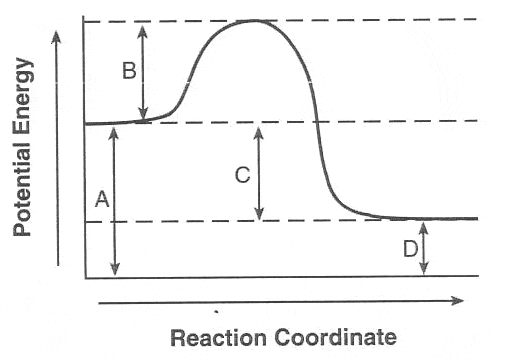
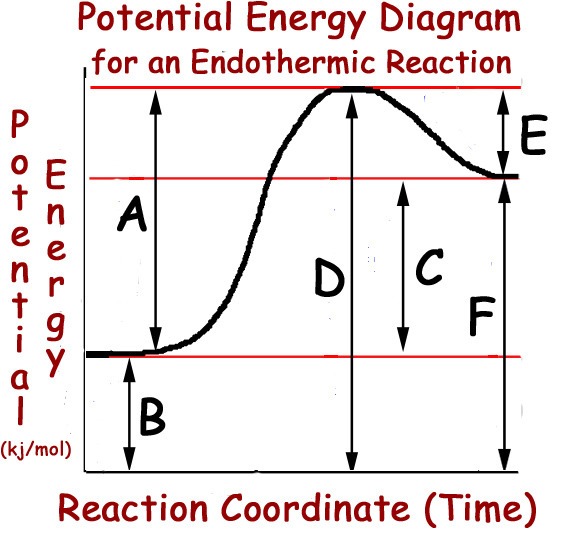
What type of reaction is this?
a)
Endothermic
b)
Exothermic
17.
What letter represents the activation energy?
a)
A
b)
B
c)
C
d)
D
18.
Increase in temperature of the reactants can do one of the following
a)
Slow collision frequency
b)
Allow less effective collision between the particles
c)
Cause particles to lose speed
d)
Increase collision between the particles thus increasing the rate.
19.
Grinding a seltzer tablet into powder increases the rate of reaction due to increased
a)
concentration
b)
surface area
c)
temperature
d)
reactants
20.
Which factors increase the rate of a reaction.
a)
increasing temperature
b)
increasing concentration
c)
increasing surface area
d)
all of these
21.
A ______________ is a substance that increases the rate of a reaction without being used up during the reaction. 
a)
catalyst
b)
product
c)
reactant
d)
solute
22.
Smaller particle size allows for a _________ surface area to be exposed for the reaction.
a)
larger
b)
smaller
23.
Exothermic reactions release heat to the surroundings.
a)
true
b)
false
24.
Increasing the concentration of the reactants will slow down the reaction.
a)
false 
b)
true
25.
In an exothermic reaction the products have
a)
more energy than the reactants
b)
the same energy as the reactants
c)
less energy than the reactants
d)
no energy
26.
In an endothermic reaction the products have 
a)
more energy than the reactants
b)
less energy than the reactants
c)
the same energy as the reactants
d)
no energy
27.
Why does a higher temperature increase the rate of a reaction?
a)
it increases both the frequency and energy of particle collisions
b)
it only increases the frequency of particle collisions
c)
it only increases the energy of particle collisions
d)
it reduces the activation energy of the reaction
28.
Products will form faster if____________
a)
the particle size of the reactants are larger.
b)
temperature is decreased.
c)
concentration of the reactants are increased.
d)
the reaction is not stirred.
29.
Le Chaltelier's Principle states that if a chemical system at equilibrium is stressed,
a)
the system will adjust to increase the stress
b)
the system will adjust to reduce the stress
c)
the system will not adjust
30.
Which of the two graphs reaches equilibrium?
a)
The left one.
b)
The right one.
c)
Both of them.
d)
Neither.
31.
This symbol indicates that a reaction is ____________
a)
reversible
b)
irreversible
32.
Identify the labels (a) and (b) on the graph.
a)
a is concentration of reactants and b is the concentration of products
b)
a is concentration of product and b is the concentration of reactant
c)
a is the volume of reactants and b is the volume of product
d)
a is the mass of reactants and b is the mass of product
33.
Define chemical equilibrium.
a)
A reaction is reversible.
b)
The concentration of the reactants is equal to the concentration of the products.
c)
The rate of a forward reaction is equal to the rate of the reverse reaction.
d)
The reaction stops and no further change in concentration occurs.
34.
Balance this equation
_Al +_HCl --> _H+_AlCl3
a)
2, 6, 3, 2
b)
it is already balanced
c)
4, 12, 3, 4
d)
2, 1, 4, 5
35.
Is the equation balanced?: 2H2O + O2 --> 4MgO + 3Fe
a)
Yes
b)
No
36.
Is this equation balanced?
a)
yes
b)
no
c)
Not enough information
37.
Is this equation balanced?
a)
yes
b)
no
c)
Not enough information
38.
Which of these will NOT speed up the rate of reaction between a strip of magnesium and hydrochloric acid?
a)
tightly coil up the strip of magnesium
b)
cut up the strip of magnesium
c)
increase the concentration of the hydrocholoric acid
d)
increase the temperature of the hydrocholoric acid
39.
Balance this equation-
__P+ __O--> __P2O3
a)
it is already balanced
b)
2, 1, 3
c)
1, 2, 3
d)
1, 3, 2
40.
Balance this equation.
_CF+ _Br-- _CBr+ _F2
a)
2,1,2,1
b)
1,2,2,1
c)
1,2,1,2
d)
2,2,2,2
41.
Balance this equation
_N+ _H--> _NH3
a)
1,2,3
b)
1,3,2
c)
1,1,2
d)
2,1,1
42.
Balance this equation.
_Mg + _Cl--> _MgCl2
a)
1, 2,1
b)
already balanced
c)
2,1,1
d)
1,1,2
43.
What does the Law of Conservation of Mass state?
a)
Matter cannot be gained or lost in a chemical reaction.
b)
Matter can only be lost in a chemical reaction.
c)
Matter can only be gained in a chemical reaction.
d)
Matter can be gained and lost in a chemical reaction. 
44.
What is the little number after an element in a chemical equation called.
Example: H2
a)
Coefficient 
b)
Subscript
c)
Atom
d)
Equation
45.
What is the arrow in a chemical equation...
H2 + O --> H2O
a)
Reactants
b)
Products 
c)
Yields 
d)
Chemical Equation 
46.
At the end of chemical reactions, what is the total mass of the reactants compared to the total mass of the products?
a)
the product is doubled
b)
the product is half the mass of the reactants
c)
the mass is the same
d)
the mass changes depending on the reaction
47.
What is a coefficient?
a)
The small number on the right of the chemical symbol.
b)
The large number to the left of a formula.
48.
When balancing equations a ____ can be placed to the left of a formula of a substance to make the equations balanced
a)
charge
b)
subscript
c)
random number
d)
coefficient
49.
iron + sulfur --> iron (II) sulfide
a)
Synthesis
b)
Decomposition
c)
single replacement
Single Replacement
d)
double replacement
Double Replacement
50.
What is 0.00 degrees Kelvin known as
a)
No such thing
b)
Very cold
c)
Freezing point of Water
d)
Absolute Zero
51.
What about gasses can be measured?
a)
Pressure and Volume
b)
Temperature, Volume, and Pressure
c)
Volume and Temperature
d)
Pressure, Temperature, Volume, and Moles
52.
Which is a quality that only gasses display
a)
Spread out to fill all available space
b)
Take the shape of their container
c)
Can't be compressed
d)
All of these
53.
Which of the following has the lowest density?
a)
Gasses
b)
Solids
c)
Liquids
d)
All mater is the same density
54.
What is 50 C in Kelvin?
a)
223
b)
323
c)
100
d)
50
55.
How are pressure and volume related?
a)
Directly
b)
Indirectly
c)
They aren't related
56.
You have a gas that has a pressure of 2 ATM and a volume of 10L.  What would be the new volume if the pressure was changed to 1 ATM?
a)
5 L
b)
20 L
c)
It would stay at 10L
d)
1 L
57.
Which of the following would increase the pressure on a system?
a)
Increase the Temperature
b)
Pump in more gas
c)
Decrease the volume
d)
All of these
58.
What does Boyle's law relate to?
a)
Temperature and Volume
b)
Volume and Pressure
c)
Temperature and Pressure
59.
What is the equation for Charles' Law?
a)
P1V1=P2V2
b)
V1/T1=V2/T2
c)
V1/n1=V2/n2
d)
P1/T1=P2/T2
60.
What is the equation for Boyle's Law?
a)
P1V1=P2V2
b)
V1/T1=V2/T2
c)
V1/n1=V2/n2
d)
P1/T1=P2/T2
61.
According to Boyle's law, at constant temperature, as the pressure of a given sample of gas is increased, the volume will –
a)
Increase
b)
Decrease
c)
Remains the same
62.
If 200 mL of a gas at 27°C is cooled to -33°C at a constant pressure, the volume will be
a)
250 mL
b)
204 mL
c)
196 mL
d)
160 mL
63.
A gas occupies 4.31 liters at a pressure of 0.755 atm. Determine the volume if the pressure is increased to 1.25 atm.
a)
2.6L
b)
2.6mL
c)
2.6kL
d)
260L
64.
A nitrogen gas has a volume of 600mL at a pressure of 1atm. What volume will the gas occupy at a pressure of 3atm, assuming the temperature remains constant? 
a)
125mL
b)
300mL
c)
200mL
d)
400mL
65.
What happens to the average kinetic energy of matter when it is heated?
a)
It increases
b)
It decreases 
c)
It doesn't change
d)
It cannot be determined
66.
0.200 atm is equal to ___________
a)
0.00026 mm Hg and 20.3 kPa
b)
0.00026 mm Hg and 2.03 kPa
c)
152 mm Hg and 2.03 kPa
d)
152 mm Hg and 20.3 kPa
67.
The energy of an object as it is in motion is defined as
a)
Kinetic Theory
b)
Kinetic energy
c)
Potential energy
d)
Electric energy
68.
How do gas molecules move? 
a)
in an orderly fashion 
b)
constantly and randomly
c)
in straight line paths
d)
in a circular motion
69.
At STP (Standard Temperature and Pressure), a gas has a volume of 3.0 L. What is the new volume if the pressure increases to 303.9 kPa? 
a)
9 L
b)
1 L
c)
9 kPa
d)
1 kPa
70.
Which container will have lower pressure?
a)
left
b)
right
c)
they both have the same pressure
71.
A container is filled with H2, and H2O. Calculate the partial pressure of H2 when the pressure of water is 17torr. The total pressure of the gases is 750torr.
a)
767.5torr
b)
732torr
c)
42.86torr
72.

•More collisions on the wall of the container causes more ____________

a)

volume

b)

temperature

c)

pressure

d)

space between particles

73.

Is this a unit for P, V, n, or T? mmHg

a)

volume

b)

temperature

c)

moles

d)

pressure

74.

Is this a unit for P, V, n, or T? Kilopascal (kPa)

a)

volume

b)

moles

c)

pressure

d)

temperature

75.

Which one, P, V, n, or T? mL

a)

pressure

b)

temperature

c)

volume

d)

moles

76.

Which one, P, V, n, or T? atm

a)

volume

b)

temp

c)

pressure

d)

moles

77.
Which solute is the most soluble at 10 ⁰C?
a)
KI
b)
KClO3
c)
NH4Cl
d)
NH3
78.
Which solute is the least soluble at 90 ⁰C?
a)
SO2
b)
KClO3
c)
KI
d)
HCl
79.
Which solute does not increase in solubility as temperature rises?
a)
NH3
b)
NaNO3
c)
KNO3
d)
NaCl
80.
How many grams of SOcan dissolve at 50 ⁰C?
a)
5 g
b)
10 g
c)
20 g
d)
39 g
81.
How many more grams of KNOdissolve at 50 ⁰C compared to 0 ⁰C?
a)
85 g
b)
15 g
c)
70 g
d)
100 g
82.
What is the maximum temperature where at least 60 g of HCl can dissolve?
a)
45 ⁰C
b)
55 ⁰C
c)
35 ⁰C
d)
65 ⁰C
83.
What is the minimum temperature needed to dissolve at least 10 g of KClO3?
a)
25 ⁰C
b)
10 ⁰C
c)
5 ⁰C
d)
100 ⁰C
84.
How does a solution become supersaturated?
a)
dissolve lots of solvent in it.
b)
dissolve a little solute in it. 
c)
dissolve more solute than you should be able to. 
d)
dissolve a super amount of solvent in it. 
85.
Describe a solute.
a)
part of solution present in largest amount
b)
gets dissolved
c)
water
d)
surrounds and breaks apart
86.
You and your friend have a contest to see who can make iced tea the fastest. Which of the following would NOT help you win?
a)
Cooling the water
b)
Using smaller crystals
c)
Heating the water
d)
Stirring quickly
87.
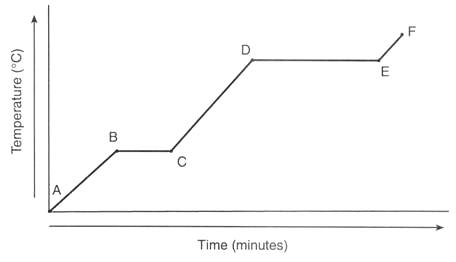
What line segment represents only the solid state?
a)
A-B
b)
B-C
c)
C-D
d)
D-E
88.
In which segment is the kinetic energy remaining constant?
a)
A-B
b)
B-C
c)
C-D
d)
E-F
89.
What state(s) of matter are present at D-E?
a)
Solid-liquid
b)
Liquid
c)
Liquid-gas
d)
Gas-Solid
90.
Between which points is the temperature of the substance increasing?
a)
A-B only. 
b)
A-B, C-D, E-F
c)
B-C only. 
d)
B-C, D-E
91.
What state of matter is segment 5?
a)
Solid
b)
Liquid
c)
Gas
d)
Plasma
92.
Between which points is the substance changing state?
a)
A-B only. 
b)
A-B, C-D, E-F
c)
B-C only. 
d)
B-C, D-E
93.
Definite shape and a definite volume.
a)
Gas
b)
Liquid
c)
Solid
94.
No Definite Shape and No Definite Volume
a)
Gas
b)
Liquid
c)
Solid
95.
Phase change from a solid to a gas.
a)
sublimation
b)
deposition
c)
condensation
d)
evaporation
96.
Phase change from a gas to a liquid.
a)
condensation
b)
evaporation
c)
melting
d)
deposition
97.
What happens to the energy of particles in a substance as it changes from gas, to liquid, to solid?
a)
KE decreases
b)
KE increases
c)
KE stays the same
d)
KE goes up and then goes down
98.

Which of the following belongs to the alkene series?

a)

C4H6

b)

C7H16

c)

C3H6

d)

CH4

99.

Which hydrocarbon contains a triple carbon to carbon bond?

a)

C2H6

b)

C4H8

c)

C3H8

d)

C5H8

100.

Unsaturated hydrocarbons must contain at least one _________ or _________ bond.

a)

single or double

b)

single or triple

c)

double or triple

d)

single or quadruple

101.

In order to be considered organic a compound must contain ___________.

a)

carbon

b)

hydrogen

c)

oxygen

d)

water

102.

A hydrocarbon compound contains only carbon and ___________.

a)

water

b)

hydrogen

c)

oxygen

d)

nitrogen

103.

Which hydrocarbon is a member of the alkyne series?

a)

C3H4

b)

C6H12

c)

C3H8

d)

C5H10

104.

An alkene containing 7 carbon atoms would be named

a)

heptane

b)

hexene

c)

heptene

d)

heptyne

105.

How many carbon atoms are in a molecule of nonane?

a)

4

b)

6

c)

10

d)

9

106.

How many bonds can each carbon atom make?

a)

2

b)

1

c)

4

d)

3

107.
The element _______is found in all of the organic compounds.
a)
Iron
b)
Nitrogen
c)
Carbon
d)
Oxygen