wayground logo

Free Printable Worksheets

Font size

S
M
L
XL
Worksheets

AP Chem Semester 1 Final Exam Review

Total questions: 110

Worksheet time: 4hrs 3mins

Name
Class
Date
1.
Which particles make up the nucleus of an atom?
a)
protons and neutrons
b)
electrons and protons
c)
electrons, protons, and neutrons
d)
electrons and neutrons
2.
How many electrons does Si contain? (click to see image)
a)
14
b)
28
c)
2
d)
4
3.
Group 18 elements are known as the _____ _____ and have full valence shells.
a)
royal gases.
b)
supreme solids.
c)
noble gases.
d)
legit liquids.
4.

What period and group is Silver (Ag)?

[Need your periodic table handy.]

a)

Period 2, Group 1

b)

Period 3, Group 16

c)

Period 5, Group 11

d)

Period 2, 14

5.
Which elements have the most similar chemical properties?
a)
K and Na
b)
K and Ca
c)
K and Cl
d)
K and S
6.
Rows on the period table are called _____ while columns are called _____.
a)
groups, families
b)
groups, periods
c)
periods, groups
d)
families, groups
7.
An element's identity is determined by the number of
a)
electrons.
b)
protons.
c)
neutrons.
d)
valence.
8.
 Why does group number 18 have the least reactive elements?
a)
They all have an odd number of protons.
b)
They all have an even number of protons. 
c)
They have the largest masses.
d)
Their electron shells are the most filled and do not need to be very reactive.
9.
The period for Bromine is ___________.
a)
3
b)
2
c)
4
10.
How many Valance electrons does Iodine Have?
a)
6
b)
16
c)
7
d)
17
11.
The elements in a column of the periodic table...
a)
have similar atomic numbers
b)
start with the same letter
c)
have similar properties
d)
are not related in any way
12.

Look at a copy of the periodic table. What element is in the 4th period and 5th group?

a)

Magnesium

b)

vanadium

c)

niobium

d)

titanium

13.
a)
energy levels
b)
valence electrons
c)
protons
d)
neutrons
14.
a)

Group 1 Alkali Metals

b)

Group 17 Halogens

c)

Group 18 Noble Gases

d)

Group 2 Alkaline Earth Metals

15.
a)
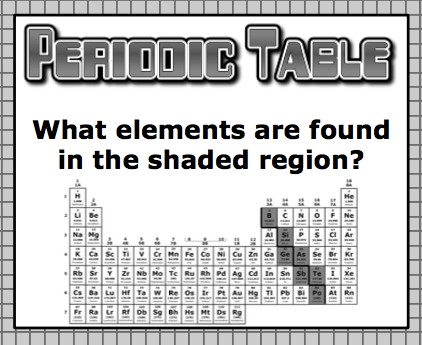
Metals
b)
Nonmetals
c)
Metalloids
16.

What is the formula in getting the number of neutron?

a)

n= atomic mass + atomic number

b)

n= atomic mass - atomic number

c)

n= atomic mass X atomic number

d)

n= atomic mass / atomic number

17.

What is the atomic number of Nickel?

a)

~30

b)

30

c)

28

d)

58.693

18.
Which side of a chemical equation is the reactant side?
a)
Left (before the yields sign)
b)
Right (after the yields sign)
19.

Which side of a chemical equation is the product side?

a)

Left (before the yields sign)

b)

Right (after the yields sign)

20.
Which problem is balanced?
a)
PbO2 + 2H2
b)
SO2 + H20 --> H2SO4
c)
2Na + 2H2O --> 2NaOH + H2
21.
 Mg  +  ___ HCl  →   MgCl2  +   H2
a)
1
b)
2
c)
3
d)
4
22.

__ Al + __ FeO → Al2O2 + __ Fe

a)

1, 1, 2

b)

2,1,2

c)

2, 2, 2

d)

2,4,2

23.

Avogadro’s number is:

a)

6.02 x 10²²

b)

6

c)

6.02 x 10²³

d)

3.01 x 10²³

24.

Determine the number of moles in 5.2 x 10²² atoms of gold.

[need your periodic table and calculator]

a)

0.086 mole

b)

0.52 mole

c)

8.63 x 1044 moles

d)

3.1 x 1046 moles

25.

What is the molar mass of Ca(NO3)2?

[need your periodic table and calculator]

a)

148.096 g

b)

164.086 g

c)

102.055 g

d)

70.084 g

26.

How many moles are in 74 g of KCl?

[need your periodic table and calculator. should take one step]

a)

0.99 mole

b)

0.014 mole

c)

11 moles

d)

0.14 mole

27.
An isotope has three forms.  30% have a mass of 4 amu, 20% have a mass of 5 amu and 50% have a mass of 3 amu.  Average atomic mass will be closest to
a)
2 amu
b)
3 amu
c)
4 amu
d)
5 amu
28.
What is the empirical formula of the following molecular formula:  C3H6
a)
C3H6
b)
CH2
c)
C2H4
d)
CH3
29.
A compound consists of 72.2% magnesium(Mg) and 27.8% nitrogen(N) by mass. What is the empirical formula?
a)
Mg4N3
b)
MgN2
c)
Mg3N
d)
MgN
30.
Which is the name of the kind of solid substance formed in this figure?  
a)
aqueous 
b)
precipitate
c)
acid
d)
synthesis 
31.
An element plus additional element reacts to form one product is an example of which type of chemical reaction? 
a)
combustion
b)
decomposition 
c)
synthesis 
d)
single replacement
32.

Which of the following compounds will not disassociate in water?

(Hint: check your solubility rules)

a)

NaCl

b)

PbCl2

c)

MgNO3

d)

Na2SO4

33.
Describes the number of molecules in a compound and is used to balance a chemical reaction. 
a)
coefficient 
b)
subscript
c)
superscript
d)
SI unit
34.
Which type of reaction takes place in the presence of oxygen and produces carbon dioxide and water?
a)
double replacement 
b)
decomposition 
c)
combustion 
d)
single replacement
35.
Provides evidence that a chemical reaction has occurred. 
a)
dissolving 
b)
melting
c)
formation of a gas
d)
bending
36.
What is the probable product of a double-replacement reaction?
a)
A new compound and a replaced metal
b)
A new compound and a replaced nonmetal
c)
2 different compounds 1 aqueous and 1 that is a solid, liquid or gas
d)
A single compound
37.
What type of chemical reaction takes place when fluorine reacts with sodium bromide?
a)
single replacement 
b)
double replacement 
c)
combustion
d)
synthesis 
38.

A chemical reaction that shows the formation of a solid and identifies the spectator ions

a)

covalent equation

b)

double replacement

c)

ionic equation

d)

dissociation

39.
A compound is reacted and forms two new substances. What type of reaction is this? 
a)
combustion 
b)
synthesis 
c)
decomposition 
d)
single replacement 
40.

What are the predicted products of this reaction? Copper (II) is the form used in this reaction.


Cu+ AgNO3-->

a)

Cu(NO3)2+Ag

b)

CuNO3 + Ag

c)

CuAg+NO3

d)

no reaction

41.

Which of the following is a product of the equation:


AgNO3 + MgCl2 =>

a)

AgMg

b)

NO3Cl2

c)

MgNO3

d)

Mg(NO3)2

42.
What are the correct coefficients when this equation is balanced?
KClO3  --> KCl  +  O2
a)
2,2,2
b)
2,2,3
c)
1,2,3
d)
3,3,3
43.

A metal is reacted with an acid to produce a salt and a hydrogen gas. What type of reaction has occurred?

[EXAMPLE: Ca +2 HCl --> CaCl2 + H2]

a)

neutralization

b)

double replacement

c)

single replacement

d)

synthesis

44.
Name the acid: HC2H3O2
a)
Acetic Acid
b)
Acetous Acid
c)
Hydrogen Acetate
d)
Hydrogen Dicarbon Trihydrogen Dioxygen
45.
What is the formula for phosphorous acid?
a)
H3PO4
b)
H2PO4
c)
H3P
d)
H3PO3
46.
What is the formula for Hydrosulfuric Acid?
a)
H2(SO3)
b)
H2S
c)
H2(SO2)
d)
H2(SO4)
47.

Write formula for ammonium phosphate.

a)

(NH4)3PO4

b)

NPO4

c)

NH4PO4

d)

NH4(PO4)3

48.

Write the formula for zinc fluoride.

a)

ZnF2

b)

ZnF

c)

Zn2F

d)

Zn2F4

49.
aluminum sulfite
a)
Al2(SO3)3
b)
Al2(SO4)3
c)
AlSO3
d)
Al3(SO3)2
50.
Ca(CN)2
a)
Calcium Cyanide
b)
Calcium Dicyanide
c)
Calcium Dicarbon Dinitrogen
d)
Calcium Thiocyanate
51.
Sr(OH)2
a)
Strontium Hydroxide
b)
Strontium Hydride
c)
Strontium Dihydroxide
d)
Strontium Dioxygen Dihydride
52.
What is the formula for copper(I) sulfate?
a)
CuSO3
b)
CuSO4
c)
Cu2SO3
d)
Cu2SO4
53.
Name this compound: 
NH4F
a)
Ammonia fluoride
b)
Ammonium fluorite
c)
Ammonia fluorate
d)
Ammonium fluoride
54.
How do covalent bonds form?
a)
Donating & receiving valence e- between atoms.
b)
Opposite slight charges attract each other between compounds.
c)
Scientists are still not sure how they form.
d)
Sharing valence e- between atoms.
55.

Which of the following is NOT formed by a covalent bond?

a)

K2S

b)

H2O

c)

I2

d)

CO2

56.
What do we call a covalent bond where electrons are shared UNEVENLY or UNEQUALLY?
a)
Ionic
b)
Polar Covalent
c)
Nonpolar Covalent
d)
Van der Waals Force
57.
In an electron dot diagram, two pairs of shared electrons represents a ...
a)
single bond
b)
double bond
c)
triple bond
d)
quadruple bond
58.
A Nitrogen molecule (N2) has one triple bond. How many electrons do the nitrogen atoms share?
a)
1
1
b)
3
c)
4
d)
6
59.

In a polar covalent bond, electrons are shared:

a)

equally

b)

unequally

c)

between two metals

d)

between a metal and a non-metal

60.
Which of the following is the correct Lewis dot structure for the molecule fluorine (F2)?
a)
A
b)
B
c)
C
d)
D
61.
Which of the following is the correct Lewis structure for the compound PBr3?
a)
structure A
b)
structure B
c)
structure C
d)
structure D
62.
Which element below is not diatomic?
a)
hydrogen
b)
oxygen
c)
nitrogen
d)
sulfur
63.
Ionic or covalent?
C  O
a)
Ionic
b)
Covalent
64.
Ionic or covalent?
Na  Br
a)
Ionic
b)
Covalent
65.
What is the correct name for C4H6?
a)
Carbon Hexahydride
b)
Pentacarbon Pentahydride
c)
Hexacarbon Tetrahydride
d)
Tetracarbon Hexahydride
66.
What is the correct name for NO?
a)
Mononitrogen Monoxide
b)
Nitrogen Monoxide
c)
Mononitrogen Dioxide
d)
Nitrogen Oxide
67.
What is the formula for Tricarbon Octahydride?
a)
Ca3O
b)
C2H8
c)
C3H8
d)
Ca3H8
68.
2CO  +  O2  −-> 2CO2
How many liters of carbon dioxide are produced from 10L of carbon monoxide?
a)
10
b)
20
c)
1
d)
5
69.

B2H6 + 3O2 -->2 HBO2 + 2 H2O

What mass of O2 will be needed to burn 36.1 g of B2H6?

a)

13.8 g O2

b)

3.86 mol of O2

c)

123.8 g O2

d)

12.4 g O2

70.

When 12 moles of O2 reacts with 1.1 mole of C10H8 what is the limiting reactant? C10H8 + 12 O2 --> 10 CO2 + 4 H2O

[Hint: doesn't matter which product you consider]

a)

Oxygen

b)

C10H8

c)

Water

d)

Carbon Dioxide

71.

4 Al + 3 O2 –> 2 Al2O3 How many moles aluminum would be needed to completely react with 45 grams of O2?

a)

1.05 moles

b)

3.75 moles

c)

1.875 grams

d)

1.875 moles

72.

What is the measured amount of a product obtained from a chemical reaction during a lab activity?

a)

mole ratio

b)

theoretical yield

c)

percentage yield

d)

actual yield

73.
If a chemist calculates the maximum amount of product that could be obtained in a chemical reaction, he or she is calculating the
a)
theoretical yield
b)
mole ratio
c)
actual yield
d)
percentage yield
74.
For the reaction represented by the equation Cl2 + 2KBr → Br2 + 2KCl, how many grams of potassium chloride can be produced from 356 grams potassium bromide?
a)
749 g
b)
225 g
c)
479 g
d)
814 g
75.
9. Complete the equation for the percent yield of a chemical reaction:
Percent yield=(________)
÷(________)×100%
a)
actual yield; theoretical yield
b)
theoretical yield; actual yield
76.
In a lab, a scientist calculate he should produce 12.3 grams of product in his experiment. When he is finished collecting his product it weighs 10.1 grams. What is his percent yield?
a)
82%
b)
0.82%
c)
10.1 %
d)
100%
77.

What is the mole ratio of H2O to H3PO4 in the following chemical equation? P4O10 + 6 H2O --> 4 H3PO4

a)

3:2

b)

2:3

c)

1:3

d)

3:1

78.
When does a chemical reaction stop?
a)
When the lab is finished
b)
When the excess reactant is used up
c)
When the limiting reactant is used up
d)
Chemical reactions never stop
79.
What is the VSEPR theory used to predict?
a)
Bond Strength
b)
Polarity
c)
Molecular Shape
d)
Electronegativity
80.
According to VSEPR, molecules adjust their shapes to keep which of the following as far away as possible?
a)
Pairs of valence electrons
b)
Inner shell electrons
c)
Mobile Electrons
d)
Electrons closest to the nucleus
81.
What is the measure of a tetrahedral bond angle?
a)
90 Degrees
b)
109.5 Degrees
c)
120 Degrees
d)
180 Degrees
82.
Which of the following shapes has unshared pairs of electrons on the central atom? 
a)
Bipyramidal
b)
Bent
c)
Trigonal Planar
d)
Tetrahedral
83.
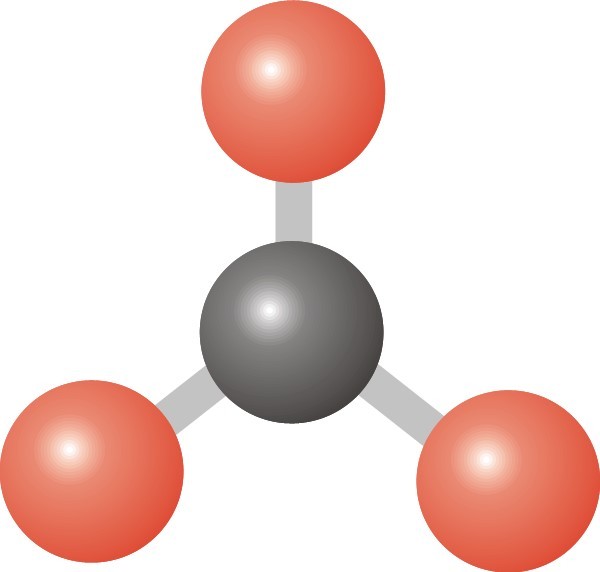
Which molecule would have this shape?
a)
BF3
b)
CH4
c)
PCl5
d)
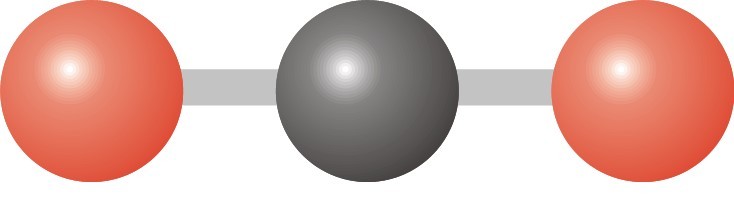
CO2
84.
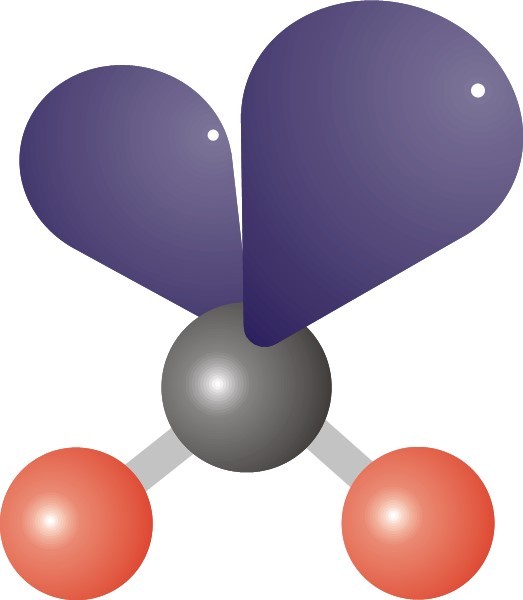
What molecule could this be? 
a)
BF3
b)
CH4
c)
H2O
d)
CO2
85.
Which of the following molecular shapes would have a bond angle of 180 Degrees?
a)
Bent
b)
Trigonal Planar
c)
Tetrahedral
d)
Linear
86.
The bond angle for a trigonal planar molecule is 
a)
90 Degrees
b)
109.5 Degrees
c)
120 Degrees
d)
180 Degrees
87.

Which shapes are altered by unshared pairs of electrons?

a)

Bent and Pyramidal

b)

Trigonal Planar and Bent

c)

Tetrahedral and Bipyramidal

d)

Pyramidal and Linear

88.
How many unshared pairs of electrons will a pyramidal molecule have? 
a)
1
b)
2
c)
3
d)
4
89.
The _____________ determines the identity of an object.
a)
# of Protons
b)
# of Electrons
c)
# of Neutrons
d)
Atomic Mass
90.
Who could this molecule be?
a)
CH4
b)
CO2
c)
PCl5
d)
BF3
91.
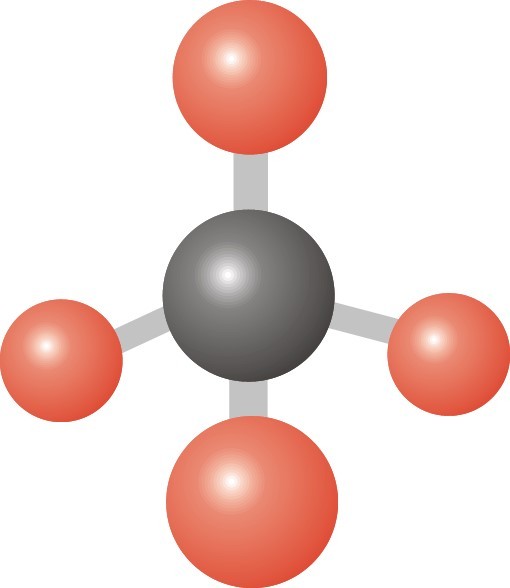
Who could this be? 
a)
CO2
b)
NH3
c)
H2S
d)
CH4
92.
In Dalton's Atomic Theory, all elements consist of __________ that cannot be divided.
a)
Atoms
b)
Parts
c)
Molecules
d)
Hydrogen
93.
In the Thomson Model, he discovered the existence of what particle?
a)
Electrons
b)
Protons
c)
Neutrons
d)
Quarks
94.
Which model involved gold foil?
a)
Thomson Model
b)
Rutherford Model
c)
Cloud Model
d)
Bohr Model
95.
Which model is this?
a)
Thomson Model
b)
Rutherford Model
c)
Cloud Model
d)
Bohr Model
96.
According to the Bohr Model, electrons are only found in specific orbits around the nucleus called __________________________
a)
Energy Levels
b)
Electron Lanes
c)
Electron Places
d)
Atomic Mass
97.
The nucleus is made up of protons and what other particle?
a)
Electrons
b)
Nothing else
c)
Neutrons
d)
Atomic Number
98.
Which of these particles was discovered first?
a)
Protons
b)
Electrons
c)
Neutrons
d)
Quarks
99.
What did James Chadwick discover?
a)
neutrons
b)
electrons
c)
the atomic theory
d)
protons
100.
Who believed that electrons were scattered amongst positively charged material.
a)
JJ Thomson
b)
Ernest Rutherford
c)
John Dalton
d)
Niels Bohr
101.
Believed that atoms are small, hard particles that were "indivisible"
a)
Democritus
b)
Aristotle
c)
Schrodinger
d)
Greek Philosophers
102.
Did experiments to show that atoms form compound in set ratios.
a)
John Dalton
b)
Schrodinger
c)
Niels Bohr
d)
JJ Thomson
103.
Discovered that the atom has a small, dense, positively charged nucleus.
a)
Ernest Rutherford
b)
Heisenberg
c)
Democritus
d)
JJ Thomson
104.
Believed that electrons traveled around the nucleus in definite paths.
a)
Niels Bohr
b)
John Dalton
c)
Modern Atomic Theory
d)
Ernest Rutherford
105.
The following element has _______________ neutrons.
a)
15
b)
16
c)
31
d)
46
106.
The Bohr model below depicts which element?
a)
Scandium
b)
Titanium
c)
Calcium
d)
Potassium
107.

Choose the correct description of J. J. Thomson's Model of an Atom.

a)

The model is a indivisible and indestructible sphere

b)

The model is a sphere in which negatively charged particles - electrons- immersed in a positively charged space of the sphere.

c)

The model is a sphere in which negatively charged particles - electrons- move around the center of an atom creating an electron cloud

d)

The model is a sphere in which negatively charged particles - electrons - move around the nucleus of an atom in a defined passes, called orbits, like planets around the sun

108.

Based on the experimental results of his Gold-Foil experiment, Ernest Rutherford concluded that

a)

The very dense center of the atom has a positive charge

b)

The very dense center of the atom has a negative charge

c)

The very dense center of the atom has no charge

d)

The atom doesn't have a center and all particles are distributed evenly like in a chocolate chip cookie

109.

Choose one of the conclusions that Ernest Rutherford made about the mass of the atom, based on the experimental results of his Gold-Foil experiment

a)

He concluded that almost all mass of the atom is distributed evenly among subatomic particles

b)

He concluded that almost all mass of the atom is distributed among electrons

c)

He concluded that almost all mass of the atom is concentrated in a small region, in a center of an atom, that has a positive charge

d)

He concluded that almost all mass of the atom is concentrated in a small region, in a center of an atom, that has a negative charge

110.

Rutherford's experiment that he used to discover protons and the nucleus.

a)

gold foil experiment

b)

cathode ray experiment

c)

neither of these is correct