wayground logo

Free Printable Worksheets

Font size

S
M
L
XL
Worksheets

Chemistry Semester 1 Revu

Total questions: 114

Worksheet time: 2hrs 44mins

Name
Class
Date
1.
What happens to particles as they heat up?
a)
They slow down
b)
Nothing
c)
They don't move
d)
They speed up
2.

When rain freezes and turns to ice or sleet, this is an example of a

a)

physical property

b)

chemical property

c)

physical change

d)

chemical change

3.

Two substances are combined. Gas is released, and a tall, black column forms. This is an example of a

a)

physical property

b)

chemical property

c)

physical change

d)

chemical change

4.

Which answer below is an example of two physical properties of matter?

a)

weight and toxicity

b)

mass and reactivity

c)

mass and volume

d)

mass and pH

5.

A mixture

a)

is made of a single substance.

b)

is made of more than one substance.

c)

always has a fixed composition.

d)

is made of substances that you can always see at all times.

6.

Students were studying different liquid samples. Which of these is most likely a pure substance?

a)

Liquid A was heated and evaporated completely. Nothing was left behind in the beaker.

b)

An acid was mixed with Liquid B, and bubbles formed.

c)

Once Liquid C cooled, a precipitate formed.

d)

The density of Liquid D is 2.3 g/mL.

7.

If a salad dressing with water and vinegar looks the SAME throughout (has a consistent color and texture), it would be an example of a

a)

heterogeneous mixture

b)

pure substance

c)

compound

d)

homogeneous mixture

8.

When salt dissolves in water, it is an example of a

a)

heterogeneous mixture

b)

chemical reaction

c)

homogeneous mixture

d)

chemical change

9.
Describes the number of molecules in a compound and is used to balance a chemical reaction. 
a)
coefficient 
b)
subscript
c)
superscript
d)
SI unit
10.
Provides evidence that a chemical reaction has occurred. 
a)
dissolving 
b)
melting
c)
formation of a gas
d)
bending
11.
What is the molar mass of Hydrogen Peroxide (H2O2)?
a)
48 g/mole
b)
34.02 g/mole
c)
36.5 g/mole
d)
35.5 g/mole
12.
How many molecules of sugar (C6H12O6) are in a mole?
a)
24 molecules
b)
180 molecules
c)
180 g
d)
6.02 x 10²³ molecules
13.
What is the molar mass of AuCl3?
a)
96 g
b)
130 g
c)
232.5 g
d)
303.3 g
14.
Which of the following is a pure substance?
a)
air
b)
granite
c)
water
d)
stainless steel
15.
Which of these shows SI unit prefixes arranged in order from smallest to largest?
a)
centi, milli, kilo
b)
milli, centi, kilo
c)
kilo, milli, centi
d)
kilo, centi, milli
16.
A sample of bismuth has a mass of 343 g and a volume of 35.0 cm3.What is the density of bismuth?
a)
0.102 g/cm3
b)
9.80 g/cm3
c)
378 g/cm3
d)
1.20 104 g/cm3
17.
An object’s weight is a measure of 
a)
the force with which it is attracted by gravity.
b)
the pressure exerted on a scale.
c)
the amount of material per unit volume.
d)
the force causing the object to move.
18.
The SI base unit for mass is the
a)
gram
b)
cubic centimeter
c)
meter
d)
kilogram
19.
What is the density of an object having a mass of 8.0 g and a volume of 25 cm3?
a)
0.32 g/cm3
b)
3.1 g/cm3
c)
200 g/cm3
d)
2.0 g/cm3
20.
Which group of measurements  is the most precise? (Each group of measurements is for a  different object)
a)
2.0 g, 3.0 g, 4.0 g
b)
1 g, 3 g, 5 g
c)
2 g, 2.5 g, 3 g
d)
2 g, 3 g, 4 g
21.

Calcium (Ca) is an example of a(n):

a)

Element

b)

Compound

c)

Homogenous Mixture

d)

Heterogeneous Mixture

22.

Methane (CH4) is an example of a(n):

a)

Element

b)

Compound

c)

Homogeneous Mixture

d)

Heterogeneous Mixture

23.

Chicken noodle soup is an example of a(n):

a)

Element

b)

Compound

c)

Homogeneous Mixture

d)

Heterogeneous Mixture

24.

Which of the following is a physical property?

a)

Heat of combustion

b)

Boiling point

c)

Flammability

d)

Reactivity

25.

Which of the following is NOT a sign that a chemical change has occurred?

a)

Change in color

b)

Change in shape

c)

Formation of a gas

d)

Change in odor

26.

Which of the following is an example of a chemical change?

a)

Ripping paper in half

b)

Boiling an egg

c)

Cracking an egg

d)

Dissolving sugar in water

27.

Which of the following is a physical change?

a)

Burning a match

b)

Vinegar reacting with baking soda

c)

Melting butter

d)

Cooking an egg

28.

Which of the following is a chemical property of water?

a)

Reacts with pure sodium.

b)

Boils at 100 oC.

c)

Dissolves sugar easily.

d)

Has a density of 1 gm/mL

29.

Which of the following is a physical property?

a)

Combustion

b)

Electronegativity

c)

Color

d)

PH Level

30.

Bleaching your hair is an example of a:

a)

physical change.

b)

chemical change.

31.

How would you classify the matter in the picture above?

a)

Element

b)

Compound

c)

Homogeneous Mixture

d)

Heterogeneous Mixture

32.
Which particles make up the nucleus of an atom?
a)
protons and neutrons
b)
electrons and protons
c)
electrons, protons, and neutrons
d)
electrons and neutrons
33.
An element with a mass number of 10 and an atomic number of 6 has how many protons?
a)
5
b)
8
c)
6
d)
10
34.
How many electrons does Si contain? (click to see image)
a)
14
b)
28
c)
2
d)
4
35.
Elements which are shiny, conduct electricity and heat are called
a)
metal
b)
nonmetal
c)
metalloid
d)
nonexistent
36.
Group 18 elements are known as the _____ _____ and have full valence shells.
a)
royal gases.
b)
supreme solids.
c)
noble gases.
d)
legit liquids.
37.
What period and group is Silver (Ag)? 
a)
Period 2, Group 1
b)
Period 3, Group 16
c)
Period 5, Group 11
d)
Period 2, 14
38.
Which elements have the most similar chemical properties?
a)
K and Na
b)
K and Ca
c)
K and Cl
d)
K and S
39.
An element's identity is determined by the number of
a)
electrons.
b)
protons.
c)
neutrons.
d)
valence.
40.
Rows on the period table are called _____ while columns are called _____.
a)
groups, families
b)
groups, periods
c)
periods, groups
d)
families, groups
41.
The central region of an atom where its neutrons and protons are is called the
a)
nucleus 
b)
electron cloud
c)
core 
d)
center 
42.
 Why does group number 18 have the least reactive elements?
a)
They all have an odd number of protons.
b)
They all have an even number of protons. 
c)
They have the largest masses.
d)
Their electron shells are the most filled and do not need to be very reactive.
43.
Beryllium is in group number______.
a)
Group 2
b)
Group 3
c)
Group 4
d)
Group 7
44.
The period for Bromine is ___________.
a)
3
b)
2
c)
4
45.
How many Valance electrons does Iodine Have?
a)
6
b)
16
c)
7
d)
17
46.
The elements in a column of the periodic table...
a)
have similar atomic numbers
b)
start with the same letter
c)
have similar properties
d)
are not related in any way
47.
What period and group is Flourine on the periodic table?
a)
Period 7, Group 3
b)
Period 5, Group 4
c)
Period 2, Group 17
d)
Period 8, Group 2
48.
Which of the following has six valence electrons?
a)
Sodium
b)
Iodine
c)
Oxygen
d)
Neon
49.
What is the atomic mass of "F"
a)
9
b)
18
c)
17
d)
19
50.
Atomic Radius is...
a)
the relative size of the atom's nucleus
b)
the relative size of the atom's electron cloud
c)
the energy required to shield the outer electrons from the nucleus
d)
a measure of the ability of an atom to attract electrons
51.
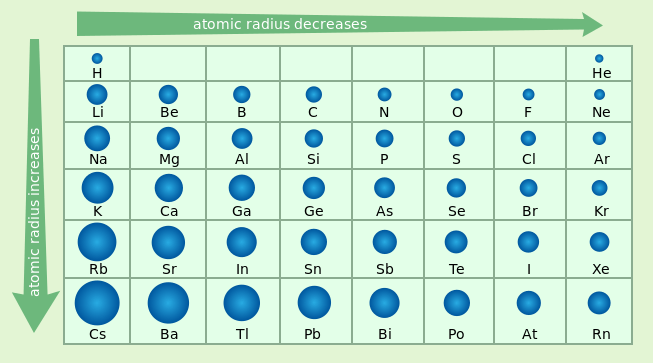
As you move down the periodic table atoms get bigger.  This is because ____________.
a)
The atoms have more mass.
b)
The atoms have more protons.
c)
The atoms have more energy levels
d)
The atoms have more nuetrons
52.
As you move across the periodic table atoms tend to get smaller because, ______________.
a)
the atoms have more mass.
b)
the atoms have less mass
c)
the atoms have more protons.
d)
the atoms have less electrons.
53.
Which atom has the largest atomic radius?
a)
potassium
b)
rubidium 
c)
francium
d)
cesium
54.
The atom with the largest atomic radius in Group 18 is - 
a)
Ar
b)
He
c)
Kr
d)
Rn
55.
Which periodic group has the smallest atomic radius?
a)
Alkali metals
b)
Halogens
c)
Noble Gases
d)
Transition metals
56.
Ionization energy is...
a)
the energy required to add an electron to a specific atom
b)
how much energy it takes to remove an electron from an atom
c)
the energy required to shield the outer electrons from the nucleus
d)
a measure of the ability of an atom to attract electrons
57.
Which of the following will have a lower ionization energy than Scandium (Sc)?
a)
Helium (He)
b)
Titanium (Ti)
c)
Calcium (Ca)
d)
Magnesium (Mg)
58.
Which of the following will have a higher ionization energy than arsenic (As)?
a)
Gallium (Ga)
b)
Neon (Ne)
c)
Antimony (Sb)
d)
Germanium (Ge)
59.
Electronegativity is...
a)
how good an atom is at attracting electrons
b)
the ability of an atom to lose electrons
c)
the energy required to remove an electron from a specific atom
d)
how easy it is to make friends. 
60.
Atoms that have a high electronegativity, _______________.
a)
give up their electrons more easily.
b)
hold on to their electrons more tightly.
c)
have more electron shells.
61.
Which of the following will have a higher electronegativity than arsenic (As)?
a)
Carbon (C)
b)
Neon (Ne)
c)
Antimony (Sb)
d)
Germanium (Ge)
62.
As atoms of elements in group 16 are considered in order from top to bottom, the electronegativity of each successive element....
a)
decreases
b)
increases
c)
remains the same
d)
none of the above
63.
The electronegativity of Cl is the highest in Period 2.  Why?
a)
Cl is the largest and has the greatest effective nuclear charge
b)
Cl is the smallest and has the lowest effective nuclear charge
c)
Cl is the largest and has the lowest effective nuclear charge
d)
Cl is the smallest and has the greatest effective nuclear charge
64.
What term is used to describe "an atom's tendency to attract electrons to itself when is is chemically combined with another element"
a)
electronation
b)
electron affinity
c)
electronegativity
d)
electrolysis
65.
What term is used to describe "The energy required to remove an electron from gaseous atoms"
a)
excitation energy
b)
ionization energy
c)
polarization energy
d)
electrolytic energy 
66.
What term is used to describe "A measure of the size of an atom"
a)
chemical reactivity
b)
atomic radius
c)
energy levels
d)
orbit
67.
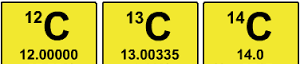
What do these isotopes of carbon all have in common?
a)
neutrons & mass number
b)
atomic number and neutrons
c)
atomic number and electrons
d)
protons, atomic number, and mass number
68.

Isotopes are atoms of the same element with different #’s of __________ & therefore different __________.

a)

neutrons ; atomic numbers

b)

protons ; atomic numbers

c)

electrons ; mass numbers

d)

neutrons ; mass number

69.
How many neutrons does an atom of the isotope Neon-22 have?
a)
12
b)
10
c)
22
d)
20
70.
Two isotopes of carbon are carbon-12 and carbon-14.  These isotopes differ from one another by two protons.
a)
true
b)
false
71.
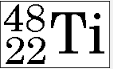
How many protons does this isotope of titanium have?
a)
48
b)
22
c)
26
d)
70
72.
How many neutrons does the isotope of lithium have?
a)
8
b)
3
c)
4
d)
5
73.

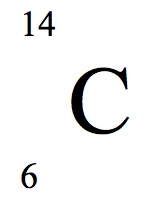
The photo above shows the isotopic notation for which isotope?

a)

Carbon 12

b)

Carbon 13

c)

Carbon 14

d)

Carbon 15

74.
How many neutrons does a Sodium 24 isotope have?
a)
12
b)
13
c)
14
d)
15
75.
How many neutrons does a Calcium 48 isotope have?
a)
16
b)
20
c)
28
d)
12
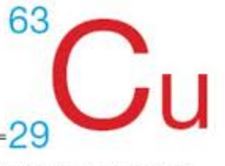
76.
What is the name of the pictured isotope?
a)
Copper-29
b)
Copper-63
c)
Copper-34
d)
CopperWopperHopperBopper
77.
How many electrons does a Copper atom have?
a)
63
b)
29
c)
92
d)
34
78.
Found in the nucleus of the atom
a)
electrons only
b)
protons only
c)
neutrons and protons
d)
neutrons and electrons
79.
An element is defined by its number of 
a)
protons
b)
electrons
c)
neutrons
d)
protons + electrons
80.
Which of the subatomic particles is the lightest
a)
all have the same mass
b)
protons 
c)
neutrons 
d)
electrons
81.
Which of the subatomic particles is the heaviest?
a)
electrons 
b)
protons 
c)
neutrons 
d)
protons and neutrons have equal mass
82.
The relative mass of an electron is...
a)
1
b)
2
c)
0
d)
3
83.
The relative mass of a proton/neutron is.....
a)
0
b)
1
c)
2
d)
3
84.
Where are electrons of an atom found?
a)
Nucleus
b)
Electron Cloud
c)
Some are in the nucleus and some in the electron cloud.
d)
They are moving everywhere.
85.
An atom with atomic number 6 would have how many protons?
a)
6
b)
12
c)
3
d)
cannot be determined 
86.
Most of an atom's mass is found in the
a)
electrons.
b)
nucleus.
87.
In a stable atom the amount of electrons is electron is equal to
a)
neutrons
b)
protons
c)
atomic mass
d)
neutrons + protons
88.
Matter can not be created nor destroyed: it can only be
a)
Destroyed a little bit
b)
Invisible
c)
Transformed, changed
d)
None of the above
89.
If reaction starts with 20g of reactants it should produce 
a)
a total of 40g of products
b)
a total of 10g of products
c)
a total of 80 g of products
d)
a total of 20g of products
90.

The Law of Conservation of Mass States

a)

Energy cannot be created nor destroyed, it can only change form.

b)

Mass cannot be created nor destroyed, it can only change form.

c)

Mass can be created or destroyed, it cannot change form.

91.

Which of the models of a chemical reaction best represents the Law of Conservation of Mass?

a)

A

b)

B

c)

C

d)

D

92.

Which of the models of a chemical reaction best represents the Law of Conservation of Mass?

a)

A

b)

B

c)

C

d)

D

93.

Which of the models of a chemical reaction best represents the Law of Conservation of Mass?

a)

A

b)

B

c)

C

d)

D

94.

A student pours hydrochloric acid (HCl) into an open beaker that contains a piece of magnesium (Mg). A chemical reaction occurs, and the data for the reaction is shown in the image. Was there a total mass increase or a total mass decrease for this experiment?

a)

There was a increase in mass.

b)

There was a decrease in mass.

c)

There was no change in mass.

95.

A student heated a 10 gram sample of a chemical in an open container. A chemical reaction occurred, and the mass of the sample was measured again. The mass of the sample was found to be less than before the reaction. Which of the following best explains the decrease in mass of the sample?

a)

The heat caused the chemical to become less dense.

b)

The reaction gave off more heat than was added.

c)

Some of the lighter particles were destroyed.

d)

Some of the particles escaped as a gas formed.

96.

A student dissolved 25 grams of salt into 1,000 grams of water. What should the mass of the saltwater mixture be?

a)

975 grams

b)

1,000 grams

c)

1,025 grams

d)

2,500 grams

97.

A student measures the mass of an iron nail to be 25 grams. The student heats the nail over a bunsen burner and measures the mass of the nail afterwards. The mass of the nail is found to be greater after burning. Which of the following best explains the increase in mass of the nail?

a)

The heat caused the compound to become more dense.

b)

The reaction gave off less heat than was added.

c)

Some of the heavier particles multiplied inside the nail.

d)

Extra particles from the air were added to the nail during burning.

98.

When a neutral atom loses an electron, the atom becomes a

a)

positively charged anion.

b)

negatively charged anion.

c)

positively charged cation.

d)

positively charged anion.

99.

The correct formula for calcium + chlorine is

a)

CaCl

b)

CaCl2

c)

CCl

d)

Ca2Cl

100.

If a compound is ionic, it will most likely contain

a)

metals only.

b)

nonmetals only.

c)

metalloids only.

d)

a metal and nonmetal(s).

101.

LiBr is called

a)

lithium bromine

b)

lithium (I) bromine

c)

lithium bromide

d)

lithuim (I) bromide

102.

When naming a compound, which of these is written first? (Choose two.)

a)

Metal

b)

Nonmetal

c)

Anion

d)

Cation

103.

When naming a compound, what must the last part be?

a)

the element with "ide" at the end

b)

the element with the ending "ite"

c)

the name of the element

d)

the element with "ide" at the end, unless its a polyatomic ion

104.

What is the name of the compound Na2(SO4)?

a)

Sodium sulfate

b)

Sodium sulfide

c)

Sodium sulfite

d)

Sodium sulfuroxide

105.

The name of the compound Ca3(PO4)2

a)

calcium phosphate

b)

tricalcium diphosphate

c)

calcium phosphorus oxide

d)

calcium phosphide

106.

If I gain electrons I become

a)

Positive because I've added to my atom

b)

negative because I've added electrons

c)

same because i'm balanced

d)

equal because now I have electrons

107.

Ionic compounds will

a)

share electrons in order to gain stability.

b)

transfer electrons in order to gain stability.

c)

constantly move electrons back and forth to gain stability.

d)

have low melting points.

108.

What do the dots represent for the oxygen atom?

a)

There are 6 valence electrons.

b)

There are 6 total electrons.

c)

Oxygen has atomic number of 6.

d)

Oxygen will give away 6 electrons in order to gain stability.

109.

By replacing the element symbol, this could be a diagram of which element?

a)

Li

b)

Al

c)

C

d)

Be

110.
According to the octet rule most elements need _______ valence electrons.
a)
2
b)
8
c)
6
d)
18
111.

Match the following elements with their correspomding number of valence electrons

a)

1

1.

Hydrogen

b)

2

2.

Magnesium

c)

3

3.

Aluminum

d)

7

4.

Bromine

e)

6

5.

Oxygen

112.

Element with 5 valence electrons

a)

Phosphorus

b)

Oxygen

c)

Hydrogen

d)

Chlorine

113.

How many valence electrons does Arsenic (As) have?

a)

5

b)

3

c)

7

d)

6

114.

How many valence electrons does Chlorine have?

a)

7

b)

8

c)

5

d)

4