
 Worksheets
Interim Chem Assessment
Total questions: 116
Worksheet time: 2hrs 56mins

What sub-atomic particle is labelled A?
Neutron
Electron
Ion
Atom
What sub-atomic particle is labelled B?
Neutron
Electron
Ion
Atom

Which atom has 4 electrons?
Atom A
Atom B
Atom C
Atom D

This picture best represents ___________________ atomic model.
Thomson's
Dalton's
Bohr's
Chadwick's

An oxygen atom has reacted to get a full outer shell. What is the correct charge for the ion?
+
-
2+
2-

Count the electrons in this atom's outer shell. What will happen when this atom reacts?
It will gain 2 electrons and become a 2- ion.
It will gain 3 electrons and become a 3- ion.
It will lose 5 electrons and become a 5- ion.
It will gain 3 electrons and become a 3+ ion.

This ion was formed when a magnesium atom...
lost two outer electrons
gained two outer electrons
lost one outer electron
gained 6 electrons

This is a lithium atom. To form a lithium ion it must...
Gain one electron
Lose one electron
Gain two electrons
Lose two electrons

Sodium is a metal. It loses one electron when it reacts. The correct chemical symbol for a sodium ion would be..?
Na+
Na-
Na2+
Na+
Predict the formula of the ionic compound that forms from Potassium and Chlorine
KCl2
KCl
P2Cl
PCl
K+1 and Cl-1
What is the correct formula for when K and F bond?
KF
K2F
KF2
K2F3
How does an ionic bond form?
The metal transfers electrons to the non metal
The two metals share electrons
The non metal transfers electrons to the metal
The two non metals share electrons

Which properties are all characteristics of ionic compounds?
solids with high melting and boiling points
soft solids which are highly malleable
when solid, the ions are held in place so the compounds cannot conduct electricity
conduct electricity when dissolved or molten

Select all the true statements:
Each outer shell electron in Cl is represented by a cross.
In Na, the total charge is -2.
Na+ and Cl- are held together by electrostatic attraction.
Na+ has a full outer shell of electrons.

This is an image of the giant ionic lattice representing Sodium Chloride, what is represented by the +?
Cl ion
Cl atom
Na atom
Na ion

This is an example of particles in a _________.
solid
liquid
gas

This is an example of particles in a ______.
solid
liquid
gas
Label the diagram.

Which scientist is given credit for discovering the electron?
Bohr
Dalton
Thomson
Rutherford
Who discovered that electrons travel in specific orbits around the nucleus?
Bohr
Schrodinger
Democritus
Rutherford
Whose gold foil experiment led to his conclusion that the nucleus of an atom contained protons?
Rutherford
Bohr
Thomson
Dalton

Whose model of the atom is represented in the image?
Thomson
Bohr
Dalton
Rutherford
Which model was created after the discovery of the nucleus?

Dalton's

Rutherford's

Quantum Mechanical

Plum Pudding
Which one of these is Dalton's Model?
What is a particle with one negative charge called?
electron
proton
quark
neutron
Who discovered electrons?
Rutherford
Bohr
J.J. Thompson
Democritus
Which model was created after the discovery of electrons?
Dalton's
Rutherford's
Quantum Mechanical Model
Plum Pudding
What is the correct order of scientists in order of their work related to the atomic theory from earliest to most recent?
Neils Bohr, Ernest Rutherford, JJ Thomson, John Dalton, & Democritus
JJ Thomson, John Dalton, Neils Bohr, Ernest Rutherford, & Democritus
Democritus, John Dalton, JJ Thomson, Ernest Rutherford, and Neils Bohr
John Dalton, Neils Bohr, JJ Thomson, Democritus, & Ernest Rutherford
Within Dalton's Atomic Theory, he had proposed...
Atoms were the smallest particles that existed and could be divisible
Atoms were the smallest particles that existed and were round
Atoms were the smallest particles that existed and could not be divisible
Worked with Rutherford to discover particles with no charge -- called neutrons.
James Chadwick
Niels Bohr
Democritus
Thomson

What is this process?
melting
vaporization
condensation
evaporation
What does exothermic mean?
Energy is transferred from reaction to surroundings, in the form of heat
Energy is transferred from surroundings to reaction, in the form of heat
Energy is transferred from reaction to surroundings, in the form of kinetic energy
Energy is transferred from surroundings to reaction, in the form of kinetic energy
What is the best equipment for measuring temperature changes?
Measuring cylinder
pH probe
Thermometer
Polystyrene cup
What is the best equipment for measuring temperature changes?
Measuring cylinder
pH probe
Thermometer
Polystyrene cup
What must you do before you add the acid and alkali together?
Estimate the final volume of the solution
Measure the starting temperature of the acid
Put a lid on it
Add water to the acid
28, 18, 19, 18, 17
Find the mean of the numbers below:
1, 8, 7, 5, 6, 4, 7, 6
40
5.5
44
5
6.5
28, 18, 19, 18, 17

This atom, neon is a member of the group called the noble gases. Why are the noble gases unreactive?
Because they already have full outer shells
Because they have an even number of electrons
Because they only need to gain one electron

Covalent bonds are usually formed between...
A metal and a non-metal
Two non-metals
Two metals
What is a polymer?
Long chain of ionic bonds
Long chain Hydrocarbon
Long chain of covalent bonds
What is a monomer?
The small repeating unit of a polymer
A disease
A molecule consisting of 1 type of atom.
A covalent lattice.
As polymers increase in lenght, they also increase in _______ (2 answers)
melting points
thermostability
intermolecular forces
difference in monomers

The diagram shows an electrolysis experiment.
During the electrolysis, sodium was formed at electrode P and chlorine at electrode Q.
Which choice correctly identifies P, Q and X?
P = anode; Q = cathode; X = concentrated solution of sodium chloride in water
P = anode; Q = cathode; X = molten sodium chloride
P = cathode; Q = anode; X = concentrated solution of sodium chloride in water
P = cathode; Q = anode; X = molten sodium chloride

Copper and hydrogen can each be formed by electrolysis.
At which electrodes are these elements formed?
A
B
C
D

The electrolyte is Sodium Chloride solution: NaCl (aq)
The ions inside are: Na+ Cl- and H+ OH-
What will be made at the anode?
H2 - hydrogen gas
Na - sodium metal
O2 - oxygen gas
Cl2 - chlorine gas
The electrolyte is Sodium Chloride solution: NaCl (aq)
The ions inside are: Na+ Cl- and H+ OH-
What will be made at the anode?
H2 - hydrogen gas
Na - sodium metal
O2 - oxygen gas
Cl2 - chlorine gas
The electrolyte is Potassium Chloride solution: KCl (aq)
The ions inside are: K+ Cl- and H+ OH-
What will be made at the cathode?
H2 - hydrogen gas
K - potassium metal
O2 - oxygen gas
Cl2 - chlorine gas
The electrolyte is Potassium Sulfate solution: K2SO4 (aq)
The ions inside are: K+ SO4- and H+ OH-
What will be made at the anode?
O2 - oxygen gas
K - potassium metal
S - Sulphur
Cl2 - chlorine gas
Sodium Chloride solution contains:
Na+ Cl- and H+ OH-
Which ion will be changed at the cathode?
OH-
Cl -
Na+
H+
Sodium Chloride solution contains:
Na+ Cl- and H+ OH-
Which ion will be changed at the anode?
OH-
Cl -
Na+
H+
Potassium Chloride solution contains:
K+ Cl- and H+ OH-
Which ion will be changed at the anode?
OH-
Cl -
K+
H+
Silver Bromide solution contains:
Ag+ Br - and H+ OH-
Which ion will be changed at the Cathode?
OH-
Br -
Ag+
H+
Silver Bromide solution contains:
Ag+ Br - and H+ OH-
Which ion will be changed at the anode?
OH-
Br -
Ag+
H+
Copper iodide solution contains:
Cu2+ I - and H+ OH-
Which ion will be changed at the anode?
OH-
I -
Cu2+
H+
Copper Fluoride solution contains:
Cu2+ F - and H+ OH-
Which ion will be changed at the Cathode?
OH-
F -
Cu2+
H+
Silver Chloride solution contains:
Ag+ Cl - and H+ OH-
Which two ions will be changed at the electrodes?
OH-
Cl -
Ag+
H+
The electrolyte is Potassium Chloride solution: KCl (aq)
The ions inside are: K+ Cl- and H+ OH-
What will be made at the anode?
H2 - hydrogen gas
K - potassium metal
O2 - oxygen gas
Cl2 - chlorine gas
In aluminum extraction the electrodes are made of
carbon (graphite)
aluminum and oxygen
platinum
steel
The anode has to be replaced frequently because
The oxygen reacts with the carbon anode to form carbon dioxide
Aluminum reacts with the carbon to form aluminum carbide
The anode gets impurities that impact the extraction
The anode is too hot and it will reduce their electrical conductivity
What do you add to aluminium ore to reduce its melting temperature?
Dendrite
Malachite
Bauxite
Cryolite
Why is Aluminium expensive? (2 answers)
The process takes a lot of electricity
Aluminium is rare
The electrodes need to be replaced often
The mines are deep
During electrolysis, what will the Aluminium Oxide split into?
Al3+ and O2-
Al and O
Al+ and O-
Aluminium and Oxide
Which ion will be attracted to the positive electrode (anode)?
Al3+
O2-
H+
All of them
When the Oxygen ion arrives at the graphite (Carbon) anode, what gas will it form?
CO2
H2O
H2
O2
When the Oxygen ion arrives at the graphite (Carbon) anode, what gas will it form?
CO2
H2O
H2
O2

P4O10 had a mass of 12g , and H3PO4 has a mass of 90g, accroding t the law of conservation of mass what is H2O mass? (a)
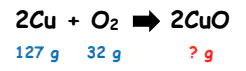
127 g Cu + 32 g O2 = (a) g CuO
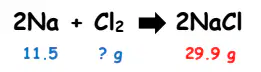
11.5 g Na + (a) ._ g Cl2 = 29.9 g NaCl
11.5 g Na + (a) ._ g Cl2 = 29.9 g NaCl
If it looks like mass was lost, then a (a) must have been produced in the chemical reaction.
If it seems like mass was gained in a chemical reaction, a (a) must have been a reactant.
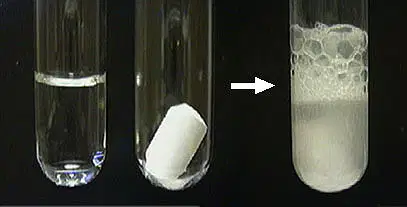
When substances are mixed and it produces a (a) , this is evidence of a chemical reaction. Often (b) occur when a gas is produced.
(a) is the gain of oxygen atoms.
(a) is the loss of oxygen atoms.
Is this an oxidation or reduction reaction?
water → hydrogen + oxygen
Oxidation
Reduction
Is this an oxidation or reduction reaction?
carbon + oxygen → carbon dioxide
Oxidation
Reduction
Is it acid or alkali when the pH is 4 pH
Acid
Alkali
Neutral
Acid + Alkali --> Salt + Water
neutralization reaction
synthesis
decomposition
single displacement
Acids are source of
hydrogen ions
hydroxide ions

The image shows a PH scale. Which option indicates strong acid?
a
b
c
d
As an acid becomes stronger…
(Higher Tier Question)
More H+ ions disassociate
More OH- ions disassociate
The acid doubles
The H+ and OH- balance
An example of a strong acid is…
(Higher Tier Question)
hydrochloric acid
ethanoic acid
carbonic acid
benzoic acid
What colour would universal indicator be when mixed with a strong acid?
Blue
Red
Green
Purple
Universal indicator, when mixed with a strong acid, turns (a) in colour.
When carbonates react with acids, which gas is produced?
Hydrogen
Carbon dioxide
Oxygen
Nitrogen
Which of the following is a neutralization reaction?
2Na + Cl2 → 2NaCl
CH4 + 2O2 → CO2 + 2H2O
HCl + KOH → KCl + H2O
CaCO3 → CO2 + CaO
Metal carbonates react with acid to form....
Salt, carboxylic acid and water
Salt, carbon dioxide and water
Salt and carbonated water
Salt and hydrogen
Metal carbonates react with acid to form....
Salt, carboxylic acid and water
Salt, carbon dioxide and water
Salt and carbonated water
Salt and hydrogen
Calcium carbonate + hydrochloric acid -->
Calcium chloride + hydrogen
Calcium choride + water
Calcium chloride + carbon dioxide + water
Calcium sulfate + carbon dioxide + water
According to pH scale, indicator will turn red if a solution is...
Acidic
Alkali
Neutral
Precipitate
which gas is formed when calcium carbonate reacts with hydrochloric acid?
calcium chloride
hydrogen
oxygen
carbon dioxide
which in the following is the right equation for reaction between metal carbonates and acid?
Metal carbonate + hydrochloric acid → metal chloride + water + hydrogen
Metal carbonate + hydrochloric acid → metal chloride + carbon dioxide
Metal carbonate + hydrochloric acid → metal chloride + water + carbon dioxide
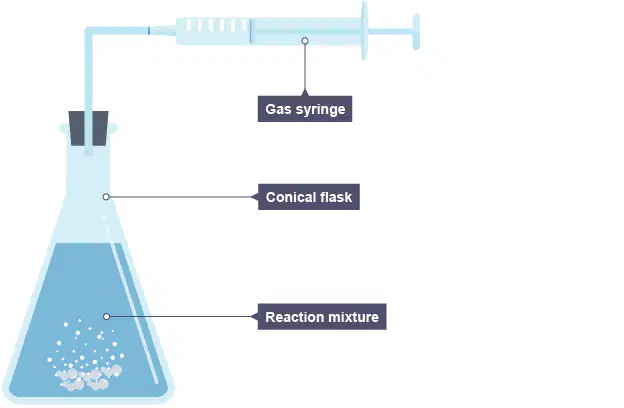
Put these steps in order to Investigate the volume of carbon dioxide produced when different masses of calcium carbonate was used. (a) (b) (c) (d) (e)
Calculate the relative formula mass of
copper (ii) chloride, CuCl2
[Relative atomic mass:
O = 16 ; Al = 27 ; S = 32 ; Cl = 35.5 ; Cu = 64 ]
90
135
137
99.5
Calculate the relative formula mass of
sulphuric acid H2SO4
[Relative atomic mass:
H = 1, S = 32, O = 16]
96
98
100
92
Calculate the relative formula mass of
copper (ii) chloride, CuCl2
[Relative atomic mass:
O = 16 ; Al = 27 ; S = 32 ; Cl = 35.5 ; Cu = 64 ]
(a)
Calculate the relative formula mass of
aluminium sulphate, Al2(SO4)3
[Relative atomic mass:
O = 16 ; Al = 27 ; S = 32 ; Cl = 35.5 ; Cu = 64 ]
(a)
50g of sodium hydroxide is dissolved in water to make up 200cm3 . What is the concentration in dm3.
0.25 g/dm3
2.5 g/dm3
25 g/dm3
250 g/dm3
Give the equation for calculating concentration from the mass of substance and volume of solution.
Concentration = mass x volume
Concentration = mass ÷ volume
Choose a correct unit for concentration.
g
gdm
g/dm3
mol

