

wayground logo

Free Printable Worksheets

Font size

S
M
L
XL
Worksheets

1st Semester Midterm Review

Total questions: 109

Worksheet time: 27hrs 15mins

Name
Class
Date
1.

During a flame test, sodium chloride produces an intense yellow flame. This yellow color is produced when electrons in excited atoms

a)

are gained by the atoms

b)

are lost by the atoms

c)

move to higher energy states within the atoms

d)

move to lower energy states within the atoms

2.

An atom that has 8 protons and 10 neutrons is an isotope of the element

a)

nitrogen

b)

oxygen

c)

fluorine

d)

neon

3.

Which elements have the most similar chemical properties?

a)

Ge, As, and Sb

b)

Mn, Fe, and Co

c)

S, Se, and Te

d)

P, S, and Cl

4.

Which atom has the lowest electronegativity?

a)

Nitrogen

b)

Oxygen

c)

Fluorine

d)

Neon

5.

What is the overall charge of an ion that has 9 protons, 11 neutrons, and 10 electrons?

a)

+1

b)

-1

c)

+2

d)

-2

6.

Which formula represents a polar molecule?

a)

Cl2

b)

CH4

c)

HCl

d)

CO2

7.

Which pair of atoms will form ionic bonds?

a)

S and F

b)

Mg and O

c)

F and Cl

d)

H and Ne

8.
The atomic number of an atom or ion refers to the number of:
a)
neutrons
b)
protons
c)
nucleons
d)
electrons
9.
How many electrons does potassium K contain? (click to see image)
a)
19
b)
39
c)
20
d)
40
10.
How many neutrons does the isotope of lithium have?
a)
8
b)
3
c)
4
d)
5
11.
which explanation of this notation is correct?
a)
 12 is proton #
b)
6 tells you there are 6 neutrons
c)
6 tells you there are 6 protons
d)
12 is not a mass # here
12.

What do these isotopes of carbon all have in common?

a)

neutrons & mass number

b)

atomic number and neutrons

c)

atomic number and electrons

d)

protons, atomic number, and mass number

13.

What element is represented in this Bohr Model?

a)

Carbon

b)

Hydrogen

c)

Aluminum

d)

Lithium

14.
What is the name of this element?
a)
Lithium
b)
Boron
c)
Carbon
d)
Neon
15.
An element with five valence electrons is
a)
phosphorus
b)
oxygen
c)
beryllium
d)
rubidium
16.
What's a valence electron?
a)
electrons in the second energy level
b)
electrons in the outermost energy level
c)
the atomic number
d)
electrons in the first level
17.

Which energy state has more energy?

a)

Ground State

b)

Excited State

18.

What is happening in the picture

a)

An atom is absorbing energy to go to a higher state

b)

An atom is emitting a photon to go to a lower state

c)

The atom is losing an electron

d)

The atom is losing a proton

19.
What atom matches this electron configuration?
1s22s22p63s23p64s23d10
a)
Zinc
b)
Copper
c)
Nickel
d)
Germanium
20.
What atom matches this electron configuration?
1s22s22p63s2
a)
Neon
b)
Magnesium
c)
Aluminum
d)
Potassium
21.
What electron configuration matches an oxygen atom?
a)
1s22s22p63s2, 3p64s23d104p5
b)
1s22s22p4
c)
1s22s22p6
d)
1s22s22p63s23p64s23d1
22.
A(n) _________ is an ion with a positive (+) charge.
a)
anion
b)
cation
c)
ion
d)
solute
23.
When an atom loses an electron, it becomes a:
a)
positive ion
b)
negative ion
c)
neutral ion
d)
neutral atom
24.
Ionic bonds form between metals and ____.
a)
metalloids
b)
metals
c)
nonmetals
25.

If an atom has no charge, which of the following must be true?

a)

It has more neutrons than protons or electrons.

b)

There are only neutrons inside the atom.

c)

Its number of protons is equal to its number of electrons.

d)

The neutrons in the atom outnumber the electrons and protons.

26.
Covalent compounds
a)
Share electrons
b)
transfer electrons
c)
None
d)
conduct electricity
27.
What do we call a covalent bond where electrons are shared UNEVENLY or UNEQUALLY?
a)
Ionic
b)
Polar Covalent
c)
Nonpolar Covalent
d)
Van der Waals Force
28.
Polar, nonpolar, or ionic?
a)
Nonpolar
b)
Polar
c)
Ionic
d)
Pizza
29.
What is oxidation number of Fe in FeO ?
a)
+2
b)
-2
c)
0
d)
+1
30.
What is the name of Groups 17?
a)
Alkali Metals
b)
Alkali Earth Metals
c)
Transition Metals
d)
Halogens
31.
Where are the metals on the Periodic Table?
a)
To the left
b)
In the upper right hand corner
c)
On the zigzag line
d)
At the bottom
32.
Where are the nonmetals on the Periodic Table?
a)
To the left
b)
In the upper right hand corner
c)
On the zigzag line
d)
At the bottom
33.
How would you describe reactivity on the periodic table?
a)
Elements in the same group are most likely to react.
b)
Elements in the same Periodic are most likely to react.
c)
Elements on opposite sides of the Periodic Table are most likely to react.
d)
There is no trend of reactivity.
34.

Across a period in the periodic table, atomic radii generally

a)

decrease

b)

decrease, then increase.

c)

increase.

d)

increase, then decrease.

35.

Down a group in the periodic table, atomic radii generally

a)

decrease.

b)

remain constant.

c)

increase.

d)

vary unpredictably.

36.

An element with the lowest electronegativity would be found in of the periodic table.

a)

Group 1, Period 7

b)

Group 3, Period 4

c)

Group 5, Period 3

d)

Group 17, Period 2

37.
What is the name of the compound with the chemical formula CrCl3?
a)
chromium tetrachloride
b)
chromium trichloride
c)
chromium (II) chloride
d)
chromium (III) chloride
38.
What do the ions K+, Ca+2, and Cl- have in common?
a)
They have the same number of protons
b)
They will form covalent bonds with oxygen
c)
They have the same electron configuration as argon
d)
They are larger than their corresponding atoms
39.
What is the correct chemical formula for sodium sulfate?
a)
NaSO4
b)
Na2SO4
c)
Na(SO4)2
d)
Na2(SO4)2
40.
Which element is located in Group 2 and Period 6 of the periodic table?
a)
Ba
b)
Mo
c)
Ra
d)
W
41.
What compound has the chemical formula MgI2?
a)
di-iodide magnesium
b)
iodide (II) magnesium
c)
magnesium (II) iodide
d)
magnesium iodide
42.
An atom contains 70 protons, 70 electrons, and 99 neutrons. What is the mass number?
a)
239
b)
169
c)
140
d)
70
43.
Which of the following particles has a positive one charge(+1) ?
a)
proton
b)
electron
c)
neutron
d)
beta particle
44.
According to the periodic table, Mg will most likely react with elements in which of these groups?
a)
1
b)
2
c)
17
d)
18
45.
Which of these compounds is most likely to contain an ionic bond?
a)
H2
b)
CO2
c)
PCl5
d)
CaO
46.

The elements from this section of the periodic table all belong to the same

a)

Family

b)

Group

c)

Period

d)

Valence

47.

One radioactive isotope of calcium has an atomic mass of 47. How many neutrons are in this calcium-47 nucleus?

a)

17

b)

20

c)

27

d)

47

48.

Use IUPAC nomenclature rules to properly identify this compound.

a)

potassium oxide

b)

dipotassium oxide

c)

potassium (I) oxide

d)

dipotassium monoxide

49.

What is the oxidation number for nitrogen?

a)

+1

b)

+4

c)

-3

d)

-2

50.

The element hydrogen has three naturally occurring isotopes. Which of the following describes the relationship of these isotopes?

a)

different mass, different atomic number

b)

same mass, different atomic number

c)

different mass, same atomic number

d)

same mass, same atomic number

51.

What quantity is the same among atoms of the same element?

a)

mass number

b)

atomic number

c)

number of neutrons

d)

number of nucleons

52.
Which two subatomic particles make up the nucleus of an atom?
a)
Protons and Electrons
b)
Neutrons and Electrons
c)
Electrons and Protons
d)
Protons and Neutrons
53.

Rutherford's gold foil experiment provided evidence that...

a)

Negative and positive charges are spread evenly throughout the atom.

b)

Alpha particles have a positive charge.

c)

Gold is not a dense as previously thought.

d)

There is a dense positively charged nucleus at the center of an atom & the rest is mostly empty space

54.

which atom has a nucleus that contains 13 protons and 14 neutrons?

a)

Mg

b)

Be

c)

Al

d)

N

55.

An ion is an example of:

a)

an atom that has lost electrons

b)

an atom that has gained electrons

c)

an atom that has gained protons

d)

an atom that has lost protons

56.

CaF2

a)

Sodium hydrogen sulfate

b)

Copper (II) sulfite

c)

Potassium oxalate

d)

Calcium fluoride

57.

chromium(II) oxide

a)

KIO4

b)

Na3AsO4

c)

CrO

d)

NaClO

58.

Calculate the average atomic mass of the element from the following isotopes and percent abundances

a)

24.32 amu

b)

25.00 amu

c)

28.88 amu

d)

21.43 amu

59.
24.1% of all the isotopes of a an element have a mass of 75.23 amu, 48.7% have a mass of 74.61 amu, and 27.2% have a mass of 75.20 amu.
What is the average mass of this element?
a)
74.92 amu
b)
24.97 amu
c)
75.01 amu
d)
74.51 amu
60.

The atomic mass of an element is the ___.

a)

average of the mass number and the atomic number for the element

b)

weighted average of the masses of the isotopes of the element

c)

total mass of the isotopes of the element

d)

total number of subatomic particles in the nucleus
61.
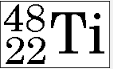
How many protons does this isotope of titanium have?
a)
48
b)
22
c)
26
d)
70
62.
Calcium has three different isotopes. One has a mass of 35.00 amu; another has a mass of 41.00 amu; and another has a mass of 40.00 amu. Which isotope is the most abundant of the three?
a)
40.00 amu
b)
41.00 amu
c)
35.00 amu
d)
impossible to tell
63.
How do covalent bonds form?
a)
Donating & receiving valence e- between atoms.
b)
Opposite slight charges attract each other between compounds.
c)
Scientists are still not sure how they form.
d)
Sharing valence e- between atoms.
64.
What is the correct name for C4H6?
a)
Carbon Hexahydride
b)
Pentacarbon Pentahydride
c)
Hexacarbon Tetrahydride
d)
Tetracarbon Hexahydride
65.
What is the correct name for NO?
a)
Mononitrogen Monoxide
b)
Nitrogen Monoxide
c)
Mononitrogen Dioxide
d)
Nitrogen Oxide
66.
Phosphorous trichloride
a)
PCl3
b)
P3Cl
c)
P3Cl3
d)
PCL
67.
As4O10
a)
arsenic oxide
b)
quadarsenic decoxide
c)
tetraarsenic decoxide
d)
arsenic decoxide
68.

Which element has properties most similar to those of Lithium?

a)

Carbon (C)

b)

Magnesium (Mg)

c)

Sodium (Na)

d)

Oxygen (O)

69.

Which element has properties most similar to those of Fluorine?

a)

Chlorine (Cl)

b)

Oxygen (O)

c)

Calcium (Ca)

d)

Boron (B)

70.

Which element is the least reactive?

a)

Lithium

b)

Potassium

c)

Cesium

d)

Francium

71.

Which element is the most reactive?

a)

Beryllium

b)

Calcium

c)

Strontium

d)

Radium

72.

The number of each period represents the number of

a)

energy levels

b)

neutrons

c)

electrons

d)

nuclei

73.

Groups 3 - 12 are called

a)

alkali metals

b)

transition metals

c)

alkali earth metals

d)

halogens

74.
As you move down a group, atomic radius increases because - 
a)
you add more and more neutrons
b)
you add more and more protons
c)
you add more and more shells (energy levels)
d)
you add more atomic mass
75.
As you move across the periodic table from left to right, the atomic radius decreases.  This is because - 
a)
the number of protons increases, so attraction to electrons increases
b)
the number of energy levels increases
c)
the number of electrons increases
d)
the atomic mass increases
76.
Francium (Fr) has the lowest ionization energy in Group 1 because - 
a)
it has the smallest number of valence electrons
b)
it has the greatest atomic mass
c)
it has the greatest number of protons, so it attracts its electrons the strongest
d)
its 1 valence electron is very far from the nucleus, so little energy is needed to remove it
77.
The energy required to remove electrons is the definition of: 
a)
Electronegativity
b)
Atomic Number
c)
Atomic Radius
d)
Ionization
78.
Electronegativity is...
a)
the ability of an atom to attract/ accept electrons
b)
the ability of an atom to lose electrons
c)
the energy required to remove an electron from a specific atom
d)
how easy it is to make friends. 
79.
Which has the greater Electronegativity: 
N or C?
a)
C
b)
N
80.
Electronegativity __________ from left to right within a period and __________ from top to bottom within a group.
a)
decreases, increases 
b)
increases, increases
c)
increases, decreases 
d)
stays the same, increases
81.
Which of the following will have a lower ionization energy than Scandium (Sc)?
a)
Helium (He)
b)
Titanium (Ti)
c)
Calcium (Ca)
d)
Magnesium (Mg)
82.
Atoms that have a high electronegativity, _______________.
a)
give up their electrons more easily.
b)
hold on to their electrons more tightly.
c)
have more electron shells.
83.
The electronegativity of Cl is the highest in Period 2.  Why?
a)
Cl is the largest and has the greatest effective nuclear charge
b)
Cl is the smallest and has the lowest effective nuclear charge
c)
Cl is the largest and has the lowest effective nuclear charge
d)
Cl is the smallest and has the greatest effective nuclear charge
84.
Which of the following will have a higher electronegativity than arsenic (As)?
a)
Carbon (C)
b)
Neon (Ne)
c)
Antimony (Sb)
d)
Germanium (Ge)
85.
Which group has the greatest number of valence electrons?
a)
1
b)
14
c)
18
d)
16
86.
How many valence electrons are found in atoms of group 15?
a)
4
b)
5
c)
2
d)
3
87.
Put the following in order of increasing ionization energy:Neon, Lithium, Carbon
a)
Lithium, Carbon, Neon
b)
Carbon, Lithium, Neon
c)
Neon, Carbon, Lithium
d)
Lithium, Neon, Carbon
88.

Which element has the greater ionization energy?

a)

Magnesium (Mg)

b)

Phosphorus (P)

89.
Which of these elements has the highest ionization energy?
a)
Lithium (Li)
b)
Potassium (K)
c)
Francium (Fr)
d)
Sodium (Na)
90.

The atom with the largest atomic radius in Period 4 (row 4) is ____.

a)

K

b)

Kr

c)

Fe

d)

Fe

91.

Which of the following has the largest electronegativity value?

a)

neon

b)

fluorine

c)

carbon

d)

lithium

92.

What is a negative ion called?

a)

anion

b)

cation

c)

covalent

d)

isotope

93.

How many electrons would a Nitrogen ion gain/lose? If it has 5 valence electrons.

a)

lose 5

b)

gain 5

c)

lose 3

d)

gain 3

94.

How many electrons would a Calcium ion gain/lose? If it has 2 valence electrons.

a)

lose 1

b)

gain 1

c)

lose 2

d)

gain 2

95.

Be has 2 valence electron. It will have a charge of _______

a)

+1

b)

+2

c)

-1

d)

-2

96.

Is the following molecule polar or nonpolar?

a)

polar

b)

nonpolar

97.
Polar, nonpolar, or ionic?
a)
Nonpolar
b)
Polar
98.
F2
a)
Polar 
b)
Nonpolar 
99.

This molecule is ......

a)

polar

b)

nonpolar

c)

ionic

d)

metallic

100.
This is an example of a __________ bond.
a)
non-polar covalent
b)
polar covalent
c)
ionic
d)
metallic
101.
If Bromine bonds with Hydrogen, a ____________ bond forms.
a)
polar covalent
b)
nonpolar covalent
c)
metallic
d)
ionic
102.

When you have Br-Br, what is the polarity?

a)

Polar

b)

nonpolar

c)

Ionic

103.

When you have Li-O, what is the polarity?

a)

nonpolar

b)

polar

c)

ionic

104.

When you have Be-F, what is the polarity?

a)

nonpolar

b)

polar

c)

ionic

105.

When you have F-F, what is the polarity?

a)

nonpolar

b)

polar

c)

ionic

106.
Carbon can form in all of these ways!  These are _________ of carbon.
a)
allotrope
b)
copy cats
c)
polymers
d)
elements
107.
Which of the following explains this picture?
a)
Atoms of the same type bonding to form an extended structure
b)
Atoms of different types bonding to form a structure
c)
Molecules of different types bonding to form a structure
d)
Christmas lights
108.
All of these are different forms of silicon.  These are what types of molecules?
a)
allotropes
b)
noble gases
c)
silicon split personailties
d)
diatomic molecules
109.

Allotropes of carbon have the same chemical properties because they have

a)

the same number of electrons

b)

the same number of valence electrons

c)

different number of electrons

d)

the same number of protons
