Worksheets
Exam #3 Review
Total questions: 105
Worksheet time: 3hrs 28mins
Which of the following will form a cation?
Aluminum
Sulfur
Iodine
Nitrogen
Which of the following will form a cation?
Barium
Phosphorous
Tellurium
Selenium
What is the definition of a cation?
An atom with no charge
An ion with a negative charge
A molecule with a positive charge
An ion with a positive charge
What is the definition of an anion?
A positively charged ion
A negatively charged ion
A molecule with no charge
A neutral ion
How are cations formed?
By losing electrons
By remaining neutral
By sharing electrons
By gaining electrons
How are anions formed?
By gaining electrons
By not gaining or losing electrons
By sharing electrons
By losing electrons
What is the charge of a common cation, calcium (Ca)?
+2
+1
-2
+3
What is the charge of a common cation, sodium (Na)?
+1
0
+2
-1
An atom that loses electrons has a ____ charge.
negative
positive
Valence electrons are atoms of the outer most energy level, there is a maximum number of eight.
True
False
Lithium
Li+
Li+2
Li+3
Lt+

an element from Group 7
Why do ionic bonds form?
so the number of protons equals the number of electrons
to fill the outermost energy level to make the atom stable
so an atom can become unstable
If an aluminum atom has 13 protons (+) and 10 electrons (-), what is it's charge?
Al+3
Al+13
Al+10
Al-10
if NONMETALS are more likely to GAIN electrons, they will form ...
anions
neutral atoms
cations
What two types of atoms make a covalent bond?
2 non-metals
1 metal and 1 non-metal
2 metals
What type of bond involves the sharing of electrons between atoms?
covalent bond
ionic bond
metallic bond
transfer bond
Identify the following compound as ionic or covalent: SO2
ionic
covalent
Identify the compound if hydrogen and chlorine are chemically combined.
HCl
HCl7
H1Cl1
H1Cl7
Is potassium a cation or an anion?
cation
anion

What will be the charge of this atom after it has been ionized?
-2
-1
+1
+2
Which atom has the LOWEST ionization energy (energy to remove an electron)


What will be the ionic charge of this atom?
-2
-1
+1
+2

What is the ionic charge of this atom?
-2
-1
+1
+2

If Carbon-14 has 6 protons, how many neutrons does it have?
6
7
8
14

Sodium has an atomic number of 11 and an atomic mass of 23. How many electrons does sodium have?
11
12
23
46

When a sodium atom reacts with a chlorine atom to form a sodium chloride compound,
sodium becomes a cation
sodium becomes an anion
sodium and chloride both become an cations
sodium remains a neutral atom
"A pure substance that cannot be broken down into other substances by physical or chemical means" is the definition of a(n)
isotope
element
compound
molecule
Potassium-39 has how many neutrons?
19
18
20
21
Isotopes of an element have a different number of...
Protons
Neutrons
Electrons
Mass

1s2 2s2 2p6 3s2

[Xe] 6s2 4f14 5d9


14
4
3
28

1s22s22p63s23p64s23d10

Which particle carries no charge?
Neutrons
Electrons
Protons

What is the state when electrons move to a higher energy level upon absorption of energy?
active
inactive
excited
ground
What form of energy is emitted when an excited electron returns to the ground state?
Photon (light)
Heat
Kinetic
Potential
What compound gives off bright red color when heated over a flame?
Lithium
Calcium
Strontium
Potassium

What is this?
Atom
Molecule
Compound

What is this?
Atom
Molecule
Compound

What is this?
Atom
Molecule
Molecule AND compound

How would this chemical formula be written?
CH3
CH4
HC4
H4C
A __________ goes up and down on the periodic table.
Group
Period
A _________ goes side to side on the periodic table.
Group
Period

What two elements are in the same Period?
K - Potassium and Na - Sodium
Li - Lithium and Mg - Magnesium
B - Boron and C - Carbon
Zn - Zinc and N - Nitrogen

Which two elements would have similar properties?
Ar - Argon and Xe - Xenon
Og - Oganesson and Lu - Lutetium
He - Helium and Lu - Lutetium
Ar - Argon and Se - Selenium
periods on the periodic table tell you
the number of valence electrons
the number of protons
the number of energy levels
the total number of subatomic particles in the element
The group number tells you the number of
protons
valence electrons
energy levels
What is the name of group number 1?
halogens
noble gases
alkali metals
alkaline earth metals
What is the name of group number 2?
transition metals
halogens
metaloids
alkaline earth metals
What group number are the halogens found?
18 (8A)
1
2
17 (7A)

Which element has properties similar to Calcium (Ca)?
Sodium
Magnesium
Potassium

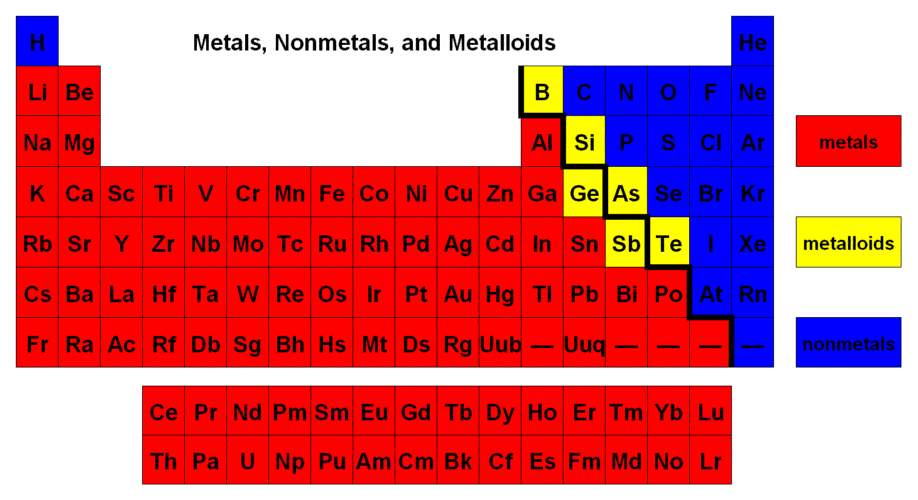
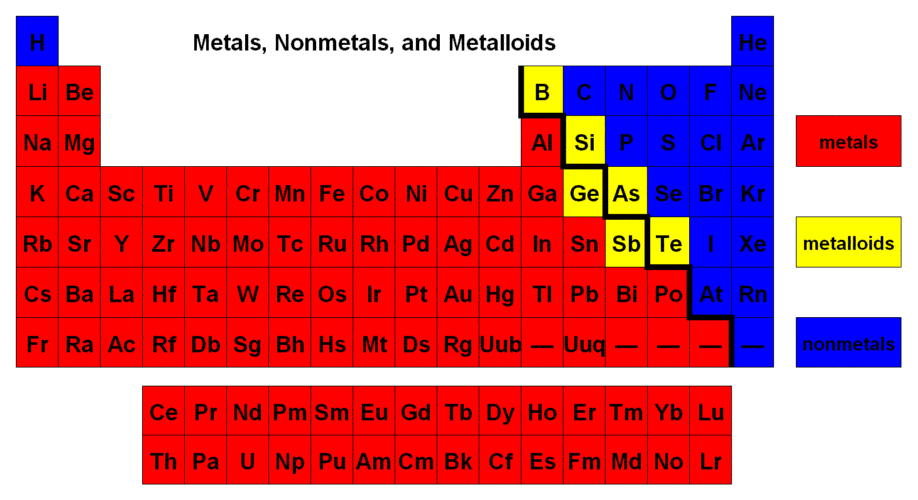
What are the red elements (those on the left)?
metals
nonmetals
metalloids

What are the blue elements (those on the right)?
metals
nonmetals
metalloids
How many Hydrogen atoms (H) are in a molecule of H2O?
1
2
3
0
How many atoms of carbon are in a molecule of vinyl chloride (C2H3Cl)?
1
3
6
2
H2O

How do covalent bonds form?
By donating and receiving valence electrons between atoms.
Scientists still aren't sure.
Opposite slight charges attract each atom in the compound.
Sharing valence electrons between atoms

What two types of atoms make a covalent bond?
2 Nonmetals
1 Metal and 1 Nonmetal
2 Metals
2 Noble Gases

1

What type of bond is the strongest?
single
Double
James
triple
What is the Octet Rule?
A guideline stating atoms tend to bond to achieve eight electrons in their outermost energy level for stability.
A principle that states all atoms must have a full outer shell of electrons regardless of the number.
A rule that indicates atoms can only bond with other atoms of the same element.
A theory that suggests atoms will always lose electrons to achieve stability.

SO₃
sulfate
sulfur oxide
sulfur trioxide
monosulfur trioxide
MgO- name?
oxygen magnesium
magnesium oxide
magnesium oxate
magnesium oxygenate
Label the compound LiBr as either ionic or covalent.
Ionic
Covalent

How many covalent bonds are created in a single ammonia molecule?
0
1
2
3
4

What type of bond will this compound likely form [Na]+ & [Cl]- ?
Ionic compound
Covalent compound
Metallic compound
A metallic bond is a bond between ________.
nonmetals
metals
transition metals
metalloids
Which of the following is NOT a property of metals?
Hard
Can conduct electricity
Very brittle (breaks easily)
Malleable (can bend without breaking)
What is meant by the term "sea of electrons"?
It's what we call all the free floating electrons in a metal.
It's what we call electrons that are floating in a liquid.
It's the total number of electrons in a metal atom.
It's the total number of electrons in the ocean.