
 Worksheets
Chem Honors NHS Fall Semester
Total questions: 115
Worksheet time: 2hrs 35mins
Name
Class
Date
1.
Which of the following best describes the particles in a gas?
a)
Vibrate, they do not move much at all and stay close together
b)
They break up and come together to form different types of particles. .
c)
They move fast and spread apart.
d)
They can slide past one another, but stay close together.
2.
Which of the following best describes the particles in a liquid?
a)
Vibrate, they do not move much at all and stay close together
b)
They break up and come together to form different types of particles. .
c)
They move fast and spread apart.
d)
They can slide past one another, but stay close together.
3.
Which of the following best describes the particles in a solid?
a)
Vibrate, they do not move much at all and stay close together
b)
They break up and come together to form different types of particles. .
c)
They move fast and spread apart.
d)
They can slide past one another, but stay close together.
4.
Which of the following best describes sublimation?
a)
A liquid changing to a gas.
b)
A gas changing to a solid.
c)
A solid changing to a gas.
d)
A liquid changing to a solid.
5.
Which of the following best describes a liquid changing to a gas?
a)
Evaporation
b)
Condensation
c)
Sublimation
d)
Deposition
6.
Which of the following substances have an indefinite shape but a definite volume?
a)
Solid
b)
Liquid
c)
Gas
7.
Which of the following substances has a definite shape and a definite volume?
a)
Solid
b)
Liquid
c)
Gas
8.
Which of the following substances has an indefinite shape and an indefinite volume?
a)
Solid
b)
Liquid
c)
Gas
9.

Rotting fruit
a)
Chemical
b)
Physical
10.

Salt + water
a)
Chemical
b)
Physical
11.

Frying an egg.
a)
Chemical
b)
Physical
12.

A change in phase
a)
Chemical
b)
Physical
13.

Can't easily go back to what you started with
a)
Chemical
b)
Physical
14.
How many significant figures does the following number have: 0.002040
a)
6
b)
4
c)
3
d)
2
15.
How many significant figures does the following number have: 0.998005
a)
9
b)
10
c)
6
d)
5
16.
Round 0.010229 to four sig figs
a)
1022
b)
1023
c)
0.01023
d)
0.01022
17.
What is the measurement 1042 Liters rounded to 2 significant figures?
a)
1040 L
b)
1.1 x 10³ L
c)
1.0 x 10³ L
d)
1050 L
18.
Determine the number of Significant Figures in 13410000-m.
a)
4
b)
3
c)
2
d)
1
19.
This particle is found in the nucleus and has no charge
a)
Neutron
b)
Proton
c)
Electron
20.
This particle is found in the nucleus and has a positive charge
a)
Electron
b)
Proton
c)
Neutron
21.
This is a negatively charged particle found outside the nucleus
a)
Electron
b)
Proton
c)
Neutron
22.
The first person to ever talk about an atom was
a)
Democritus
b)
Rutherford
c)
Dalton
23.
All matter is made of what?
a)
energy
b)
atoms
c)
electrons
d)
compounds
24.
How did Rutherford discover the proton?
a)
Cathode tube ray experiment
b)
Gold Foil Experiment
c)
Planetary Model
d)
Plum Pudding Model
25.

What scientist is best known for his "Plum Pudding" model of the atom?
a)
J.J. Tomson
b)
Ernest Rutherford
c)
John Dalton
d)
Democritus
26.

J.J. Thomson provided evidence that an atom...
a)
is the smallest particle of matter
b)
contains negatively charged particles
c)
has an overall negative charge
d)
has an overall positive charge
27.
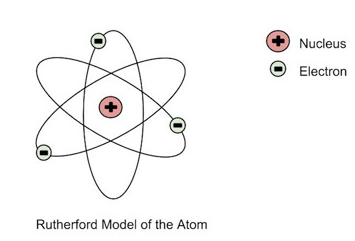
Rutherford's gold foil experiment provided evidence that...
a)
negative and positive charges are spread evenly throughout the atom.
b)
alpha particles have a positive charge.
c)
gold is not a dense as previously thought.
d)
there is a dense positively charged nucleus at the center of an atom.
28.
This particle determines what element you have - the elements identity.
a)
electron
b)
proton
c)
neutron
d)
valence shell
29.
What is the mass of a proton and a neutron?
a)
1amu
b)
2grams
c)
13amu
d)
10cm
30.
What are valence electrons?
a)
electrons on the first orbital always
b)
nucleus
c)
the outermost shell
d)
the number of electrons on the outermost orbital
31.
Elements on the periodic table increase by...
a)
atomic mass
b)
size
c)
mass number
d)
atomic #
32.
What is the difference between the atomic mass and the mass number?
a)
the atomic mass is always a whole number
b)
the atomic mass equals the atomic #
c)
mass number is the rounded atomic mass - always a whole number
d)
electrons
33.
Each column in the periodic table is called a
a)
period
b)
group
c)
cluster
d)
unit
34.
Which group of the periodic table is composed of inert (not reactive) gases?
a)
alkali metals
b)
alkaline earth metals
c)
halogens
d)
noble gases
35.
Elements which are shiny, conduct electricity and heat are called
a)
metal
b)
nonmetal
c)
metalloid
d)
nonexistent
36.
What atom matches this electron configuration?
1s22s22p63s23p64s23d10
1s22s22p63s23p64s23d10
a)
Zinc
b)
Copper
c)
Nickel
d)
Germanium
37.
What electron configuration matches an oxygen atom?
a)
1s22s22p63s2, 3p64s23d104p5
b)
1s22s22p4
c)
1s22s22p6
d)
1s22s22p63s23p64s23d1
38.
How many electrons can the first energy level hold?
a)
1
b)
2
c)
8
d)
0
39.
Electrons occupy orbitals of lowest energy first is part of what electron configuration rule?
a)
Hund’s Rule
b)
Aufbau Principle
c)
Pauli Exclusion Principle
40.
What is the maximum number of electrons that an orbital can have?
a)
1 electron
b)
2 electrons
c)
3 electrons
d)
4 electrons
41.
How many p orbitals are there in a sublevel?
a)
2
b)
1
c)
4
d)
3
42.
How many electrons can the d sublevel hold?
a)
8
b)
10
c)
2
d)
4
43.

Which element is pictured?
a)
neon
b)
fluorine
c)
magnesium
d)
argon
44.

What is incorrect about this orbital diagram?
a)
Both arrows in the 2p box should be pointing up
b)
There is nothing incorrect with this diagram
c)
In the there should only be 1 orbital in the first 2p box and one in the 2nd 2p box
d)
All the arrows should be pointing up.
45.

Which orbital shows a violation of Hund's Rule?
a)
A
b)
B
c)
C
d)
D
46.
Density: Chemical or Physical Property
a)
Chemical Property
b)
Physical Property
47.
Melting Point: Chemical or Physical Property
a)
Chemical Property
b)
Physical Property
48.
Flammability (burns): Chemical or Physical Property
a)
Chemical Property
b)
Physical Property
49.

This picture represents which of the following?
a)
element
b)
compound
c)
mixture
50.
How does filtration separate a mixture?
a)
by separating with your hands
b)
by evaporating
c)
by running the mixture through a filter and removing a solid from a liquid
d)
pouring off
51.
How does evaporation separate a mixture?
a)
pouring the mixture through a filter
b)
evaporating the liquid part of the solution, leaving the solid part behind
c)
separating materials by hand
d)
pouring off
52.
This variable in an experiment is the one being deliberately changed by the scientist.
a)
dependent variable
b)
independent variable
c)
data
d)
control group
53.
A possible explanation to a problem that has not yet been tested.
a)
data
b)
theory
c)
hypothesis
d)
fact
54.
A series of steps used by scientists to solve a problem or answer a question.
a)
scientific method
b)
recipe
c)
data collection
d)
metric system
55.
In a controlled experiment, how many independent variables can be worked with at a time?
a)
one
b)
none
c)
two or more
d)
how ever many makes sense.
56.
Mr. S. sets up an experiment to see how the mass of a ball affects the distance it rolls off a ramp. Identify the independent variable.
a)
distance traveled by the ball
b)
height of the ramp
c)
mass of the ball
d)
weight of the ball
57.
If I study for my scientific method quiz, then I will have a better test score. What is the dependent variable?
a)
Scientific Method
b)
Studying
c)
Independent variable
d)
Test score
58.
Which is NOT a step in the scientific method?
a)
Make observation
b)
Form a theory
c)
Collect data
d)
Form a hypothesis
59.
This part of the experiment serves as a basis of comparison; the one variable being tested has been omitted.
a)
experimental group
b)
control group
c)
data
d)
variables
60.
True or False: Your hypothesis can never be wrong.
a)
True
b)
False
61.

Which vocabulary term is used to identify the distance between points C & G?
a)
Amplitude
b)
Crest
c)
Frequency
d)
Wavelength
62.
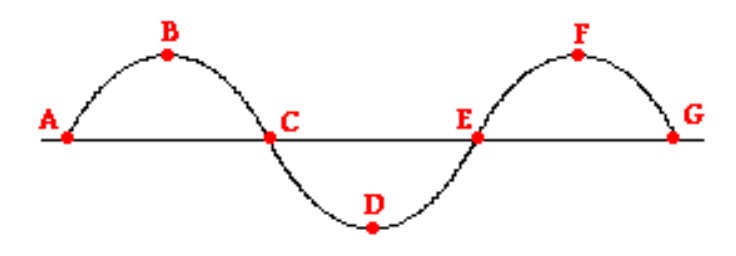
Which letter(s) represent the trough of the wave?
a)
A
b)
B
c)
C
d)
D
D
D
63.
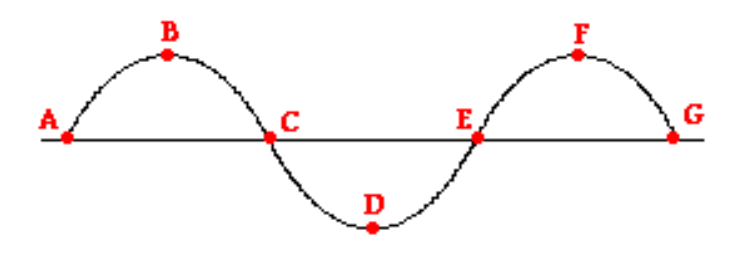
Which letter(s) represent the crest of the wave?
a)
A
b)
B
c)
C
d)
D
64.
Electrons occupy orbitals of lowest energy first is part of what electron configuration rule?
a)
Hund’s Rule
b)
Aufbau Principle
c)
Pauli Exclusion Principle
65.
What is this element?
1s22s22p63s23p6
4s23d104p6
1s22s22p63s23p6
4s23d104p6
a)
Argon
b)
Krypton
c)
Selenium
d)
Bromide
66.
What is the shorthand electron configuration for Sulfur atom?
a)
[Ar] 3p4
b)
[He] 3s23p4
c)
[Ne] 3s23p4
d)
[Na] 3s23p3
67.
What atom matches this electron configuration?
[Xe] 6s2 4f14 5d9
[Xe] 6s2 4f14 5d9
a)
Mercury
b)
Gold
c)
Platinum
d)
Thallium
68.
What noble gas should be used to write the shorthand configuration for Te?
a)
Ar
b)
Kr
c)
Xe
d)
Sb
69.
What is the correct configuration for lead?
a)
[Rn] 6s2 5d10 4f14 6p2
b)
[Xe] 6s2 6d10 6p2
c)
[Xe] 6s2 5d10 6p2
d)
[Xe] 6s2 5d10 4f14 6p2
70.
What is the Pauli Exclusion Principle?
a)
An atomic orbital can only hold a maximum of 2 electrons, each with opposite spins
b)
An atomic orbital can hold a minimum of 6 electrons, each with opposite spins
c)
An atomic orbital can hold a maximum of 6 electrons, each with the same spin
d)
An atomic orbital can hold a minimum of 2 electrons, each with opposite spins
71.
Which orbital shows a violation of Hund's Rule?
a)
A
b)
B
c)
C
d)
D
72.
How many electrons should Oxygen have around its Lewis dot model?
a)
5
b)
6
c)
7
d)
8
73.
Three pairs of electrons are shared in a
a)
Single bond
b)
Double bond
c)
Triple bond
74.
A covalent bond is
a)
a bond that shares electrons metallicaly
b)
A bond that shares electrons with non metals
c)
Metalloids bonding
d)
metals and nonmetals bonding
75.

What is the correct formula for this molecule?
a)
NH
b)
N3H
c)
NH3
d)
NH4
76.

Which of the following is the correct Lewis dot structure for the molecule fluorine (F2)?
a)
A
b)
B
c)
C
d)
D
77.

Which of the following is the correct Lewis structure for CH2O?
a)
Option A
b)
Option B
c)
Option C
d)
Option D
78.
Hydrogen needs _____ electrons in its valence shell to be stable.
a)
4
b)
6
c)
8
d)
2
79.
Which element is not a metal?
a)
H
b)
Re
c)
Al
d)
B
80.
Which is a halogen?
a)
Helium
b)
Chlorine
c)
Oxygen
d)
Neptune
81.
Which is an alkali metal?
a)
Magnesium
b)
Iron
c)
Sodium
d)
Europium
82.

How did Mendeleev arrange the elements?
a)
alphabetical
b)
density
c)
melting point
d)
atomic mass
83.
Why do ionic bonds form?
a)
so the number of protons equals the number of electrons
b)
to fill the outermost energy level
c)
so an atom can become unstable
84.
For an atom to LOSE and electron what has to be broken?
a)
The attraction between the electrons and protons
b)
the attraction between the electrons and neutrons
c)
The attraction between the protons
d)
The attraction between the electrons
85.
Alkali metal elements will tend to become an ion with a charge of _____
a)
1+
b)
1-
c)
2+
d)
2-
86.
Ionic compounds are formed when one or more valence electrons are transferred from _____
a)
a nonmetal atom to a metal atom
b)
a nonmetal atom to a nonmetal atom
c)
a metal atom to a nonmetal atom
d)
a metal atom to a metal atom
87.

Which of these is covalent?
a)
NaCl
b)
Pb(NO3)2
c)
CO2
d)
AlCl3
88.
How do the following two elements bond together?
Cr3+ O2-
Cr3+ O2-
a)
CrO
b)
Cr3O2
c)
Cr2O3
d)
CrO3
89.
Which of the following is an example of a COVALENT COMPOUND?
a)
H2S
b)
KI
c)
CaCl2
d)
MgO
90.
Which of the following is an example of an IONIC COMPOUND?
a)
NaCl
b)
H2O
c)
CO2
d)
NO
91.
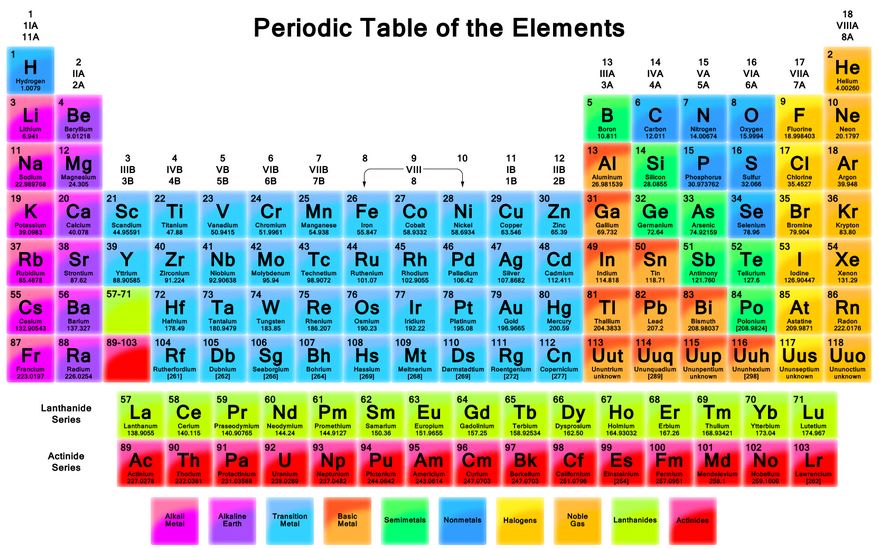
Elements on the LEFT side of the periodic table will most likely form:
a)
Positive ions
b)
Negative ions
c)
Neutral Ions
d)
None of these
92.

This picture shows a...
a)
Ionic Bond
b)
Covalent Bond
c)
Both bonds
d)
Neither bond
93.
Which of the following will have a higher electronegativity than arsenic (As)?
a)
Carbon (C)
b)
Neon (Ne)
c)
Antimony (Sb)
d)
Germanium (Ge)
94.
Which of the following will have a lower ionization energy than Scandium (Sc)?
a)
Helium (He)
b)
Titanium (Ti)
c)
Calcium (Ca)
d)
Magnesium (Mg)
95.
As atoms of elements in group 16 are considered in order from top to bottom, the electronegativity of each successive element....
a)
decreases
b)
increases
c)
remains the same
d)
none of the above
96.
Which atom has the largest atomic radius?
a)
potassium
b)
rubidium
c)
francium
d)
cesium
97.
As you move down the periodic table atoms get bigger. This is because ____________.
a)
The atoms have more mass.
b)
The atoms have more protons.
c)
The atoms have more energy levels
d)
The atoms have more nuetrons
98.
As you move across the periodic table atoms tend to get smaller because, ______________.
a)
the atoms have more mass.
b)
the atoms have less mass
c)
the atoms have more protons.
d)
the atoms have less electrons.
99.
Metals are good conductors of heat and electricity.
a)
true
b)
false
100.
Ionization energy is...
a)
the energy required to add an electron to a specific atom
b)
how much energy it takes to remove an electron from an atom
c)
the energy required to shield the outer electrons from the nucleus
d)
a measure of the ability of an atom to attract electrons
101.
Electronegativity is...
a)
how good an atom is at attracting electrons
b)
the ability of an atom to lose electrons
c)
the energy required to remove an electron from a specific atom
d)
how easy it is to make friends.
102.
Which statement correctly and completely identifies a trend?
a)
Atomic radius decreases across a period and increases down a group.
b)
Electronegativity decreases across a period and decreases down a group.
c)
Ionization energy increases across a period and increases down a group.
d)
Ionic radius increases across a period and increases down a group.
103.
The element with the largest electronegativity in the halogens is -
a)
At
b)
F
c)
Cl
d)
Br
104.
Atomic radius generally increases as we move __________.
a)
down a group and from right to left across a period
b)
up a group and from left to right across a period
c)
down a group and from left to right across a period
d)
up a group and from right to left across a period
105.
Electronegativity __________ from left to right within a period and __________ from top to bottom within a group.
a)
decreases, increases
b)
increases, increases
c)
increases, decreases
d)
stays the same, increases
106.
Which has the greater EN:
H or F?
H or F?
a)
H
b)
F
107.
Which of the following will have a larger radius than Zinc?
a)
Gallium
b)
Aluminum
c)
Magnesium
d)
Strontium
108.
Density is an...
a)
Extensive Property
b)
Intensive Property
109.
Intensive property is dependent on the amount of a substance.
a)
True
b)
False
110.
Freezing point is an example of extensive property.
a)
True
b)
False
111.
Flammability is an ...
a)
Intensive property
b)
Extensive property
112.
Stretching the copper into thin wires demonstrates...
a)
Ductility
b)
Malleability
113.

This is a correct dot diagram for neon (Ne)
a)
true
b)
false
114.

This could be the dot diagram of
a)
Al
b)
Si
c)
Na
d)
Mg
115.

This is a correct dot diagram for fluorine (F)
a)
true
b)
false
100 %

