
 Worksheets
Unit 6 Review
Total questions: 102
Worksheet time: 2hrs 45mins
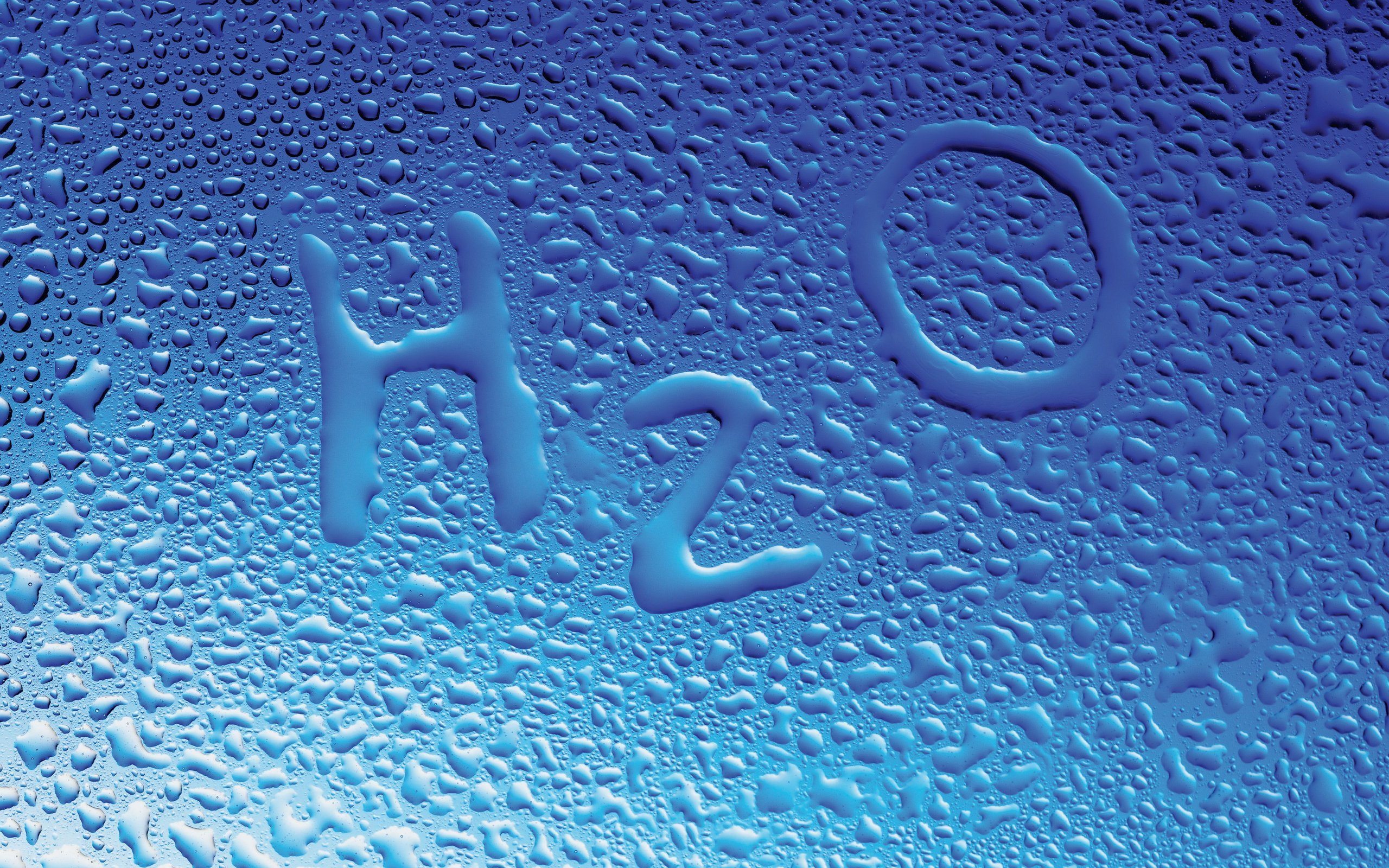

Which state of matter is shown?
solid
liquid
gas

The phase change from liquid to gas is _________
Melting
Evaporation
Deposition
Condensation

Phase change from liquid to solid is ___________.
Freezing
Melting
Sublimation
Condensation
Phase change going from a Gas to a Solid...
Deposition
Sublimation
Condensation
Vaporization


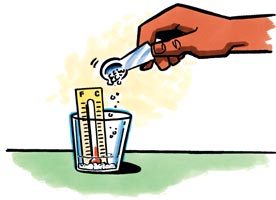
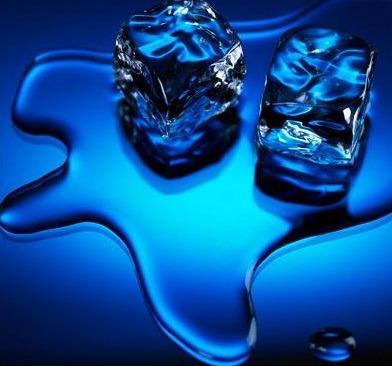
____ reactions usually feel cold.
endothermic
exothermic
This is a type of mixture where one substance dissolves into another
Solution
Miscibility
Compound
Solubility
The substance that does the dissolving
Solute
Solvent
Solution
Miscibility
The substance getting dissolved
Solvent
Solute
Solution
Mixture


Kool-Aid - flavoring, coloring, sugar, and water. Identify the solvent.
water
powder
sugar
powder and sugar
Which sweet tea would you expect to taste the sweetest?
1M
3M
5 M
2.5M
What is molarity?
a concentration unit, defined to be number of atoms per moles of water
a concentration unit, defined to be the number of moles of solute divided by the number of liters of solution.
a conversion factor, used to change moles to grams
a conversion factor, used to change milliliters to liters
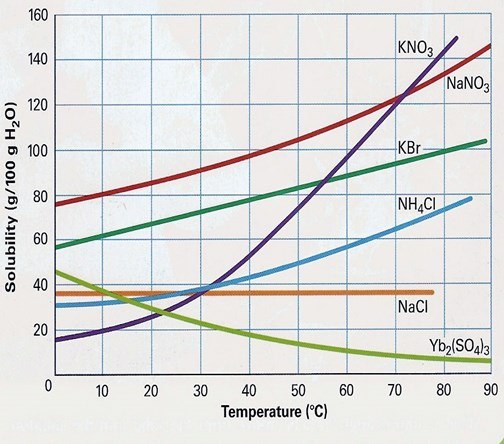
At 30'C, which substance has the lowest solubility?
KNO3
KBr
NaCl
Yb2(SO4)3

Molarity is measured in _____.
moles per g.
mols per L.
moles per mm.
moles per mL.
How many mols of HCl are in 3 liters of 2.0M HCl solution?
2.0
1.5
6.0
0.66
Particles are very small, can pass through filter paper, looks the same throughout, doesn’t settle
Suspension
Colloid
Solution
Element
Mixture consisting of particles that are in between the size of solutions and suspensions, cannot be filtered, includes foams and gels
Suspension
Colloid
Solution
Element
A mixture in which the particles are so large that they settle unless stirred, can be filtered
Suspension
Colloid
Solution
Element
Orange juice with pulp and Italian dressing are each an example of
Suspension
Colloid
Solution
Element
A marshmallow is an example of
Suspension
Colloid
Solution
Element
Milk and mayo are each an example of
Suspension
Colloid
Solution
Element
Paint and jello are each an example of
Suspension
Colloid
Solution
Element
This type of mixture that doesn't separate on its own but still contains undissolved particles.
Solutions are
Homogenous
Heterogenous

The temperature and pressure at which the gas and liquid states of a substance become identical and form one phase is called the
Critical point
Triple point
Melting point
Boiling point

Using the supplied solubility curve diagram, determine the temperature at which KNO3 and NH4Cl have the same solubility.
16°C
39°C
25°C
73°C

Using the supplied solubility curve diagram, determine what type of solution would be present if 50 grams of NH3 was dissolved in 100 grams of water at 30°C.
saturated
unsaturated
supersaturated

Using the supplied solubility curve diagram, determine which compound listed below is least soluble at 70°C.
NH4Cl
NaCl
KCl
KNO3

Using the supplied solubility curve, determine the temperature that Ce2(SO4)3 and KClO3 have the same solubility.
26°C
3°C
57°C
80°C

Using the supplied solubility curve, determine the type of solution that is formed if 80 grams of NaNO3 were dissolved in 100 grams of water at 30°C.
saturated
unsaturated
supersaturated

Using the supplied solubility curve, determine which compound listed below is most soluble at 20°C.
NH3
KCl
KClO3
NaNO3

Using the supplied solubility curve, determine the type of solution formed if 10 grams of Ce2(SO4)3 were dissolved in 100 grams of water at 50°C.
saturated
unsaturated
supersaturated

Using the supplied solubility curve, determine how many grams of KNO3 will need to be dissolved in 100 grams of water at 60°C to make a saturated solution.
103 grams
85 grams
124 grams
140 grams

Using the supplied solubility curve, determine the type of solution formed when 60 grams of NH4Cl are dissolved in 100 grams of water at 80°C.
saturated
unsaturated
supersaturated

The the supplied solubility curve shows that when 79 grams of NaNO3 is dissolved in 100 grams of water at 10°C, that a saturated solution will be formed.
True
False
Develop a model to illustrate the process of dissolving table salt (NaCl) in water. Explain the roles of solvation and dissociation in this process.
Solvation involves the breaking of ionic bonds in NaCl, while dissociation involves the formation of new covalent bonds with water molecules.
Solvation involves water molecules surrounding Na+ and Cl- ions, while dissociation involves the separation of NaCl into Na+ and Cl- ions.
Solvation involves the evaporation of water, while dissociation involves the condensation of NaCl.
Solvation and dissociation both involve the formation of a new compound between NaCl and water.
Calculate the molarity of a solution made by dissolving 5 moles of solute in 2 liters of solution.
2.5 M
5 M
10 M
2 M
Communicate the steps required to prepare a 1 M solution of NaCl, including how to properly label the solution.
Dissolve 58.44 g of NaCl in 1 L of water, label the solution as "1 M NaCl Solution."
Dissolve 100 g of NaCl in 1 L of water, label the solution as "1 M NaCl Solution."
Dissolve 58.44 g of NaCl in 500 mL of water, label the solution as "1 M NaCl Solution."
Dissolve 100 g of NaCl in 500 mL of water, label the solution as "1 M NaCl Solution."
Explain how you would use evidence to determine whether a solute dissociates or merely dissolves in a solvent.
Measure the change in temperature of the solution.
Observe the color change of the solution.
Conduct an electrical conductivity test to see if ions are present in the solution.
Measure the pH of the solution.
What 2 ions appear on both sides of the equation?
Na+ (aq) + Cl- (aq) + Ag + (aq) + (NO3)+ (aq)→Na+ (aq) + (NO3) + AgCl(s)
Ag and NO3
Na and Cl
Na and NO3
Ag and Cl
Write the chemical equation that represents the dissociation of the ionic compound Na2(SO4) .
Na+2 + (SO4)-1
Na+1 + (SO4)-1
Na+2 + (SO4)-4
Na+1 + (SO4)-2
Which of the following shows the correct disassociation of the reaction for BaCl2?
Ba 2+ (aq) + Cl2 - (aq) -> BaCl2 (s)
Ba 2+ (aq) + 2 Cl - (aq) -> BaCl2 (s)
BaCl2 (aq) -> Ba 2+ (aq) + 2 Cl - (aq)
BaCl2(s) -> Ba 2+(aq)+ 2Cl (aq)
CuCl2(aq) + NaOH(aq) → Cu(OH)2(s) + NaCl(aq)
Define: Net Ionic Equation
a balanced chemical equation in which all the reactants and products are given by their chemical formulae.
a chemical equation that shows all soluble species broken into their respective ions.
a chemical equation showing only the species which are actively involved in the reaction.
What is the net ionic equation for the reaction between K3PO4 (aq) and CuSO4 (aq)
2 K+(aq) + SO42-(aq) → K2SO4 (s)
K+(aq) + SO42-(aq) → KSO4 (s)
2 Cu2+(aq) + 3 PO43-(aq) → Cu3(PO4)2 (s)
Cu2+(aq) + PO43-(aq) → CuPO4 (s)
CuCl2 + NaOH → Cu(OH)2 + NaCl
Which product is insoluble?
Identify the correct net ionic equation for the reaction of AgNO3 and CaCl2?
Ca2+(aq) + 2Cl- (aq) → CaCl(s)
Ag+(aq) + Cl- (aq) → AgCl(s)
Ag + Cl → AgCl
Ag+ + Ca2+ →Ag2Ca (s)
Define: Solubility
What is dissolved
What does the dissolving
A measure of how much solute can dissolve in solvent
a charged ion
What is the correct net ionic equation for the reaction between HBr(aq) and LiOH(aq)?
2 H+(aq) + O2-(aq) → H2O(l)
2 H2 (aq) + O2(aq) → 2 H2O(l)
2 H2 (g) + O2(g) → 2 H2O(l)
H+(aq) + OH-(aq) → H2O(l)
What is the net ionic equation for the reaction between K3PO4 (aq) and CuSO4 (aq)
2 K+(aq) + SO42-(aq) → K2SO4 (s)
K+(aq) + SO42-(aq) → KSO4 (s)
3 Cu2+(aq) + 2 PO43-(aq) → Cu3(PO4)2 (s)
Cu2+(aq) + PO43-(aq) → CuPO4 (s)
CuCl2(aq) + NaOH(aq) → Cu(OH)2(s) + NaCl(aq)
What of these is always soluble?
Nitrates
Phosphates
Carbonates
Hydroxides

What is the precipitate of this reaction?
MgCl2 + 2 NaOH --> Mg(OH)2 + 2 NaCl
MgCl2
NaOH
Mg(OH)2
NaCl
What is the precipitate of this reaction?
Na2O + NiF2 --> 2 NaF + NiO
Na2O
NiF2
NaF
NiO
Mixing Fe(NO3)2 (aq) and Na2CO3 (aq) causes an orange precipitate to form. What is the chemical formula of the precipitate?
Fe(NO3)2 (s)
FeCO3 (s)
NaNO3 (s)
Na2(NO3)2 (s)
According to the solubility rules (chart), compounds containing Ammonium cations, NH4+ are:
Not Soluble
Sometimes Soluble
Always Soluble
Always insoluble
CaCl2(aq) + 2 AgNO3(aq) → Ca(NO3)2(aq) + 2 AgCl(s)
Which product above is the precipitate?
CaCl2(aq)
AgNO3(aq)
Ca(NO3)2(aq)
AgCl(s)
Predict the Products of the double-replacement (precipitate) reactions
K3PO4(aq) + AlCl3(aq) →
K3PO4 (s) + AlCl (aq)
KCl (aq) + Al2(PO4)3 (s)
KCl (s) + Al2(PO4)3 (aq)
K3AL (s) + Cl3PO4 (aq)
What factor increases the dissolution rate due to more surface area being exposed to the solvent?
Granulated sugar compared to a sugar cube
Adding a solute with a common ion
Decreasing the temperature
Using a non-polar solvent for a polar solute
What process allows fresh solvent molecules to come into contact with the solute, speeding up dissolution?
Condensation
Evaporation
Agitation or stirring
Freezing
How does temperature affect the dissolution process?
Increases molecule movement, aiding dissolution
Decreases molecule movement
Has no effect on dissolution
Only affects gases
What type of solutes dissolve well in polar solvents?
Insoluble solutes
Solid solutes only
Polar solutes
Non-polar solutes
Which factor does NOT directly affect the rate of dissolution?
Surface area of the solute
Presence of other solutes
Agitation of the solution
Color of the solvent
What is solubility?
How much of a solute can dissolve in a given amount of solvent
The color change when a solute dissolves
The temperature at which a solute dissolves
How quickly a solute dissolves in a solvent
In order to dilute a solution, you need to
add more of the solid
add more water
find the mass
find the volume
A solution is prepared by dissolving 0.60 g of sodium chloride NaCl in 500 mL of water. Identify the solute.
water
sodium chloride
NaCl solution
distilled water
What is required for a liquid to conduct an electric current?
ions that are mobile
ions in a strong bond
covalent bonds
shared protons
Why are all ionic compounds electrolytes?
because they are non-metals
because they share electrons when they bond
because they are electrically neutral
because they dissociate into ions
An atom that has lost or gained electrons.
ion
proton
non-metal
metalloid
Why are molecular compounds nonelectrolytes?
they do not have kinetic energy
they do not contain atoms
they do not have chemical bonds
they are not composed of ions
Which describes an Electrolyte?
Substance that give out ions when dissolved in water, which are able to conduct electricity
Substances that prehibit electricity from traveling across a solvent
A chemical used to combust flames in a laboratory setting
A type of current that is utilized to determine if there is a blockage anywhere in the system.
Which of the following, when dissolved in water, would create a nonelectrolyte?
C2H6O
NH4NO3
NaOH
BaCl2
As pressure increases in water
gases are less able to dissolve
gases are more able to dissolve
gases are less able to stay dissolved
How does an increase in temperature affect the solubility of gases?
It increases the solubility of the gas.
It decreases the solubility of the gas.
It has no effect on the solubility of the gas.

