wayground logo

Free Printable Worksheets

Font size

S
M
L
XL
Worksheets

Matter and Change

Total questions: 100

Worksheet time: 2hrs 55mins

Name
Class
Date
1.
What are the states of matter?
a)
solid, liquid, and juice
b)
solid and liquid
c)
solid and gas
d)
solid, liquid, and gas
2.
A description of objects that can be measured and observed.
a)
gas
b)
mustangs
c)
physical properties
d)
melting point
3.
Cutting an orange is a physical change.
a)
True
b)
False
4.
An example of a physical property is 
a)
flammability
b)
acidic
c)
color
d)
ability to rust
5.
What causes a change in the state of matter?
a)
physical properties
b)
chemical energy
c)
temperature
6.
Which change can occur when  you add heat energy to water?
a)
The water can change from a liquid to a solid
b)
The water can change from a gas to a liquid
c)
The water can change from a liquid to a gas
d)
The water can change from a solid to a liquid
7.
Changing the way matter looks without changing it into NEW matter is a:
a)
Chemical change
b)
Physical change
c)
Energy change
d)
BOTH a chemical and a physical change
8.
Which of the following could be a characteristic that changes in matter during a PHYSICAL CHANGE?
a)
Size
b)
State
c)
Texture
d)
All of the above
9.
Chopping wood is an example of a:
a)
Physical change
b)
Chemical change
10.
Water freezing to ice is an example of a:
a)
Physical change
b)
Chemical change
11.
Burning wood to ash is an example of a:
a)
Physical change
b)
Chemical change
12.
Smashing a piece of candy into smaller pieces is an example of a:
a)
Physical change
b)
Chemical change
13.
A physical change does not need energy to occur.
a)
True
b)
False
14.
Adding HEAT to matter causes its particles to:
a)
move faster and farther apart
b)
Move slower and farther apart
c)
Move faster and closer together
d)
Move slower and closer together
15.
Molecules are closest together in a 
a)
Solid
b)
Liquid
c)
Gas
d)
plasma
16.
Which state of matter has particles arranged like this?
a)
solid
b)
liquid
c)
gas
17.
Which state of matter has particles arranged like this?
a)
solid
b)
liquid
c)
gas
18.
Which state of matter has particles arranged like this?
a)
solid
b)
liquid
c)
gas
19.
A chemical change
a)
doesn't really change much.
b)
creates a new substance
c)
is a change in the state of matter
20.
Something that takes up space and has mass.
a)
volume
b)
matter
c)
mass
d)
density
21.
A state of matter that has a definite volume and shape.
a)
solid
b)
liquid
c)
gas
d)
matter
22.
A measure of how much mass is contained in a given unit of volume.
a)
mass
b)
density
c)
volume
d)
matter
23.
The amount of space something takes up
a)
density
b)
volume
c)
mass
d)
matter
24.
Shape is a ____ that helps identify an object.
a)
physical property
b)
chemical property
c)
mass
d)
matter
25.
Iron + oxygen = rust is an example of a ___________.
a)
physical property/change
b)
chemical property/change
c)
mass
d)
volume
26.
A tool used to measure temperature.
a)
scale
b)
graduated cylinder
c)
themometer
d)
magnifying glass
27.
When a popsicle melts, that state of matter changes from...
a)
a gas to a liquid
b)
a liquid to a gas
c)
a liquid to a solid
d)
a solid to a liquid
28.
What process do you observe when you fill a glass with ice and a cold drink and the outside of the glass becomes wet?
a)
evaporation
b)
condensation
c)
freezing
d)
melting
29.
I hung my pool towel across the chair to dry in the hot sun.  What process will occur? 
a)
condensation
b)
evaporation
c)
freezing
d)
melting
30.
Describe what happens to juice when freezing takes place.
a)
A.  Heat is being added, so the liquid changes to a solid.
b)
A.  Heat is being added, so the liquid stays a liquid.
c)
A.  Heat is being removed, so the liquid changes to a gas.
d)
A.  Heat is being removed, so the liquid changes to a solid.
31.
What change of state does this pot show?
a)
Boiling
b)
Condensation
c)
Freezing
d)
Melting
32.
Which of the following things will not produce heat?
a)
a magnet
b)
electricity
c)
friction
d)
sun
33.
What temperature does water freeze? 
a)
212 F
b)
0 C
c)
100 C
d)
37 F
34.
Heat + Solid = Liquid
What process occurs?
a)
Freezing
b)
Melting
c)
Evaporation
d)
Condensation
35.
Heat + Liquid = Gas
What process is occurring?
a)
freezing
b)
evaporation
c)
condensation
d)
melting
36.
Gas - Heat = Liquid
What process is occurring?
a)
condensation
b)
evaporation
c)
freezing
d)
melting
37.
Liquid - Heat = Solid
What process is occuring
a)
melting
b)
freezing
c)
evaporation
d)
condensation
38.
The ability of a substance to be dissolved is called
a)
malleability
b)
mass
c)
density
d)
solubility
39.
A substance that consists of two or more different elements that cannot be easily separated is called
a)
atom
b)
element
c)
mixture
d)
compound
40.
A pure substance that contains a single type of atom is called
a)
mixture
b)
compound
c)
element
d)
atom
41.
A substance made of a single type of atom that cannot be separated is called
a)
element
b)
compound
c)
mixture
d)
atom
42.
Made of two or more different substances that can be easily separated is called
a)
element
b)
compound
c)
mixture
d)
pure substance
43.
The substance shown here is a(n)
a)
atom
b)
element
c)
compound
d)
pure substance and a compound
44.
The substance shown here is a(n)
a)
element
b)
compound
c)
mixture of elements
d)
mixture of compounds
45.
The substance shown here is a(n)
a)
element
b)
compound
c)
mixture of elements
d)
mixture of compounds
46.
The substance shown here is a(n)
a)
elements
b)
mixture of elements
c)
mixture of compounds
d)
mixture of elements and compounds
47.
What does the cup show? 
a)
a solution being added to a solvent
b)
a solvent being added to a solute
c)
a solute being added to a solution
d)
a solute being added to a solvent
48.
McKenna filled a graduated cylinder with 50 ml of water. She measured the density of the water and found it to be 1 g/ml. What would you expect to happen to the density of the water if McKenna added 100 ml more water to the cylinder?
a)
density would increase because volume increased
b)
density would decrease because mass increased
c)
density would stay same because it is a characteristic property
d)
density would increase because mass increased
49.
Determine the density of a substance with a volume of 11 ml and a mass of 22 grams.
a)
242 g/ml
b)
33 g/ml
c)
11 g/ml
d)
2 g/ml
50.
If Hudson has a large piece of aluminum, and Jacob has a small piece, they would both have the same...
a)
mass
b)
volume
c)
density
d)
weight
51.

Sand and salt are placed in the bottom of a beaker filled with water. The beaker is heated, and the water is stirred.


What will happen to the salt and sand?

a)

The sand and salt will settle to the bottom.

b)

The sand and salt will dissolve in the water

c)

The salt will dissolve, and the sand will settle

d)

The sand will evaporate, and the salt will dissolve.

52.

A mixture of sand, salt, and iron fillings is stirred into a beaker of water. The mixture is then allowed to settle.


What will separate the iron fillings from the mixture?

a)

Magnetism

b)

Filtration

c)

Flotation

d)

Sifting

53.

A student drops a rock and a cork in a cup of water as shown.


The student observes that the cork floats while the rock sinks in water. What can be concluded from the observation?

a)

The cork is more dense than the rock and water

b)

The rock is more dense than the cork and water

c)

The rock is more dense than the cork but less dense than the water

d)

The cork is more dense than the water but less dense than the rock

54.

Colton and his brothers put some raisins, hazelnuts, almonds, and peanuts in a bowl to make a snack for their movie. What does this snack represent?

a)

a solution

b)

a new element

c)

a new compound

d)

a mixture

55.

Which of the following represent physical changes?

a)

fruit ripening

b)

milk turing sour

c)

chopping wood

d)

mixing food color and water

e)

melting butter

56.

Which of the following represent chemical changes?

a)

chopping wood

b)

milk turning sour

c)

breaking a pencil

d)

fruit ripening

e)

roasting a marshmellow

57.

Carrie and Amanda live on a farm and do lots of chores to help their parents.


Which chore is an example of a chemical change?

a)

chopping wood

b)

burning leaves

c)

boiling water

d)

cutting the grass

58.

Lisa was at the fair and noticed people walking around with these 8 differently shaped balloons filled with helium gas.


Which is the best conclusion Lisa could make about gases after she observed these balloons?

a)

Gases take the shape and size of their containers

b)

Gases have definite shapes and sizes

c)

Gases have definite shapes and volumes

d)

Gases' sizes and shapes do not change

59.

A scientist uses an instrument to study the small particles in a piece of matter. The diagram shows what the scientist sees.


What state of matter is the scientist most likely observing?

a)

gas

b)

solid

c)

liquid

d)

vapor

60.

What type of mixture is air (with smog) ?

a)

Homogeneous

b)

Heterogeneous

61.

What type of mixture is chocolate chip ice cream?

a)

Homogeneous

b)

Heterogeneous

62.

Which of the following are pure substances?

a)

Carbon dioxide (CO2)

b)

Milk

c)

Salt water

d)

Nitrogen (N2)

63.

Which of the following are mixtures?

a)

Sodium bicarbonate (NaHCO3)

b)

Steel (Fe + C)

c)

Salt water (NaCl + H2O)

d)

Gold (Au)

64.

Which of the following are compounds?

a)

Silver nitrate (AgNO3)

b)

Bronze (Cu + Sn)

c)

Sugar (C12H22O11)

d)

Blood

65.

Which of the following is an element?

a)

Lead metal

b)

Iron rust

c)

Aluminum foil

d)

Silver sulfate

66.

What is the main evidence that a chemical change has occured?

a)

Change of color

b)

Production of Bubbles

c)

Production of Fire

d)

A new substance is produced

67.

Which of the following are examples of intensive properties?

a)

Conductivity

b)

Mass

c)

Length

d)

Density

68.

Which of the following are extensive properties?

a)

Mass

b)

Volume

c)

Density

d)

Temperature

69.

How do you identify an element?

a)

It is made of only one type of atoms

b)

It is made of different type of atoms

c)

It can be found on the Periodic Table

d)

It is represented by a chemical symbol
70.

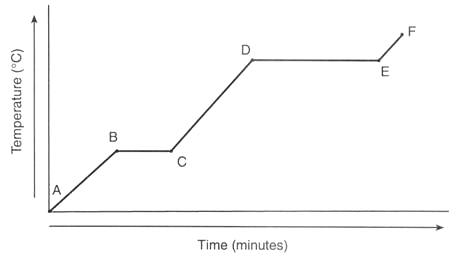
What state/phase is the object likely from points A to B?

a)

Solid

b)

Liquid

c)

Gas

d)

Plasma

71.

What is happening to the particles in the substance between points A and B?

a)

Melting

b)

Freezing

c)

Speeding Up

d)

Slowing Down

72.

What is happening to the particles in the substance between points D and E?

a)

Melting

b)

Freezing

c)

Vaporizing

d)

Sublimating

73.

Where on the graph are phase changes taking place?

a)

1

b)

2

c)

3

d)

4

e)

5

74.
During physical changes, matter always retains its
a)
identity
b)
shape
c)
size
d)
color
75.
Determine the number of sig figs in the following measurement: 
0.036653 m
a)
7
b)
5
c)
2
d)
0
76.
Determine the number of sig figs in the following measurement: 
72,100 g
a)
5
b)
3
c)
6
d)
4
77.
Determine the number of sig figs in the following measurement: 
25.03 L
a)
4
b)
3
c)
2
d)
1
78.
Determine the number of sig figs in the following measurement: 
0.00300
a)
3
b)
6
c)
1
d)
5
79.
Calculate the answer to the following problem and round the final answer to the correct number of sig figs:
24.567 + 0.04478 =
a)
24.61178
b)
24.612
c)
24.611
d)
24.61
80.
Express the following number in scientific notation: 
0.00075
a)
7.5 x 10⁻⁴
b)
7.5 x 10⁴
c)
7.5 x 10³
d)
7.5 x 10⁻³
81.
Express the following number in scientific notation: 
0.00000534
a)
5.34 x 10⁻⁶
b)
5.34 x 10⁶
c)
534 x 105
d)
5.34 x 10⁻⁵
82.
Calculate the answer to the following problem and round the final answer to the correct number of sig figs:
4.627 / 0.00371 = 
a)
1247.169811
b)
1250
c)
1247
d)
1240
83.
Name the equipment?
a)
beaker
b)
graduated cylinder
c)
erlenmeyer flask
d)
test tube
84.
Name the lab equipment?
a)
smock
b)
apron
c)
cover up
d)
goggles
85.
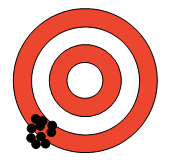
This bullseye demonstrates...
a)
High Accuracy & High Precision
b)
High Accuracy & Low Precision
c)
Low Accuracy & High Precision
d)
Low Accuracy & Low Precision
86.
It is a measure of how close measurements come to each other when they are made in the same way
a)
Accuracy
b)
Precision
c)
Error
d)
Extrapolation
87.
a)
Student A
b)
Student B
c)
Student C
d)
Cannot be determined
88.
This image is an example of...
a)
precision ONLY
b)
accuracy ONLY
c)
BOTH precision and accuracy
d)
NEITHER precision and accuracy 
89.

Which Student is the most Precise?

a)

Alex

b)

Shandra

c)

Luis

90.
A set of data are all close to each other, but they are not close to the actual value.  This set of data can be described as...
a)
accurate
b)
precise
c)
both precise and accurate
91.
A set of data are all close to each other, and they are close to the actual value.  This set of data can be described as...
a)
accurate
b)
precise
c)
both precise and accurate
92.
A series of steps used by scientists to solve a problem or answer a question. 
a)
scientific method
b)
recipe
c)
data collection
d)
metric system
93.
A testable explanation to a problem that has not yet been tested. 
a)
data
b)
theory
c)
hypothesis
d)
fact
94.
This variable in an experiment is the one being changed by the scientist. 
a)
dependent variable
b)
independent variable
c)
data
d)
control group
95.
Dependent variable means
a)
the scientist controls what to test
b)
educated guess
c)
ask a question
d)
what is being measured
96.

Which is the SI unit of measurement for time?

a)

seconds

b)

minutes

c)

hours

d)

days

97.

Which is the SI unit of measurement for temperature?

a)

Kelvin

b)

Celcius

c)

Fahrenheit

d)

Centigrade

98.

500 g = _____ kg

a)

5

b)

.05

c)

.5

d)

500,000

99.

7.6 m = _____ cm

a)

760

b)

7.6

c)

.076

d)

7600

100.

2.3 cm = _____ mm

a)

2.3

b)

23

c)

230

d)

0.23