
 Worksheets
Chem review
Total questions: 97
Worksheet time: 2hrs 42mins


146C --> 0-1e + ________
If a nucleus after beta decay is 23491Pa, what was the nucleus just before the release of the beta particle?
23492U
23891Pa
23591Pa
23490Th
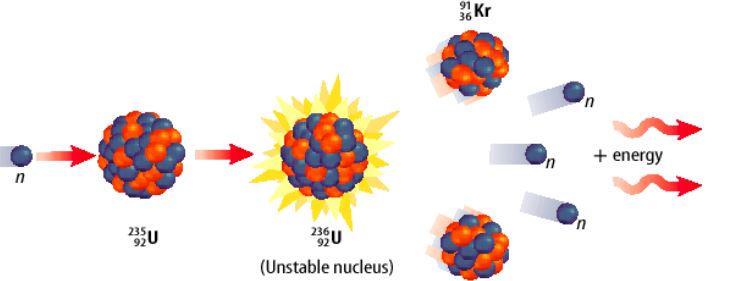
A positively charged electron is known as a _________.
proton
beta particle
alpha particle
positron

Use the balanced equation and the Molar Mass table above to answer the following question.
How much Ca3(PO4)2(s) could be produced in an industrial process if 55.00 g of CaCl2 in solution reacted completely with sufficient Na3(PO4)(aq)?
310.2 g
155.1 g
103.4 g
51.70 g
Carbon tetrachloride is a solvent which is used as a refrigerant and also as a cleaning agent. Today, methane and chlorine are mainly used to produce carbon tetrachloride:
CH4 + 4Cl2 → CCl4 + 4HCl
How many grams of carbon tetrachloride can be produced from reacting 709.0 grams of chlorine (Cl2) with excess methane?
3.845 g
61.53 g
384.5 g
6153 g
For the reaction HCl + NaOH → NaCl + H2O which reactant is the limiting reactant given 100.0 g of sodium hydroxide and 100.0 g of hydrochloric acid?
Hydrochloric acid
Sodium hydroxide
Sodium chloride
Water
In the reaction A + B → C + D, if element B is in excess, then —
A is the limiting reactant
B is the limiting reactant
C is the limiting reactant
Both A and B are limiting reactants
Calcium hydroxide and hydrochloric acid react to form calcium chloride and water as shown in the chemical reaction. If the chemicals are present in exactly the correct ratios to fully use all of the ingredients, how many moles of water would be formed from 5 moles of HCl? Balance the equation first.
__ Ca(OH)2 + __ HCl → __ CaCl2 + __ H2O
1 mole
2 moles
5 moles
10 moles

Use the balanced equation and the Molar Mass table to answer the following question.
Suppose 110.0 g of CaCl2 in solution is mixed with 163.9 g of Na3(PO4) in solution. How much Ca3(PO4)(s) would be produced?
310.2 g
155.1 g
103.4 g
51.70 g
In the reaction 2RbNO3 → 2RbNO2 + O2, how many moles of O2 are produced when 5.0 mol of RbNO3 decompose?
1.0 mol
2.5 mol
3.0 mol
7.5 mol
Who started the modern day atomic theory of the atom?
Democritus
Dalton
Thomson
Bohr
Democritus AND Dalton did NOT believe that
atoms are indivisible and indestructible
all matter is made of atoms
changes in matter are due to changes in groupings of atoms
the nucleus is in the center of an atom
Rutherford discovered what subatomic particle through his experimentation?
The proton
The neutron
The electron
The quark
What did Thomson call his model of the atom?
The electronegativity model
The plum pudding model
The Thomson model
The cathode ray model
In his experiment, Rutherford concluded that atoms have a nucleus because
most of the particles went straight through the foil.
some of the particles were deflected near the front of the screen.
some of the particles were deflected back towards the alpha source.
not enough information is given.
Who discovered the mass and charge of an electron?
Dalton
Bohr
Rutherford
Millikan
Who discovered that electrons travel in circular orbits around the nucleus?
Bohr
Millikan
Dalton
Thomson
Rutherford discovered that an atom contains a(n):
atomic mass
isotope
electron
nucleus
According to Rutherford, atoms are mostly composed of:
objects
empty space
protons, neutrons, and electrons
only protons
How many d orbitals make up the d subshell?
1
5
3
7
If n = 3, what is the maximum number of electrons that can fit in this shell?
2
8
18
32

What orbital is shown in the picture?
s orbital
p orbital
d orbital
f orbital
What is the difference in a 1s orbital and a 2s orbital?
The shape of the orbital
The size of the orbital
The number of electrons it can hold
None of the above
Which of the following values does NOT represent a valid electron?
n=(2), l=(1), ml=(1), ms=(+1/2)
n=(4), l=(2), ml=(-1), ms=(-1/2)
n=(2), l=(0), ml=(0), m=(-1/2)
n=(4), l=(2), ml=(-3), ms=(+1/2)
Which form of radiation has the highest frequency?
radio waves
ultraviolet
x-ray
gamma
Heisenberg's Uncertainty Principle states that it is impossible to know both the ___________ and the __________ of a particle at the same time.
velocity, position
velocity, energy
position, energy
velocity, speed
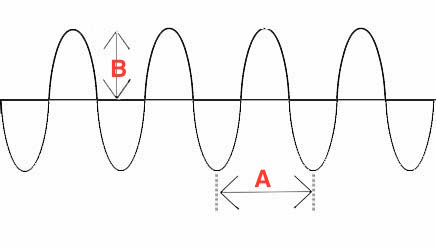
What property of this wave is represented by the letter "A"
amplitude
crest
trough
wavelength
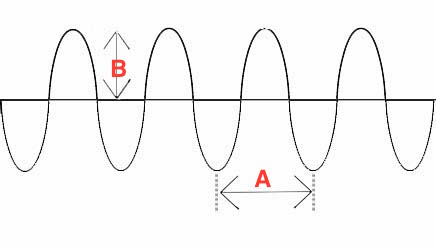
A wave with a large wavelength will have a ______ frequency and _____ energy
high, low
high, high
low, high
low, low
The frequency of violet light is 7.5x10¹⁴ Hz. What is its wavelength?
4.0x10⁻⁷ m
4.0x10⁷ m
2.25x10²³m
2.25x10²³ Hz
Red light has a wavelength of 675 x 10-9 m. What is its frequency?
2.03x10¹¹ m
4.44x10¹⁴ Hz
4.44x10¹⁴ nm
2.03x10¹¹ Hz
What is the speed of light?
3.0x10⁸ ms
3.0x10⁸ m/s
6.626x10⁻³⁴ Js
6.626x10⁻³⁴ J/s
Ground state means that an electron is...
at its lowest possible potential energy
in the first shell of an atom
laying low for the weekend
removed from an atom
What is Planck's Constant?
6.63x10⁻³⁴ Js
6.63x10⁻³⁴ J/s
3.0x10⁸ ms
3.0x10⁸ m/s
In order to go from ground state to an excited state, an electron must
emit energy
absorb energy
rotate
wiggle
When an electron returns to ground state from an excited state, the atom will
emit energy
absorb energy
rotate
wiggle

Choose the correct shape for this molecule:
Trigonal planar
Octahedral
Tetrahedral
Linear


What is the molecular shape of a molecule with 1 bond and 3 lone pairs on the central atom?
linear
bent
tetrahedral
trigonal planar
octahedral
What is the molecular shape of a molecule with 2 bonds and 0 lone pairs on central atom?
linear
bent
tetrahedral
trigonal planar
octahedral
What is the molecular shape of a molecule with 4 bonds and 1 lone pairs on central atom?
trigonal bipyramidal
see saw
tetrahedral
t-shaped
trigonal pyramidal
KNO3
NH4F



A type of chemical bonding in which two atoms share a pair of electrons with each other equally
Polar
Nonpolar
Intermolecular
Ionic
The temperature of a substance that occurs when the vapor pressure of the liquid is equal to the pressure above the surface of the liquid.
Melting Point
Evaporation
Boiling Point
Freezing Point

Forces of attraction or repulsion that act within a molecule
Conductivity
Thermal
Intermolecular
Intramolecular
The process by which a sample of matter changes from a liquid to a gaseous vapor state
Condensation
Melting
Evaporation
Freezing
Any of several forms of electrostatic attraction between atoms that hold the atoms together
Atomic Structure
Thermal Energy
Bonds
Conductivity

Describes a molecule in which one or more atoms is slightly negative and one or more is slightly positive
Nonpolar
Polar
Bond
Which of the following is a mixture?
milk
oxygen
water
carbon dioxide
Matter that has a definite volume but no definite shape is a
liquid
solid
gas
plasma



