wayground logo

Free Printable Worksheets

Font size

S
M
L
XL
Worksheets

CP CHEM REVIEW

Total questions: 94

Worksheet time: 2hrs 58mins

Name
Class
Date
1.

Which subatomic particle has a negative charge?

a)

Proton

b)

Neutron

c)

Electron

d)

Atom

2.
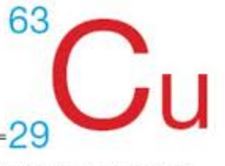
How many electrons does a Copper atom have?
a)
63
b)
29
c)
92
d)
34
3.
An atom with atomic number 6 would have how many protons?
a)
6
b)
12
c)
3
d)
cannot be determined 
4.

What is in the nucleus of an atom?

a)

Neutrons and protons

b)

Protons

c)

Protons and Electrons

d)

Electrons and Nuetrons

5.

Which of the following determines the identity of an element?

a)

number of protons

b)

atomic mass

c)

number of neutrons

d)

number of shells

6.
In the modern periodic table elements are arranged by:
a)
atomic mass
b)
atomic number
c)
valence electrons
d)
number of isotopes
7.
An element's identity is determined by the number of
a)
electrons.
b)
protons.
c)
neutrons.
d)
valence.
8.
All matter is made of .....
a)
energy 
b)
atoms 
c)
air
d)
chemistry
9.
Most of the mass of an atom is found it its _____.
a)
electron cloud
b)
nucleus
c)
atomic number
d)
empty space
10.
Rutherford's experiment showed that most of an atom is made up of _____.
a)
a nucleus
b)
an electron cloud
c)
empty space
d)
alpha particles
11.
Which is an electron?
a)
A
b)
B
c)
C
12.
Which is a proton?
a)
A
b)
B
c)
C
13.
Which item on this element square is the chemical symbol?
a)
Copper
b)
29
c)
Cu
d)
63.546
14.
Which item on this element square represents the atomic number?
a)
13
b)
Al
c)
Aluminum
d)
26.981538
15.
What is the atomic mass of "F"
a)
9
b)
18
c)
17
d)
19
16.
An atom of the element with atomic number 6 always has _____.
a)
six protons in its nucleus
b)
an atomic mass of six
c)
more than six neutrons
d)
six electron clouds
17.

Which scientist developed the atomic theory, saying elements are composed of atoms, atoms of the same element are identical, atoms can change when chemically mixed with other elements?

a)

JJ Thomson

b)

Ernest Rutherford

c)

John Dalton

d)

James Chadwick

18.

JJ Thomson's theory was nicknamed _______.

a)

Billiard Ball Theory or sphere

b)

Solar System Theory

c)

Electron Cloud

d)

Plum Pudding or Chocolate Chip

19.
Who discovered the proton?
a)
Thomson
b)
Dalton
c)
Bohr
d)
Rutherford
20.
He developed the planetary model of the atom.
a)
Rutherford
b)
Bohr
c)
Chadwick
d)
Dalton
21.
What did Thomson discover?
a)
electron
b)
proton
c)
neutron
d)
electron cloud
22.
The Gold Foil experiment was done by __________.
a)
Chadwick
b)
Bohr
c)
Rutherford
d)
Thomson
23.

The scientist responsible for "discovering" the nucleus and saying the atom is mostly empty space is:

a)

Bohr

b)

Rutherford

c)

Schroedinger

d)

Einstein

24.
What was wrong with Dalton's model of the atom?
a)
He said the atom had a dense, positive center.
b)
He said the atom was made of positive matter surrounding negative particles.
c)
He said atoms cannot be subdivided, created or destroyed.
d)
He said e- follow specific paths.
25.
What was Dalton's model of the atom described as?
a)
plum pudding model
b)
solar system model
c)
electron cloud
d)
solid sphere
26.

What was the name of Schrodinger's model of the atom?

a)

plum pudding model

b)

solar system model

c)

electron cloud

d)

solid sphere

27.
Which is the current model of the atom?
a)
plum pudding model
b)
solar system model
c)
electron cloud
d)
solid sphere
28.

Whose model is pictured?

a)

Dalton

b)

Thomson

c)

Rutherford

d)

Bohr

29.

What was wrong with Bohr's model of the atom?

a)

He said the atom had a dense, positive center.

b)

He said the atom was made of positive matter surrounding negative particles.

c)

He said atoms cannot be subdivided, created or destroyed.

d)

He said electrons follow specific paths, and you can tell where the electrons are

30.

An ionic compound forms between a _______ and _______.

a)

metal and non-metal

b)

two metals

c)

two non-metals

31.

Name the ionic compound, LiCl

a)

lithium chlorine

b)

lithium chloride

c)

lithium chlorate

d)

lithium monochloride

32.

Name the ionic compound, CaCO3

a)

calcium carbide

b)

calcium carbon trioxide

c)

calcium carbon oxide

d)

calcium carbonate

33.

Name the ionic compound, FeBr3

a)

Iron (II) bromide

b)

Iron (III) bromide

34.
K20 - name?
a)
potassium dioxide
b)
potassium oxide
c)
potassium oxygen
d)
dipotassium dioxide
35.

What is the formula for diphosphorus pentoxide?

a)

P2O5

b)

PO5

c)

P5O2

d)

Po2O5

36.

What is the name for SiCl4?

a)

silicon tetrachloride

b)

silicon quadchloride

c)

monosilicon tetrachloride

d)

silicon chloride

37.

What is the chemical formula of sulfur hexabromide?

a)

SBr₆

b)

S₆Br

c)

S(VI)Br

d)

SBr4

38.
What is krypton?
a)
element
b)
compound
c)
mixture
39.
Can be found on the periodic table
a)
Element
b)
Compound
c)
MIxture
40.
Ba+2, Br-1
a)
BrBa
b)
Br2Ba2
c)
BaBr2
d)
Br2Ba
41.
Ca+2, O-2
a)
CaO
b)
OCa
c)
Ca-2O+2
d)
Ca2O2
42.
The name of FeCl₂ is
a)
iron chloride
b)
iron (II) chloride
c)
iron (I) chloride
d)
iron dichloride
43.
Ca+2P-3
a)
PCa
b)
P2Ca3
c)
CaP
d)
Ca3P2
44.
When adding a subscript to a polyatomic ion, you should...
a)
multiply any subscripts on the polyatomic ion by the subscript you are adding
b)
put parentheses around the polyatomic ion before adding a subscript
c)
write the new subscript next to any subscripts on the polyatomic ion
d)
put the polyatomic ion in square brackets before adding the subscript
45.
What is the correct name for P₃Cl₆?
a)
Potassium chloride
b)
Phosphorous chloride
c)
Triphosphorous hexachloride
d)
Tetraphosphorous heptachloride
46.
What is the correct name for MgI₂?
a)
Manganese IV iodide
b)
Manganese diiodide
c)
Magnesium iodide
d)
Magnesium diiodide
47.
The correct name of Mg₃N₂ is
a)
manganese nitride
b)
magnesium nitride
c)
magnesium (III) nitride
d)
trimagnesium dinitride
48.
What is the correct formula for dinitrogen tetroxide?
a)
N₃O₃
b)
(N₂)₂(O₄)₃
c)
N₂O₄
d)
N₄O₂
49.
What is the correct formula for phosphorous trichloride?
a)
P₃Cl
b)
PCl₃
c)
KCl₃
d)
K₃Cl
50.
At the end of chemical reactions, what is the total mass of the reactants compared to the total mass of the products?
a)
the product is doubled
b)
the product is half the mass of the reactants
c)
the mass is the same
d)
the mass changes depending on the reaction
51.
In chemical reactions, what does the principle of conservation of mass mean?
a)
Matter is not created or destroyed.
b)
The total mass of the reactants is greater than the total mass of the products.
c)
The total mass of the reactants is less than the total mass of the products.
d)
Matter is not changed.
52.
The red numbers in the image below represent ________
a)
subscripts
b)
coefficients
c)
I don't know, and don't want to try
d)
None of the answers are correct
53.
The blue numbers in the image below represent ________
a)
I don't know, and don't want to try
b)
coefficients
c)
subscripts
d)
none of the answers are correct
54.

What is the right part of a chemical equation called...

H2 + O2 --> H2O

a)

Reactants

b)

Products

c)

Yields

d)

Chemical Equation

55.

What is the arrow in a chemical equation...

H2 + O2 --> H2O

a)

Reactants

b)

Products

c)

Yields

d)

Chemical Equation

56.
What is the right ratio of chemicals for the BCE (Balanced Chemical Equation)?__H2SO3 + __KOH--> __H2O+ __K2SO3
a)
2,1 --> 2,1
b)
1,2 --> 1,1
c)
1,2 --> 1,2
d)
1,2 --> 2,1
57.
What is the right ratio of chemicals for the BCE (Balanced Chemical Equation)?__AgNO3 + __H2S --> __Ag2S+ __HNO3
a)
2,1 --> 1,2
b)
1,2 --> 1,1
c)
1,2 --> 1,2
d)
1,2 --> 2,1
58.
4Si + S8 --> 2Si2S4
a)
Synthesis
b)
Decomposition
c)
Single displacement
d)
Double displacement
59.
3Ca + 2AlCl3 --> 3CaCl2 + 2Al
a)
Synthesis
b)
Decomposition
c)
Single diplacement
d)
Double displacement
60.
3KOH + H3PO4 --> K3PO4 + 3H2O
a)
Synthesis 
b)
Decomposition
c)
Single displacement
d)
Double displacement
61.
2Pb(NO3)2 --> 2PbO + 4NO2 + O2
a)
Synthesis 
b)
Decomposition
c)
Single displacement
d)
Combustion
62.
3Mg + N2 --> Mg3N2
a)
Synthesis 
b)
Decomposition
c)
Single displacement
d)
Combustion
63.
2NO2 --> N2 + 2O2
a)
Synthesis
b)
Decomposition
c)
Single displacement
d)
Combustion
64.
P4 + 3O--> 2P2O3
a)
Synthesis 
b)
Decomposition
c)
Single displacement
d)
Combustion
65.
When balancing equations a ____ can be placed to the left of a formula of a substance to make the equations balanced
a)
charge
b)
subscript
c)
random number
d)
coefficient
66.
What coefficient should be used to make the following equation balanced?
N2+O2--> _NO 
a)
1
b)
2
c)
3
d)
4
67.
Balance this equation:
 __Li + __Cl2 -> __LiCl
a)
2Li + Cl2 -> 4LiCl2
b)
2Li + Cl2 -> LiCl2
c)
2Li +  Cl2 -> 2LiCl
68.
H2SO4 + Fe -->H2 + FeSO4
a)
Synthesis
b)
Decomposition
c)
Single Replacement
d)
Double Replacement
69.
At the end of chemical reactions, what is the total mass of the reactants compared to the total mass of the products?
a)
the product is doubled
b)
the product is half the mass of the reactants
c)
the mass is the same
d)
the mass changes depending on the reaction
70.
What is the atomic number?
a)
the number of protons
b)
the number of protons and neutrons
c)
the number of neutrons
d)
the number of protons and electrons
71.
What is the mass number defined as?
a)
the number of protons
b)
the number of protons and neutrons
c)
the number of neutrons
d)
the number of protons and electrons
72.

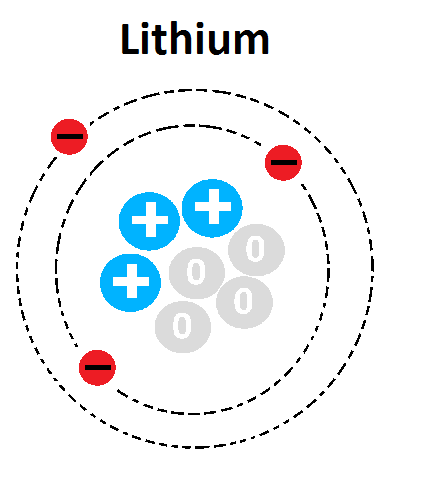
What is the mass number of this atom?

a)

1

b)

3

c)

4

d)

7

73.

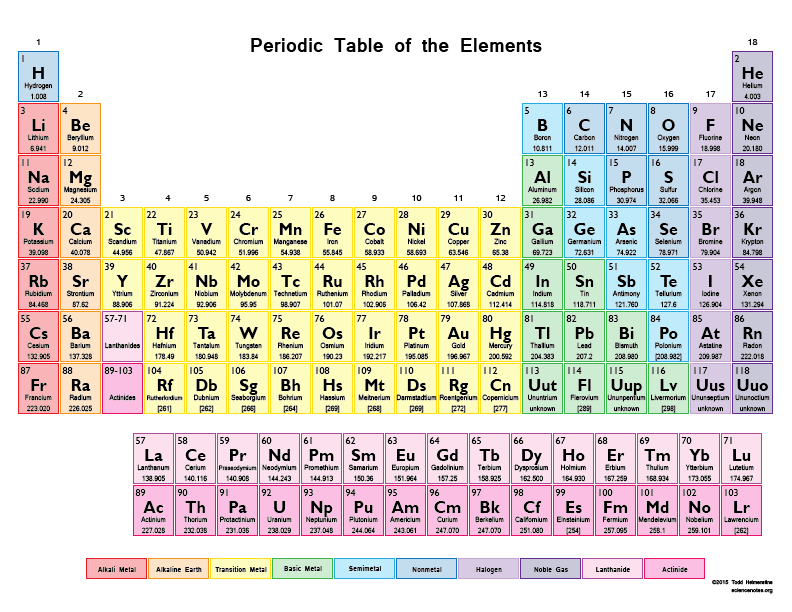
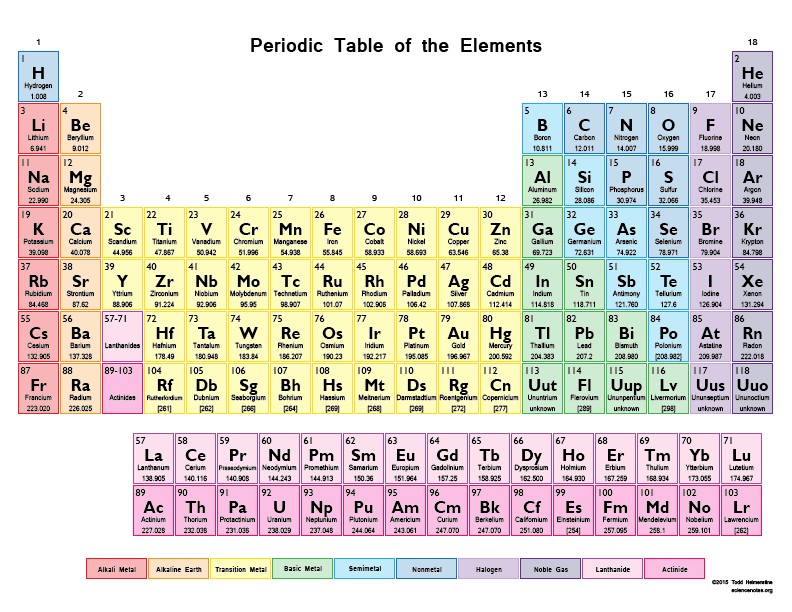
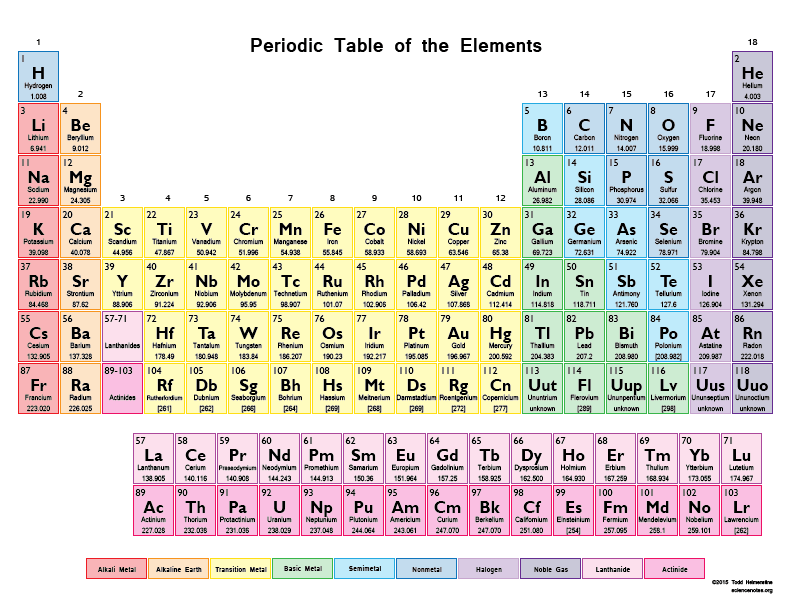
What is the atomic number of Barium, Ba? (enlarge the periodic table)

a)

20

b)

38

c)

56

d)

88

74.

How many protons are in a sodium atom, Na? (tap to enlarge the periodic table)

a)

Sodium has 1 proton.

b)

Sodium has 3 protons.

c)

Sodium has 11 protons

75.

Atoms of the same element which have a different number of neutrons are called _________________.

a)

ions

b)

isotopes

c)

quarks

d)

molecules

76.

An element has the mass number 12 and atomic number 6. The number of neutrons in it is:

a)

6

b)

10

c)

4

d)

8

77.

How many neutrons does C-14 [atomic #6] contain? (tap to enlarge the image)

a)

6

b)

7

c)

14

d)

8

78.
Oxygen has 8 protons. What is oxygen's atomic number?
a)
16
b)
8
c)
15.999
d)
0
79.
A neutral atom of Carbon-13 has ________ electrons and _________ neutrons
a)
13, 13
b)
6, 7
c)
7, 7
d)
6, 6
80.
Isotopes are atoms of the same element that have the same number of __________ but different number of __________ . Therefore, isotopes of the same element have different masses. 
a)
protons, neutrons
b)
protons, electrons
c)
neutrons, protons
d)
electrons, protons
81.
The  mass of an atom is located  in the ___________ and the volume of an atom is made of the ____________
a)
electron cloud, nucleus
b)
electron cloud, energy levels
c)
nucleus, electron cloud
d)
nucleus, neutrons
82.
The  mass of an atom is located  in the ___________ and the volume of an atom is made of the ____________
a)
electron cloud, nucleus
b)
electron cloud, energy levels
c)
nucleus, electron cloud
d)
nucleus, neutrons
83.
A neutral atom of the isotope 2612Mg would consist of
a)
12 protons, 26 neutrons, 26 electrons
b)
26 protons, 12 neutrons, 26 electrons
c)
26 protons, 14 neutrons, 14 electrons
d)
12 protons, 14 neutrons, 12 electrons
84.

The vertical columns on the periodic table are called:

a)

periods

b)

elements

c)

groups

d)

matter

85.

The horizontal rows on the periodic table are called:

a)

periods

b)

elements

c)

groups

d)

matter

86.

What group does Lithium (Li) belong to?

a)

1

b)

2

c)

3

d)

4

87.

Which period does Lithium (Li) belong to?

a)

1

b)

2

c)

3

d)

4

88.

Which of the following is not true of Metals?

a)

they make up a majority of elements

b)

they are shiny

c)

they are good conductors

d)

they are poor conductors

89.

True or False? - Nonmetals can be solids, liquids, or gases.

a)

True

b)

False

90.

Which of the following elements is a Metalloid? (Select all that apply)

a)

Boron (B)

b)

Aluminum (Al)

c)

Carbon (C)

d)

Silicon (Si)

91.

Which group are the Alkali Metals in?

a)

1

b)

2

c)

17

d)

18

92.

Which group are the Halogens in?

a)

1

b)

2

c)

17

d)

18

93.

Which group are the Alkaline Earth Metals in?

a)

1

b)

2

c)

17

d)

18

94.

Which group are the Noble Gases in?

a)

1

b)

2

c)

17

d)

18