Wayground logo

Free Printable Worksheets

Font size

S
M
L
XL
Worksheets

Work, Energy and Power

Total questions: 63

Worksheet time: 2hrs 5mins

Name
Class
Date
1.

At which point is potential energy greatest?

a)

W

b)

X

c)

Y

d)

Z

2.
Power is defined as the
a)
force on an object times the distance the object moves.
b)
force on an object divided by the time the force acts.
c)
work done times the time taken to do that work.
d)
work done on an object divided by the time to do the work
3.
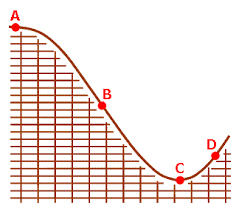
At which point(s) on the roller coaster is the kinetic energy at its maximum?
a)
A
b)
B
c)
C
d)
D
4.
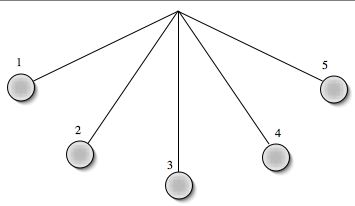
When a pendulum swings, at which point is potential energy at its greatest?
a)
1
b)
2
c)
3
d)
4
5.
When a pendulum swings, at which point is kinetic energy highest?
a)
1
b)
2
c)
3
d)
4
6.
In order for Work to happen, what 2 things must occur?
a)
Mass and Displacement
b)
Force and Mass
c)
Force and Work
d)
Force and displacement
7.
In which situation is NO work done?
a)
picking up a book bag
b)
dropping the bookbag
c)
carrying the bookbag
d)
none of these
8.
The unit used to measure work is the 
a)
Watt
b)
Newton
c)
Joule
d)
meter
9.
A force exerted over a distance to move an object is ______________________.
a)
power
b)
work
c)
momentum
d)
Watt
10.
The efficiency of a machine can be increased by reducing __________________________. 
a)
effort
b)
resistance friction
c)
fulcrum
d)
friction
11.
The unit used to measure power is the 
a)
Watt
b)
Newton
c)
Joule
d)
Newton*meter
12.

Which of the following is the best example of work being done.

a)

doing homework

b)

lifting a box

c)

pushing a stationary box

d)

holding a box

13.
No machine in existence has 100% efficiency due to ____________________.
a)
magic
b)
friction
c)
smoke
d)
input
14.
 Work done = Force x _________
a)
a. distance
b)
b. acceleration
c)
c. velocity
d)
d. speed
15.
How much work is done when the engine produces 350 N of force to move a car 5 m?
a)
70 J
b)
1750 J
c)
355 J
d)
175 J
16.
In which of these cases is work being done? 
a)
A student sleeps
b)
A student pushes a locked door that does not move
c)
a student carries his chair into another room
d)
A student sits on the carpet
17.
Would it be easier to move a box of the same mass up a ramp that was long and gradual or short and steep?
a)
long and gradual
b)
short and steep
18.
What is the unit for mass?
a)
Kilogram (Kg)
b)
Newton (N)
c)
Joule (J)
d)
Watt (W)
19.
The amount of work done in a certain amount of time is known as 
a)
work
b)
effort force
c)
resistance force 
d)
power
20.
The more POWER you use to move an object, the more work you do. 
a)
True
b)
False
21.
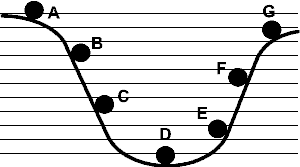
Which point has the most potential energy?
a)
G
b)
f
c)
b
d)
a
22.
Which 2 letters have the most kinetic energy
a)
W & Y
b)
X & Z
23.

_______ is stored energy.

a)

Potential Energy

b)

Kinetic Energy

c)

Newton’s 2nd Law

d)

Newton’s 3rd Law.

24.

___________ is energy in motion

a)

Potential Energy

b)

Kinetic Energy

c)

Newton’s 2nd Law

d)

Newton’s 3rd Law.

25.

Energy can never be created nor destroyed only changed from one form to another but the total amount of energy remains the same.

a)

Law of conservation of energy

b)

Law of conservation of momentum

c)

Energy creation theory

d)

Energy constant formula

26.

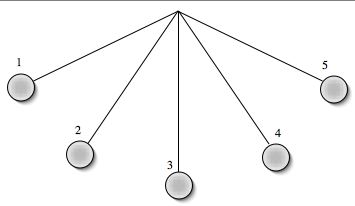
A pendulum follows the path shown in the diagram. At what point is the Kinetic Energy (KE) of the pendulum that greatest?

a)

point 1 and 5

b)

point 3

c)

point 2 and 4

d)

all points

27.
What states that energy can never be created or destroyed?
a)
law of conservation of momentum
b)
law of conservation of energy
c)
law of conservation of matter
d)
law of conservation of water
28.
What is being transferred as you do work?
a)
Energy
b)
Heat
c)
Power
d)
Gravitational Potential Energy
29.
The SI unit of work is?
a)
Joules
b)
Watts
c)
Newtons
d)
meters
30.
The energy of movement is...? 
a)
Kinetic
b)
Potential
c)
Elastic
31.
Energy that is stored is called...
a)
Kinetic
b)
Potential 
32.
The SI unit for power is...?
a)
Watts
b)
Joules
c)
Newtons
d)
Meters
33.
Two riders of equal mass begin at rest from the top of a hill. There is friction between the sleds and the snow as shown. Which rider will have the greatest velocity at the bottom of the hill?
a)
Rider A because friction removes more energy from B.
b)
Rider B because friction removes more energy from A.
c)
Both riders will have the same velocity.
34.
Two riders of equal mass begin at the top of a hill. If we assume no friction , which rider will have the greatest velocity at the bottom of the hill?
a)
Rider A
b)
Rider B
c)
Both Riders will have the same velocity
35.
Bro A bench presses 145-lbs five times in 20 seconds.
Bro B bench presses 145-lbs five times in 10 seconds.
a)
Bro A has more power
b)
Bro B has more power
c)
Both Bros have the same power
d)
Bro
36.
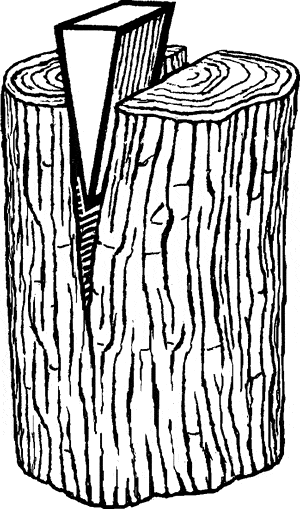
A simple machine that can split things apart or hold a door open.
a)
wedge
b)
screw
c)
lever
d)
hand
37.
How could I reduce the effort force needed to lift the load?
a)
move the fulcrum away from the load
b)
move the fulcrum closer to the load
c)
place the fulcrum in the middle
38.
A fishing pole is an example of a compound machine. What simple machines are used to make up this compound machine?
a)
lever, wheel and axle, pulley
b)
wheel and axle, inclined plane, pulley
c)
wheel and axle, pulley, inclined plane
39.
Two students played on the slide. Student A wore shorts and student B wore long pants. Which of these best explains why Student B moved down the slide more smoothly than Student A?
a)
more acceleration
b)
less gravity
c)
more weight
d)
less friction
40.
Which body part acts as the fulcrums of levers?
a)
Lungs
b)
Bones
c)
Joints
d)
Muscles
41.
What type of simple machine is found on the cap of a pickle jar?
a)
lever
b)
inclined plane
c)
pulley
d)
screw
42.

Flagpole

a)

wedge

b)

pulley

c)

incline plane

43.

Stairs

a)

wedge

b)

pulley

c)

inclined plane

44.
Consists of two or more simple machines.
a)
multiple machine
b)
compound machine
c)
duplex machine
45.
Which of the following is NOT an example of a compound machine?
a)
scissors
b)
fishing pole
c)
ramp
46.

Name this simple machine.

a)

Wheel and Axle

b)

Lever

c)

Pulley

47.

What is the center point of a lever called?

a)

Fulcrum

b)

An axle

c)

a wedge

48.
Machines help us to.....
a)
Do work
b)
Increase power
c)
Apply a force
d)
All of the above
49.

Work input is the work

a)

done ON the machine

b)

done BY the machine

50.

What is a machine efficiency?

a)

ration (fraction) of work output to work input

b)

work done by a machine

c)

force applied to a machine

51.

Work/Time = ________?

a)

Force

b)

Speed

c)

Power

52.
Which of the following is a member of the inclined plane family?
a)
scissors
b)
axle
c)
pulley
d)
screw
53.

24. Which of the following can be determined when you are given work and time?

a)

Mechanical advantage

b)

power

c)

speed

54.

19. What are the two families of simple machines?

a)

first class and second class

b)

inclined plane and lever

c)

pulley and screw

55.

9. Which of the following is an example of a compound machine?

a)

ax blade

b)

scissors

c)

screw

56.
What is the work done by a machine on an object?
a)
Lever
b)
Power
c)
Work Output
57.
What is the work that you do on a machine?
a)
Lever
b)
Work output
c)
Work input
58.
What is the number of times the machine mutliples force?
a)
Mechanical Advantage
b)
Power
c)
Mechanical Efficiency 
59.
Is this an example of work?
A teacher applies a force to a wall and becomes exhausted.
a)
True
b)
False
60.

What is mechanical advantage?

a)

The advantage a machine has over a bicycle

b)

A measure of how much a simple machine reduces work

c)

A measure of when is the best time to use a simple machine

d)

the number of times a machine increases input force

61.

What is a machine?

a)

an object that has AI

b)

an object that is designed to take over the earth in 2020

c)

a device that changes force

d)

a mechanism that is used to decrease the amount of work done

62.
The faster an object moves, the ________ kinetic energy it has. 
a)
more
b)
less
c)
none of the above
d)
all of the above 
63.

The _____ of a machine compares the output work to the input work and expressed as a percent.

a)

mechanical advantage

b)

efficiency

c)

output force

d)

effectiveness