wayground logo

Free Printable Worksheets

NEW

Font size

S
M
L
XL
Worksheets

SNC 1DI Final Exam Review

Total questions: 45

Worksheet time: 43mins

Name
Class
Date
1.
What does this symbol indicate?
a)
Corrosive substances are present; protect your hands.
b)
Wash your hands.
c)
Extreme temperatures are present; wear appropriate gloves.
d)
Bacteria are present.
2.
What safety symbol is this?
a)
Flammable 
b)
Oxidizing Agent
c)
No Open Flame
d)
Explosion
3.
An experiment is performed on plants to see how different liquids affect plant growth. Each plant in the experiment is given a different liquid; water, apple juice, or milk. Each plant has the same amount of soil, sunlight, and listens to the same music. In this investigation, the independent variable is ...
a)
The type of plant
b)
The amount of sunlight
c)
The type of music
d)
The type of liquid
4.
A student is planning an experiment to find out how the height from which he drops a ball affects how high the ball bounces. The dependent variable is the _____.
a)
Diameter of the ball
b)
Force acting on the ball
c)
Height that the ball bounces
d)
Height from which the ball is dropped
5.

These kind of observations use your senses to observe results.

a)

Qualitative

b)

Quantitative

6.
These kind of observations are made using instruments such as rulers, balances and thermometers.
a)
Qualitative
b)
Quantitative
7.

Which one of these is a chemical property?

a)

melting point

b)

boiling point

c)

colour

d)

flammability

8.

Which is NOT a physical property?

a)

odour

b)

reacts with acid

c)

ability to conduct electric current

d)

hardness

9.

Which of the following is a chemical property?

a)

ability to rust

b)

ability to conduct electricity

c)

volume

d)

density

10.

Something that goes from liquid to gas is...

a)

Evaporation

b)

Melting

c)

Freezing

d)

Sublimation

11.

Fog on the bathroom mirror after a shower is a good example of...

a)

Condensation

b)

Evapouration

c)

Deposition

d)

Freezing

12.

Matter is made up of small particles called...

a)

particles

b)

gases

c)

liquids

d)

atoms

13.
The positive particles of an atom are 
a)
electrons 
b)
positrons 
c)
neutrons 
d)
protons 
14.

The central region of an atom where the neutrons and protons are

a)

nucleus

b)

electron cloud

c)

core

d)

center

15.

An atom with atomic number 6 has how many protons?

a)

6

b)

12

c)

3

d)

cannot be determined

16.
Particles in an atom that are neutral and have no charge are 
a)
negatrons 
b)
electrons 
c)
neutrons 
d)
protons 
17.
A particle that moves around the nucleus is a(n)...
a)
Proton
b)
Neutron
c)
Electron
d)
Quark
18.
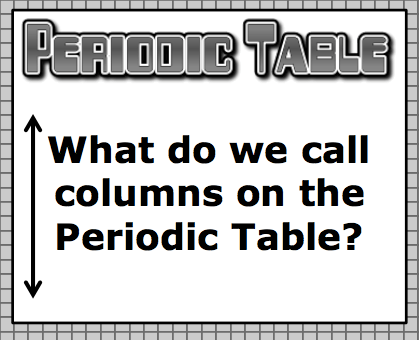
a)
Periods
b)
Groups
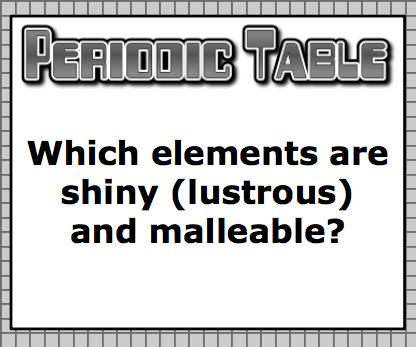
19.
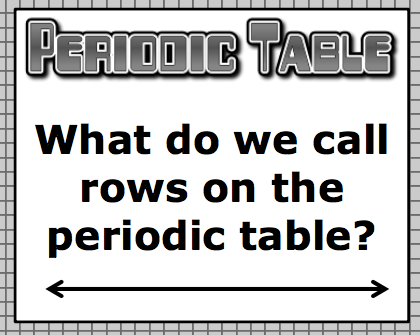
a)
Periods
b)
Groups
20.
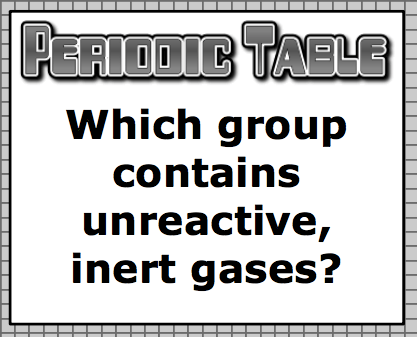
a)
Group 1
b)
Group 17
c)
Group 2
d)
Group 18
21.
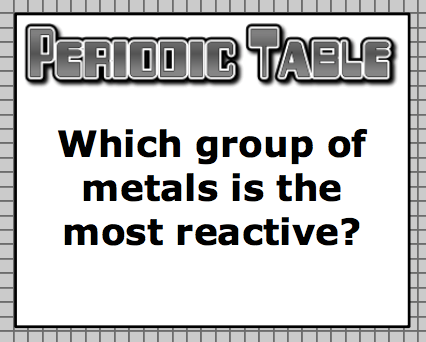
a)
Group 1
b)
Group 17
c)
Group 18
d)
Group 2
22.
a)
Metals
b)
Nonmetals
c)
Metalloids
23.
a)

same number of energy levels

b)

same number of valence electrons

c)

same number of protons

d)

same number of neutrons

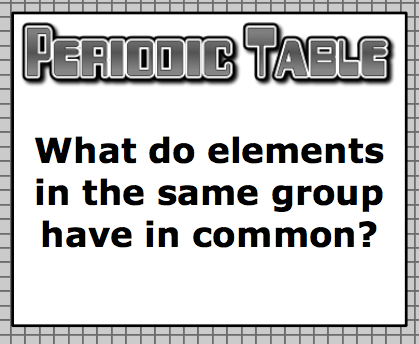
24.
a)

same number of energy levels

b)

same number of valence electrons

c)

same number of protons

d)

same number of neutrons

25.
When socks get stuck to towels in your dryer, this is an example of________________
a)
current electricity
b)
static electricity
26.
What types of charges attract?
a)
Positive and Positive
b)
Positive and Neutral
c)
Negative and Neutral
d)
Positive and Negative
27.
True or False, Lighting is a form of static electricity.
a)
True
b)
False
28.
Something electricity can't move through is called a(n) ______.
a)
conductor
b)
wire
c)
shoe
d)
insulator
29.

Which is NOT an insulator.

a)

Wool

b)

Plastic

c)

Copper

d)

Glass

30.

A volt is a unit of

a)

Electric Potential

b)

Charge

c)

Energy

d)

Work

31.

An Ohm is

a)

A unit of resistance

b)

A unit of current

c)

A type of charge

d)

Voltage

32.

What is the formula for Ohm's law

a)

V= I x R

b)

I= V x R

c)

R= V x I

d)

none of the above

33.

This is an example of a(n) _______ circuit

a)

open

b)

series

c)

parallel

d)

square

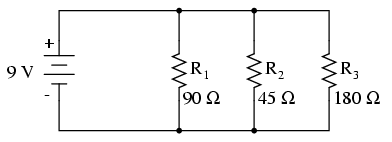
34.

This is an example of a(n) ______ circuit

a)

Series

b)

Parallel

c)

Open

d)

Dihexihedral

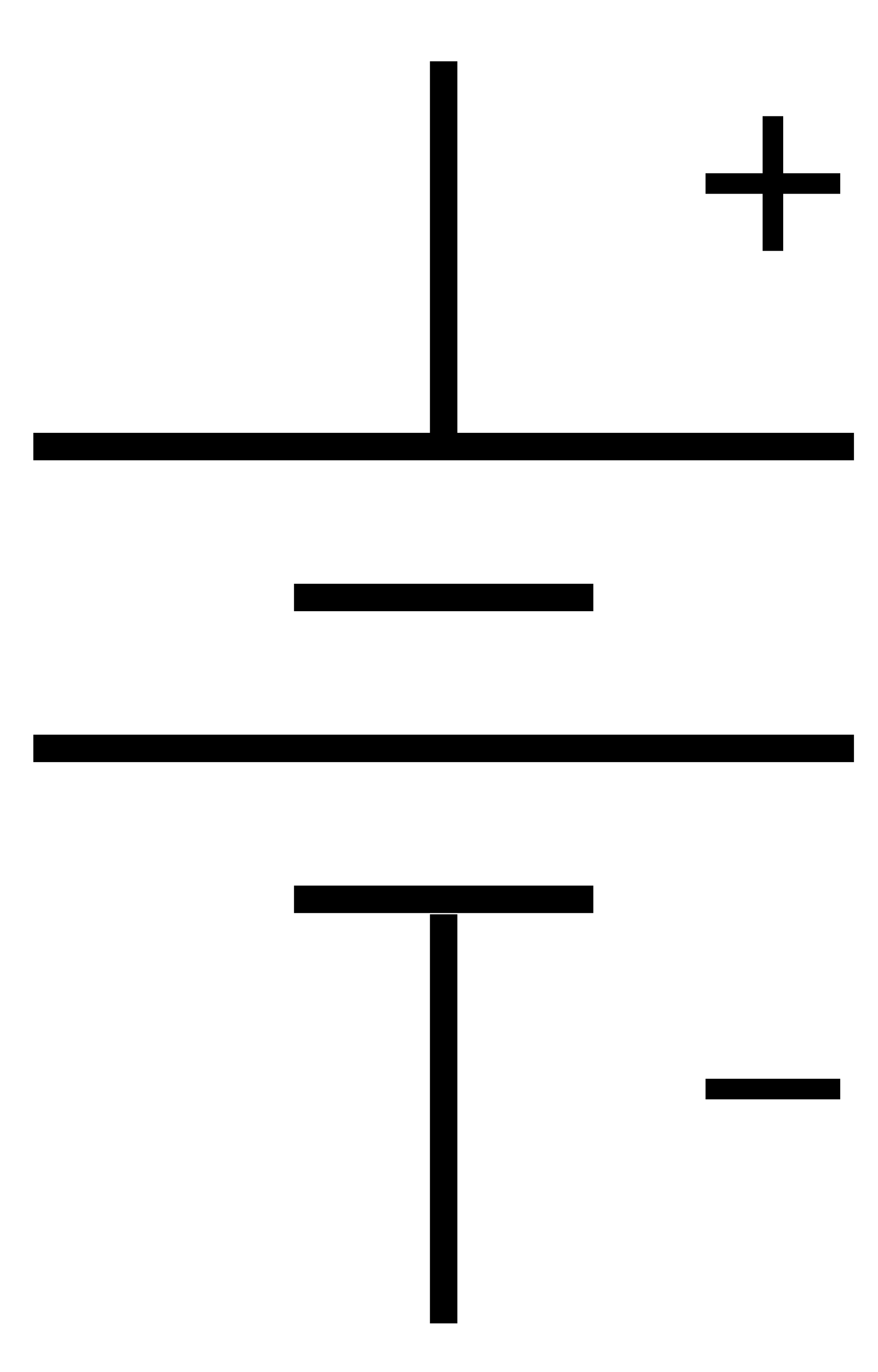
35.
what is this symbol for?
a)
light bulb
b)
switch
c)
battery
d)
resistor
36.

An organism that produces its own food supply from inorganic compounds is called a(n)

a)

heterotroph

b)

consumer

c)

detritivore

d)

autotroph

37.
What is the term for each step in the transfer of energy and matter within a biological community?
a)
energy path
b)
food web
c)
trophic level
d)
food pyramid
38.

symbiotic relationship in which both organisms benefit

a)

competition

b)

mutualism

c)

commensalism

d)

parasitism

39.
which symbiosis is this 
a)
parasitism 
b)
mutualism
c)
commensalism
d)
nonalism 
40.

The largest number of individuals that an environment can support (k) long term is...

a)

carrying capacity

b)

exponential growth

c)

lag phase

d)

population density

41.
How did the zebra mussels end up in the Great Lakes?
a)
In ballast tanks of ships
b)
They were intentionally released
c)
They have always been in the Great Lakes
d)
That's not a zebra mussel
42.
The ____________________ model of the solar system places the Sun at the centre of the orbiting planets.
a)
geocentric
b)
heliocentric
c)
equinox
d)
solstice
43.
A __________________ is a cloud of gas and dust where stars are born.
a)
nebula
b)
black hole
c)
constellation
d)
galaxy
44.

Which astronomical event determines the length of the year?

a)

the time it takes the Moon to revolve around Earth

b)

the time it takes Earth to revolve around the Sun

c)

the time it takes Earth to rotate on its axis

d)

the time it takes the Sun to go across the sky

45.

What is the unit of measurement used to measure the distance within our solar system?

a)

astronomical unit

b)

kilometers

c)

space speed

d)

light years