Wayground logo

Free Printable Worksheets

Font size

S
M
L
XL
Worksheets

Chemistry CP2 MIDTERM Review

Total questions: 100

Worksheet time: 2hrs 6mins

Name
Class
Date
1.
The number in the upper corner of an element tile (7 for nitrogen) is called _____
a)
the proton number
b)
the atomic number
c)
the electron number
d)
the mass number
2.
If an atom contains exactly three protons, then it's an atom of _____
a)
lithium
b)
gold
c)
nitrogen
d)
carbon
3.
If you want to know which atom an element is, then count the _____
a)
protons
b)
neutrons
c)
electrons
d)
nucleons
4.
For an atom to be electrically neutral, it must contain the same number of _____
a)
protons and neutrons
b)
neutrons and electrons
c)
protons and electrons
d)
nucleons and electrons
5.
Different versions of an element, with differing numbers of neutrons, are called _____
a)
isosceles
b)
isomers
c)
isotopes
d)
isicless
6.
Rounding the atomic weight to the nearest whole number gives us the _____
a)
proton number
b)
mass number
c)
nucleon number
d)
average weight
7.
The nucleus contains _____
a)
only protons
b)
protons and neutrons
c)
protons and electrons
d)
electrons and neutrons
8.
Which subatomic particle has a relative charge of -1?
a)
the proton
b)
the neutron
c)
the electron
d)
the photon
9.

An aluminum isotope consists of 13 protons, 13 electrons, and 14 neutrons. Its mass number is

a)

13

b)

14

c)

27

d)

40

10.

Atoms that carry an electric charge and gain or lose electrons are called...

a)

negative charges.

b)

positive charges.

c)

ions.

d)

isotopes.

11.
Use the picture to answer. How many electrons are in a neutral atom of gold?
a)
79
b)
196.967
c)
197
d)
118
12.

Which of the following could have 14 neutrons?

a)

Al-27

b)

Si-29

c)

Mg-25

d)

Na-22

13.

What is the mass number of an atom of gold with 117 neutrons?

a)

117

b)

196

c)

196.97

d)

197

14.

If an atom of oxygen has a charge of -2, how many electrons does the atom have?

a)

18

b)

6

c)

8

d)

10

15.

If an atom of nickel has a charge of +3, how many electrons does the atom have?

a)

28

b)

25

c)

26

d)

31

16.

Which of the following would produce an anion?

a)

Ca

b)

Al

c)

K

d)

F

17.

Cations are

a)

positive

b)

negative

c)

on the right side of the periodi table.

d)

nonmetals

18.

Anions are _______ that form ____________ ions and __________ electrons.

a)

nonmetals, positive, lose

b)

nonmetals, negative, gain

c)

metals, positive, gain

d)

metals, positive, lose

19.

Cations are _______ that form ____________ ions and __________ electrons.

a)

nonmetals, positive, lose

b)

nonmetals, negative, gain

c)

metals, positive, gain

d)

metals, positive, lose

20.

Magnesium always loses 2 electrons to become a ___ ion.

a)

Mg+

b)

Mg2+

c)

Mg-

d)

Mg2-

21.

Isotopes are atoms of the same element with different #’s of __________ & therefore different __________.

a)

n0 ; atomic #’s

b)

p+ ; atomic #’s

c)

e- ; atomic masses

d)

n0 ; atomic masses

22.
What is the name of the pictured isotope?
a)
Copper-29
b)
Copper-63
c)
Copper-34
d)
CopperWopperHopperBopper
23.
Make sure you get enough Potassium in your diet!
a)
Huh?
b)
K
c)
I <3 bananas
d)
Sure
24.
In chemistry, a "mole" is:
a)
The mass of an atom
b)
a large number used to count particles
c)
based on the volume of a substance
25.
How many atoms of iodine are in a mole of iodine?
a)
53
b)
63.55g
c)
126.9
d)
6.02 x 10²³
26.
The number 6.02 x 10²³ is called...
a)
Obama's number
b)
Bohr's number
c)
Trump's number
d)
Avogadro's number
27.
A mole of Neon contains
6.02 x 10²³ _____.
a)
atoms
b)
formula units
c)
ions
d)
molecules
28.
How many moles are in 4.5x1024 particles?
a)
0.747 particles
b)
0.747 mol
c)
2.71x1047 mol
d)
2.71x1047 particles
29.
How many molecules are there in 5.9 moles of NaCl?
a)
3.5x1024molecules
b)
9.79x10⁻²⁴molecules
c)
1.02x10²³molecules
30.

How many moles are in 15 grams of Lithium?

a)

2.14

b)

0.47

c)

105

d)

7

31.
How many atoms are there in 3.2 grams of sulfur?
a)
6.022 x 10²³ atoms S
b)
6.022 x 10²² atoms S
c)
0.031 atoms S
d)
1.66 x 10⁻²⁴ atoms S
32.
A weather balloon containing helium gas is 1000 grams. How many atoms of He are in the balloon?
a)
4 atoms
b)
250 atoms
c)
1.5 x 1026 atoms
33.
What are the units for molar mass?
a)
grams
b)
amu
c)
grams/mole
d)
liters
34.
Which compound has the smallest molar mass?
a)
CO
b)
CO2
c)
H2O
d)
H2O2
35.
What is the molar mass of Ca(OH)2
a)
74.1 g/mol
b)
210.0g/mol
c)
98.9g/mol
d)
219.9g/mol
36.
What is the molar mass of Fe3(PO4)2
a)
823.8g/mol
b)
357.5 g/mol
c)
455.6g/mol
d)
86.3g/mol
37.

What kind of test do Chemistry students like the best?

a)

Fill in the blank

b)

Moletiple Choice

c)

Essays

d)

True/False

38.

What is Avogadro's favorite Disney movie?

a)

Peter Pan

b)

The Lion King

c)

The Little Molemaid

d)

Toy Story

39.
240 cm = ___________ m
a)
2400
b)
24
c)
2.4
d)
0.24
40.
1000 m = ___________ km
a)
100
b)
10
c)
1
d)
0.1
41.
15.6 L = ___________ mL
a)
15,600
b)
156,000
c)
1,560,000
d)
15,600,000
42.
2804 mg = ___________ g
a)
0.2804
b)
2.804
c)
28.04
d)
280.4
43.
0.932 g = ___________ mg
a)
9.32
b)
93.2
c)
932
d)
9,320
44.
3 km = ___________ mm
a)
30
b)
300
c)
3,000
d)
3,000,000
45.
 1234 mg = ___________ kg
a)
0.0001234
b)
0.001234
c)
0.01234
d)
0.1234
46.
183 cm = ___________ m
a)
0.183
b)
1.83
c)
18.3
d)
1,830
47.
How do you write
8.317 x 10⁶
in standard form?
a)
8, 371, 000
b)
83, 170, 000
c)
837, 100
d)
8, 317, 000
48.

Express the following in standard notation:

8.025 x 10⁻⁸

a)

.00000008025

b)

.000000008025

c)

802,500,000,000

d)

80,250,000,000

49.
Which of the following is correct scientific notation?
a)
20.35 x 10⁴
b)
.2035 x 104
c)
2035 4
d)
2.035 x10⁴
50.
Which one of these is in scientific notation?
a)
8.987000
b)
8.98 x 10⁶
c)
80.987 x 10
d)
8.986
51.
How do you write
1001
in scientific notation?
a)
1.0001 x 10⁴
b)
1.01 x 10⁵
c)
1.001 x 10³
d)
10.1 x 10³
52.
How would you write 0.0005 in scientific notation?
a)
50 x 105
b)
5 x 10⁻⁴
c)
5 x 10⁻³
d)
.5 x 103
53.
How would you write 564,000,000 in scientific notation?
a)
5.64 x 10⁻⁷
b)
5.64 x 10⁶
c)
5.64 x 10⁸
d)
56.4 x 10⁷
54.
What two types of atoms make a covalent bond?
a)
2 Nonmetals
b)
1 Nonmetal and 1 Metal
c)
2 Metals
d)
2 Noble Gases
55.
How are covalent bonds explained?
a)
When one atom takes the other atom's electron
b)
When the atom shares an electron with an another atom
c)
When the two nucleus merge
d)
When the neutrons leave the nucleus
56.
In the correct Lewis Structure for methane (CH4), how many unpaired electrons can be found around Carbon?
a)
0
b)
2
c)
4
d)
8
57.
How many valence electrons does calcium have?
a)
2
b)
4
c)
6
d)
7
58.
How many valence electrons does hydrogen have?
a)
1
b)
2
c)
3
d)
4
59.
Which of the following is NOT a property of ionic compounds?
a)
They have very high melting points
b)
They conduct electricity when in solution
c)
They have high boiling points
d)
They are insoluble in water
60.
This is a correct dot diagram for neon (Ne)
a)
true
b)
false
61.
Ionic compounds are formed when one or more valence electrons are transferred from _____
a)
a nonmetal atom to a metal atom
b)
a nonmetal atom to a nonmetal atom
c)
a metal atom to a nonmetal atom
d)
a metal atom to a metal atom
62.
This could be the dot diagram of
a)
Ne
b)
H
c)
C
d)
F
63.
A covalent bond in which electrons are shared unequally is:
a)
polar
b)
a double bond
c)
ionic
d)
polyatomic
64.
How many valence electrons do most atoms need to be stable?
a)
1
b)
2
c)
6
d)
8
65.
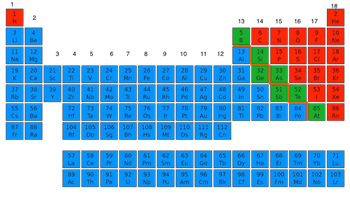
Where are the nonmetals located on the periodic table? 
a)
Blue
b)
Red
c)
Green
66.
What is the correct formula for this molecule?
a)
NH
b)
N3H
c)
NH3
d)
NH4
67.
What is the charge on an Aluminium ion?
a)
3
b)
+3
c)
+2
d)
+1
68.
What is the charge on a chloride ion?
a)
-1
b)
1
c)
+2
d)
+1
69.
What is the charge of Neon?
a)
0
b)
+1
c)
-1
d)
1
70.
How many valence electrons does hydrogen have?
a)
1
b)
2
c)
3
d)
4
71.
How many valence electrons does calcium have?
a)
2
b)
4
c)
6
d)
7
72.
Magnesium bromide is an ionic compound with the chemical formula MgBr₂.  What does the "2" tell you?
a)
There are 2 bromide ions for every magnesium ion
b)
Bromide has a 2- charge
c)
Bromide has a 2+ charge
d)
There are 2 magnesium ions to every bromide ion
73.
Which of the following is a characteristic property of ionic compounds?
a)
They form hard, brittle crystals with characteristic shapes
b)
They have low melting points
c)
They have low boiling points
d)
They contain no charged particles
74.
In what form can an ionic compound conduct electricity?
a)
when dissolved in water
b)
as a solid
c)
as a crystal
d)
when warmed slightly
75.
Elements in Group 1 lose one electron to form ions with a _________________ charge.
a)
1+
b)
2+
c)
0
d)
1-
76.
Nitrogen will ____ electrons when forming an ionic bond.
a)
gain 1
b)
lose 1
c)
gain 3
d)
lose 3
77.
Ionic bonds form between metals and ____.
a)
metalloids
b)
metals
c)
nonmetals
78.
What are ionic bonds?
a)
valence electrons transferred between atoms
b)
Inner most electrons transferred between atoms
79.
Nonmetals tend to 
a)
gain electrons
b)
lose electrons
80.
When metals bond with non-metals they form what type of bonds
a)
covalent
b)
ionic
c)
cooperative
d)
lewis
81.
How do the following two elements bond together?
Cr3+  O2-         
a)
CrO
b)
Cr3O2
c)
Cr2O3
d)
CrO3
82.
How do the following two elements bond together?
K1+  S2- 
a)
KS
b)
K8S
c)
K6S3
d)
K2S
83.
Which of the following is an ionic compound:
a)
NH4
b)
I2
c)
RbBr
d)
CO
84.
In chemical compounds, covalent bonds form when
a)
the electronegativity difference between two atoms is very large.
b)
electrons are completely transferred between two metals.
c)
pairs of electrons are shared between two nonmetal atoms.
d)
two nonmetal atoms are attracted to each other by opposite charges.
85.
What region of the periodic table contains atoms that form covalent bonds?
a)
the left side
b)
the middle
c)
the right side
d)
top left
86.
Is carbon considered a metal or a non-metal?
a)
metal
b)
nonmetal
c)
other
87.
Why do atoms share electrons?
a)
To attain the electron configuration of a noble gas.
b)
To become ions and take a charge
c)
to increase the mass
d)
it's a nice thing to do.
88.

How many electrons are shared in a single covalent bond?

a)

2 pairs

b)

4

c)

2

d)

1

89.
Which of the following is NOT formed by a covalent bond?
a)
K2S
b)
H2O
c)
I2
d)
CO2
90.
How do covalent bonds form?
a)
Donating & receiving valence e- between atoms.
b)
Opposite slight charges attract each other between compounds.
c)
Scientists are still not sure how they form.
d)
Sharing valence e- between atoms.
91.
What do we call a covalent bond where electrons are shared UNEVENLY or UNEQUALLY?
a)
Ionic
b)
Polar Covalent
c)
Nonpolar Covalent
d)
Van der Waals Force
92.

Which of the following is a covalent bonding?

a)

MgS

b)

NaCl

c)

CH4

d)

LiBr

93.

Which of the following is a non-polar covalent bonding?

a)

Carbon Dioxide

b)

Oxygen gas

c)

Ammonia

d)

Water

94.

This is an example of an ionic or covalent bond?

a)

Ionic Bonding

b)

Covalent Bonding

95.

Ionic or Covalent Bonding?

a)

Ionic Bonding

b)

Covalent Bonding

96.

Ionic or Covalent Bonding?

a)

Ionic Bonding

b)

Covalent Bonding

97.

Dot structures and stick diagrams are used to represent what types of bonds?

a)

Ionic Bonding

b)

Covalent Bonding

98.

Bonding Diagrams and the Cross Over method are usually used to demonstrate what type of bonds?

a)

Ionic Bonding

b)

Covalent Bonding

99.
Why was 6 afraid of 7?
a)
Because it has no curves
b)
Because 7 ate 9
100.
What is 1,888,999,555 x 9,444,354,657,093 x 253,654,981 x 0?
a)
0
b)
Commutative Property
c)
174,999,875,931,258,684,316