wayground logo

Free Printable Worksheets

Font size

S
M
L
XL
Worksheets

Plants and back - Review Quiz

Total questions: 111

Worksheet time: 1hrs 23mins
Name
Class
Date
1.
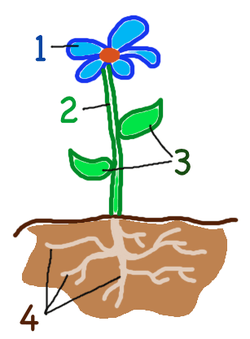
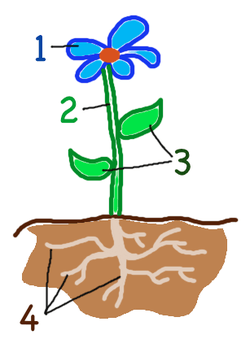
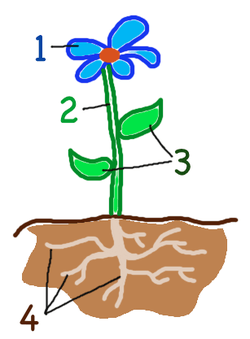
What part of the plant is #1?
a)
flower
b)
stem
c)
root
d)
leaf
2.
What part of the plant is #2?
a)
leaf
b)
flower
c)
stem
d)
root
3.
What part of the plant is #3?
a)
leaf
b)
root
c)
flower
d)
stem
4.
who uses photosynthesis 
a)
us
b)
no body
c)
i dont know 
d)
plants
5.
The function of a ___ is to absorb water, store food, and anchor plants. 
a)
flower
b)
leaf
c)
stem
d)
root
6.
What is the tissue that is used to transport necessary materials throughout the plant?
a)
Circulatory tissue
b)
Transport tissue
c)
Vascular tissue
d)
Pathway tissue
7.
Which of the following statements best describes xylem's function in the plant?
a)
transpports water and minerals up from the roots to the rest of the plant
b)
transports food down from the leaves to the rest of the plant
c)
transports water and minerals down from the roots to the rest of the plant
d)
transports food up from the leaves to the rest of the plant
8.
Which of the following statements best describes phloem's function in the plant?
a)
transpports water and minerals up from the roots to the rest of the plant
b)
transports food down from the leaves to the rest of the plant
c)
transports water and minerals down from the roots to the rest of the plant
d)
transports food up from the leaves to the rest of the plant
9.
What is the part of the flower that is brightly colored to attract pollinators?
a)
Petals
b)
Stamen
c)
Pistil
d)
Sepals
10.
What is the male part of the flower?
a)
Petals
b)
Stamen
c)
Pistil
d)
Sepals
11.
What is the female part of the flower?
a)
Petals
b)
Stamen
c)
Pistil
d)
Sepals
12.
What part of the male part of the flower makes pollen?
a)
Ovary
b)
Anther
c)
Filament
d)
Stigma
13.
What part of the male part of the flower holds up the anther?
a)
Ovary
b)
Anther
c)
Filament
d)
Stigma
14.
What part of the female part of the flower gathers pollen?
a)
Ovary
b)
Style
c)
Filament
d)
Stigma
15.
What part of the female part of the flower is a tube that pollen travels through?
a)
Ovary
b)
Style
c)
Filament
d)
Stigma
16.
What part of the female part of the flower is the place that holds the eggs?
a)
Ovary
b)
Style
c)
Filament
d)
Stigma
17.
What is the male reproductive material of plants?
a)
Seeds
b)
Pollen
c)
Fruit
d)
Sepals
18.
What are the small, green leaf-like structures that protect the flower when it is a bud?
a)
Seeds
b)
Pollen
c)
Petals
d)
Sepals
19.
What part of the flower turns into the fruit?
a)
Seeds
b)
Ovary
c)
Stamen
d)
Sepals
20.
What organelle in the leaves of plants capture light energy from the sun to complete photosynthesis?
a)
Chloroplasts
b)
Mitochondria
c)
Nucleus
d)
Ribosomes
21.
What is pollination?
a)
the transfer of pollen from the anther to the stigma
b)
the union of pollen and egg cells in the ovary of the flower
c)
the dispersal of seeds to a new location
d)
the transfer of cash in a business transaction between plants
22.
Which of the following would NOT be an example of a pollinator?
a)
Bumblebee
b)
Hummingbird
c)
Fruit Bat
d)
Praying Mantis
23.
What helps plants pollinate by carrying pollen from one plant to another?
a)
Mailman
b)
Pollinator
c)
Terminator
d)
Commentator
24.
In which type of growth response does the plant grow toward a light source?
a)
Phototropism
b)
Heliotropism
c)
Geotropism
d)
Hydrotropism
25.

Which plant parts do people sometimes eat?

a)

fruits and seeds

b)

roots, stems, flowers

c)

leaves, fruit, roots, stems, seeds, flowers

d)

leaves, stem, and roots

26.

How do plants get air?

a)

through the roots

b)

through holes in the flowers

c)

through holes in the stem

d)

through holes on underside of leaves

27.

What do plants sue to make their own food?

a)

air and water

b)

air, water, and light

c)

light and air

d)

only light

28.

Why do plants grow seeds?

a)

to reproduce (grow new seeds)

b)

to make good smells

c)

to grow flowers

d)

to grow bigger

29.

How can seeds travel from place to place?

a)

carried by air and water only

b)

carried by air, water, and animals

c)

carried by animals only

d)

carried by gravity and erosion only

30.

What is special about plants that grow in hot places?

a)

storage organ below ground, keep leaves all year, dormant in winter, smaller, roots are thick

b)

thick stems, food made in stems, water stored in stems, large leaves

c)

larger, bigger leaves, water stored in buds, shorter roots

d)

shorter roots, bigger round leaves, thins stems, reproduce quicker

31.
What do plants give off after photosynthesis?
a)
Oxygen
b)
carbon
c)
nitrogen
d)
hydrogen
32.
Plants need ________from the air for photosynthesis
a)
oxygen
b)
soil
c)
carbon dioxide
d)
sugar
33.
What molecule absorbs sunlight during photosynthesis?
a)
Epidermis
b)
thylakoid
c)
the leaf
d)
chlorophyll
34.
Which statement about photosynthesis is correct?
a)
Plants get the energy they need for photosynthesis from water.
b)
Plants get the energy they need for photosynthesis from soil.
c)
Plants get the energy they need for photosynthesis from sunlight.
d)
Plants do not require energy to perform photosynthesis.
35.
The products of photosynthesis are
a)
water and carbon dioxide
b)
oxygen and water
c)
sugar and cabon dioxide
d)
oxygen and sugar (glucose)
36.
Which gas is removed from the atmosphere during photosynthesis?
a)
hydrogen
b)
oxygen
c)
nitrogen
d)
carbon dioxide
37.
Why are plants important to life on Earth?
a)
They make our world more beautiful
b)
They make the planet look green
c)
They use carbon dioxide and give us oxygen
d)
They provide shade for insects
38.
In what part of the cell does photosynthesis occur?
a)
Nucleus
b)
Chloroplast
c)
Epidermis
d)
Vacuole
39.
After photosynthesis, plants store their energy as _________ .
a)
chlorophyll
b)
pigment
c)
glucose (sugar)
d)
Oxygen
40.
Which of the following is the smallest unit of life that can carry out all life functions?
a)
the mitochondria
b)
the vacuoles
c)
the nucleus
d)
the cell
41.
Which structures are found in every living cell?
a)
cell membrane and cytoplasm
b)
chloroplasts and mitochondria
c)
a cell wall and nucleus
d)
chloroplasts and cell wall
42.
Which cell structure is found in plant and animals cells and controls what can come into or leave a cell?
a)
cell membrane
b)
cytoplasm
c)
nucleus
d)
vacuole
43.
What is the function of the cell nucleus found in both plant and animal cells?
a)
to produce energy
b)
to control cell activity
c)
to remove waste products
d)
to allow molecules to enter the cell
44.
What is one basic function of the vacuoles?
a)
circulating oxygen
b)
producing food
c)
controlling cell processes
d)
storing water
45.
Chloroplasts in plant cells allow the plant to perform a function that animal cells cannot do.  What is the main function of the chloroplasts found in plant cells?
a)
to absorb light energy and manufacture food
b)
to remove waste materials by active transport
c)
to manufacture chemical energy from food
d)
to control the shape of the cell
46.
All cells need energy to function.  Which cell organelle is responsible for producing energy in the cell?
a)
chloroplasts
b)
mitochondria
c)
nucleus
d)
vacuoles
47.
What is the function of a cell wall?
a)
to protect and support the cell
b)
to perform different functions in each cell
c)
to prevent water from passing through it
d)
to prevent oxygen from entering the cell
48.
In what part of the plant cell does the process of photosynthesis take place?
a)
nucleus
b)
mitochondria
c)
chloroplasts
d)
vacuoles
49.
Cells with a nucleus and membrane-bound organelles are called ____________________.
a)
prokaryotes
b)
eukaryotes
c)
bacteria
d)
protists
50.
Which of the following is not part of the cell theory?
a)
cells must contain DNA 
b)
all living things are made from cells
c)
cells can only come from other cells
d)
cells are the basic unit of life
51.
Who was the first  person to see cells under the microscope and give them their name?
a)
Mattias Schleiden
b)
Robert Hooke
c)
Theordor Schwann
d)
Anton van Leeuwenhoek
52.
The basic unit of structure and function in a living things.
a)
chloroplast
b)
nucleus
c)
cell
d)
cell membrane
53.
Robert Hooke, Anton van Leeuwenhoek, Theodor Schwann, Rudolf Virchow, and Matthias Schliden were all responsible for what theory?
a)
The Theory of Gravity
b)
The Theory of Relativity
c)
The Cell Theory
d)
The Theory of Continental Drift
54.
What tool do you use to view the cells?
a)
metric ruler
b)
centrifuge
c)
microscope
d)
telescope
55.
Which of the following is NOT a cell theory.
a)
All non-living things are made of cells
b)
All cells come from pre-existing cells
c)
Cells are the basic unit of structure and function of all living things
56.
All living things are made up of...
a)
cells
b)
cell tissues
c)
organ
d)
organ systems
57.
All cells come from___________ cells.
a)
pregnant
b)
pre-existing
c)
paternal
d)
pin size
58.
Rocks are not living because
a)
they never move
b)
they aren't needed for humans
c)
they are not made of cells
d)
they don't break down
59.
All cells are produced ____________.
a)
From pre-existing and deceased cells
b)
from other pre-existing cells
c)
Cells can come from anywhere, as long as there is the sun.
60.
What is one way in which all living things on Earth are alike?
a)
All living things have hair.
b)
All living things are made of cells and come from other cells.
c)
The cells of all living things have chloroplast.
d)
All living things can move. 
61.
what is a cell classified as?
a)
a basic unit of structure and function of all living organisms
b)
a unit based on only plants and animals that are living
62.
How are unicellular organisms different from multicellular organisms? 
a)
There are no differences.
b)
They are made of many cells. 
c)
They are only classified as prokaryotes.
d)
They are made of only one cell. 
63.
A possible explanation to a problem that has not yet been tested. 
a)
data
b)
theory
c)
hypothesis
d)
fact
64.
A possible explanation to a problem that has not yet been tested. 
a)
data
b)
theory
c)
hypothesis
d)
fact
65.
This variable in an experiment is the one being deliberately changed by the scientist. 
a)
dependent variable
b)
independent variable
c)
data
d)
control group
66.
What step does every scientific experiment begin with?
a)
hypothesis
b)
question/problem
c)
procedures
d)
conclusion
67.
The summary at the end of an experiment that explains the results. 
a)
conclusion
b)
procedures
c)
materials
d)
responding variable
68.
Testing a hypothesis often involves a(n):
a)
answer
b)
experiment
c)
problem
d)
safety check
69.
Observations made during an experiment are called:
a)
data
b)
problems
c)
conclusions
d)
questions
70.
Which is NOT a step in the scientific method?
a)
Make observation
b)
Form a theory
c)
Collect data
d)
Form a hypothesis
71.
Should experiments be repeated over and over to see if the results are the same each time?
a)
yes
b)
no
72.
There are two types of data. Which type of data involves numbers that are obtained by counting or measuring?
a)
quantitative
b)
qualitative
73.
There are two types of data. Which type of data involves descriptions that cannot be counted or measured?
a)
qualitative
b)
quantitative
74.
A series of steps used by scientists to solve a problem or answer a question. 
a)
scientific method
b)
recipe
c)
data collection
d)
metric system
75.
Measuring the number of times a person breathes after exercise involves ____ data. 
a)
quantitative
b)
qualitative
76.
Recording data on how yellow or orange leaves turn in October by describing them as "green" "slightly yellow" "very yellow" or "orange" is ____ data
a)
quantitative
b)
qualitative
77.
Which variable depends on what is done at the beginning of an experiment?
a)
Dependent
b)
Independent
c)
Control
d)
Following
78.
When experimenting with the growth of a plant, a scientist uses three (of the same type of) plants, two different fertilizers, equal light, and equal water. What type of variable is the fertilizer?
a)
Dependent
b)
Independent
c)
Control
d)
Compound
79.
The base unit of metric length.
a)
Meter
b)
Liter 
c)
Kilogram
d)
milligram
80.
How many cm's is in a meter?
a)
1000
b)
10
c)
100
d)
1
81.
The appropriate abbreviation of centimeter is..
a)
cm
b)
Cm
c)
cM
d)
CM
82.
m stands for....
a)
millimeter
b)
meter
c)
centimeter
d)
Liter
83.
What is the length of the eraser?
a)
3 cm 
b)
2 cm 
c)
5 cm
d)
7 cm
84.
Using your senses to gather information.
a)
hypothesis 
b)
observation 
c)
seeing 
d)
guessing 
85.
Heterozygous is when...
a)
the alleles are the same
b)
the alleles are different
c)
the alleles are absent
d)
the alleles are present
86.
T - tall and t = short
In the punnett square below, what belongs in the missing square
a)
tt
b)
Tt
c)
Bb
d)
TT
87.
In a heterozygous genotype, the ___________ allele takes over in the phenotype.
a)
recessive
b)
dominant
c)
lower case letter
d)
both 
88.
G = green, g = yellow
The genotype for a yellow plant is...
a)
GG
b)
Gg
c)
gg
d)
all of the choices result in yellow
89.
B = brown fur  b = white fur
In the punnett square, what is the probability for white fur? 
a)
0%
b)
25%
c)
50%
d)
75%
90.
Which of the following alleles is homozygous (purebred) recessive?
a)
Tt
b)
tt
c)
TT
d)
t
91.
Dominant alleles are represented by a:
a)
Male gene
b)
lowercase letter
c)
recessive trait
d)
capital letter
92.
AA and Aa always show up as
a)
dominant
b)
recessive
93.
aa always shows up as
a)
dominant
b)
recessive
94.
Which of the following genotypes is heterozygous?
a)
Bb
b)
BB
c)
bb
d)
B
95.
Which of the following genotypes is homozygous dominant?
a)
A
b)
Aa
c)
AA
d)
aa
96.
Which of the following is homozygous recessive?
a)
Tt
b)
tt
c)
TT
d)
T
97.
Which of the following is homozygous dominant?
a)
Yy
b)
Y
c)
yy
d)
YY
98.
What does sponge bob live in
a)
Corn
b)
Pin Apple
c)
Pine Apple 
99.

Who is this?

a)

Sponge the bob

b)

Bobbbbb

c)

Not here.

d)

Spongebob

100.
What color is Sponge bob?
a)
yellow
b)
blue
c)
green 
d)
purple 
101.
Who is Sponge bob's pet?
a)
Gary 
b)
The flying Dutchman
c)
Mrs.Puff
d)
Fish #7
102.
What is Patrick?
a)
Star fish 
b)
whale 
c)
sponge
d)
krab
103.

where does sponge bob work

a)

chum bucket

b)

the pineapple

c)

crusty crab

104.
What does Sponge bob have over his head when he said "imagination"?
a)
A rainboe
b)
A rainbow
c)
a spider
d)
a bunny 
105.
If there is an accident who should you inform?
a)
a student
b)
the teacher
c)
the custodian
106.
What type of shoes should you wear to science lab?
a)
open toe
b)
closed toe
107.
Should you eat or drink in the lab or eat, drink, or sniff the chemicals in the lab?
a)
No
b)
Yes
108.
Never do anything not in the lab instructions or without your teacher's permission.
a)
True
b)
False
109.
What should you do when gathering materials for an experiment?
a)
 A. Read all directions carefully
b)
B. Check all materials for chips or cracks (or broken)
c)
Clean the materials if they seem dirty/used
d)
D. All of the above
110.
Horseplay or practical jokes in the laboratory are...
a)
always against the rules.
b)
okay.
c)
not dangerous.
d)
okay if you are working alone.
111.
You may eat whenever food is used during a lab.
a)
True
b)
False