wayground logo

Free Printable Worksheets

Font size

S
M
L
XL
Worksheets

4th CAT 19

Total questions: 185

Worksheet time: 4hrs 46mins

Name
Class
Date
1.
An inherited trait that helps those organisms that have it to survive
a)
niche
b)
structure
c)
characteristic
d)
adaptation
2.
An animal that is hunted as food
a)
prey
b)
predator
c)
decomposer
d)
producer
3.
An organism that hunts and feeds on another organism is a ______________________.
a)
prey
b)
producer
c)
predator
d)
decomposer
4.
The space, conditions and all the living and non-living things around an organism is its _________________.
a)
home
b)
environment
c)
neighborhood
d)
ecosystem
5.
Coloring or another physical characteristic that help an organism blend in with its environment
a)
mimicry
b)
camouflage
c)
hibernation
d)
migration
6.
A natural process in which new organisms are created and the species continues
a)
population
b)
niche
c)
reproduction
d)
behavior
7.
The role an organism plays in its ecosystem
a)
niche
b)
behavior
c)
structure
d)
function
8.
When an organism copies a characteristic of something else in order to better its chances for survival and reproduction
a)
hibernation
b)
camouflage
c)
mimicry
d)
migration
9.
The seasonal movement of an organism from one place to another
a)
camouflage
b)
migration
c)
hibernation
d)
function
10.
When an organism slows its life functions for a period of time to better its chances for survival during harsh conditions
a)
camouflage
b)
migration
c)
mimicry
d)
hibernation
11.
When an organism slows its life functions for a period of time to better its chances for survival during harsh conditions
a)
camouflage
b)
migration
c)
mimicry
d)
hibernation
12.
The place or environment where an organism naturally lives
a)
function
b)
habitat
c)
community
d)
ecosystem
13.
A group of organisms which are similar to each other and can combine to have offspring
a)
species
b)
characteristic
c)
club
d)
organisms
14.
features that help identify something
a)
appearance
b)
characteristics
c)
behaviors
d)
structures
15.
Function is ________________________.
a)
the way something looks
b)
how something sounds
c)
what something does
d)
the role of an organism
16.
Function is ________________________.
a)
the way something looks
b)
how something sounds
c)
what something does
d)
the role of an organism
17.
A group of organisms of the same species
a)
ecosystem
b)
community
c)
population
d)
group
18.
All the populations in a specific area or region
a)
community
b)
ecosystem
c)
population
d)
species
19.
1. What is an adaptation?
a)
A feature or behavior that helps an animal survie.
b)
The food that an animal eats.
c)
How energy moves in a food web.
20.
This is a period of deep sleep that occurs in some animals when outside temperatures are cold: ______
a)
hibernation
b)
migration
21.
How do adaptations help animals?
a)
To hide from predators
b)
to hunt for food
c)
to survive in their habitats
d)
All of these are correct
22.
An example of a physical adaptation is...
a)
a turtle hiding inside its shell
b)
The spikes on a porcupine fish
c)
a rabbit burrowing underground
d)
a viper biting when threatened
23.
Why do some animals hibernate?
a)
The cold weather makes them sleepy.
b)
Their food supply is smaller in the winter.
c)
They have no one to play with.
24.
Some animals move great distances as the seasons change.  What is this called?
a)
hibernation
b)
migration
c)
habitat
d)
coloration
25.
 Which of these BEST describes how some birds survive when the weather gets cold? 

     
a)
 a.   They store twigs and sticks in their nest 
b)
 b. They migrate to a warmer climate 
c)
 c. They grow more feathers to stay warm in the winter 
d)
 d. They hide in bushes and wait for warm weather 
26.
Some animals move great distances as the seasons change.  What is this called?
a)
hibernation
b)
migration
c)
habitat
d)
coloration
27.
Lions often hide in the tall grass while stalking their prey.  This is an example of...
a)
camouflage
b)
warning coloration
c)
mimicry
d)
hibernation
28.
Lions often hide in the tall grass while stalking their prey.  This is an example of...
a)
camouflage
b)
warning coloration
c)
mimicry
d)
hibernation
29.
Cactus has spines instead of leaves. The spines reduces water loss through the stomata.
a)
Structural
b)
Behavioural
30.
Which feature of a rose helps it grow without being eaten by large animals?
a)
flowers with bright colors
b)
sharp thorns
c)
small seeds
d)
deep roots
31.
Which adaptation would NOT help a hawk catch a mouse?
a)
Hollow Bones 
b)
Good eye sight
c)
Talons
d)
Camouflage
32.
An example of a physical adaptation is...
a)
a turtle hiding inside its shell
b)
The spikes on a porcupine fish
c)
a rabbit burrowing underground
d)
a viper biting when threatened
33.
Which feature helps an animal hide from other animals?
a)
looking like a dangerous animal
b)
being the same color as the place it lives (camoflauge)
c)
having sharp claws or a strong shel
d)
having only a few young and caring for them
34.
Some plants have small leaves that help them do which of these?
a)
grow tall
b)
save water
c)
make seeds
make seeds
d)
fall off in winter
35.
A nice smell is an adaptation that __________________.
a)
helps the plant keep water inside the leaves.
b)
pokes animals that try to eat the plant.
c)
attracts pollinators to the plant.
36.
How are hardwood trees adapted to live in cold winters?
a)
They have long stems buried in mud.
b)
They live on tree islands.
c)
They lose their leaves in winter.
d)
They grow low to the ground.
37.
What does it mean to survive?
a)
To stay alive
b)
To grow
c)
To have energy
d)
To be born
38.
What is a trait?
a)
plant
b)
an adaptation
c)
a characteristic or feature
39.
What does it mean to reproduce?
a)
to eat things
b)
to make things pretty
c)
to produce energy
d)
to produce new living things
40.
What does it mean to survive?
a)
To stay alive
b)
To grow
c)
To have energy
d)
To be born
41.
The Prickly Pear Cactus can grow in a dry environment because.....
a)
it is able to story water
b)
it has spiny leaves
c)
is carnivorous
d)
collects salt
42.
The Bald Eagle has __________.
a)
keen eyesight
b)
sharp talons
c)
sharp beak
d)
all of the above
43.
A trait that helps a living thing survive.
a)
instinct
b)
mimicry
c)
camouflage
d)
adaptation
44.
Which adaptation (for the underlined animal) serves the function of defense?
a)
A walking stick looks like the twig on which it rests.
b)
A porcupine’s quills cause a predator to seek another meal.
c)
A whale filters plankton and krill from the water in which it swims.
d)
A penguin is dark on top and white below to blend in with the water.
45.
Plants with spines and waxy leaves are well suited for life in which environment?
a)
Desert
b)
Temperate forest
c)
Grassland
d)
Tropical Rainfroest
46.
Dandelions have light furry seeds that allow them to spread easily. 
a)
True
b)
False
47.
Dandelions have light furry seeds that allow them to spread easily. 
a)
True
b)
False
48.
Why do animals use camouflage?
a)
To look pretty
b)
To stay safe
c)
To play Hide and Go Seek
d)
To eat food
49.
The raccoon has hands and feet.  Why would the raccoon need this adaptation?
a)
to fight
b)
to help them find and pick up food
c)
to hang from trees
d)
to dig a tunnel
50.
A Porcupine has sharp quills.  Why would a porcupine need this adaptation?
a)
to protect itself
b)
to keep warm
c)
to kill its prey
d)
to cover its skin
51.
 A giraffe has a long neck.  Why would the giraffe need this adaptation?
a)
to keep warm
b)
to reach food high above the ground
c)
to have room to eat more
d)
to catch birds
52.
Being able to move around to find resources that animals need. Adaptation: A bunny hopping around looking for food.
a)
HIbernation
b)
Locomotion
c)
Migration
d)
Food Obtainment
53.
How an animal gets food?
a)
Defense
b)
Camouflage
c)
Food Obtainment
d)
Life Cycle
54.
Traveling done by an animal to find food and water. 
Adaption: birds flying south for the winter
a)
Camouflage
b)
Migration
c)
Hibernation
d)
Locomotion
55.
A resting state through the winter. 
Adaptation: Bear sleeping in a cave during the winter months
a)
Locomotion
b)
Hibernation
c)
Migration
d)
Defense
56.
Color or pattern that helps an animal blend in with its habitat
Adaptation: polar bears in the Artic
a)
Hibernation
b)
Locomotion
c)
Camouflage
d)
Migration
57.
What do you call an animal that is hunted by another animal?
a)
prey
b)
predator
c)
producer
d)
herbivore
58.
Some animals have bright colors to warn other animals to stay away (because of toxins or harmful effects).  This is called...?
a)
camouflage
b)
instinct
c)
mimicry
d)
warning coloration
59.
The way an animal behaves in a group in order to survive is called...?
a)
hibernation
b)
social interaction
c)
herding
d)
population
60.
What do you call an animal that only eats other animals?
a)
herbivore
b)
prey
c)
predator
d)
carnivore
61.
A bird's nest gets blown out of a tree during a strong storm.  How will the bird adapt?
a)
It will build a new nest.
b)
It will die.
c)
It will migrate.
d)
It will hibernate
62.
Which animal would hibernate to survive throughout the winter months?
a)
bear
b)
deer
c)
bird
d)
wolf
63.
An animal that only eats plants is called a ...?
a)
predator
b)
carnivore
c)
omnivore
d)
herbivore
64.
A wasp beetle has the same body markings as a wasp.  this helps the wasp beetle because predators think it's a wasp.  This adaptation is called...?
a)
behavior
b)
countershading
c)
camouflage
d)
mimicry
65.
Lions often hide in the tall grass while stalking their prey.  This is an example of how __________ helps them to survive.
a)
camouflage
b)
warning coloring
c)
mimicry
d)
hibernation
66.
Michael went to the circus and saw a seal balance a beach ball on its nose.  This is an example of a(an)...?
a)
instinct
b)
learned behavior
c)
mimicry
d)
camouflage
67.
Some zebras watch for predators while others eat.  This is an example of...?
a)
migration
b)
social interaction
c)
hibernation
d)
mimicry
68.
Animals that are herbivores usually have...?
a)
sharp teeth for tearing
b)
no teeth
c)
flat teeth for grinding
d)
pointed teeth for stabbing
69.
A behavior an animal is born knowing how to do is called a(an)...?
a)
instinct
b)
learned behavior
c)
camouflage
d)
body covering
70.
Some animals are dark on the upper part of their body and lighter underneath.  This type of camouflage is called...?
a)
warning coloration
b)
countershading
c)
mimicry
d)
none of the above
71.
Which example below is NOT an adaptation that helps a beaver survive?
a)
The beaver's webbed feet help it swim.
b)
The beaver's pointed teeth help it tear meat.
c)
The beaver's fur is oily which makes it waterproof.
d)
The beaver has flat teeth for ching bark and other plant material.
72.
How do elephants keep their bodies cool on very warm days?
a)
They flap their ears to cool their blood.
b)
They move to shady areas.
c)
They look for water holes so they can splash water and mud on their bodies.
d)
All of these are true.
73.
Why does a skunk have a bright white stripe down its back?
a)
The stripe provides camouflage.
b)
The stripe contains poison.
c)
I helps blend in with the snow.
d)
It warns predators that  it is harmful in some way.
74.
Which example below is a physical adaptation?
a)
Young lions play together.
b)
Zebras form a herd and watch for predators.
c)
A bird builds a nest.
d)
A deer has flat teeth for chewing plants.
75.
Which example below is a physical adaptation?
a)
Young lions play together.
b)
Zebras form a herd and watch for predators.
c)
A bird builds a nest.
d)
A deer has flat teeth for chewing plants.
76.

Which covers birds and helps them fly?

a)

sharp teeth

b)

feathers

c)

webbed feet

d)

shell

77.

Which helps animals eat meat?

a)

feathers

b)

camouflage

c)

sharp teeth

d)

gills

78.

Which can help animals breathe under water?

a)

gills

b)

sharp teeth

c)

claws

d)

feathers

79.

Which can help an animal swim?

a)

shell

b)

camouflage

c)

webbed feet

d)

sharp teeth

80.

What do seals and polar bears have under their fur to help them stay warm?

a)

feathers

b)

shell

c)

gills

d)

a layer of blubber

81.

What did our water/glove experiment show?

a)

that the gloved hand got colder

b)

that the hand without a glove got colder

82.

Which helps an animal stay warm?

a)

fur

b)

claws

c)

sharp teeth

d)

webbed feet

83.

Which can help an animal swim?

a)

shell

b)

camouflage

c)

webbed feet

d)

sharp teeth

84.
Survival of the Fittest and Evolution were proposed by what scientist?
a)
Charles Darwin
b)
Albert Einstein
c)
Steven Hawking
d)
Isaac Newton
85.
What are the most studied animals in the galapagos?
a)
Finches
b)
Tortoises
c)
Turtles
d)
Lizards
86.
What is the advantage of having different shaped beaks?
a)
To look different from other species.
b)
To be able to eat the food readily available in the environment.
c)
To protect itself against predators.
d)
To protect itself against prey.
87.
The theory of evolution by natural selection means that what is changing over time?
a)
The inherited traits of a population.
b)
The acquired traits of a population.
c)
Hair color and eye color
d)
Attractive features.
88.

What word describes a trait that helps an organism survive in its environment?

a)

natural selection

b)

mutation

c)

camouflage

d)

adaptation

89.
Do organisms "decide" to evolve and change?
a)
Yes, they know they need to change to survive 
b)
No, they change because of natural selection
90.
The differences among a species, like different bird beaks, are called
a)
genes.
b)
variations.
c)
traits.
d)
theories.
91.
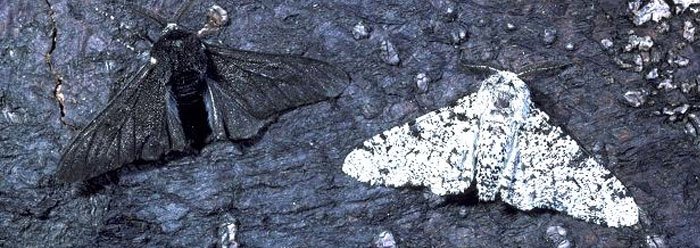
The trees these moths used to live on were white, but have been covered in soot from coal factories. Which moth will be more successful in this environment?
a)
Dark moth
b)
Light moth
c)
Both will be equally successful
d)
Neither will be successful
92.
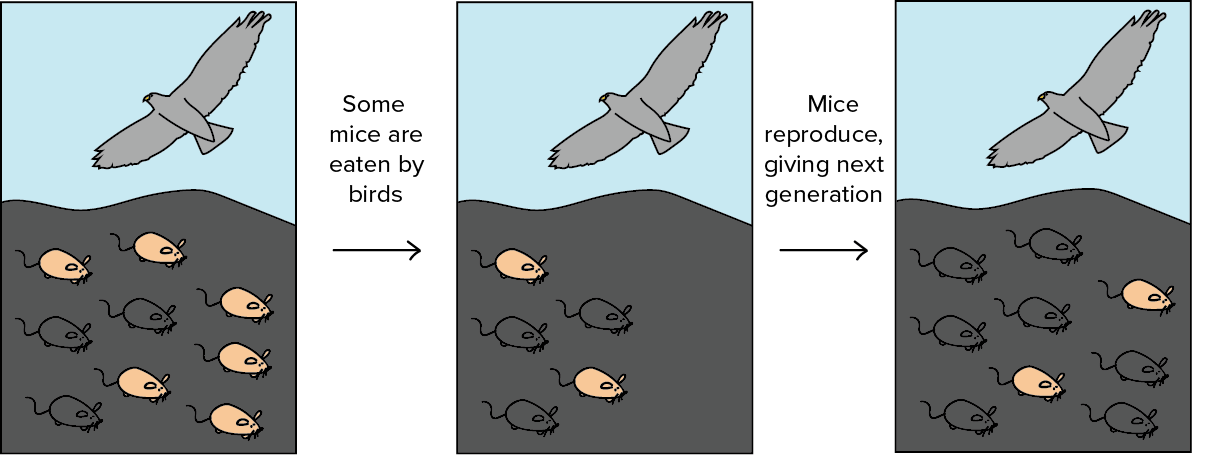
Why is the mouse population changing over time?
a)
The light mice can reproduce more successfully than the dark mice
b)
The hawks eat more dark mice than light mice because the dark mice taste better
c)
The hawks eat more light mice than dark mice because they can see the light mice more easily
d)
The hawks eat more dark mice than light mice because they can see the dark mice more easily
93.

Organisms that are better adapted to the environment survive to pass traits to their offspring is known as

a)

Natural Selection

b)

Homeostasis

c)

Selective Breeding

d)

Extinction

94.
Selective breeding is where ___________ decides which traits should be passed on
a)
Nature
b)
 A human
c)
Mr. Holt
d)
The illuminati
95.
Natural selection is where ___________ decides which traits should be passed on
a)
Nature
b)
A human
c)
Mr. Holt
d)
The illuminati
96.

The Prickly Pear Cactus can grow in a dry environment because.....

a)

it is able to store water

b)

it has spiny leaves

c)

is carnivorous

d)

collects salt

97.

Xylem tubes transport..

a)

Water

b)

Mineral ions

c)

Food substances (e.g. sucrose)

98.
Natural selection is where ___________ decides which traits should be passed on
a)
Nature
b)
A human
c)
Mr. Holt
d)
The illuminati
99.
This is a period of deep sleep that occurs in some animals when outside temperatures are cold: ______
a)
hibernation
b)
migration
100.
Why is the mouse population changing over time?
a)
The light mice can reproduce more successfully than the dark mice
b)
The hawks eat more dark mice than light mice because the dark mice taste better
c)
The hawks eat more light mice than dark mice because they can see the light mice more easily
d)
The hawks eat more dark mice than light mice because they can see the dark mice more easily
101.

The space, weather conditions, and non-living things around an organism is its _________________.

a)

adaptation

b)

environment

c)

variations

d)

ecosystem

102.

An inherited trait that helps those organisms to survive

a)

niche

b)

variation

c)

characteristic

d)

adaptation

103.
A group of organisms which are similar to each other and can combine to have offspring
a)
species
b)
characteristic
c)
club
d)
organisms
104.

A giraffe has a long neck in order to better reach leaves to eat. This occurred by _____

a)

an adaptation being naturally selected for and passed through many generations

b)

giraffes stretching their necks to reach leaves, and passing their new long necks to their offspring

c)

an adaptation being passed through one generation

d)

giraffes with short necks all becoming extinct at once, and longer neck giraffes reproducing

105.
Which of the following is a physical adaptation for the underlined animal?
a)
A butterfly has bright colors to warn predators that it is poisonous.
b)
A hognose snake rolls over, slows its breathing, and hangs its tongue out to play dead.
c)
A herd of buffalo encircle their young to protect them from a pack of wolves.
d)
A dung beetle rolls a piece of dung across the desert.
106.
How do adaptations help animals?
a)
To escape animals
b)
to hunt for food
c)
to survive in their habitats
d)
All of these are correct
107.

Being able to move around to find resources that animals need. Adaptation: A bunny hopping around looking for food.

a)

HIbernation

b)

Locomotion

c)

Migration

d)

mimicry

108.

Being able to move around to find resources that animals need. Adaptation: A bunny hopping around looking for food.

a)

HIbernation

b)

Locomotion

c)

Migration

d)

mimicry

109.
How an animal protects itself Adaptation: Skunk and its spray
a)
Defense
b)
Hibernation
c)
Locomotion
d)
Migration
110.

Many birds can use their beaks to pick up small objects. This function of the birds’ beaks helps birds survive in a particular environment. Picking up small objects is

a)

a variation that helps birds drink water

b)

a variation that helps birds hunt prey

c)

an adaptation that helps birds escape from predators

d)

an adaptation that helps birds collect materials for a nest

111.

Penguins huddle close together to keep warm. What type of adaptation is this?

a)

Structural

b)

Behavioral

112.

Where do variations come from?

a)

variations come from evolution

b)

variations come from the environment

c)

variations are caused by random mutations to body structures

d)

variations are caused by random mutations to DNA

113.

Which of these responses to an environment do you recognize as a behavioral adaptation?

a)

a clownfish seeking shelter in a poisonous sea anemone

b)

a bird having hollow bones for flying

c)

a bird having a pointed beak to grasp small seeds

d)

a tiger having stripes to camouflage itself from prey

114.
A giraffe has a long neck in order to better reach leaves to eat.  This is an example of _____. 
a)
an adaptation
b)
environment
c)
response
d)
stimulus
115.
Some forest plants have wide ________ that help them collect light.
a)
thorns
b)
stems
c)
adaptations
d)
leaves
116.
The part of the plant that holds the plant in place and absorbs water and minerals from the soil.
a)
stem
b)
roots
c)
leaves
117.
An example of a plant adaptation is ______________.
a)
its color
b)
its use
c)
its environment
118.
Some trees shed their leaves in time for winter. How is this adaption useful?
a)
The trees save energy during the darker, colder months.
b)
The trees take in more sunlight through their branches.
c)
The trees attract animals to spread their seeds.
d)
The trees blend into their environment and hide.
119.
The roots of cacti are usually shallow and spread out widely. How does this adaptation help the plants?
a)
The roots can take in more sunlight to grow faster.
b)
The roots can get up to the surface faster to get air.
c)
The roots can collect water quickly when it rains.
d)
The roots can spread pollen faster and reproduce.
120.

A nice smell is an adaptation that __________________.

a)

helps the plant keep water inside the leaves.

b)

pokes animals that try to eat the plant.

c)

attracts pollinators to the plant to help it reproduce.

121.

Parrots have special feet, with two toes on the front and back to help them cling to branches.

a)

Behavioral Adaptation

b)

Structural/Physical Adaptation

122.
Plants have adaptations to protect them from animals.
a)
True
b)
False
123.

An example of a plant adaptation is ____________.

a)

colorful flowers

b)

seeds with hooks

c)

large leaves

d)

all of the above

124.

When a rabbit's fur turns white in the winter, it is better able to hide from predators. This adaptation is called __________.

a)

camouflage

b)

fur trade

c)

fur exchange

d)

hide and seek

125.

How has a camel adapted to life in the desert?

a)

It does not need water ever.

b)

It stores water in the hump on its until it needs it.

c)

It carries a water bottle at all times.

d)

It sucks on Lifesavers.

126.

How has a giraffe adapted to finding food high in a tree?

a)

It is able to climb trees.

b)

It kicks the tree until food falls to the ground.

c)

It has developed a very long neck to reach the food in the tree.

d)

It orders pizza.

127.

Some species of birds have adapted to cold weather by flying south where it is warmer. This adaptation is called ___________.

a)

meditation

b)

migration

c)

migraine

d)

moving on up

128.

Certain species of mammals, like bears, are famous for adjusting to the winter season by hibernating. This means they __________________________.

a)

run around fast to stay warm.

b)

kill other animals and wrap up in their fur.

c)

turn on their electric blanket.

d)

sleep through the whole winter, using their body fat as fuel.

129.

Fish have adapted to life under water by using ________ to breathe.

a)

oxygen tanks

b)

gills

c)

lungs

d)

snorkels

130.

How has the cheetah adapted to catch its prey?

a)

By driving a really sweet car!

b)

By hypnotizing the animal it wants to eat.

c)

By throwing rocks at other animals to slow them down.

d)

By developing powerful legs capable of running up to 60 miles per hour.

131.
The shape of a bird’s foot is an adaptation that helps the bird survive in its environment. Which foot is most likely an adaptation of a bird that needs to swim to find food?
a)
A
b)
B
c)
C
d)
D
132.
Which best describes how a porcupine defends itself from predators?
a)
it changes color
b)
it has sharp quills
c)
it moves very rapidly
d)
it makes a loud noise
133.
Why do animals like monkeys have long arms and tails?
a)
to hug each other
b)
to wrap around them to stay warm
c)
to swing quickly from tree branches
d)
to high-five each other
134.
Why do some animals play dead or mimic themselves to look like something else?
a)
to play games with friends
b)
to defend themselves
c)
it's tired of how it looks
d)
it helps them hibernate
135.
Animals such as elephants and walruses have tusks. How does this help them?
a)
Tusks help them swim.
b)
Tusks help them camouflage.
c)
Tusks look pretty to other animals.
d)
Tusks protect the animal when fighting.
136.
Which of the following is an adaptation that helps a seal survive in a cold habitat?
a)
blubber
b)
body shape
c)
skin color
d)
sharp teeth
137.
Which of these is NOT A PART of hibernation?
a)
eat a lot of food
b)
slow breathing
c)
summer
d)
burrow
138.
What are chameleons most famous for?
a)
being able to change the color of their skin
b)
for shedding their skin
c)
for their appetite
d)
for being friendly creatures
139.
Which of these animals migrate?
a)
birds
b)
fish
c)
insects
d)
all of these migrate
140.
Some animals migrate because it is either too hot or too _________.
a)
crowded
b)
cold
c)
careful
d)
just right
141.
Animals can migrate a few miles or several thousand miles.
a)
True
b)
False
c)
No Clue
d)
Both true and false
142.
Birds and bats tend to fly _________ for the winter.
a)
north
b)
west
c)
south
d)
east
143.
Anoles are the lizards sold as chameleons in South America.
a)
True
b)
False
c)
Not sure
144.
What feature on a chameleon helps them in their ability to grasp branches?
a)
their forearms
b)
their two groups of toes
c)
their ears
d)
their tail
145.
How does a toad make itself look scarier?
a)
It turns another color
b)
It makes it's body bigger
c)
It sticks out it's tongue
d)
It plays dead
146.
What happens if giraffes can not reach the leaves of the tree that they are attempting to eat from?
a)
They will eventually die of hunger
b)
They will push the tree until it falls
c)
They will steal food from elephants
d)
They really do not have to eat
147.
Where does a box turtle hide when it is frightened?
a)
on the side of the road
b)
in it's shell
c)
under a car
d)
in a cage
148.
Colorful flowers with a sweet smell help some plants meet their needs by:
a)
attracting insects
b)
collecting sunlight
c)
survive the cold
d)
absorb rainwater
149.
The bright, red color of the male cardinal is an adaptation that helps it to
a)
hide from predators
b)
find the food it eats
c)
absorb sunlight for warmth
d)
look attractive to females
150.

What is a variation?

a)

a physical trait that helps an organism survive and reproduce

b)

any difference between organisms

c)

any inheritable trait

d)

an adaptation that helps an organism survive and reproduce

151.

What word describes a trait that helps an organism survive in its environment?

a)

natural selection

b)

mutation

c)

camouflage

d)

adaptation

152.
Organisms that are better adapted to the environment survive to pass traits to their offspring
a)
Natural Selection
b)
Homeostasis
c)
Selective Breeding
d)
Extinction
153.
Some forest plants have wide ________ that help them collect light.
a)
thorns
b)
stems
c)
adaptations
d)
leaves
154.
Some trees shed their leaves in time for winter. How is this adaption useful?
a)
The trees save energy during the darker, colder months.
b)
The trees take in more sunlight through their branches.
c)
The trees attract animals to spread their seeds.
d)
The trees blend into their environment and hide.
155.
What is the advantage of having different shaped beaks?
a)
To look different from other species.
b)
To be able to eat the food readily available in the environment.
c)
To protect itself against predators.
d)
To protect itself against prey.
156.
All of the following statements are reasons for selective breeding except:
a)
To produce offspring with desirable characteristics
b)
Farmers increase their profit by improving crops
c)
To improve the quality of food products
d)
To increase migration patterns
157.

Why are the gills of the fish an internal adaptation?

a)

The gills don't help the fish eat so they are considered an external adaptation.

b)

Gills allow the fish to swim faster and stronger

c)

The gills are within the fish and allows the fish to survive as they capture oxygen from the water.

d)

Gills are not considered an adaptation

158.

What internal adaptation do plants have that allow the transportation of water?

a)

Leaves

b)

Phloem

c)

Root

d)

Xylem

159.
Which term refers to a farmer choosing the best corn from this year to plant next year?
a)
natural selection
b)
selective breeding
c)
genetic engineering
d)
genetic transformation
160.

Evidence shows that the wolf is the ancestor to all of the breeds of dogs shown below. How did this variation arise in a relatively short period of time?

a)

Genetic manipulation

b)

Natural selection

c)

Random chance

d)

Selective breeding

161.

Hollow bones in birds is a perfect example of?

a)

Hollow birds help with the mating dance.

b)

How birds find food

c)

A feature that most other animals also have.

d)

An internal adaptation that allows bird to survive.

162.

Xylem tubes transport..

a)

Water & minerals

b)

Chlorophyll

c)

Food substances (e.g. glucose)

163.

Why do animals hibernate?

a)

To survive the extreme cold

b)

To escape predators

c)

To survive the extreme heat

d)

To find food

164.
A table of arachnid and insect characteristics is shown. Which characteristic could be used to distinguish between
arachnids and insects?
a)
Jointed legs
b)
Body segments
c)
Presence of eyes
d)
Presence of antennae
165.
What adaptation does this squirrel have that allows it to glide through the air?
a)
Extra skin under the arms and legs to capture air as it falls.
b)
Big ears to capture are as it falls
c)
Small eyes to see where it will land
d)
A short thin tail
166.
The polar bear's white fur allows it to hide in the cold arctic. This adaptation is called________________.
a)
White on white
b)
Camouflage
c)
Color matching
d)
behavioral adaptation 
167.
Polar bears have an adaptation that allows them to swim. What is most likely this adaptation?
a)
White coat
b)
Fat belly
c)
Small eyes
d)
Webbed Feet
168.
Most desert plants have spines. How does this adaptation help them survive in a harsh environment?
a)
The spines capture water
b)
The spines make it colder
c)
The spines will make it rain
d)
The spines will protect the plant from animals that want to eat it
169.
Cactus have a thick, hard surface (cuticle) that prevent ______________ from evaporating.
a)
Water
b)
Air
c)
Sugar
d)
light
170.
What is the function (job) of fish gills?
a)
To absorb water from the water
b)
To make the fish faster
c)
To make the fish lighter
d)
To absorb oxygen from the water
171.
The feet of this bird tell us that this animal can...
a)
Run fast
b)
Swim 
c)
Fly fast
d)
Climb rocks 
172.
What adaptation most likely helps this bird fly?
a)
A strong beak
b)
Small feet
c)
Hollow bones 
d)
The color of the bird
173.
Xylem is a plant adaptation that allows plants to transport ______________ up the stem.
a)
Salt 
b)
Sugar
c)
Water
d)
Coffee
174.
Why do hollow bones help birds during flight?
a)
Hollow bones make the birds weigh less
b)
Hollow bones are full of heavy blood
c)
Hollow bones store water
d)
Hollow bones are made of feathers 
175.
Birds migrate during the winter to less cold areas. What type of adaptation is this?
a)
Behavioral 
b)
Physiological 
176.
Some plants such as beets, onions and tulips have physical adaptations that allows them to store energy for the next season. What are these types of roots called?
a)
Dubs
b)
Bulbs
c)
Xylem
d)
Phloem 
177.
Anteaters have a long thin snout and even longer tongue. What is this adaptation most likely for?
a)
To reach through small tunnels in the ground where it can find insects.
b)
To reach for fruits in trees
c)
To fight off predators 
d)
'to lick himself after eating 
178.
The Great Horned Owl has his eyes in the front of his head. What can you conclude about this fact?
a)
The Horned Owl is a prey
b)
The Horned Owl is a predator
179.
Goats have eyes on the side of the head. What does this adaptation say about the animal?
a)
He is a prey, and it allows goats to have a wide viewing range
b)
He is a prey, and it allows goats to have a smaller viewing range.
c)
Goats are predators 
d)
Goats are predators, and this allows them to see more
180.
Define Adaptation.
a)
How an organism has NOT changed and continues to live in an environment 
b)
All animals can live in any environment 
c)
How an organism grows over time
d)
Special features or behaviors that allow an animal to survive in an environment.
181.
Hibernation is a ____________________ adaptation that allows animals to survive at times where food is not available.
a)
physical 
b)
behavioral 
182.
This stick insect is using ________________ to blend in to it's environment. 
a)
air 
b)
terra
c)
camouflage 
d)
synthesis 
183.
Define Heredity
a)
The passing of genetic material from child to parent
b)
DNA and RNA
c)
The passing of genetic material from brother to sister 
d)
The passing of genetic material from parent to offspring
184.
If a fishes gills are small, what might this say about the oxygen in the water?
a)
The water has no oxygen
b)
The water must have a high concentration of oxygen. 
c)
The water must have a low concentration of oxygen
d)
The water is clear and cold
185.
Some plants such as beets, onions and tulips have physical adaptations that allows them to store energy for the next season. What are these types of roots called?
a)
Dubs
b)
Bulbs
c)
Xylem
d)
Phloem