wayground logo

Free Printable Worksheets

Font size

S
M
L
XL
Worksheets

Dichotomous Key Practice and Vocabulary

Total questions: 176

Worksheet time: 3hrs 47mins

Name
Class
Date
1.
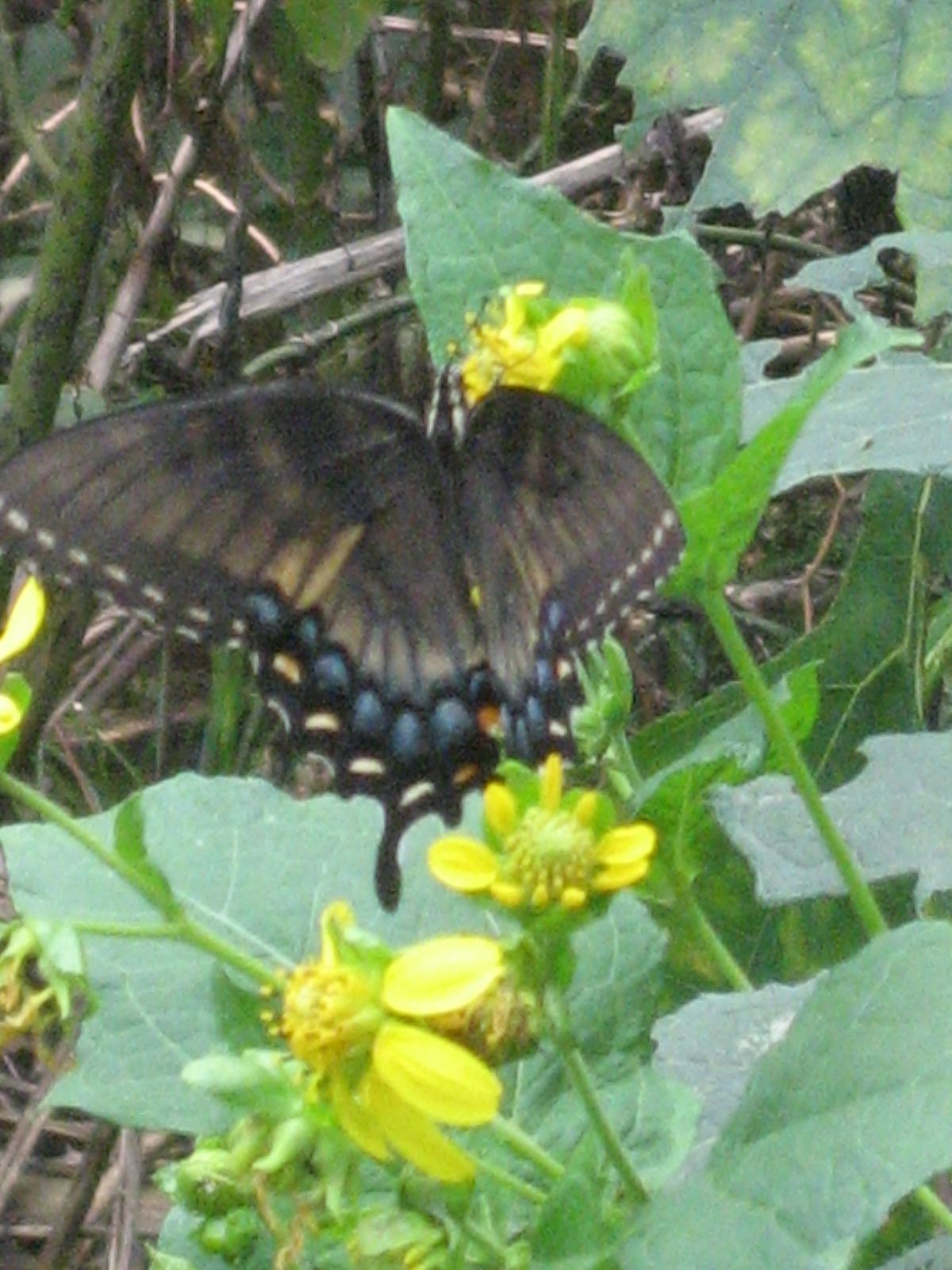
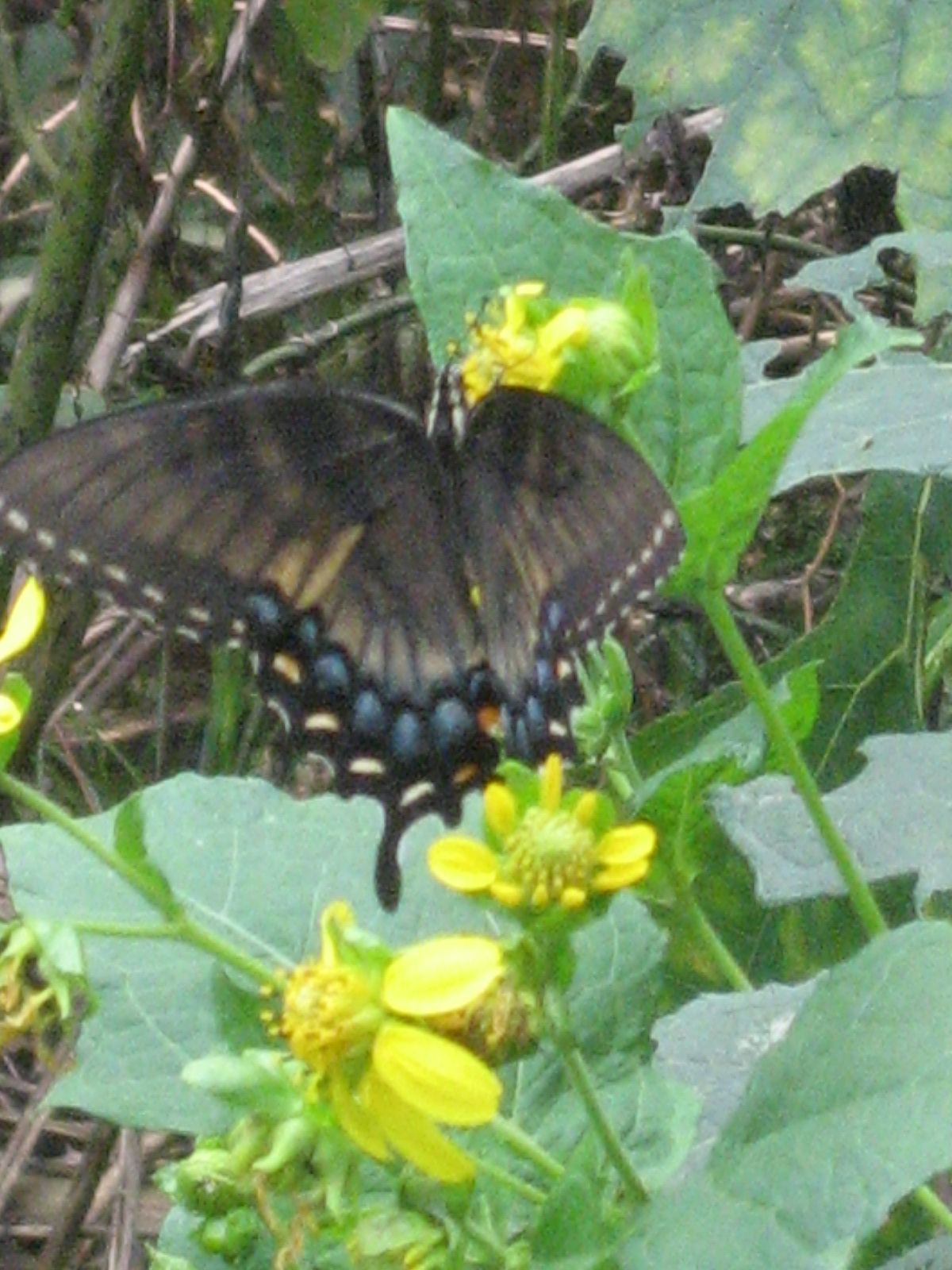
Which of the following characteristics will most likely be helpful in identifying a butterfly using a dichotomous key?
a)
Migrates north every spring
b)
hangs on branches
c)
flutters wings fast on hot days
d)
Wings have long extensions
2.
A dichotomous key for insects is given. To what order does an insect with two pairs of scaly wings belong?
a)
Coleoptera
b)
Heteroptera
c)
Diptera
d)
Lepidoptera
3.
A student discovers an arachnid with a segmented abdomen, long legs, and a tail with no stinger. The student uses the dichotomous key below to identify it. Which arachnid has the student found?
a)
Whip Scorpion
b)
Wind Scorpion
c)
Daddy long legs
d)
Scorpion
4.
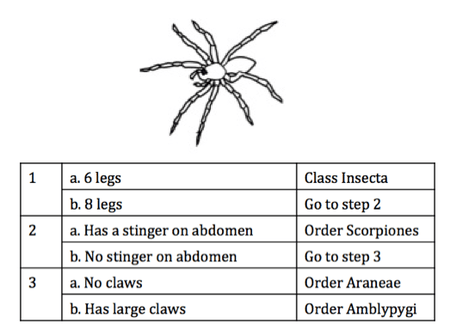
An illustration and a dichotomous key are given. What is the correct classification for this organism?
a)
Class Insecta
b)
Order Amblygygi
c)
Order Araneae
d)
Order Scorpiones
5.
A labeled diagram of a fiddler crab is provided. Which of the following is an accurate observation of the structures of a fiddler crab? Fiddler crabs have -
a)
five pairs of walking legs on each side.
b)
an enlarged propodus on both front legs.
c)
a pair of eyes on stalks at the top of the body.
d)
two pairs or chelipeds for a total of four.
6.
A table of arachnid and insect characteristics is shown. Which characteristic could be used to distinguish between
arachnids and insects?
a)
Jointed legs
b)
Body segments
c)
Presence of eyes
d)
Presence of antennae
7.
What step do we always start with when using dichotomous keys?
a)
1
b)
2
c)
3
d)
4
8.
A botanist discovers a new plant in the jungle. Which of the
following observations of the plant’s characteristics would be useful in determining its identity with a dichotomous key?
a)
It was discovered in the summertime
b)
It is wet from a recent rain storm.
c)
Its leaves curl up on the edges.
d)
It is eaten by native jungle ants.
9.
When using a dichotomous key to identify organisms, what do we look at?
a)
physical features
b)
weather patterns
c)
environment
d)
diet
10.
The scientific name for an organism is made from the:
a)
class and family name
b)
genus and species name
c)
domain and kingdom name
d)
kingdom and phylum name
11.
Tool used by a taxonomist to identify an unknown organism is a:
a)
dichotomous key
b)
binomial nmenclature
c)
scientific name
d)
binomial key
12.
An illustration and a dichotomous key are given. What is the correct classification for this organism?
a)
Class Insecta
b)
Order Amblygygi
c)
Order Araneae
d)
Order Scorpiones
13.
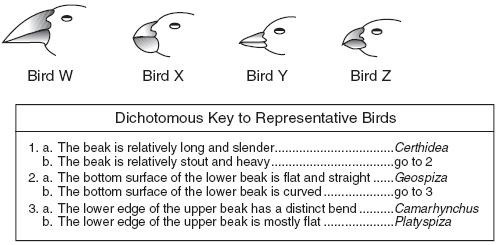
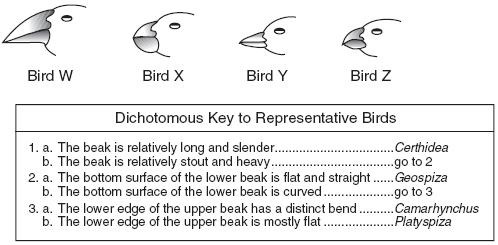
What is the name of bird W?
a)
Certhidea
b)
Geospiza
c)
Camarhynchus
d)
Platyspiza
14.
What is the name of bird Z?
a)
Certhidea
b)
Geospiza
c)
Camarhynchus
d)
Platyspiza
15.
What is a dichotomous key used for in science?
a)
To organize biomes
b)
Classify organisms
c)
Identify bacteria only
d)
None of these
16.
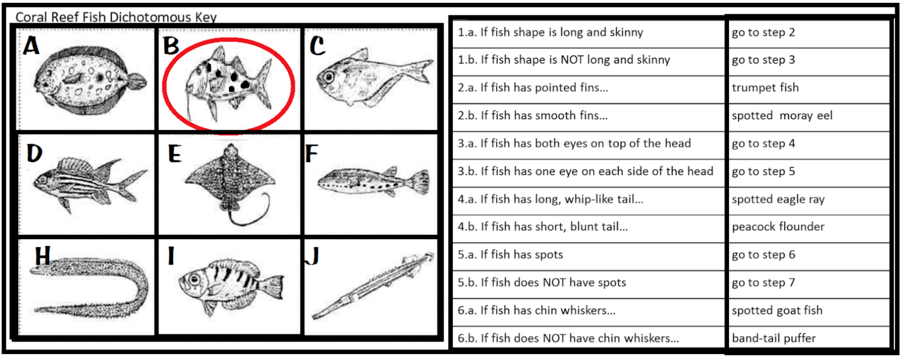
Using this dichotomous key, identify the name of the circled Fish, J.
a)
peacock flounder
b)
band-tail puffer
c)
trumpet fish
d)
spotted goat fish
17.
Using this dichotomous key, identity the name of the circled fish.
a)
band-tail puffer
b)
spotted goat fish
c)
peacock flounder
d)
trumpet fish
18.
Which of the following is the correct way to write the scientific name of a house cat? (imagine that these options are all in italics)
a)
Felis Domesticus
b)
felis domesticus
c)
Felis domesticus
d)
felis Domesticus
19.
The first part of a scientific name is an organism's _______________ and the second part is its ________________.
a)
species, genus
b)
phylum, order
c)
class, spices
d)
genus, species
20.
What is the purpose of a dichotomous key?
a)
to find a common ancestor
b)
to show the evolution of organisms
c)
to show relationships between organisms
d)
to identify organisms
21.
Tool used by a taxonomist to identify an unknown organism is a:
a)
dichotomous key
b)
binomial nmenclature
c)
scientific name
d)
binomial key
22.

What step do we always start with when using dichotomous keys?

a)

Step 1

b)

Step 2

c)

Step 3

d)

Step 4

23.
Using this dichotomous key, identify the name of the circled Fish, J.
a)
peacock flounder
b)
band-tail puffer
c)
trumpet fish
d)
spotted goat fish
24.
The 8 levels of classification, most broad to most specific.
a)
Domain, Genus, Family, Order, Class, Phylum, Kingdom, Species
b)
Domain, Species, Kingdom, Genus, Phylum, Family, Class, Order
c)
Domain, Kingdom, Phylum, Class, Order, Family, Genus, Species
d)
Order, Kingdom, Species, Domain, Phylum, Family, Class, Genus
25.
What is the scientific name of housefly?
a)
Musca domestica
b)
Insect domestica
c)
Animalia domestica
d)
Diptera domestica
26.
Term given to describe the 2 name naming system is:
a)
dichotmous key
b)
binomial nomenclature
c)
2 scientific names
d)
binomial key
27.

Identify the fish

a)

Sebastes serriceps

b)

Sebastes nebulosus

c)

Naucrates ductor

d)

Seriola lalandi

28.
What characteristics does the magnolia leaf have?
a)
Lobed edge
b)
Simple leaf
c)
Compound leaf
d)
Jagged Edge
29.

Look at the observation data provided. Based on the observation data and key above, what is the correct identification for the three arachnids? (7.11A)

a)

Scorpion, Whipscorpion, and Wind scorpion

b)

Whipscorpion, Daddy Long Legs, and Scorpion

c)

Scorpion, Daddy Long Legs, and Tick

d)

Whipscorpion, Wind scorpion, and Daddy Long Legs

30.
What is the purpose of a dichotomous key?
a)
to find a common ancestor
b)
to show the evolution of organisms
c)
to see what organisms eat
d)
to identify organisms
31.

Hollow, light weight bones is an adaptation that...

a)

is an internal structure that helps birds fly

b)

is an external structure that helps birds fly

c)

disables birds ability to fly

d)

helps birds walk

32.

The purpose of gills on a fish is to

a)

Take in nitrogen from the water

b)

Help fish avoid predators

c)

Take in hydrogen f

d)

exchange gas

33.

The squirrel in the picture is using an adaptation called

a)

camouflage

b)

hibernation

c)

migration

d)

retention

34.

An example of stuctural/externaladaptation is...

a)

blood type

b)

stomach size

c)

camouflage

d)

migration

35.

Plants have a structure that allow them to transport water from the roots to the leaves

a)

Phloem

b)

Xylem

c)

Stem

d)

Soot

36.

In selective breeding humans select the most desirable traits

a)

True

b)

False

37.
An inherited trait that helps those organisms that have it to survive
a)
niche
b)
structure
c)
characteristic
d)
adaptation
38.
When an organism copies a characteristic of something else in order to better its chances for survival and reproduction
a)
hibernation
b)
camouflage
c)
mimicry
d)
migration
39.
The seasonal movement of an organism from one place to another
a)
camouflage
b)
migration
c)
hibernation
d)
function
40.
A group of organisms which are similar to each other and can combine to have offspring
a)
species
b)
characteristic
c)
club
d)
organisms
41.

Spines on a cactus are what kind of external adaptation?

a)

Structural

b)

Behavioral

42.
Where the better adapted organisms survive to pass traits along to offspring.
a)
Evolution
b)
Natural Selection
c)
Extinction
d)
Artifical Selection
43.

What is the advantage of having different shaped beaks?

a)

To look different from other species.

b)

To be able to get food

c)

To protect itself against predators.

d)

To protect itself against prey.

44.
The theory of evolution by natural selection means that what is changing over time?
a)
The inherited traits of a population.
b)
The acquired traits of a population.
c)
Hair color and eye color
d)
Attractive features.
45.
Why are advantageous traits more likely to be passed onto offspring?
a)
Because they are more likely to survive and reproduce.
b)
Because they come from dominant alleles.
c)
Because they come from recessive alleles.
d)
Because the trait is an acquired phenotype.
46.
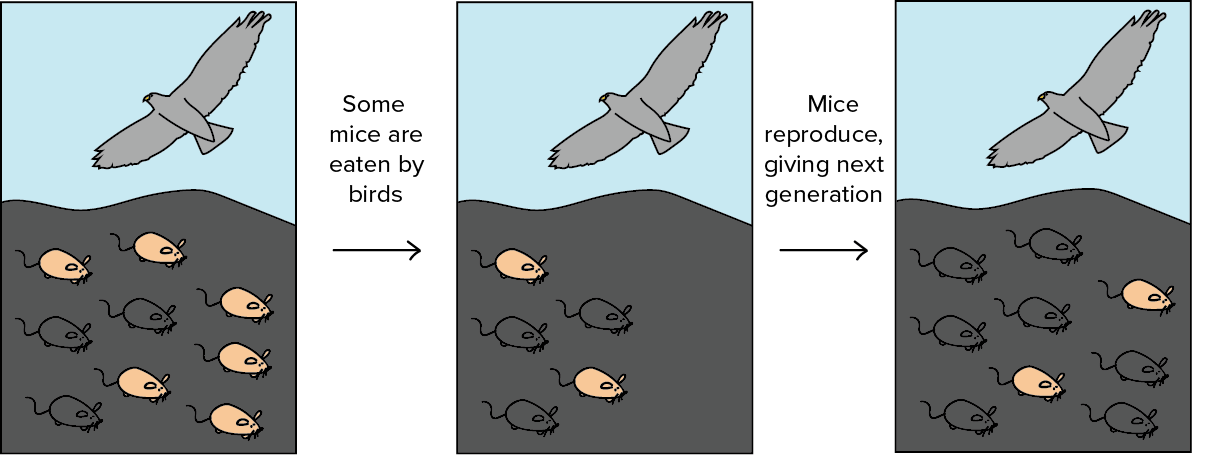
Why is the mouse population changing over time?
a)
The light mice can reproduce more successfully than the dark mice
b)
The hawks eat more dark mice than light mice because the dark mice taste better
c)
The hawks eat more light mice than dark mice because they can see the light mice more easily
d)
The hawks eat more dark mice than light mice because they can see the dark mice more easily
47.
This is an example of....
a)
Dieting 
b)
Evolution 
c)
Selective Breeding 
d)
Adaptation 
48.

Some dairy farmers want to increase the amount of milk produced by their cows. How can the farmers use selective breeding to increase milk production?

a)

increasing the age of cows bred

b)

choosing cows that are high milk producers

c)

limiting number of offspring per cow

d)

choosing cows that produce milk after eating the most food

49.
An inherited trait that helps those organisms that have it to survive
a)
niche
b)
structure
c)
characteristic
d)
adaptation
50.

When an organism slows its life functions for a period of time to better its chances for survival during harsh conditions

a)

internal adaptation

b)

structural adaptation

c)

behavioral adaptation

51.

Which of the following is a structural adaptation for the underlined animal?

a)

A butterfly has bright colors to warn predators that it is poisonous.

b)

A hognose snake rolls over, slows its breathing, and hangs its tongue out to play dead.

c)

A herd of buffalo encircle their young to protect them from a pack of wolves.

d)

A dung beetle rolls a piece of dung across the desert.

52.
How do adaptations help animals?
a)
To escape animals
b)
to hunt for food
c)
to survive in their habitats
d)
All of these are correct
53.

Which of the following are behavioral adaptations? (choose all that are correct)

a)

a turtle hiding inside its shell

b)

a rabbit burrowing underground

c)

a bear's sharp claws

d)

the spikes on a procupine

e)

a viper biting when threatened

54.

The respiratory organs of the fish that filter oxygen out of the water are called...

a)

xylem

b)

gills

c)

behavior adaptation

d)

hollow bones

55.

Hollow Bones_ are found in birds and help them fly. They have a hard outside but the inside of full of air cavities. What type of adaptation is this?

a)

structural adaptation

b)

behavioral adaptation

c)

internal adaptation

d)

external adaptation

56.

The main job of the xylem is to...

a)

provide support and transport minerals in a plant

b)

help a bird fly

c)

act as the respiratory organ for fish

d)

help the animal go into a deep sleep during winter

57.

A permanent change in the DNA of an animal is a...

a)

population

b)

variation

c)

adaptation

d)

genetic mutation

58.

__________ are differences between similar organisms caused by genetic or environmental changes.

a)

Variations

b)

Adaptations

c)

natural selection

d)

domestic animals

59.

Who is in control when it comes to selective breeding?

a)

Dogs

b)

Humans

c)

Cats

d)

Mules

60.
Why did the population of peppered moths in England change from light to dark after the Industrial Revolution?
a)
Light moths were easy to see against sooty trees and were eaten
b)
Light moths were killed by soot
c)
The birds that ate the dark moths were killed by soot
d)
Dark moths were produced by industrial processes
61.
In natural selection, the selective agent is the
a)
humans
b)
mutations
c)
breeders
d)
environment
62.
Natural selection can also be referred to as:
a)
Survival of the weakest
b)
Survival
c)
Survival of the fittest
d)
Artificial selection
63.
Where humans have bred organisms together based on traits we like.
a)
Evolution
b)
Natural Selection
c)
Extinction 
d)
Artificial Selection
64.
Tigers, Jellyfish, Gorillas and Sponges are all part of kingdom _______.
a)
Animalia
b)
Plantae
c)
Fungi
d)
Bacteria
65.
 You would find mushrooms in which kingdom?
a)
Plantae
b)
Protists
c)
Fungi
d)
Animalia
66.
Which kingdom do humans belong to?
a)
Plantae
b)
Fungi
c)
Animalia
d)
Protista
67.
The scientific name for an organism is made from the:
a)
class and family name
b)
genus and species name
c)
domain and kingdom name
d)
kingdom and phylum name
68.
The 8 levels of classification, most broad to most specific.
a)
Domain, Genus, Family, Order, Class, Phylum, Kingdom, Species
b)
Domain, Species, Kingdom, Genus, Phylum, Family, Class, Order
c)
Domain, Kingdom, Phylum, Class, Order, Family, Genus, Species
d)
Order, Kingdom, Species, Domain, Phylum, Family, Class, Genus
69.
What is the most specific level of classification?
a)
Family
b)
Domain
c)
Species
d)
Carolus Linnaeus
70.
Which of the following characteristics would be the most helpful to identify an organism using a dichotomous key?
a)
Where did the parents gets it's DNA
b)
It's leaves are long and narrow
c)
Where the animal was born
d)
The age of the organism
71.
A tool used to help identify organisms based on their physical traits is?
a)
Selective breeding
b)
Microscope
c)
Dichotomous keys
d)
Natural Selection
72.
Whats an adaptation?
a)
Traits that don't help an animal survive
b)
How animals migrate an area
c)
DNA
d)
Traits that help organisms survive
73.
Diversity in a species is important because?
a)
The DNA in the organism will transfer.
b)
Increases the chances of survival when the environment changes
c)
Increases the chances of dominating in an ecosystem
d)
Decreses the chances of survival when the environment changes
74.
When the environment changes.  Which animals are most likely going to survive?
a)
Animals that are able to adapt.
b)
Animals that are not able to adapt.
c)
Animals that reproduce asexually.
d)
Animals that have only one set of DNA
75.
Natural selection cannot occur without.......
a)
Genetic variation
b)
Mutations in DNA
c)
Asexual reproduction
d)
Scientist crossbreeding 
76.
Which of the following is a benefit of variation within a species?
a)
It does not help animals survive change in the environment
b)
It helps them be unique
c)
It ensures some organisms can survive an environment change
77.
What is the name of bird Z?
a)
Certhidea
b)
Geospiza
c)
Camarhynchus
d)
Platyspiza
78.
What is a dichotomous key used for in science?
a)
To organize biomes
b)
Classify organisms
c)
Identify bacteria only
d)
None of these
79.
A dichotomous key for insects is given. To what order does an insect with two pairs of scaly wings belong?
a)
Coleoptera
b)
Heteroptera
c)
Diptera
d)
Lepidoptera
80.
The scientific name for an organism is made from the:
a)
class and family name
b)
genus and species name
c)
domain and kingdom name
d)
kingdom and phylum name
81.
Tool used by a taxonomist to identify an unknown organism is a:
a)
dichotomous key
b)
binomial nmenclature
c)
scientific name
d)
binomial key
82.
Using this dichotomous key, identity the name of the circled fish.
a)
band-tail puffer
b)
spotted goat fish
c)
peacock flounder
d)
trumpet fish
83.
A dichotomous key for insects is given. To what order does an insect with two pairs of scaly wings belong?
a)
Coleoptera
b)
Heteroptera
c)
Diptera
d)
Lepidoptera
84.
Which of the following organisms are LEAST closely related?
a)
organisms that share a domain
b)
organisms that share a family 
c)
organisms that share a genus 
d)
organisms that share a species 
85.

The organism in the picture absorbs energy from the sun. This process allows the plant to store energy as sugar that will be used later. This type of feeder is

a)

heterotroph

b)

autotroph

c)

decomposer

d)

carnivore

86.

Which taxa shown does Rana catesbeiana (American Bullfrog) and Rana temporia (Common Frog) have in common?

a)

Family

b)

Order

c)

Species

d)

Genus

87.

Fungi often look like plants. This confuses some novice scientists who may think they may undergo photosynthesis. We know that fungi are

a)

heterotrophs

b)

autotrophs

c)

producers

d)

nitrogen fixers

88.

Identify the row that correctly identifies the two kingdoms in the table.

a)

A

b)

B

c)

C

d)

D

89.

Which statement about Fungi is incorrect?

a)

Fungi are heterotrophs and absorb their food

b)

Fungi reproduce asexually and sexually

c)

Fungi have cell walls with cellulose

d)

Fungi are multicellular and unicellular

90.

A multicellular organism that contains cellulose in their cell wall, are eukaryotes and produce their own food would be found in which kingdom?

a)

Animalia

b)

Protista

c)

Plantae

d)

Fungi

91.

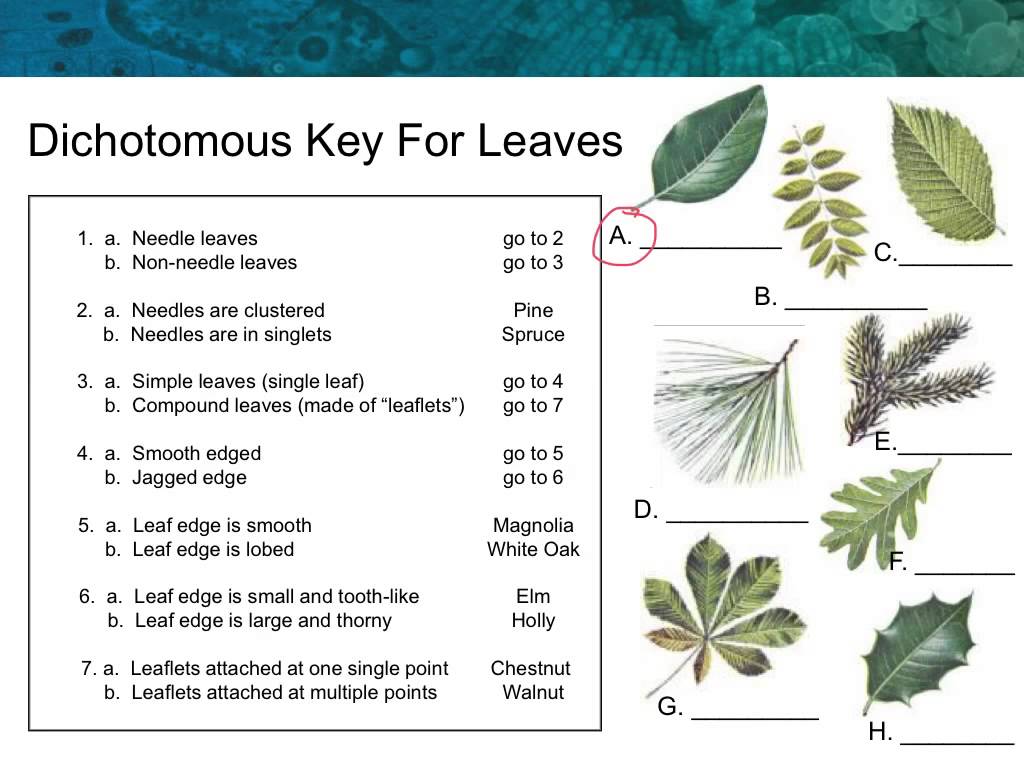
Identify the leaf using the key provided

a)

Liquidambar styraciflua

b)

Gingko biloba

c)

Pinus stobus

d)

Populus balsamifera

92.

The advantage of Scientific Naming or binomial nomenclature is

a)

All names are created in Latin, then translated to English.

b)

Organisms can be identified universally.

c)

Common names are easier to say and well accepted by all.

d)

There is no true advantage since common names are very specific.

93.

The taxa in the correct order are

a)

Domain, Phylum, Kingdom, Class, Order

b)

Kingdom, Phylum, Order, Family, Genus, Species

c)

Domain, Kingdom, Phylum, Class, Order, Family, Genus, Species

d)

Domain, Kingdom, Class, Order, Phylum, Family, Species, Genus

94.

At which taxonomic level does Organism C diverge from Organism A?

a)

Family

b)

Order

c)

Genus

d)

Species

95.

This organism is unicellular, lives in an aquatic environment, contains a nucleus, and is a heterotroph. Which kingdom would it belong to?

a)

Animalia

b)

Plantae

c)

Bacteria

d)

Protista

96.

Which description does not apply to amphibians?

a)

larvae

b)

smooth skin

c)

live birth

d)

cold blooded

97.

Which descriptors do not apply to reptiles?

a)

cold blooded

b)

lay eggs

c)

smooth skin

d)

give milk

98.
a _______ leaf has a single expanse of blade tissue
a)
Pinnately compound
b)
palmately compound
c)
simple
d)
rachis
99.
A leaf arrangement where exactly two leaves are located at a node
a)
alternate
b)
opposite
c)
whorled
d)
palmate
100.
xylem and phloem in a leaf are part of the 
a)
veins
b)
epidermis
c)
spongy mesophyll
d)
palisade mesophyll
101.
What is the main purpose of leaves?
a)
Perform photosynthesis
b)
Transport food and water
c)
Absorb water
d)
All of these
102.
Where do most plants produce their food?
a)
Stem
b)
Leaves
c)
Roots
d)
Seeds
103.
The flat broad surface part of the leaf is called the _,
a)
Petiole
b)
Node
c)
Blade
d)
Mesophyll
104.
How are monocot veins in leaves arranged?
a)
Side by side
b)
Branched
105.
How are dicot veins in leaves arranged?
a)
Side by side
b)
Branched
106.
Stomata
a)
tiny holes in the leaves of a plant that allow gases to enter or leave the plant
b)
living things
c)
a plant part that carries out photosynthesis to make food for the plant
d)
the process in which plants use energy from the sun to make their own food
107.
Gases pass in and out of a leaf through the what?
a)
vascular tissue
b)
mouth hole
c)
stomata
d)
cell wall
108.
____________ cells open and close the stomata
a)
palisade
b)
guard
c)
xylem
d)
epidermis
109.
When a plant is full of water, guard cells will expand...
a)
opening stomata to release water
b)
closing stomata to save water
110.
A plant's growth response to an external stimulus
a)
tropism
b)
vascular tissue
c)
empermidis
d)
monocots and dicots
111.
A plant growing in response to the sunlight. 
a)
Gravitropism 
b)
Phototropism
c)
Thigmotropism
d)
Hydrotropism
112.
When the plant responds to touch
a)
Phototropism
b)
Thigmotropism
c)
Gravitropism
d)
Hydrotropism
113.
When the plant responds to water
a)
Phototropism
b)
Gravitropism
c)
Hydrotropism
d)
Thigmotropism
114.
When the plant responds to gravtiy
a)
Phototropism
b)
Thigmotropism
c)
Gravitropism
d)
Hydrotropism
115.

How do you describe the branching in the above picture?

a)

Alternate

b)

Opposite

c)

whorled

d)

None of the above

116.

Which of the following describes the way tree branches in the picture above?

a)

Compound

b)

Alternate

c)

Opposite

d)

All of the above

117.
a)
alternate
b)
opposite
c)
simple
d)
pinnate compound
118.
a)
opposite 
b)
palmate
c)
alternate
d)
pinnately compound
119.
a)
palmate
b)
pinnate
c)
alternate
d)
simple
120.

Identify the leaf arrangement of the plant species.

a)

Bipinnate

b)

Alternate

c)

Entire

d)

Opposite

121.

Identify the leaf arrangement of the plant species.

a)

Opposite

b)

Alternate

c)

Palmate

d)

Bipinnate

122.

Identify the leaf arrangement of the plant species.

a)

Whorled

b)

Pinnate

c)

Opposite

d)

Sinuate

123.

Identify the following leaf margin of the plant species.

a)

Opposite

b)

Serrate

c)

Lobate

d)

Entire

124.

Identify the leaf margin of the plant species.

a)

Spiny

b)

Serrate

c)

Entire

d)

Alternate

125.
a)
bipinnately compound
b)
alternate
c)
palmate
d)
pinnate compound
126.
a)
bipinnate compound
b)
pinnate compound
c)
palmate
d)
double opposite
127.
What type of leaf is this? 
a)
pinnate
b)
palmate
c)
simple
d)
none
128.
What type of leaf margin is this?
a)
smooth
b)
serrated
129.
The picture is of what type of leaf?
a)
simple
b)
compound
c)
complex
d)
staggered
130.
The picture is of what type of leaf arrangement?
a)
alternate
b)
whorled
c)
opposite
d)
simple
131.
The picture is of what type of leaf arrangement?
a)
alternate
b)
opposite
c)
whorled
d)
compound
132.
What type of leaf arrangement is shown?
a)
opposite
b)
whorled
c)
alternate
d)
cyclical 
133.
What type of leaf arrangement is shown?
a)
opposite
b)
alternate
c)
whorled
d)
cyclical 
134.
Type of leaf margin shown?
a)
smooth
b)
toothed
c)
lobed
d)
bristle-tipped
135.
Type of leaf margin shown?
a)
Smooth
b)
Toothed
c)
Lobed
d)
Bristle-tipped
136.
Type of leaf shown?
a)
Palmately lobed
b)
Palmately compound
c)
Pinneately lobed
d)
Pinneately compound
137.
Type of leaf shown?
a)
Palmately lobed
b)
Palmately compound
c)
Pinneately lobed
d)
Pinneately compound
138.
Type of leaf shown?
a)
Palmately lobed
b)
Palmately compound
c)
Pinneately lobed
d)
Pinneately compound
139.
Type of leaf shown?
a)
Palmately lobed
b)
Palmately compound
c)
Pinneately lobed
d)
Pinneately compound
140.
Type of leaf shown?
a)
Needle-like
b)
Scale-like
c)
Broad and flat
d)
All of the choices
141.
Type of leaf shown?
a)
Needle-like
b)
Scale-like
c)
Broad and flat
d)
All of the choices
142.
Type of leaf shown?
a)
Needle-like
b)
Scale-like
c)
Broad and flat
d)
All of the choices
143.
Type of leaf shown?
a)
Needle-like
b)
Scale-like
c)
Broad and flat
d)
All of the choices
144.
Conifer leaves are usually:
a)
Scale-like
b)
Needle-like
c)
Broad and flat
d)
Scale-like OR Needle-like
145.
Type of tree?
a)
maple
b)
oak
c)
holly
d)
pine
146.

This leaf's venation is

a)

parallel

b)

pinnate

c)

palmate

d)

All the above

147.

This leaf's arrangement is

a)

simple

b)

compound pinnate

c)

compound palmate

d)

All the above

148.

This leaf's arrangement is

a)

simple

b)

compound pinnate

c)

compound palmate

d)

All the above

149.

This leaf's margin is

a)

smooth

b)

wavy

c)

lobed

d)

serrate

150.

This leaf's venation is

a)

parallel

b)

pinnate

c)

palmate

d)

All the above

151.

This leaf's venation is

a)

parallel

b)

pinnate

c)

palmate

d)

All the above

152.

Which leaf has a parallel venation?

a)

Left

b)

Middle

c)

Right

d)

All

153.

Name the leaf margin.

a)

Smooth

b)

Wavy

c)

Lobed

d)

Serrated/Coarse-toothed

154.

Name the leaf shape.

a)

Orbicular

b)

Heart-shaped/Cordate

c)

Deltoid/Triangle

d)

Oval

155.

The flat broad surface part of the leaf is called the _,

a)

Petiole

b)

Midrib

c)

Blade

d)

Chlorophyll

156.

What type of leaf arrangement is this?

a)

Whorl

b)

Needle

c)

Alternate

d)

Basal

157.

What is the arrangement of this leaf?

a)

Scale-like

b)

Cluster of more than 5

c)

Opposite

d)

Four-sided

158.
a)
serrate leaf margin
b)
serrulate leaf margin
c)
sinuate leaf margin
d)
undulate leaf margin
159.

What is a simple leaf?

a)

The simplest form of leaf

b)

Has only one blade

c)

Is divided into three or more sections

d)

Not very common

160.

What is a compound leaf?

a)

A leaf with multiple blades

b)

There is only one type

c)

Has only one blade

d)

Most plants have this type of leaf

161.

What leaf vein pattern is this?

a)

Parallel

b)

Pinnate

c)

Palmate

162.

What leaf vein pattern is this?

a)

Parallel

b)

Pinnate

c)

Palmate

163.

Is this leaf simple, compound, or neither

a)

Simple

b)

Compound

c)

Neither

164.

Is this leaf simple, compound, or neither

a)

Simple

b)

Compound

c)

Neither

165.

Is this leaf arrangement alternate, opposite or whorled?

a)

Alternate

b)

Opposite

c)

Whorled

166.

Is this leaf arrangement alternate, opposite or whorled?

a)

Alternate

b)

Opposite

c)

Whorled

167.

Is the leaf margin smooth or serrate?

a)

Smooth

b)

Serrate

168.

Is the leaf margin smooth or serrate?

a)

Smooth

b)

Serrate

169.

Is this leaf shape lobed or entire?

a)

Lobed

b)

Entire

170.

Is this leaf shape lobed or entire?

a)

Lobed

b)

Entire

171.

Is this leaf shape lobed or entire?

a)

Lobed

b)

Entire

172.

Is this leaf shape lobed or entire?

a)

Lobed

b)

Entire

173.

Is this leaf shape lobed or entire?

a)

Lobed

b)

Entire

174.

Is this leaf shape lobed or entire?

a)

Lobed

b)

Entire

175.
Veins or leaflets radiating out fan like
a)
Palmate
b)
Pinnate
c)
Deciduous
d)
Evergreen
176.
A leaf that is made up of one leaf blade
a)
Compound
b)
Serrate
c)
Lobe
d)
Simple