
 Worksheets
Fossil Review
Total questions: 53
Worksheet time: 55mins
Name
Class
Date
1.
How are Sedimentary Rocks formed?
a)
Cooling and Hardening
b)
Heat and Pressure
c)
Compacting and Cementing
d)
Melting
2.
Where can the oldest layer be found?
a)
The top layer
b)
The middle layer
c)
They are all the same age
d)
The bottom layer
3.
In what kind of rock can fossils be found?
a)
Sedimentary Rocks
b)
Igneous Rocks
c)
Metamorphic Rocks
d)
Granite
4.
How are fossils created?
a)
Traces of organisms get turned into stone.
b)
Dead organisms are quickly buried for millions of years.
c)
Animals get trapped.
d)
All of the above
5.
What are the 3 main fossil fuels?
a)
Coal, Oil, and Gasoline
b)
Coal, Oil, and Natural Gas
c)
Electricity, Gasoline, Petroleum
d)
Coal, Oil, Non-renewable Resources
6.
What must be present for Fossil Fuels to form?
a)
Bones and Sediment
b)
Dead Organisms and Layers of Sediment
c)
Dead Organisms, Layers of Sediment, and Heat & Pressure over time
d)
Bones, Layers of Sediment, and Heat & Pressure over time
7.
Fossil Fuels formed over long periods of time after particles in water settled to the sea floor and formed marine mud. What kinds of particles needed to be present in the marine mud in order for fossil fuels to form.
a)
Mostly sand and a few small bits of wood
b)
Mostly decaying organisms
c)
Mostly lava and a few sedimentary rocks
d)
Mostly metal minerals
8.
Some students made a model to show one of the first steps in the formation of sedimentary rock. The students pour 2 cm of light-colored sand into a clear plastic box. Then they add 1 cm of gravel. Finally, they pour 2 cm of dark-colored sand on top of the gravel. Which characteristic of sedimentary rock does this model best show?
a)
Sedimentary rock is made of layers.
b)
Sedimentary rock is cemented bits of rock.
c)
Sedimentary rock is often limestone.
d)
Sedimentary rock is common in Texas.
9.
All of these are related to the formation of oil or natural gas EXCEPT
a)
Decomposed Animals
b)
Decayed Plants
c)
Sedimentary Rocks
d)
Active Volcanoes
10.
Coal often forms where once there was swamps. What characteristic of swamps is important to the formation of coal?
a)
High Temperature
b)
Abundant Plant Life
c)
Frequent Rains
d)
Reptile Predators
11.
What changes buried organic matter into fossil fuels?
a)
Industrial Pollution
b)
Ocean Currents
c)
Volcanic Activity
d)
Heat and Pressure
12.
A student creates a model of the formation of fossil fuels by first placing a layer of leaves, representing organic matter, in the bottom of a cup. What step will come next in the model?
a)
Pouring water over the leaves to model washing away by rivers
b)
adding sand on top of the leaves to model burial in sediments
c)
Burning the leaves to model the decay of organic matter
d)
Putting the leaves in the freezer to model conditions on top of mountains
13.

Which layer formed first?
a)
Rock Layer W
b)
Rock Layer X
c)
Rock Layer Y
d)
Rock Layer Z
14.
What feature is the same in the formation of many sedimentary rocks and all fossil fuels? Many sedimentary rocks and all fossil fuels -
a)
require material to be buried and exposed to heat and pressure
b)
are made out of organic material that stores the sun's energy
c)
form where there are frequent earthquakes and volcanic activity
d)
are produced high in the mountains where temperatures are low
15.
Sedimentary rocks form when broken bits of other rock are deposited and then -
a)
buried and squeezed and cemented together
b)
melted by the heat of the Earth's core
c)
completely dissolved in the salt water of the ocean
d)
used by humans as a natural resource
16.
Fossil Fuels form in sedimentary rocks when -
a)
plants use the nutrients in the sediments to grow
b)
organic matter is buried along with sediments
c)
rivers carry sediments down mountainsides
d)
sediments are used by humans as a resource
17.

Which area is most likely to have fossil fuels present today?
a)
A
b)
B
c)
C
d)
D
18.
Oil formation occurs where, millions of years ago, there were large oceans. This is because oceans have -
a)
waves that are constantly moving
b)
great numbers of tiny marine animals
c)
currents that mix the water thoroughly
d)
deep caverns where no light can reach
19.
Most sedimentary rock forms in the ocean. This is because oceans -
a)
emit much less pollution that other habitats
b)
receive the majority of the Sun's energy
c)
have fewer plants and animals than on land
d)
are where most bits of broken rock get deposited
20.
Fossils give us evidence about which of the following?
a)
plants and animals that lived long ago
b)
how weathering and erosion break down rocks
c)
the other planets in our solar system
d)
the transfer of energy from one form to another
21.
The formation of fossil fuels is a process that takes millions of years and starts with energy from the sun. The sun contributes to the formation of fossil fuels by -
a)
heating up the Earth's core where fossil fuels form
b)
generating winds so humans use less fossil fuels
c)
give energy to the living things that become fossil fuels
d)
giving off heat, similar to burning fossil fuels
22.
Several wooly mammoth fossils have been found. Mammoths, which lived hundreds of thousands of years ago, were covered with thick fur. Based on the evidence, mammoth fossils tell us that the area in which they are found -
a)
has too many humans
b)
no longer has large animals
c)
was, at one time, very cold
d)
receives more rain that it used to
23.
Finding the fossils of trees in an area that is currently a desert without much life might tell us that the area, millions of years ago -
a)
was heavily eroded by strong winds
b)
received enough rain to support a forest
c)
suffered very powerful earthquakes
d)
was destroyed by the impact of meteorites
24.
A scientist is seeking rocks that formed at the mouth of a river. The fossils of which of the following would be the best evidence that rocks were formed under these conditions?
a)
freshwater birds
b)
large animals
c)
flying insects
d)
tropical bats
25.
An area is currently a forest. What evidence would best indicate that this area was covered by water millions of years ago?
a)
An increase in rainfall in the forest over time
b)
The presence of plants in the forest that need water to live
c)
Fossils of fish discovered in rock below the forest
d)
Insects in the forest that lay their eggs in the water
26.
Herbivores are animals that eat plants. Finding many fossils of large herbivores in rocks that are millions of years old would lead to what conclusion about the ancient environment of the area? A reasonable conclusion is that the area was once a -
a)
rocky seashore
b)
thriving grassland
c)
frozen lake
d)
muddy swamp
27.

People who study fossils are called ____.
a)
meterologists
b)
fossilologists
c)
paleontologists
d)
fossil hunters
28.

Which of the following is NOT an example of a fossil?
a)
a petrified dinosaur bone
b)
a footprint captured in mud
c)
a seashell found on the beach
d)
an insect stuck in amber
29.

Which of the following is NOT something you could learn from a fossil?
a)
The size of the animal
b)
What the animal ate
c)
The color of the animal
d)
Where the animal lived
30.

In which kind of rock do we usually find a fossil?
a)
sedimentary rock
b)
metamorphic rock
c)
igneous rock
31.
In order for a fossil to form, which of the following events must happen FIRST?
a)
Slowly, minerals in the water replace the bone.
b)
Sediment covers the bone.
c)
An animal dies.
d)
The bone is no longer a bone, but a rock copy.
32.

_____ is any living thing, plant or animal, even you!
a)
A paleontologist
b)
An organism
c)
A fossil
d)
A rock
33.

Why don't we know what many ancient plants looked like?
a)
They had too many soft parts.
b)
They were all eaten by dinosaurs.
c)
There weren't ancient plants.
d)
They had too many hard parts.
34.
Which statement BEST describes how the fossil bones of a dinosaur are formed?
a)
The dinosaur became trapped in amber.
b)
The dinosaur was covered in sediment.
c)
The dinosaur was frozen in ice.
d)
The dinosaur stepped in wet mud.
35.
What happens when a group of animals become extinct?
a)
All of its members have died.
b)
Only a few of its members are still living.
c)
The animals can no longer lay eggs.
d)
All of its members move to another place.
36.
Lily sees a skeleton of a dinosaur at a museum. What is true about the bones that make up the skeleton?
a)
The bones are made up of minerals.
b)
The bones are those of the dinosaur itself.
c)
The bones were formed from mud that hardened.
d)
The bones are made up of amber.
37.

The diagram shows layers of sedimentary rock and examples of the fossils each layer contains, Which layer contains the oldest fossils?
a)
A. Layer 2
b)
B. Layer 4
c)
C. Layer 1
d)
D. Layer 3
38.
Where are most fossils found?
a)
A. In sand dunes
b)
B. In volcanoes
c)
C. In igneous rocks
d)
D. In sedimentary rocks
39.

The surface of the land displays a mountain range and rivers. What might a scientist conclude about about the environment, based on the fossils in the sedimentary layers?
a)
A. The land was once a rainforest.
b)
The area was once covered by a desert.
c)
C. The area was once a grassy plain.
d)
D. The area was once near or covered by an ocean.
40.

Which fossil layer is the youngest?
a)
A. Layer A
b)
B. Layer B
c)
C. Layer C
d)
D. Layer D
41.
How are fossils created?
a)
A. Traces of organisms harden like rock.
b)
B. Dead organisms are quickly buried for millions of years.
c)
C. Animals get trapped.
d)
D. All of the above
42.
What are the 3 main fossil fuels?
a)
A. Coal, oil, and vegetable oil.
b)
B. Coal, Oil, and Natural Gas
c)
C. Electricity, Gasoline, Petroleum
d)
D. Coal, Oil, Non-renewable Resources
43.

What type of fossil is this?
a)
Mold
b)
Cast
c)
Preserved remains
d)
Trace fossil
44.

In which kind of rock do we usually find a fossil?
a)
sedimentary rock
b)
rock candy
c)
hard rock
45.

Which layer is oldest?
a)
A
b)
W
c)
G
d)
Z
46.
How old do Paleontologists believe the Earth is?
a)
2015 years old
b)
3.6 billion years old
c)
4.6 billion years old
d)
4.6 million years old
47.

According to the law of superposition, which layer is the youngest?
a)
A
b)
B
c)
C
48.
Which is an example of a trace fossil?
a)
animal tracks
b)
coprolite
c)
burrows
d)
all of the answers given here
49.

What is an example of an index fossil?
a)
t-rex fossils
b)
insect in amber
c)
trilobites or ammonites
d)
woolly mammoth fossils
50.

What is a fossil?
a)
the remains or physical evidence of an organism preserved by geologic processes
b)
fossils can be preserved in rock, amber, asphalt, or ice
c)
any naturally preserved evidence of animal activity
d)
fossil of an organism that lived during a relatively short period of time
51.
Which of the following would NOT help an organism become fossilized?
a)
shell
b)
skeleton
c)
buried quickly with sediment
d)
soft body parts
52.
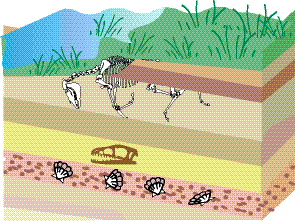
According to the law of superposition, the oldest fossils are found
a)
At the top of the rock layers
b)
Near the bottom of the rock layers
c)
In the middle of the rock layers
d)
Somewhat near the surface
53.
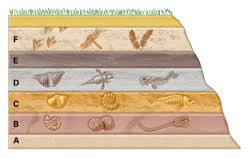
Which rock layer contains the newest fossils?
a)
F
b)
E
c)
B
d)
C
100 %

