wayground logo

Free Printable Worksheets

NEW

Font size

S
M
L
XL
Worksheets

AQA B1a - Cells

Total questions: 27

Worksheet time: 16mins

Name
Class
Date
1.
Which of the following is the smallest unit of life that can carry out all life functions?
a)
the mitochondria
b)
the vacuoles
c)
the nucleus
d)
the cell
2.
Which structures are found in every living cell?
a)
cell membrane and cytoplasm
b)
chloroplasts and mitochondria
c)
a cell wall and nucleus
d)
chloroplasts and cell wall
3.

Which cell structure is found in plant and animals cells and controls what can enter or leave a cell?

a)

cell membrane

b)

cytoplasm

c)

nucleus

d)

vacuole

4.
What is the function of the cell nucleus found in both plant and animal cells?
a)
to produce energy
b)
to control cell activity
c)
to remove waste products
d)
to allow molecules to enter the cell
5.
All cells need energy to function.  Which cell organelle is responsible for producing energy in the cell?
a)
chloroplasts
b)
mitochondria
c)
nucleus
d)
vacuoles
6.
What is the function of a cell wall?
a)
to protect and support the cell
b)
to perform different functions in each cell
c)
to prevent water from passing through it
d)
to prevent oxygen from entering the cell
7.
 Starch and water molecules in potato cells are stored in what organelle?
a)
mitochondria
b)
nucleus
c)
cell wall
d)
vacuole
8.
Which organelle belongs in both plant and animal cells?
a)
Cytoplasm
b)
Chloroplast
c)
Large Central Vacuole
d)
Cell Wall
9.
Which organelle belongs in both plant and animal cells?
a)
Chloroplast
b)
Mitochondrion
c)
Large Central Vacuole
d)
Cell Wall
10.

Which of the following is not a characteristic of a prokaryotic cell?

a)

unicellular

b)

floating DNA

c)

very small

d)

complex

11.

Which of the following is a characteristic of both eukaryotic and prokaryotic cells?

a)

ribosomes

b)

nucleus

c)

membrane bound organelles

d)

simple

12.
Prokaryotic cells include bacteria.
a)
True
b)
False
13.

Unicellular means...

a)

single-celled

b)

unicycle

c)

multi-celled

d)

united cells

14.

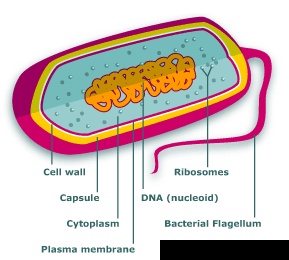
Which type of cell is shown in the diagram?

a)

Prokaryote

b)

Eukaryote

15.
Which of the following is found inside a prokaryote?
a)
cytoplasm
b)
DNA
c)
ribosomes
d)
all of these
16.
Cells can only be seen with the help of a...
a)
hand lens 
b)
magnifying glass
c)
3D glasses 
d)
microscope 
17.

What is meant by the term 'multicellular'?

a)

one cell

b)

no cells

c)

many cells

d)

no nucleus

18.

Plants and animal cells are examples of...

a)

prokaryotic cells

b)

eukaryotic cells

19.
These cells have DNA surrounded by a nuclear membrane...
a)
Eukaryotic
b)
Prokaryotic
c)
Neither
d)
Both prokaryotic and eukaryotic
20.

Animal, fungi, plant, and protist cells are all examples of which type of cell?

a)

Eukaryotic

b)

Prokaryotic

c)

Both prokaryotic and eukaryotic

21.

Prokaryotic cells are older than eukaryotic cells.

a)

False

b)

True

22.
Which best explains why muscle cells are different from blood cells?
a)
Muscle cells are produced by the brain, but blood cells are produced by the heart. 
b)
Different genes are activated in muscle cells than in blood cells. 
c)
Muscles cells experience different environmental influences than blood cells. 
d)
A mutation occurs during the development of muscle cells but not in blood cells. 
23.

Which of the diagrams shows a plant cell?

a)

A

b)

B

c)

C

d)

D

24.

Which specialised cell contains no choloroplasts and has a long thin shape to maximise surface area?

a)

a) ciliated epithelial cell

b)

b) palisade cell

c)

c) root hair cell

d)

d) white blood cell

25.

If an object was magnified x10 would the object appear

a)

a) bigger

b)

b) smaller

c)

c) the same

26.

Which specialised cell has small hairs and can move mucus?

a)

a) ciliated epithelial cell

b)

b) palisade cell

c)

c) root hair cell

d)

d) white blood cell

27.

If an object was magnified by x10 eye piece lens and a x50 objective lens, what would the total magnification be?

a)

x 60

b)

x50

c)

x 500

d)

x 5