wayground logo

Free Printable Worksheets

NEW

Font size

S
M
L
XL
Worksheets

PBS 2.1 & 2.3 Review

Total questions: 80

Worksheet time: 1hrs 26mins

Name
Class
Date
1.
Diabetes Type I
a)
Juvenile diabetes
b)
Adult onset diabetes
2.
Diabetes Type II
a)
Juvenile diabetes
b)
Adult onset diabetes
3.
Hormone that causes blood sugar to be lowered
a)
Glucagon
b)
Glycogen
c)
Insulin
d)
Glucose
4.
Hormone that causes blood sugar to be raised
a)
Glucagon
b)
Glycogen
c)
Insulin
d)
Glucose
5.
Gland that secretes hormones that regulate blood glucose
a)
Liver
b)
Adrenals
c)
Pancreas
d)
Thyroid
6.
Protein situated on the cell membrane that is sensitive to Insulin molecules
a)
glucose transporter
b)
insulin receptor
c)
insulin channel
d)
glucose channel
7.
A steady or balanced state of the body
a)
Homeostasis
b)
Homeopathy
c)
Negative feedback
d)
Postive feedback
8.
This organ stores glygogen
a)
Pancreas
b)
Liver
c)
Small Intestine
d)
Spleen
9.
Positive Feedback mechanism
a)
Body's control of glucose levels
b)
Body's control of temperature
c)
Body's control of childbirth process
d)
Body's control of pH levels
10.
What happens in the liver when the bloodstream has lower than usual glucose levels
a)
Glucose is converted to glycogen
b)
Glycogen is converted to glucose
c)
The liver keeps storing glycogen
11.
What is released by the pancreas when blood sugar is low?
a)
glucose
b)
glucagon
c)
insulin
d)
glycogen
12.
A type of feedback in the body where the output reduces the original effect of the stimulus.
a)
negative
b)
positive
c)
oscillating
d)
reduction
13.
What is the best diagnosis for this patient?
a)
Type 1 
b)
Type 2
c)
Normal
d)
Insulin Dependent
14.
What is this type of feedback?
a)
positive
b)
negative
c)
infinity
d)
a figure 8
15.
This type of feedback.
a)
circular
b)
negative
c)
positive
d)
oscillating
16.
Type of diabetes characterized by insulin resistance
a)
Type I
b)
Type II
17.
What information does GTT give a doctor?
a)
how well a person is able to get sugar in to cells over time
b)
how well a person is able to burn fat over time
c)
how well a person is able to burn sugar over time
d)
how well a person is able to produce insulin over time
18.
Anna Garcia
a)
was a type 1 diabetic
b)
was a type II diabetic
c)
had no history of diabetes
19.
A type of feedback that causes the system to stop doing the original action and to either take no action or to perform an opposite action.
a)
ridiculous feedback
b)
gregarious feedback
c)
positive
d)
negative
20.
Which gland produces insulin and glucagon?
a)
Anterior pituitary
b)
Posterior pituitary
c)
Pancreas
d)
Adrenal
21.
What body system is the slow-acting control system using hormones?
a)
Endocrine
b)
Exocrine
c)
Nervous
d)
Integumentary
22.
______ is the fuel for the body that is manufactured from the food we eat.
a)
Insulin
b)
Glucagon
c)
Glucose
d)
Glucosamine
23.
In Type I Diabetes
a)
no insulin production
b)
insulin does not work
c)
glucose levels always too low
24.
Which individual(s) has/have diabetes?
a)
Anna and Patients A and B
b)
Patient A only
c)
Patient B and Anna
d)
Patient A and Anna
25.
Which individual(s) has/have Type 1 diabetes?
a)
Anna only
b)
Patient A
c)
Patients A and B
d)
Patient B and Anna
26.
The risk factors for developing type 2 diabetes include all of the following except: 
a)
Advanced age 
b)
obesity 
c)
poor foot care 
d)
physical inactivity 
27.
Which of the following scenarios represents a negative feed back loop 
a)
During child birth, pressure on the cervix causes a signal telling the brain to release oxytocin. Oxytocin then causes muscles in the uterus to contract, resulting in more pressure on the cervix 
b)
After a meal, digestion in the stomach and nutrient uptake in the small intestine results in increased blood sugar. In response the human body releases the hormone insulin which allows sugar to enter cells resulting in a decrease of blood sugar. 
c)
During blood clotting, the protein prothrombinase catalyzes the formation of thrombin. Thrombin causes fibers to form, activates the formation of a clotting factor, and causes an increase in platelets. Increase in platelets in turn increases the quantity of the prothombinase triggering a release of even more thrombin 
d)
When the immune system is fighting pathogens, cytokines signal immune cells such as T-cells and macrophages to travel to the site of infection. In addition cytokines activate those cells, stimulating them to produce more sytokines.
28.
In type II diabetes,
I. the person does not produce insulin
II. insulin never bonds to insulin protein receptors
III. very little glucose is able to get inside cells
IV. insulin receptors do not respond to insulin like they should
a)
All of these
b)
III and IV
c)
II and III
d)
I and IV
29.
A test of the body’s ability to metabolize glucose that involves the administration of a measured dose of glucose to the fasting stomach and the determination of blood glucose levels in the blood or urine at intervals thereafter and that is used especially to detect diabetes.
a)
glucose tolerance testing
b)
Gel Electroperesis
30.
A product of living cells that circulates in blood and produces a specific, often stimulatory, effect on the activity of cells that are often far from the source of this.
a)
Glucose
b)
Hormone
31.
The maintenance of relatively stable internal physiological conditions (as body temperature or the pH of blood) in higher animals under fluctuating environmental conditions.
a)
Homeostasis
b)
negative feedback
32.
A primary mechanism of homeostasis, whereby a change in a physiological variable that is being monitored triggers a response that counteracts the initial fluctuation.
a)
positive feedback
b)
negative feedback
33.
Feedback that tends to magnify a process or increase its output.
a)
negative feedback
b)
positive feedback
34.
Osmosis is the movement of _____ across a membrane.
a)
food
b)
energy
c)
oxygen
d)
water
35.
During osmosis
a)
water moves from high to low concentration
b)
large or oddly shaped molecules move across a cell membrane
c)
water moves when energy is used
d)
proteins are built
36.
Permeable means
a)
things can pass through
b)
the concentration levels are different
c)
it is permanent
d)
things are stuck
37.
The diffusion of water through a semi-permeable membrane is called?
a)
Osmosis
b)
Cell wall
c)
Diffusion
d)
Respiration
38.
A person would never have pure water put into their veins in a hospital because their cells would...
a)
Shrink/Dehydrate
b)
Expand
39.
A person should never drink salty water because their cells would
a)
shrink
b)
expand
40.
What is the definition of  Selective Permeability?
a)
The movement of materials across the cell membrane that requires NO ENERGY from the cell.
b)
The movement of materials through (or across) the cell membrane
c)
The ability of the cell membrane to allow some things to pass through while preventing other things from passing through.
d)
The movement of molecules from an area of high concentration (where the molecules are more crowded together) to a area of low concentration (where molecules are more spread apart)
41.
Osmosis
a)
diffusion of water molecules through a semi-permeable mebrane from an area of low concentration to an area of high concentration
b)
the diffusion of particles from an area of high concentration to an area of low concentration
c)
diffusion of water molecules through a semi-permeable membrane from an area of high concentration to an area of low concentration
d)
the diffusion of particles from an area of low concentration to an area of high concentration
42.
_______ regulates what enters and leaves a cell.  
a)
Cell Membrane
b)
Nucleus
c)
Mitochondria
d)
Cytoplasm
43.
Which way will the water molecules move during osmosis?
a)
Out of the cell, so the cell shrinks.
b)
Out of the cell, so the cell swells.
c)
Into the cell, so the cell shrinks.
d)
Into the cell, so the cell swells.
44.

An animal cell placed in a hyperglycemic environment will

a)

Stay the same

b)

Shrink- get smaller

c)

Swell- get bigger

45.

In a solution, salt and/or sugar is considered the _______.

a)

solvent

b)

solute

c)

solution

46.

If a cell containing 5% sugar is placed into a glass of water with 20% sugar, the cell is _______ compared to the water in glass.

a)

hyperglycemic

b)

hypoglycemic

47.

If the volume of a cell decreases when it is placed in a solution, that solution is said to be __________ to the cell

a)

hyperglycemic

b)

subatomic

c)

isotonic

d)

hypoglycemic

48.

The cell below is in a _____________ solution.

a)

Hypertonic/hyperglycemic

b)

Hypotonic/hypoglycemic

c)

Isotonic

49.

The cell below is in a _________ solution.

a)

Hypotonic/hypoglycemic

b)

Hypertonic/hyperglycemic

c)

Isotonic

50.

Which cell is placed into a hypotonic/hypoglycemic environment?

a)

A

b)

B

c)

C

d)

D

51.
What is the best diagnosis for this patient?
a)
Type 1 
b)
Type 2
c)
Normal
d)
Insulin Dependent
52.
A type of feedback in the body where the output reduces the original effect of the stimulus.
a)
negative
b)
positive
c)
oscillating
d)
reduction
53.
Why do type 1 diabetics pee a lot? 
a)
low blood sugar
b)
because they are taking in too much insulin
c)
too much sugar in the blood
d)
side effect of the medication
54.
Lifestyle choices that prevent Type 2 diabetes.
I. Eating a diet high in fat
II. Eating a diet high in protein and low in carbs
III. Drinking diet pop
IV. Exercise
V. Eating foods high in fiber
a)
II and V 
b)
I, II, III, IV, and V
c)
II, IV, and V
d)
I, III
55.
The type of cells that make glucagon.
a)
alpha cells of pancreas
b)
beta cells of pancreas
c)
liver
d)
brain
56.
Type of diabetes characterized by insulin resistance
a)
Type I
b)
Type II
57.
Which gland produces insulin and glucagon?
a)
Anterior pituitary
b)
Posterior pituitary
c)
Pancreas
d)
Adrenal
58.
Which individual(s) has/have Type 1 diabetes?
a)
Anna only
b)
Patient A
c)
Patients A and B
d)
Patient B and Anna
59.
In both types of Diabetes
a)
insulin is not produced
b)
insulin does not work properly
c)
blood glucose levels remain high after eating
d)
insulin receptors do not work
60.

What molecule is brought to the surface of the cell membrane to let glucose in?

a)

Glucose

b)

GLUTES

c)

GLUT4

d)

GLUT4000

61.

What is the point of a feedback loop?

a)

To provide the body with more energy

b)

To provide the body with more food

c)

To make sure the conditions in the body are always changing

d)

To make sure the conditions in the body remain stable
62.
Failure to maintain homeostasis could result in:
a)
lack of internal balance
b)
eventual death
c)
difficulty carrying on metabolism 
d)
all three
63.

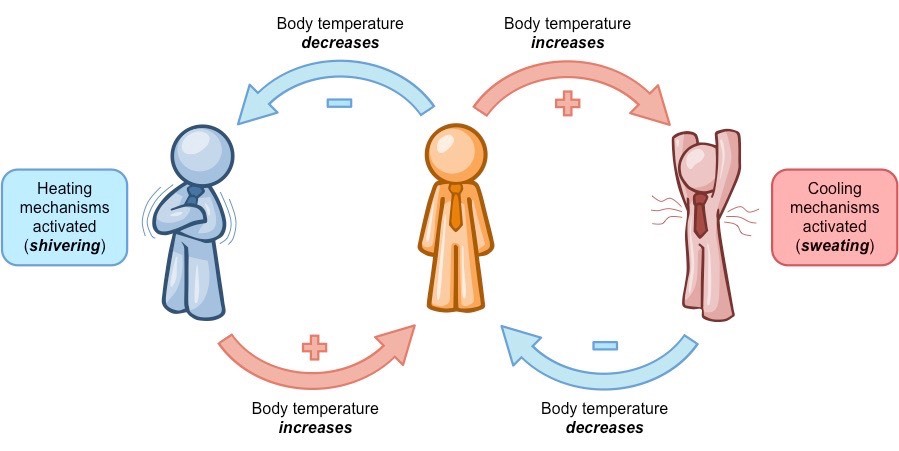
In this body temperature feedback loop, predict what would happen if cooling mechanisms were NOT activated?

a)

The body would not warm up.

b)

The body would not cool down.

c)

Your body would get colder and colder.

d)

Your body would release lots of heat.

64.
Maintaining body temperature is an example of a:
a)
negative feedback loop
b)
positive feedback loop
65.
If the calcium in your blood decreases below homeostasis levels, a gland in the brain will sense the decrease and send a chemical message to your bones. Your bones will release calcium into the blood, bringing blood calcium levels back up.
a)
Positive Feedback Response
b)
Negative Feedback Loop 
66.
What is released by the pancreas when blood sugar is low?
a)
glucose
b)
glucagon
c)
insulin
d)
glycogen
67.
What is this type of feedback?
a)
positive
b)
negative
c)
infinity
d)
a figure 8
68.
This type of feedback.
a)
circular
b)
negative
c)
positive
d)
oscillating
69.
Identify symptoms associated with Type I Diabetes
I. Weight gain
II. Decreased urination
III. Feeling hungry
IV. Feeling thirsty
V. Weight loss
VI. Hyperactivity
a)
All of these
b)
I, III, V, VI
c)
III, IV, and V
d)
II, IV, VI
70.
What information does GTT give a doctor?
a)
how well a person is able to get sugar in to cells over time
b)
how well a person is able to burn fat over time
c)
how well a person is able to burn sugar over time
d)
how well a person is able to produce insulin over time
71.
Symptoms--
Elevated blood pressure
Continual slightly elevated blood sugar
Hard to lose weight
Always hungry
Based on only these, diagnose this patient
a)
Normal
b)
Type I
c)
Type II
72.
In Type I Diabetes
a)
no insulin production
b)
insulin does not work
c)
glucose levels always too low
73.
Ideally, your cells should be in a(n) _______ solution
a)
isotonic
b)
hypertonic
c)
hypotonic
d)
isometric
74.
If you looked at red blood cells under a microscope and saw the blood cells exploded, what would you say happened?
a)
The cells were placed in a hypotonic solution.
b)
the solution was isotonic.
c)
The solution was hypertonic.
75.
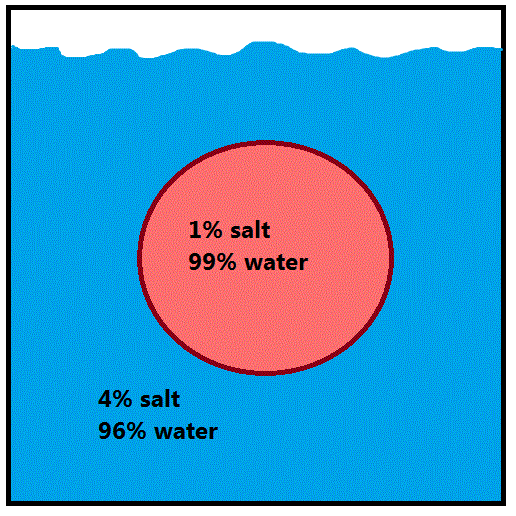
 If a cell containing 5% salt is placed into a glass of water with 20% salt, the water is _______ compared to the cell.
a)
hypertonic-
b)
hypotonic
c)
isotonic
76.
Where will the water go?
a)
Into the cell
b)
Out of the cell
c)
Equally in & out - it's isotonic
d)
There is no water
77.
A blood cell is placed into the jar, as seen. Where will the water go?
a)
Into the cell
b)
Out of the cell
c)
Equally in & out - it's isotonic
d)
The water is a lie
78.
HYPO means...
a)
Low
b)
High
c)
Equal
d)
Fat
79.
ISO means...
a)
Low
b)
A lot
c)
Equal
d)
Mammal
80.
Why can't you drink salt water?
a)
It's hypertonic to your cells
b)
It's hypotonic to your cells
c)
It's isotonic to your cells
d)
It's paratonic to your cells