wayground logo

Free Printable Worksheets

NEW

Font size

S
M
L
XL
Worksheets

Cnidarians Review (Marine Science FL)

Total questions: 45

Worksheet time: 30mins

Name
Class
Date
1.

What type of symmetry do Cnidarians have?

a)

Asymmetrical

b)

Bilateral

c)

Radial

d)

Medial

2.

What are cnidocytes?

a)

digestive cells

b)

another name for eyes

c)

reproductive cells

d)

stinging cells

3.

What is the name of the algae that inhabit the coral?

a)

green algae

b)

euglenoids

c)

zooxanthellae

4.

Can coral sting you?

a)

yes

b)

no

5.

What is the only jelly with eyes?

a)

true jelly

b)

box jelly

c)

comb jelly

d)

sea nettle

6.

Which is not a type of cnidarian?

a)

cubozoa

b)

scyphozoa

c)

hydrozoa

d)

anthozoa

e)

plantozoa

7.

what are the two body forms of a cnidarian?

a)

polyp and medusa

b)

medusa and sessile

c)

polyp and sessile

d)

medusa and radual

8.

Cubozoans have _______ bumms.

a)

2

b)

4

c)

8

d)

12

9.
Ctenophores capture their prey by using ___________.
a)
colloblasts
b)
nematocysts
c)
statocysts
d)
cnidocytes
10.
Sea anemones and corals lack
a)
a medusa stage
b)
a polyp stage
c)
a sexual stage
d)
an asexual stage
11.
The class of cnidarians with the most conspicuous medusa stage is
a)
Class Hydrozoa
b)
Class Scyphozoa
c)
Class Anthozoa
d)
Class Ctenophora
12.
Hydra reproduce asexually by
a)
buds
b)
nematocysts
c)
gland cells
d)
gametes
13.
The anthozoans include
a)
Box jellies & Anemones
b)
Corals & Anemones
c)
Comb jellies & Corals
d)
Hydra & Euglena
14.
Of the radiates, the ctenophores are most likely to be bioluminescent.
a)
True
b)
False
15.
Instead of a digestive system, cnidarians have a
a)
gastrovascular cavity
b)
multiple stomachs
c)
nothing, and instead use osmosis
d)
a gastrointestinal tract
16.
Cnidarians have nerves, but no central nervous system
a)
True
b)
False
17.
How many body openings do cnidarians have?
a)
1
b)
2
c)
3
d)
None
18.

The larva of cnidarians is called?

a)

a planula

b)

a polyp

c)

a medusa

d)

a mesoglea

19.

The bell shaped, free swimming body form of cnidarians is the

a)

polyp

b)

medusa

c)

planula

d)

mesoglea

20.
Sea anemones are sessile
a)
True
b)
False
21.
Ctenophores rely on _________ to swim
a)
comb plates
b)
ocean currents
c)
the wind
d)
full body contractions
22.
The most dangerous class of cnidarians are the
a)
the Cubozoans
b)
the Scyphozoans
c)
the Anthonzoans
d)
the Hydrozoans
23.
Which class of cnidarians are known as the true jellyfish?
a)
Scyphozoa
b)
Anthozoa
c)
Hydrozoa
d)
Cubozoa
24.
Microscopic zooanthellae are photosynthetic algae that
a)
live in coral tissue and make food
b)
prey on cnidarians
c)
live in the stomachs of jellyfish and help them digest
d)
help cnidarians camoflague themselves
25.
What are the organelles inside the stinging cells that inject paralyzing toxins into their prey?
a)
pinacocytes
b)
lysomatocyts
c)
choanocytes
d)
nematocysts
26.
Instead of a brain or central nervous system, jelly fish have what in place to help them respond to the environment.
a)
Stinging Cells
b)
Nerve Net
c)
Internet
d)
Chloroplast
27.
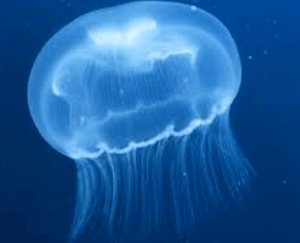
What form is this organism? (Image 1)
a)
Polyp
b)
Medusa
28.
Which Phylum does this animal belong?
a)
Phylum Porifera
b)
Phylum Cnidaria
29.
How do medusa move?
a)
pulsing their bell
b)
crawling with tentacles
c)
complex muscular limbs
d)
They are sessile.
30.

In Cnidarians, digestion occurs in the ______.

a)

epidermis

b)

manubrium

c)

Gastrovascular cavity

d)

tentacles

31.
True jellies belong to the class _______.
a)
Staurozoa
b)
Anthozoa
c)
Cubozoa
d)
Scyphozoa
32.
Anemones and corals belong in ______.
a)
Staurozoa
b)
Anthozoa
c)
Cubozoa
d)
Scyphozoa
33.
Which class of Cnidarian has no medusa phase?
a)
Anthozoa
b)
Cubozoa
c)
Scyphozoa
d)
Hydrozoa
34.
____________ are cube shaped medusa. Their polyp stage is inconspicuous and in some species, has never been observed.
a)
Anthozoans
b)
Scyphozoans
c)
Cubozoans
d)
Hydrozoans
35.
This form of cnidaria is known as a _______.
a)
polyp
b)
medusa
36.
This form of cnidaria is known as a __________.
a)
medusa
b)
polyp
37.
This belongs to the ________ phylum.
a)
porifera
b)
echinodermata
c)
mollusca
d)
cnidaria
38.

Contained in the class scyphozoa

a)

Coral

b)

Sea Anenome

c)

Sponges

d)

Jellyfish

39.

An organism with no backbone

a)

Vertebrate

b)

Invertebrate

40.

Can the toxin in a jellyfish sting harm humans?

a)

Yes

b)

No

41.

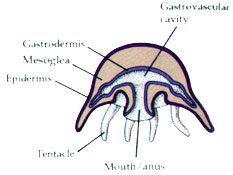
Which body form is represented by this diagram?

a)

Mesoglea

b)

Medusa

c)

Porifera

d)

Choanocyte

42.

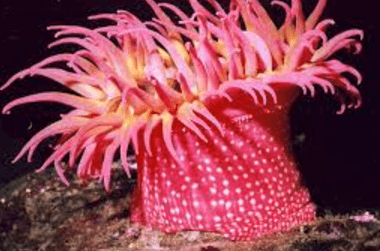
Which Class does this organism belong in?

a)

Class Scyphozoa

b)

Class Anthozoa

c)

Class Hydrozoa

d)

Class Cubozoa

43.

Which of these is NOT a Cnidarian Class?

a)

Anthozoa

b)

Monozoa

c)

Scyphozoa

d)

Hydrozoa

44.
Polyps are ______, while medusa are ______. 
a)
sessile, motile
b)
motile, sessile
c)
both motile and sessile, just motile
45.
Scyphozoans have a _______ functioning in equilibrium.
a)
statocyst
b)
ocelli
c)
collencyst
d)
coralcyst