Wayground logo

Free Printable Worksheets

Font size

S
M
L
XL
Worksheets

Evolution/Succession

Total questions: 84

Worksheet time: 1hrs 6mins
Name
Class
Date
1.
Which term refers to the process by which individuals that are better suited to the environment survive and reproduce therefore passing down their genes to their offspring? 
a)
Evolution 
b)
Variation 
c)
Adaptation
d)
Natural Selection 
2.
Darwin referred to this as survival of the fittest. Over time, it results in changes in the inherited characteristics of a population because organisms with adaptations that make them fit for their environment will survive and reproduce better than those without favorable traits.
a)
Natural Selection
b)
Genetic Variation
c)
Survival of the Fittest
3.
Which of the following is NOT an example of natural selection? 
a)
People selectively breeding hamsters.
b)
Insect populations developing resistance to certain pesticides.
c)
Bacteria becoming resistant to antibiotics.
d)
Male birds of certain species developing colorful feathers to attract female mates.
4.
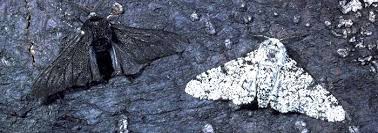
The environment around Manchester, England, changed during the Industrial Revolution.  How did this change affect peppered moths living in the area?
a)
Natural selection favored moths with dark wings because predators could not see them on the soot-colored trees.
b)
Natural selection favored moths with white wings that were easy for predators to see.
c)
Natural selection favored moths with white wings because predators could not see them on the soot-colored trees.
d)
Natural selection caused moths with white wings to become extinct.
5.
The separation of a group of individuals from the rest of the population is referred to as 
a)
genetic drift
b)
natural selection
c)
geographic isolation
d)
survival of the fittest
6.
What is the study of organisms at the early stages of development?
a)
DNA studies
b)
embryology 
c)
extinction
d)
fossil record
7.
What is an organism that has similar characteristics and can reproduce?
a)
species
b)
organism
c)
embryology
d)
vestigial 
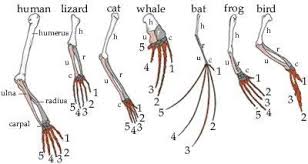
8.
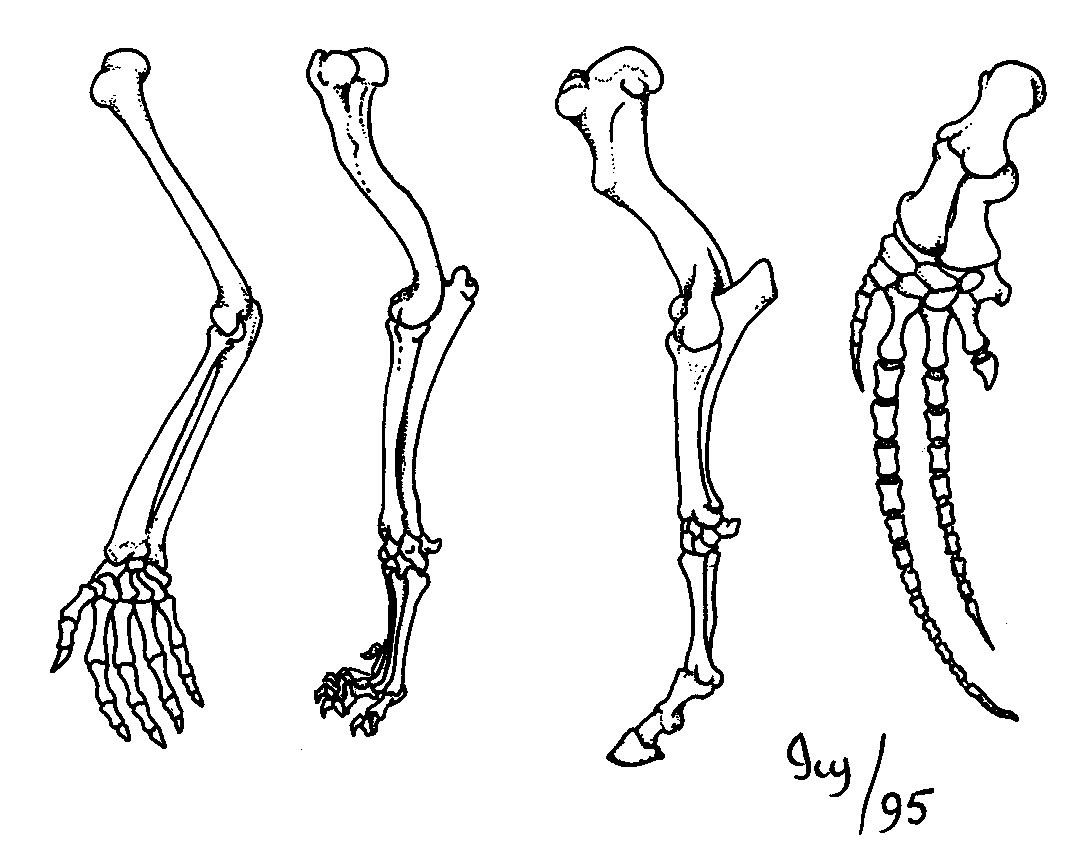
What is this an example of?
a)
vestigial structures
b)
embryology
c)
homologous structures
d)
fossil record
9.
Predict which moth would increase in population
a)
light 
b)
dark
10.
The cause of artificial selection is…
a)
The environment
b)
Humans
c)
Mutation
d)
Gene Flow
11.
A remnant or trace of an organism from the past is called a _______.
a)
Ancestor
b)
Skeleton
c)
Fossil
d)
Imprints
12.
Structures with the same parts have different functions; suggests that organisms share a common ancestry
a)
vestigial structures
b)
homologous structures
c)
adaptive radiation
d)
fossil
13.
Which of the following is an example of a vestigial structure?
a)
the wings of a red-tailed hawk
b)
the hind limbs of a house cat
c)
the fins of sharks
d)
the tailbone of a human
14.
In natural selection, the selective agent is the
a)
humans
b)
mutations
c)
breeders
d)
environment
15.
All rabbits living in a particular area would be an example of a(n)
a)
population
b)
species
c)
fossil
d)
individual organism
16.

What is suggested by the anatomical similarity of different species of vertebrates?

a)

no evolutionary relationships between the groups

b)

recent common ancestry

c)

similar environments in the past

d)

evolution from a distant common ancestor

17.
Some organisms that share a common ancestor have features that have different functions, but similar structures.  These are known as
a)
vestigial structures
b)
analogous structures
c)
homologous structures
d)
fossil structures
18.
If an organism has a vestigial structure, that structure likely once had a function in a(n)
a)
close relative
b)
early ancestor
c)
unrelated organism
d)
embryological stage
19.
Two organisms that are closely related would have
a)
very similar DNA sequence
b)
exactly the same DNA sequences
c)
no proteins in common
d)
completely different DNA sequence
20.
What is speciation?
a)
combining of tow species to form one with different traits
b)
isolation that affects mating behaviors
c)
timing of mating that prevents normal sexual selection
d)
divergence of two or more species from an existing one
21.
An earthquake causes an ocean channel top open and separate an island into two.  the species on each section are now in
a)
geographic isoliation
b)
behavioral isolation
c)
disruptive selection
d)
temporal isolation
22.
two species are in different environments and look very similar.  However, that are not closely related (analogous).  Their resemblance is most likely an example of.
a)
sexual selection
b)
temporal isolation
c)
convergent evolution
d)
divergent evolution
23.

Other insects cannot, but, a bumble bee has just enough weight to open up the snapdragon flower and pollinate. This adaption is ....

a)

convergent evolution

b)

co-evolution

c)

divergent evolution

d)

speciation

24.
What is the process in which humans breed organisms for certain traits?
a)
natural selection
b)
inheritance
c)
artificial selection
d)
descent withOUT modification
25.
Where the better adapted organisms survive to pass traits along to offspring.
a)
Evolution
b)
Natural Selection
c)
Extinction
d)
Artifical Selection
26.
Why are advantageous traits more likely to be passed onto offspring?
a)
Because they are more likely to survive and reproduce.
b)
Because they come from dominant alleles.
c)
Because they come from recessive alleles.
d)
Because the trait is an acquired phenotype.
27.

When two organisms evolve in response to the other

a)

Speciation

b)

Coevolution

c)

Gradualism

d)

Convergent evolution

28.

Which pattern of evolution results in one species splitting into many over time?

a)

Convergent evolution

b)

Sexual selection

c)

Coevolution

d)

Divergent evolution

29.

Organisms that live in similar environments, such as the ocean, often have similar adaptations. This is often due to....

a)

Sexual selection

b)

Gradualism

c)

Coevolution

d)

Convergent evolution

30.
A population of bacteria is treated with hand sanitizer. Because of genetic variation in the population, what is a possible outcome?
a)
Some may be resistant and survive
b)
They will get better at obtaining a food source
c)
The population will grow quickly
d)
All of the bacteria are already resistant
31.

An earthquake causes an ocean channel to open up on an island where a low area previously existed. The island’s lizard population is now separated on the two parts of the island, providing an example of

a)

geographic isolation.

b)

behavioral isolation.

c)

disruptive selection.

d)

temporal isolation.

32.

The Galápagos Islands in the Pacific Ocean have varied habitats. Divergent evolution is occurring on these islands, meaning that the species that live there

a)

have lived unchanged through long periods of stability.

b)

are becoming more like each other in response to their habitats.

c)

change in response to changes in other species they interact with.

d)

had common ancestors but have become increasingly different.

33.

The wings of robins and the wings of dragonflies are examples of

a)

divergent adaptation

b)

convergent evoltuion

c)

adaptive radiation

d)

punctuated equilibrium

34.

Occurs when stable environment favours the intermediate phenotype

a)

Directional selection

b)

Disruptive selection

c)

Stabilizing selection

d)

Inbeeding

35.

A balanced polymorphism exist through disruptive selection in seed cracker finches from Cameroon in which small and large billed birds specialized in cracking soft and hard seeds, respectively. If long term climatic change resulted in all seeds becoming hard, what type of selection would then operate on the finch population?

a)

Sexual selection

b)

Stabilizing selection

c)

Directional selection

d)

Disruptive selection

36.

Occurs when changing environment favours one extreme phenotype

a)

stabilizing selection

b)

Directional selection

c)

Disruptive selection

d)

Outbreeding

37.

Occurs when environmental conditions fluctuate between two opposite extreme values.

a)

Artificial selection

b)

Distruptive selection

c)

Directional selection

d)

Stabilizing selection

38.
Sharks and dolphins both have streamlined bodies that allow them to move through water efficiently, this is an example of which type of evolution?
a)
Divergent
b)
Coevolution
c)
Convergent
d)
Artificial
39.

What type of selection is depicted in the picture?

a)

stabilizing

b)

directional

c)

disruptive

40.

Robins typically lay fours eggs. If more then four eggs are produced then the baby chicks are malnourished while smaller egg numbers result in no viable (able to live) baby chicks. This is an example of

a)

stabalizing

b)

disruptive

c)

directional

41.
What type of selection?
a)
Directional 
b)
Stabilizing
c)
Disruptive
42.
Which of the three graphs shows stabilizing selection?
a)
A
b)
B
c)
C
43.
If finches with large beaks and finches with small beaks increase in a population while finches with average sized beaks decreases, which pattern of natural selection has occurred?
a)
Directional selection
b)
Disruptive selection 
c)
Stabilizing selection
44.
What is the correct explanation for what is happening in this graph?
a)
There are a lot of average-sized beaks
b)
There are no beaks
c)
There are a lot of small beaks only
d)
There are a lot of small and large beaks, but not average-sized ones
45.
Scientists find that most feral cats in a neighborhood have whiskers about 12 cm long. After about 15 generations of stabilizing selection, what would you expect to see?
a)
even more cats with 12 cm long whiskers
b)
most cats with less than 12 cm long whiskers
c)
most cats with more than 12 cm long whiskers
d)
most cats with whiskers either less than or more than 12 cm long, very few with whiskers 12 cms 
46.
Human babies don't do well if they are born too small. If they are too big complications can occur during birth. Baby size should then be selected for by which method?
a)
stabilizing
b)
directional
c)
disruptive
d)
Beyonce is having twins
47.
An extreme phenotype is favored causing the alleles to shift toward that phenotype
a)
Disruptive Selection
b)
Directional  Selection
c)
Stabilizing Selection
d)
Artificial Selection
48.
What is the order of succession shown in this figure?
a)
A, B, C, D
b)
B, A, D, C
c)
C, D, A, B
d)
D, A, B, C
49.
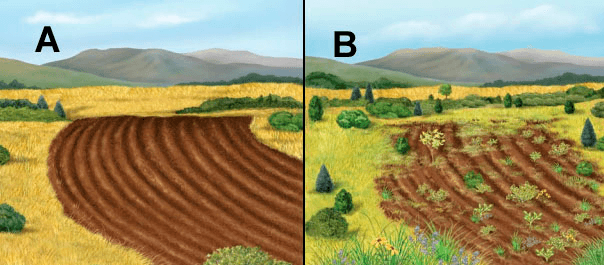
What type of succession is shown going from figure A to figure B?
a)
primary succession
b)
ecological succession
c)
secondary succession
d)
intermediate
50.
What is the goal of the pioneer species in Primary Succession?
a)
To kill the dead materials after a disaster
b)
To rebuild soil
c)
To feed Johnny
d)
To put fresh oxygen into the air
51.
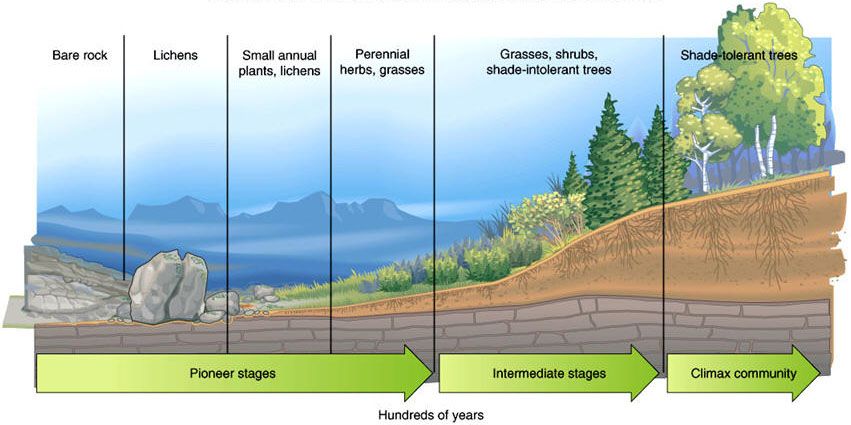
The picture shows what type of succession?
a)
primary
b)
secondary
c)
tertiary
d)
quadanary
52.
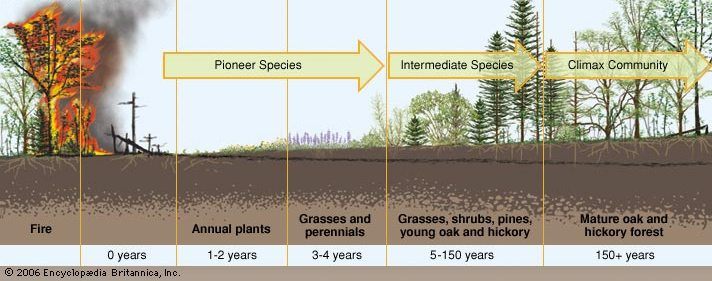
The picture shows what type of succession?
a)
primary
b)
secondary
c)
tertiary
d)
quadanary
53.
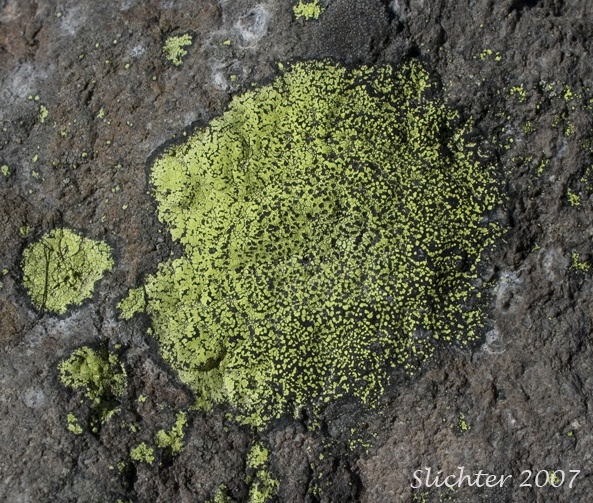
What is the name given to lichen or algae after a primary succession?
a)
pioneer species
b)
volunteer species
c)
founder species
d)
conqueror species
54.
After a volcanic eruption, lava covers the land. What is the order that plants grow to repopulate the area?
a)
Lichens → Shrubs → Grasses → Trees
b)
Lichens → tree → shrubs→Grasses
c)
Grasses → Lichens → Shrubs → Trees
d)
Lichens → Grasses → Shrubs → Trees
55.
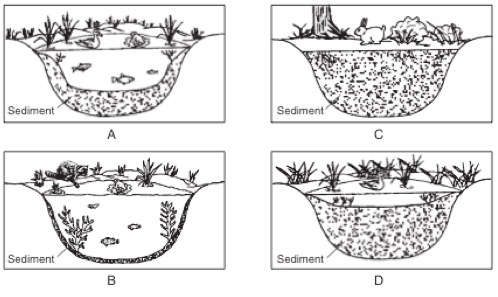
What is the correct order from oldest (happened first) to youngest (happened last) in this pond succession?
a)
A, B, C, D
b)
D, C, B, A
c)
B, A, D, C
d)
C, D, A, B
56.
Reaches a climax community quicker because soil is already present
a)
primary succession 
b)
secondary succession
c)
both types of succession
57.
Final illustration (#8) shows
a)
pioneer species
b)
climax community
c)
only biotic factors
d)
only abiotic factors
58.
Succession type?
a)
primary succession
b)
secondary succession
c)
tertiary succession
d)
variable succession
59.
What type of speciation involves geographic isolation?
a)
Allopatric
b)
Sympatric
c)
Both
60.
Which type of speciation occurred when a few finches were blown from the coast of South America to the Galapagos Islands and then evolved into 14 different finch species?
a)
Allopatric
b)
Sympatric
61.
Which type of speciation occurred when maggot flies living on harthorns began to feed on apples?
a)
Allopatric
b)
Sympatric
62.
What is geographic isolation?
a)
Members of a population live together within an geographic boundary
b)
Members of a population may become isolated from one another by geographic boundaries
c)
An isolation that is geographic
d)
None of these
63.
What is allopatric speciation?
a)
Occurs when a physical barrier divides one population into two or more populations
b)
Occurs when a reproductive barrier divides one population into two or more populations
c)
Occurs when species evolve into a new species without a physical barrier
d)
Occurs when species into into a new species at random
64.
What type of selection is this?
a)
Directional Selection
b)
Stabilizing Selection
c)
Disruptive Selection
d)
Natural Selection
65.
What type of selection is this?
a)
Directional Selection
b)
Stabilizing Selection
c)
Disruptive Selection
d)
Natural Selection
66.
What type of selection is this?
a)
Directional Selection
b)
Stabilizing Selection
c)
Disruptive Selection
d)
Natural Selection
67.
What type of speciation involves geographic isolation?
a)
Allopatric
b)
Sympatric
c)
Both
68.
What type of speciation involves isolation due to behavior such as sexual selection or habitat differentiation?
a)
Allopatric
b)
Sympatric
c)
Both
69.
Which type of speciation occurred when maggot flies living on harthorns began to feed on apples?
a)
Allopatric
b)
Sympatric
70.
Sympatric speciation is when one species evolves in to two...
a)
In the same geographic area
b)
In different geographic areas
c)
Because of different climates
d)
None of the above
71.
A flash flood carried a raft of Amazon ants away from their original population. There is enough distance between the two groups, that they will never meet in nature again. What type of reproductive barrier is this?
a)
behavioral isolation
b)
temporal isolation 
c)
gametic isolation
d)
geographic isolation 
72.

A new river forms and splits two populations, causing ______________ speciation

a)

Sympatric

b)

Allopatric

c)

Extreme

d)

Convergent

73.

Orcas occur in the same habitat but some are avoiding each other and do not interbreed. They have different diets, vocal behavior, and social structures. What type of speciation is this?

a)

Allopatric

b)

Sympatric

c)

Complex

d)

Covergent

74.

when the organism develops different courtship rituals which do not attract main population this is a part of ____________ speciation.

a)

Allopatric

b)

Sympatric

c)

Simple

d)

Temporal

75.

The emergence of new rivers or streams is a type of ____________ isolation.

a)

Temporal

b)

Mechanical

c)

Behavioral

d)

Geographic

76.

When the Grand Canyon in Arizona formed, two populations of one squirrel species were separated by the giant canyon. This is an example of _____________ speciation.

a)

Allopatric

b)

Sympatric

c)

Simple

d)

Divergent

77.
The process by which populations slowly change over time is called__________
a)
selective breeding
b)
adaptation
c)
sepeciation
d)
evolution
78.
Study of embryos of various organisms to show a common ancestor because of similarities in development
a)
natural selection
b)
embryology
c)
speciation
d)
evolution
79.
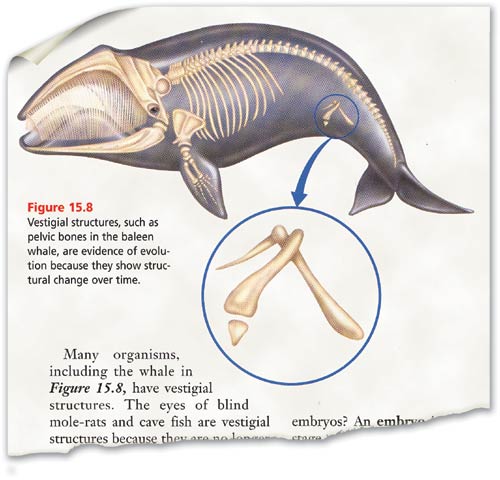
Whales are aquatic mammals that contain a pelvis bone.  Even though it does not aid in its movement, the function must have been used by a common ancestor of the whale.  Thus, the pelvis is referred to as a(n)
a)
vestigial structure
b)
analogous structure
c)
homologous structure
80.
Which of the following pieces of evolution evidence contain both homologous and vestigial structures?
a)
fossil record
b)
comparing embryology
c)
comparing biochemistry
d)
comparing anatomy
81.
Human newborns usually weigh between 6-8 pounds
a)
stabilizing selection
b)
directional selection
c)
disruptive selection
d)
sexual selection
82.

Scientists can determine relatedness among organisms by comparing partial amino acid sequences. The table shows four partial amino acid sequences from four organisms. Which organisms is the LEAST related to the other three organisms?

a)

Organism 1

b)

Organism 2

c)

Organism 3

d)

Organism 4

83.

The diagram shows light- an dark-colored beetles that live on a tree. Which result is most likely to occur to the beetle population due to predation over time?

a)

The number of light-colored beetles in the population will increase.

b)

There will be more dark-colored beetles than light-colored beetles.

c)

The number of light-colored beetles will decrease.

d)

The dark-colored beetles will move to a different type of tree.

84.

Adaptations that result from natural selection are expected to increase the fitness of an organism. In terms of natural selection, which of the following best describes fitness?

a)

Being able to escape from predators.

b)

Being among the strongest organisms in a population.

c)

Being able to survive, find a mate, and produce offspring.

d)

Being able to survive long enough to reach the adult stage.