wayground logo

Free Printable Worksheets

Font size

S
M
L
XL
Worksheets

Primary and Secondary succession

Total questions: 85

Worksheet time: 2hrs 19mins

Name
Class
Date
1.
succession that occurs in an area with no soil
a)
ecological succession 
b)
primary succession 
c)
secondary succession
d)
pioneer speciles
2.
succession that occurs in an area where soil is already present
a)
ecological succession 
b)
primary succession 
c)
secondary succession
d)
pioneer speciles
3.
the first organisms that appear in an ecological community
a)
ecological succession 
b)
primary succession 
c)
secondary succession
d)
pioneer speciles
4.
a stable ecological community that has reached equilibrium
a)
ecological succession 
b)
climax community
c)
secondary succession
d)
pioneer speciles
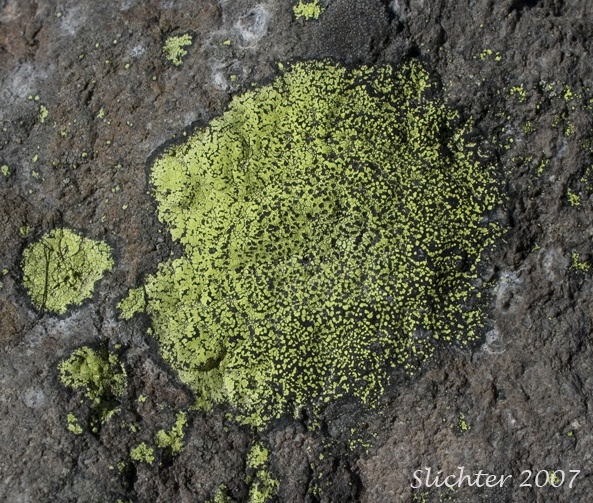
5.
starts with bare rock followed by lichen
a)
primary succession 
b)
secondary succession
c)
both types of succession
6.
reaches a climax community quicker because soil is already present
a)
primary succession 
b)
secondary succession
c)
both types of succession
7.
The picture shows what type of succession?
a)
primary
b)
secondary
c)
tertiary
d)
quadanary
8.
How do lichens contribute to primary succession?
a)
Lichens decompose organic matter from animals and plants
b)
Lichens begin to break down rock to form soil
c)
Lichens are nitrogen fixing bacteria
9.
Natural disasters such as flooding and tornadoes are linked to ________________.
a)
primary
b)
secondary
c)
old field
d)
ecosystem
10.
What type of succession is shown going from figure A to figure B?
a)
primary succession
b)
eutrophication
c)
secondary succession
d)
intermediate
11.

Breaking News! A new island has formed off of Hawaii! What must occur for it to become an ecosystem?

a)

Secondary Succession

b)

Aquatic succession

c)

Primary Succession

d)

Ferns must grow

12.

Primary succession occurs in areas with:

a)

very little soil

b)

lots of soil

c)

no soil

d)

soil that has been disturbed

13.

Why do grasses appear before shrubs in ecological succession?

a)

loosen the dirt for new trees to take roots?

b)

provide food for animals returning to the area

c)

require plenty of sunlight to make their own food

d)

can grow even in areas with shallow soil
14.
What is the name given to lichen or algae after a primary succession?
a)
pioneer species
b)
volunteer species
c)
founder species
d)
conqueror species
15.

Primary succession occurs in an area that has:

a)

soil

b)

no soil

c)

some soil

d)

none of these

16.

___ are the first organisms to colonize an area and begin the process of ecological succession.

a)

foundational organisms

b)

introductory organisms

c)

primary organisms

d)

pioneer species

17.

What is an example of an area that is likely to undergo primary succession?

a)

Glaciers melt and leave exposed rock

b)

Plants die from drought and decompose

c)

Land is bulldozed and soil remains

18.

Which of the following is the correct order of ecological succession?

a)

grass - shrubs - lichens - trees

b)

lichens - shrubs - grasses - trees

c)

lichens - grasses - shrubs - trees

d)

grasses - lichens - shrubs - trees

19.

What is the main difference between primary and secondary ecological succession?

a)

Primary begins WITHOUT soil; Secondary begins WITH soil

b)

Primary is the first state and secondary is the second stage

c)

Primary builds plant community; secondary builds animal community

d)

Primary begins WITH soil; Secondary begins WITHOUT soil

20.

What is the term that describes a steady and stable community?

a)

peak community

b)

turf community

c)

climax community

d)

disturbed community

21.

Which is faster: Primary or Secondary Succession?

a)

Primary Succession

b)

Secondary Succession

c)

Both Take The Same Amount of Time

22.

Which of the following is NOT a pioneer species?

a)

Shrubs

b)

Lichen

c)

Mosses

d)

Fungi

23.

T or F: Succession increases biodiversity.

a)

true

b)

false

24.

The Final stage of ecological succession is...

a)

Mature Tree Growth

b)

Climax Community

c)

Pioneer Community

d)

Primary Succession

25.

A bare rock community must first undergo...

a)

the break down of soil in primary succession

b)

the formation of grasses in secondary succesion

c)

creating a climax community

d)

the growth of trees on it

26.
Natural disasters such as flooding and tornadoes are linked to ________________.
a)
primary
b)
secondary
c)
old field
d)
ecosystem
27.
What is the process of combining nitrogen gas with other elements to make nitrogen into usable compounds?
a)
nitrogen composition
b)
ammonia 
c)
nitrogen fixation
d)
denitrification
28.
How much of the atmosphere is composed of nitrogen gas?
a)
87%
b)
38%
c)
78%
d)
21%
29.
Organisms that break down dead plants & animals and release nitrogen back into atmosphere...
a)
bacteria
b)
plants
c)
animals
d)
producers
30.
Organisms that need nitrogen to survive
a)
only plants
b)
only animals
c)
only bacteria
d)
all living organisms
31.
Plants and animals cannot use nitrogen directly from the air.
a)
True
b)
False
32.
After plants and animals contain nitrogen, what puts it back into atmosphere and soil?
a)
decomposition
b)
precipitation
c)
condensation
d)
bacteria
33.
What happens when organisms die and decay? 
a)
Their bodies are lifted up
b)
Their nitrogen returns to the soil
c)
they keep their nitrogen
d)
They stay on earth forever
34.
The process in which Nitrogen circulates and is recycled is called ____________
a)
The nitrogen cycle
b)
The water cycle
c)
The carbon cycle
d)
Nitrogen Fixation 
35.
_____ is the conversion of organic nitrogen into ammonia
a)
Nitrogen Fixation
b)
Ammonification
c)
Denitrification
d)
Assimilation 
36.
Nitrification happens in the ______
a)
Air 
b)
Soil 
c)
Ground Water 
d)
Plants 
37.
Biodiversity refers to
a)
extinct species
b)
the variety of species on Earth
c)
nonrenewable resources
d)
the rate of species decline
38.
How did the zebra mussels end up in the Great Lakes?
a)
In ballast tanks of ships
b)
They were intentionally released
c)
They have always been in the Great Lakes
d)
That's not a zebra mussel
39.
1. What makes a species invasive?
a)
Moving to a new ecosystem and taking resources from natives 
b)
Not having papers
c)
Species that can't adapt
d)
Plants that take up too much space
40.
What kind of organisms can become invasive? 
a)
Lions, Tigers, Bears
b)
Plants, Animals, or Pathogens 
c)
Animals
d)
Plants
41.
What is a native specie?
a)
A specie that is local and has lived in the same place
b)
A specie who has come from another state or country
c)
A specie that has no "home" and travels for its whole life
d)
None of the above
42.
A population of an organism will only grow exponentially if:
a)
The resources are unlimited
b)
They want to
c)
The resources are limited
d)
They do not like to compete
43.
Invasive species have a negative impact on...
a)
the ecosystem
b)
the economy
c)
Both the ecosystem and the economy
d)
None of these
44.
What do invasive species do to the habitat they move into? (paragraph 2)
a)
crowd out local plants and animals
b)
eat all the mice and deer
c)
create a food chain
45.
What's one EFFECT of pythons invading the Everglades?
a)
the number of small mammals, like mice, are decreasing
b)
the number of white-tailed deer is increasing
c)
pythons can grow to be 18 feet long
46.
What is an invasive species?
a)
A native (naturally found) species which are added to an area. 
b)
A non-native (not naturally found) species added to an area. 
c)
A keystone species in an environment
d)
none of the above
47.

Invasive species alter the ecosystem by _____ in number quickly. This leads to _____ food for the native species.

a)

increasing, less

b)

increasing, more

c)

decreasing, less

d)

decreasing, more

48.

TRUE or FALSE? Invasive species grow quickly due to the lack of predators. This leads to a decline or extinction of the native population.

a)

True

b)

False

49.

A species that is not native to an area is called a ---

a)

Native Species.

b)

Natural Species.

c)

Invasive Species.

d)

Symbiotic Species.

50.

The primary cause of the introduction of invasive species introduction is ---

a)

too much food.

b)

human action.

c)

weather events.

d)

asteroids.

51.

Click on the map to help answer this question. What can we predict about the population of Feral Swine for the year 2016?

a)

There will be less feral swine in 2016 than there were in 1982.

b)

There will be more feral swine in 2016 than there were in 2010

c)

There were fewer feral swine in 2004 than 1982.

d)

There will be no change in feral swine population.

52.

Invasive species cause harm to the --- [choose 3]

a)

economy.

b)

atmosphere only.

c)

environment.

d)

health of organisms.

e)

water only.

53.

TRUE or FALSE? Invasive species can be introduced to an ecosystem accidentally.

a)

True

b)

False

54.

Invasive species --- [choose 3]

a)

take over the habitat of other organisms.

b)

increases the populations of native organisms.

c)

decrease biodiversity.

d)

increase biodiversity.

e)

cause the populations of native organisms to decrease.

55.

Biodiversity refers to ---

a)

extinct species.

b)

the variety of species on Earth.

c)

nonrenewable resources.

d)

the rate of species decline.

56.

Which group is not represented in the food web?

a)

producers

b)

primary consumers

c)

secondary consumers

d)

decomposers

57.

Which one of the following is true of grass in an ecosystem?

a)

It converts oxygen to glucose.

b)

It produces carbon dioxide from oxygen and water.

c)

It produces glucose from carbon dioxide and water.

d)

It converts water to energy.

58.

How would the removal of earthworms from the food chain affect the other organisms?

a)

The number of bass will increase.

b)

The number of crayfish will decrease.

c)

The crayfish will get their energy directly from the sun.

d)

The number of bass and ospreys (bird) will increase.

59.

For the food chain shown, which of the following changes would have the most severe consequences?

a)

a drastic decrease in rainfall, causing a drought

b)

the poaching of predatory hawks by game hunters

c)

the introduction of a second predator that eats field mice

d)

a parasitic infestation that reduces the cricket population

60.

A chemical pesticide was applied to an area of this ecosystem by a landowner to control the mouse population. There was a decrease in the mouse population due to the presence of this pesticide. Which one of the following would most likely occur due to this change in the ecosystem?

a)

The amount of grass would decrease.

b)

The snake population would increase.

c)

The rabbit food supply would increase.

d)

The snake food supply would increase.

61.

the maximum population size of a species that can be sustained in that specific environment, given the food, habitat, water, and other resources available

a)

carrying capacity

b)

limiting factor

c)

greenhouse effect

d)

global warming

62.

increase in the Earth's average atmospheric temperature due to an increase in the levels of greenhouse gases

a)

global warming

b)

greenhouse effect

c)

carrying capacity

d)

acid rain

63.

An increase of Co2 causes....

a)

Decrease in Co2 in the atmosphere

b)

High levels of Salt in the ocean

c)

Greenhouse effect, global climate change,loss of biodiversity

d)

Primary ecological succession

64.

Burning of fossil fuels can increase...

a)

Nitrogen in the soil.

b)

The number of trees in a forest.

c)

Co2 in the atmosphere and cause Global warming.

d)

The amount of oxygen in the air.

65.

Too much nitrogen in the soil can cause..

a)

High oxygen concentration in the atmosphere

b)

Ocean sinks

c)

Algae blooms; decreasing oxygen in the water

d)

Carbon soil

66.

An invasive species is

a)

Any kind of living organism that is not native to an ecosystem and causes harm.

b)

It is a native species to the local area.

c)

It is primary succession; where life starts from bare rock

d)

It is a climax community; a mature forest

67.

The process in which a community changes through time

a)

ecological succession

b)

biodiversity

c)

evolution

d)

ecosystem resilience

68.

Occurs in an area that has never before been colonized

a)

primary succession

b)

natural disturbance

c)

ecological resilience

d)

secondary succession

69.

Occurs in a formerly inhabited area that was disturbed.

a)

primary succession

b)

natural disturbance

c)

ecological resilience

d)

secondary succession

70.

The first species to colonize a disturbed area

a)

pioneer species

b)

trees

c)

shrubs

d)

successional species

71.

Which of the situations listed can result in primary succession? (Check all that apply)

a)

A new island is formed

b)

fire

c)

bulldozing a meadow

d)

a glacier retreats

72.

The image is an example of

a)

primary succession

b)

secondary succession

c)

biodiversity

d)

pioneer species

73.
Which of the following would be the most likely effect, if there were a sudden increase in the cricket population?
a)
There would be a decrease in the small bird population.
b)
There would be a decrease in the grass/flowers population.
c)
There would be a decrease in the mice population.
d)
There would be an increase in the grass/flowers population.
74.
Examples of how humans negatively affect local ecosystems are
a)
Building dams, deforestation (cutting down trees), adding point sources to nearby streams to allow for run-off, building roads and structures, and salting roads.
b)
Creating laws to prohibit fishing from local streams.
c)
Planting trees and other plants to attract native species.
d)
Removing non-native species from the environment.
75.
How would the biodiversity of this ecosystem be affected if the lantern fish disappeared?
a)
The ocean sunfish population would increase.
b)
The large shark population would die out.
c)
The squid would die out.
d)
There would be no change.
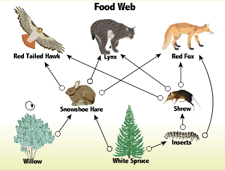
76.
What may happen if the snowshoe hare was removed from the food web pictured?
a)
The insects in the habitat would increase.
b)
The shrew population would decrease due to being only hawk food source.
c)
The willow tree population would decrease.
d)
Foxes would dies due to no food source. 
77.
What does NOT produce carbon dioxide?
a)
Photosynthesis
b)
Burning Fossil Fuels
c)
Animal respiration
d)
Plants decaying
78.
Which of the following removes carbon from the atmosphere?
a)
Combustion
b)
Respiration
c)
Photosynthesis
d)
Death
79.
Respiration is the process by which animals take in _____ and release _____. 
a)
photosynthesis, air
b)
carbon, oxygen
c)
oxygen
d)
oxygen, carbon dioxide
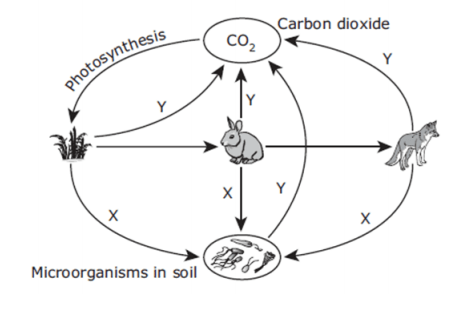
80.
The diagram shows the flow of organic molecules through an ecosystem. What two processes are identified by the labels X and Y?
a)
X : Respiration
Y : Predation
b)
X : Adaptation
Y : Decomposition
c)
X : Fermentation
Y : Nitrogen Fixation
d)
X : Decomposition
Y : Respiration
81.
Which one of these does not add CO2 to the atmosphere?
a)
cooking with gas
b)
planting trees
c)
burning wood
d)
riding in a bus
82.
How do living organisms return carbon to the atmosphere in the carbon cycle?
a)
respiration and photosynthesis
b)
 decomposition and respiration
83.

What organisms in the ocean absorb the most carbon dioxide?

a)

Algae and marine plants

b)

Ocean mammals, like whales and dolphins

c)

Fish

d)

Coral

84.

Look at the diagram of the food web. The arrows means “eaten by.”


What will happen if the number of snakes goes down?

a)

The owl will eat the grass

b)

The number of frogs will go down

c)

The hawk and owl will have less food

d)

The number of mice and grasshoppers will go up.

85.

In an ecosystem, a fungus, such as the mushroom pictured here, functions as a

a)

autotroph

b)

decomposer

c)

predator

d)

producer