
 Worksheets
Rocks and Minerals 201819
Total questions: 40
Worksheet time: 36mins
Name
Class
Date
1.
What type of rock would you most likely find a fossil inside of?
a)
sedimentary
b)
igneous
c)
metamorphic
d)
diamond
2.
True or False:
Sedimentary rocks always form under water.
Sedimentary rocks always form under water.
a)
true
b)
false
3.
What is Luster?
a)
The color of a mineral when it is ground into a powder.
b)
A measure of how easily a mineral can be scratched.
c)
The way a mineral shines, or reflects light.
4.
Another way to test hardness is...
a)
Mineral scale
b)
Moh's scale
c)
Streak scale
5.
What is metamorphic rock?
a)
Rock that forms when melted, or molten rock from deep below Earth's surface cools and hardens.
b)
A solid material made up of one or more minerals.
c)
Rock that forms when existing rocks are changed by heat, pressure, or chemicals beneath the Earth's surface.
6.
What is a rock?
a)
Rock that forms when melted, or molten rock from deep below Earth's surface cools and hardens.
b)
A solid material made up of one or more minerals.
c)
Rock that forms when existing rocks are changed by heat, pressure, or chemicals beneath the Earth's surface.
7.

This rock was found near the mouth of a volcano. What type of rock is this?
a)
Sedimentary
b)
Igneous
c)
Metamorphic
8.

This rock was molten lava that cooled quickly as it came out of a volcano. What type of rock is this?
a)
Sedimentary
b)
Igneous
c)
Metamorphic
9.
In order for a metamorphic rock to form, _______ is needed.
a)
Pressure
b)
Heat
c)
Heat and Pressure
d)
Weathering
10.
Is magma below or above ground
a)
above
b)
below
11.
What are 3 properties that are used to identify minerals?
a)
luster, color and sound
b)
smell, color and hardness
c)
luster, color and hardness
d)
luster, smell and hardness
12.
_____ rock forms when magma ______ & solidifies.
a)
Sedimentary; thickens
b)
Igneous; thickens
c)
Metamorphic; deepens
d)
Igneous; cools
13.
Which of these is true about sedimentary rocks?
a)
They are made of many layers
b)
they form very quickly
c)
they are unchanged by weathering
d)
they contain many small air pockets
14.
A fingernail has a hardness of 10.
a)
False
b)
True
15.
This is a "fire rock"
a)
Sedimentary
b)
Igneous
c)
Metamorphic
16.
A diamond is the hardest mineral.
a)
True
b)
False
17.
Scientists who study rock and minerals are called geologists
a)
False
b)
True
18.
The continuous series of change that rocks undergo is known as the _____.
a)
rock cycle
b)
water cycle
c)
hibernation
d)
metamorphisis
19.
Which of the following natural resources are nonrenewable?
a)
Water
b)
Animals
c)
Natural gas
d)
Wind
20.
All of these resources are renewable EXCEPT:
a)
Oxygen
b)
Crude Oil
c)
Ice
d)
Corn
21.
Fossil fuels are nonrenewable because...
a)
they are used to produce heat
b)
they take a long time to form
c)
they can be found underground
22.
What does conserving resources mean?
a)
Use as much of the resources as you can
b)
Only use the resources at school
c)
Protecting the resource so it does not run out
23.
A resource that is not easily replaced...
a)
Renewable
b)
Nonrenewable
24.
Which group includes ALL renewable resources?
a)
Coal, trees, water, oil
b)
Water, wind, sun, plants
c)
Minerals, sun, natural gas, water
25.
Which of these is renewable?
a)
Water
b)
Oil
c)
Coal
d)
Minerals
26.
What is hardness?
a)
The tendency of a mineral to split easily along flat surfaces.
b)
A measure of how easily a mineral can be scratched.
c)
The way a mineral shines, or reflects light.
27.
Rain washing away soil from a hillside
a)
Weathering
b)
Erosion
28.
Water getting into cracks, freezing, and breaking the rocks or pavement apart
a)
Weathering
b)
Erosion
29.
Wind blowing sand from one location to another
a)
Weathering
b)
Erosion
30.
Wind blasting sand at rock and carving out arches
a)
Weathering
b)
Erosion
31.
Flood waters moving soil from one location to another
a)
Weathering
b)
Erosion
32.
What is sediment?
a)
the process of rocks being broken down and carried away
b)
bits of rock and sand caused by the weathering of rocks
c)
the top layer of the soil
d)
decaying plant or animal material
33.
What are the 3 major types of rocks?
a)
Igneous, Metamorphic, Sedimentary
b)
Metamorphic, Igneous, Cementation
c)
Brown, Red, Gray
d)
Streak, Hardness, Breakage
34.
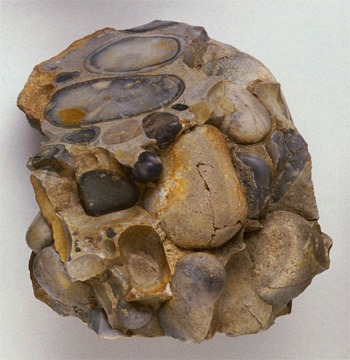
This rock was formed by smaller pieces of rock that settled at the bottom of a lake millions of years ago. What type of rock is this?
a)
Sedimentary
b)
Igneous
c)
Metamorphic
35.

Which mineral property is being shown here?
a)
luster
b)
hardness
c)
cleavage
d)
streak
36.

Which type of rock forms from extreme heat and pressure?
a)
Igneous
b)
Sedimentary
c)
Organic
d)
Metamorphic
37.

What is # 4 on the MOH's scale?
a)
Fluorite
b)
Feldspar
c)
Quartz
d)
Calcite
38.

What is # 8?
a)
Minerals
b)
Apatite
c)
Corundum
d)
Topaz
39.

The following image shows what mineral property?
a)
Hardness
b)
Streak
c)
Cleavage
d)
Density
40.
A mineral's resistance to being scratched is called?
a)
streak
b)
luster
c)
hardness
d)
heft
100 %

