wayground logo

Free Printable Worksheets

NEW

Font size

S
M
L
XL
Worksheets

Revision

Total questions: 60

Worksheet time: 49mins

Name
Class
Date
1.
What is structure A?
a)
Substrate
b)
Active site
c)
Enzyme
d)
Products
2.
What is structure D?
a)
Substrate
b)
Active site
c)
Enzyme
d)
Products
3.
What is structure C?
a)
Substrate
b)
Active site
c)
Enzyme
d)
Products
4.
What is a substance called if it speeds up a chemical reaction?
a)
reusable
b)
catalyst
c)
specific
d)
fragile
5.
Each enzyme only has 1 substrate that will fit its active site.  What is this called?
a)
reusablility
b)
denaturation
c)
specificity
d)
fragility
6.
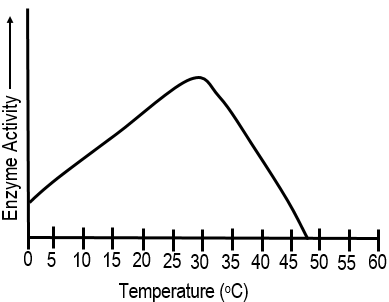
Based on the graph, what is the optimal temperature for this enzyme? 
a)
15oC
b)
40oC
c)
30oC
d)
35oC
7.
An enzyme speeds up a chemical reaction in the cell but can only be used once.  True or False? 
a)
true
b)
false
8.
What happens when enzymes are heated to a high temperature?
a)
The enzymes die.
b)
The shapes of the enzyme are altered denature
c)
The enzymes' amino acid sequence changes.
d)
The enzymes remain the same
9.
Which of these is NOT true?
a)
Enzymes can denature (change shape) when the temperature gets too high.
b)
Enzymes can only be used once in a chemical reaction. 
c)
Extreme pH can denature enzymes.
d)
Enzymes speed up chemical reactions. 
10.
Which of these is most likely an enzyme?  
a)
Sucrose
b)
Galactose
c)
Fructose
d)
Amylase
11.
Which is NOT true?
a)
Enzymes speed up chemical reactions.
b)
Enzymes react best at a specific temperature.
c)
Enzymes only control ONE type of reaction.
d)
Enzymes are made of fatty acids.
12.
The pH at which an enzyme is most efficient is called the _________ pH of an enzyme.
a)
neutral
b)
optimum
c)
minimum
d)
experimental 
13.

Starch digestion occurs in the mouth cavity and in the duodenum but it stops in the stomach.

Why is this?

a)

All the starch has been digested before it reaches the stomach.

b)

Cells in the stomach do not produce amylase.

c)

The pH in the stomach alters the shape of the amylase.

d)

The temperature in the stomach is too high for amylase to work.

14.

When the temperature or pH causes the enzyme to change so it no longer works, this is called ....

a)

Allosteric inhibition

b)

Substrate concentration

c)

Denaturation

d)

Active Site transference

15.
Biomass is the .....
a)
total mass of materials in a living organism
b)
weight of an organism
c)
the mass of air in our atmosphere
16.
Where is chlorophyll found?
a)
Xylem vessels
b)
Root hair cell
c)
Chloroplasts
17.
What  sugar is made in photosynthesis?
a)
Sucrose
b)
Glucose
c)
Cellulose
18.
What energy is required for photosynthesis?
a)
Chemical energy
b)
Thermal energy
c)
Light energy
19.
What are the small pores called on the underside of leaves that allow gases into and out of the cell?
a)
Stomata
b)
Xylem vessels
c)
Phloem vessels
20.
What do guard cells do?
a)
Control the opening and closing of stomata
b)
Take water from roots to leaves
c)
Absorb water from soil
21.
What two raw materials are needed for photosynthesis?
a)
Water and oxygen
b)
Water and carbon dioxide
c)
carbon dioxide and oxygen
22.
Leaves are broad and flat so that they can:
a)
absorb more water from the air
b)
absorb more light from the sun
c)
absorb more heat from the sun
23.
Which of the following is not a limiting factor for photosynthesis?
a)
light intensity
b)
temperature
c)
oxygen levels
24.
Which of the following is a limiting factor for photosynthesis?
a)
light intensity
b)
glucose levels
c)
oxygen levels
25.
Starch is a polymer (very long molecule made of repeating units or monomers). What is the repeating unit (monomer) in starch?
a)
Cellulose
b)
Amino acids
c)
Glucose
26.
Which types of leaf cells are packed with many chloroplasts for photosynthesis?
a)
Palisade cells
b)
Guard cells
c)
Spongy cells
27.
What are the products of photosynthesis?
a)
Glucose and carbon dioxide
b)
Carbon dioxide and water
c)
Glucose and oxygen
28.
In daylight, water flows into guard cells making them rigid - stoma opens. At night, water flows out of the guard cells making them less rigid - stoma closes.
a)
True
b)
False
29.
Oxygen diffuses out of leaves through these. Carbon dioxide diffuses into the leaves through these.
a)
Stomata
b)
Guard cells
c)
Spongy cells
30.
Organisms that perform photosynthesis are known as 
a)
hydrotrophs
b)
chemotrophs
c)
heterotrophs
d)
autotrophs
31.
Photosynthetic organisms require which 2 inorganic substances
a)
water and glucose
b)
water and oxygen
c)
water and nitrogen
d)
water and carbon dioxide
32.
Chlorophyll is _________absorbing pigment found in _________.
a)
carbon dioxide: chloroplasts
b)
oxygen; ribosomes
c)
water; nucleus
d)
light; chloroplasts
33.
Plants acquire water to perform photosynthesis through
a)
stomates
b)
ribosomes
c)
roots
d)
leaves
34.
Plants can use the oxygen they produce during
a)
DNA replication
b)
Photosynthesis
c)
cell respiration
d)
protein synthesis
35.
Which of the following is the correct equation for PHOTOSYNTHESIS?
a)
carbon dioxide + water --> oxygen + glucose
b)
carbon dioxide + glucose + water --> oxygen 
c)
oxygen + water --> carbon dioxide + glucose
d)
glucose+ oxygen ---> water + carbon dioxide 
36.
Which is not a requirement for germination of a seed?
a)
Favorable Temperature
b)
light
c)
fertilizer
d)
sufficient moisture
37.
Young plant that develops from the fertilized egg
a)
embryo
b)
cotyledon
c)
seed coat
38.
Seeds are only able to sprout or___________ under the right conditions
a)
grow
b)
germinate
c)
multiply
d)
spread
39.

All seeds have

a)

Seed Coat

b)

cotyledon

c)

Embryo

d)

All of the above

40.
Which word identifies letter B?
a)
cotyledon
b)
seed coat
c)
embryo
41.

Why do flowers smell nice and they're colored bright?

a)

So that they can make fruit

b)

So that they can pollinate

c)

So that they can attract birds and bees

42.

What is part of the some plants that have seeds and is usually sweet?

a)

The fruit

b)

Pistil

c)

pollen

d)

What

43.

Pollen comes from one plant to another, what is that called?

a)

Attract

b)

Pollinate

c)

reproduce

44.

What do bees suck from the flowers to make their honey?

a)

Nectar

b)

Pistil

c)

Stamen

45.

What do you call the yellow dust that is inside flowers?

a)

Pollen

b)

fruit

c)

nectar

46.
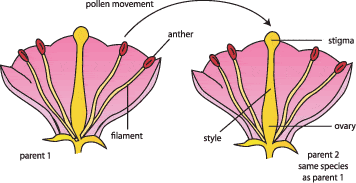
Pollination can occur within the same flower. 
a)
True 
b)
False 
47.
Pollination can occur between flowers of the same plant. 
a)
True 
b)
False 
48.
Pollination can occur between flowers of the different plants of the same species. 
a)
True 
b)
False 
49.
I have large petals and are usually brightly coloured. How am I pollinated?
a)
By animals
b)
By birds 
c)
By insects 
d)
All of the above
50.
Which of the following is a pollinator?
a)
spider
b)
terminator
c)
bee
d)
ant
51.
Which of the following is NOT a pollinator?
a)
bees
b)
humming bird
c)
fruit bat
d)
scorpion
52.
A plant can have both male and female parts.
a)
True
b)
False
53.
Why do bees need nectar?
a)
to eat
b)
to sleep
c)
for honey
d)
to be sticky
54.
What does an ovule become when it is pollinated?
a)
a seed
b)
a sprout
c)
a fruit
d)
it stays an ovule
55.
Fertilization is the process by which an 
a)
egg and pollen combine
b)
embryo grows into a plant
c)
animal carries pollen between plants
56.
What does a plant need to germinate?
a)
water, sunlight, warm temperature
b)
water and dirt
c)
oxygen and sun
57.
What is D? (pg.134)
a)
Anther
b)
Ovules
c)
Pollen Tube
d)
Stigma
58.
What color is chlorophyll?
a)
Green
b)
Purple
c)
Blue
d)
Red
59.
What are the white parts of the flower below?
a)
Pistil
b)
Petals
c)
Stamen
d)
Stigma
60.
If a bee does not come in contact with a flower's pollen...
a)
the plant is not likely to reproduce
b)
the plant is more likely to reproduce