
Font size
 Worksheets
Thermodynamics
Total questions: 165
Worksheet time: 4hrs 2mins
True or False? Temperature is a measure of the total kinetic energy in a substance.
True
False
Select the correct SI unit for Heat
calorie
joule
kelvin
celsius
Select the correct SI unit for temperature
calorie
joule
kelvin
celsius
Select the correct symbol for Heat
H
t
Q
E
If system A and system B have no heat flow between them and system B and system C have no heat flow between them, what do systems A and C have in common?
They must have no heat flow between them
A is hotter than C
C is hotter than A
Heat is flowing back and forth between the two systems rapidly.
The transfer of heat through a fluid (liquid or gas) is...
Conduction
Convection
Radiation
Ablation

What method of heat transfer is causing heat to flow from the tip of the spoon to the handle of the spoon?
Conduction
Convection
Radiation
Erosion

What method of heat transfer do solar panels rely on?
Conduction
Convection
Radiation
Nucleation

A wool blanket is an example of a good ___________.
Radiator
Conductor
Insulator
Equilizer
What is the branch of physics concerned with heat and temperature?
Kinematics
Mechanics
Optics
Thermodynamics
A measure of the amount of disorder or randomness in a system.
Entropy
Exothermic
First Law of Thermodynamics
Heat engine
The law stating that energy is neither created nor destroyed; it only changes form. It is also known as the law of conservation of energy.
First Law of Thermodynamics
Second Law of Thermodynamics
Third Law of Thermodynamics
Fourth Law of Thermodynamics
A law stating that all spontaneous processes result in an increase in the total entropy of the system and its surroundings.
First Law of Thermodynamics
Second Law of Thermodynamics
Third Law of Thermodynamics
Fourth Law of Thermodynamics
Consider 2 blocks of Aluminium (one of 1kg and one of 10 kg) and being supplied with thermal energy.
Which one heats up the fastest?
1 kg
10 kg
They both heat up at the same rate
They don't heat up.
The specific heat(c) of copper is 0.39 Jg-1K-1. What is the temperature change(∆T) when 100 Joules of heat(Q) is added to 20 grams?
12.82 °C
24.12°C
351 °C

Specific heat of water is 4.18 J/g°C. Specific heat of wood is 1.760 J/g°C What material needs more heat energy to raise the temperature?
Water
Wood
Both are same


How do you calculate Enthalpy of a reaction?
ΔH = ΔHproducts - ΔHreactants
ΔT = q / mC
ΔG = ΔH -TΔS
E = mc2
A reaction that gives out energy to the surroundings causes the surroundings ....
temperature to drop
temperature to rise
temperature to remain constant
temperature to vary
The enthalpy change is a negative (-) value, what side of the equation will the energy value be on.
Reactants
Products

In the reaction picture, the energy will be on product or reactant
Product
Reactant

endothermic reaction
exothermic reaction

In the Image, will the heat (+177.8 KJ) be a product or a reactant?
Product
Reactant

In the Image, will the heat (+177.8 KJ) be a product or a reactant?
Product
Reactant

The potential energy diagram of a reaction is shown. Which statement below is correct relating to this reaction?
#1 represents the enthalpy change for this exothermic reaction.
#2 represents the enthalpy change for this endothermic reaction.
#3 represents the enthalpy change for this endothermic reaction.
#4 represents the enthalpy change for this exothermic reaction.

What is the Heat of Reaction ΔH for this reaction?
-200 KJ
200 KJ
400 KJ
-300 KJ
What type of reaction is this?
Exothermic
Endothermic
Energy Producing
No way to tell
The enthalpy change for the reaction
C(s, graphite) + 1⁄2O2(g) --> CO(g) cannot be measured directly since some carbon dioxide is always formed in the reaction.
It can be calculated using Hess’s Law and the enthalpy changes of combustion of graphite and of carbon monoxide.
C(s, graphite) + O2(g) --> CO2 ΔH=-394 kJmol–1
CO(g) + 1⁄2O2(g) --> CO2 ΔH=-283 kJmol–1
The enthalpy change for the reaction of graphite with oxygen to give carbon monoxide is
-677 kJmol–1
-111 kJmol–1
+111 kJmol–1
+677 kJmol–1
The enthalpies of formation of C(s), H2(g) and C4H9OH(l) (in kJmol-1) are as follows
C(s) ∆H=a
H2(g) ∆H=b
C4H9OH(l) ∆H=c
What is the enthalpy change for the reaction shown below?
4C(g) + 5H2(l) + ½O2(g) -> C4H9OH(l)
c – 4a + 5b
4a + 5b - c
2a + 10b - c
2a + 5b + c
You are given these two equations:
2H2 + O2 → 2H2O ∆H = -572 kJ
H2 + O2 → H2O2 ∆H = -188 kJ
How do you calculate the Enthalpy of Reaction?
ΔH = ΔHproducts - ΔHreactants
ΔG = ΔH -TΔS
ΔT = q / mC
E = mc2
Systemsincludes _______.
reactants
products
both reactants and products
None of the above
Change in enthalpy is also called as _______.
Systematic Reaction
Balanced Reaction
Energy of Reaction
Heat of Reaction
Endothermic:_________:__________
Exothermic:_________:__________
positive:warm
negative:cold
positive:warm
negative:warm
positive:cold
negative:cold
positive:cold
negative:warm
When the solids Ba(OH)2 and NH4SCN are mixed, a solution is produced and the temperature drops. Which statement about the energetics of this reaction is correct?
The reaction is endothermic and ΔH is negative
The reaction is endothermic and ΔH is positive
The reaction is exothermic and ΔH is negative
The reaction is exothermic and ΔH is positive
Which of the following represents an exothermic reaction?


Find the enthalpy of formation for the following chemical equation.
CH4 (g) + 2 O2 (g) --> CO2 (g) + 2 H2O (g)
-802.3 kJ
802.3 kJ
951.9 kJ
-951.9 kJ

Find the enthalpy of formation for the following chemical reaction.
2Al (s) + Fe2O3 (s) --> Al2O3 (s) + 2Fe (s)
-847.6 kJ
847.6 kJ
2492 kJ
-2492 kJ
Find the enthalpy change that occurs over the following two-step equations.
2 H2 (g) + O2 (g) --> 2 H2O (l) ΔH = -572 kJ
2 H2O2 (l) --> 2 H2 (g) + 2 O2 (g) ΔH = 376 kJ
-196 kJ
-948 kJ
196 kJ
948 kJ
Find the change in enthalpy over the following two-step equations.
N2 (g) + O2 (g) --> 2 NO (g) ΔH = 180kJ
2 NO (g) + O2 (g) --> 2 NO2 ΔH = -112kJ
-292 kJ
-68 kJ
292 kJ
68 kJ

How much energy would it take to condense 4.9 moles of C2H5OH?
189.14 kJ
-189.14 kJ
24.206 kJ
-24.206 kJ

How much energy is required to turn 7.3 moles of NH3 from a solid to a liquid?
-170.09 kJ
-41.32 kJ
41.32 kJ
170.09 kJ
Which of these processes represents a decrease in entropy?
sublimation of CO2
boiling water
condensation of steam on cold glass
NaCl dissolving in water
Which of these reactions shows a DECREASE in entropy?
CaCO3(s) → CaO(s) + CO2(g)
3O2(g) → 2O3(g)
2NH3(g) → 3H2(g) + N2(g)
C6H6(l) → C6H6(g)
Which reaction has a +ΔS ?
AgNO3(aq) + NaCl(aq) → AgCl(s) + NaNO3(aq)
H2O(g) + CO2(g) → H2CO3(aq)
H2(g) + I2(g) → 2Hl(g)
C2H2O2(g) → 2CO(g) + H2(g)
Systems in nature tend to undergo changes toward
lower energy and less disorder
lower energy and more disorder
higher energy and less disorder
higher energy and more disorder
What is a spontaneous process ?
slow process
fast process
process that needs an external intervention to occur
process that does not need external intervention to occur / keep happening
What information do we need to perform a calculation of Gibbs Free Energy?
Enthalpy of the reaction.
Entropy of the reaction.
The temperature of the reaction in Kelvin.
All of the above are needed.
Which of the following would most likely lead to a spontaneous reaction.
A high negative enthalpy.
A low negative enthalpy.
A high positive enthalpy.
A low positive enthalpy.
Your enthalpy is +20 and your entropy is +5. Which temperature will give a spontaneous reaction?
0
4
8
Your enthalpy is high and negative but your entropy is also negative. What type of temperature would you want to get a spontaneous reaction?
low
high
Which combination of ΔH and ΔS NEVER has a spontaneous reaction?
+ΔH and +ΔS
+ΔH and -ΔS
-ΔH and -ΔS
-ΔH and +ΔS
Your enthalpy is -20 and your entropy is -8. Which temperature will give you a spontaneous reaction?
1
3
5
At what temperature would a given reaction become spontaneous if ΔH =+119kJ and ΔS=+263J/K.mol
452 K
-2210 K
382 K
-363 K
6. The formation ½ A2 + 2 B2 + C --> CAB4 has an enthalpy of formation of -104 kJ and a change in entropy of -60.8 J/K at 30 °C. What is the free energy and spontaneity of the reaction?
-85.6 kJ, spontaneous
-18.3 kJ, not spontaneous
+18.3 kJ, spontaneous
+85.6 kJ, not spontaneous
What is the symbol for entropy?
H
G
S
E
Entropy is a measure of
accuracy
precision
the disorder of a system
the attraction of a nucleus for an electron
Which of these processes represents a decrease in entropy?
sublimation of CO2
boiling water
condensation of steam on cold glass
NaCl dissolving in water
Which of these reactions shows a DECREASE in entropy?
CaCO3(s) → CaO(s) + CO2(g)
3O2(g) → 2O3(g)
2NH3(g) → 3H2(g) + N2(g)
C6H6(l) → C6H6(g)
The entropy will usually increase when
a molecule is broken into two or more smaller molecules
a reaction occurs that results in an increase in the number of moles of gas
a solid changes to a liquid
all of these
Which reaction has a +ΔS ?
AgNO3(aq) + NaCl(aq) → AgCl(s) + NaNO3(aq)
H2O(g) + CO2(g) → H2CO3(aq)
H2(g) + I2(g) → 2Hl(g)
C2H2O2(g) → 2CO(g) + H2(g)
Systems in nature tend to undergo changes toward
lower energy and less disorder
lower energy and more disorder
higher energy and less disorder
higher energy and more disorder
Which sample has the lowest entropy?
1 mole of KNO3(l)
1 mole of KNO3(s)
1 mole of H2O(l)
1 mole of H2O(g)
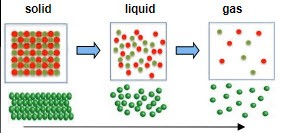
Entropy increases from solid, liquid to gas. Why?
Molecular disorder increases
Molecules increase in number from solid to gas
Molecules are heavier in solid
Molecules are more reactive
Which sample has the lowest entropy?
1 mole of HNO3(aq)
1 mole of KNO3(s)
1 mole of H2O(l)
1 mole of N2O(g)
Which state of matter has the greatest motion and least orderly arrangement?
solid
liquid
gas
aqueous
Which phase change represents a decrease in entropy?
solid to liquid
gas to liquid
liquid to gas
solid to gas
Given the change of phase: CO2(g) → CO2(s)
As CO2(g) changes to CO2(s), the entropy of the system
decreases
increases
remains the same
What phase of matter has the most entropy?
solid
liquid
gas
Entropy of a system increases when a reaction increases the number of particles.
True
False
Which represents a decrease in entropy?
sublimation of CO2
boiling water
condensation of steam on cold glass
NaCl dissolving in water
Predict the entropy
change for this reaction
N2O4(g) → 2NO2(g)
ΔS = +ve and non spontaneous
ΔS = -ve and spontaneous
ΔS = -ve and non spontaneous
ΔS = +ve and spontaneous
Which of the reactions below has a negative ∆S?
CuCO3 (s) + 2HCl (aq) → CuCl2 (aq) + CO2 (g) + H2O (l)
C (s) + O2 (g) → CO2 (g)
CuO (s) + H2SO4 (aq) → CuSO4 (aq) + H2O (l)
BaCl2 (aq) + Na2SO4 (aq) → BaSO4 (s) + 2NaCl (aq)
What is a spontaneous process ?
slow process
fast process
process that needs an external intervention to occur
process that does not need external intervention to occur / keep happening
What does Gibbs Free Energy tell us?
How much energy is given off by a reaction.
The tendency of a reaction to become "random"
How spontaneous a reaction is.
What information do we need to perform a calculation of Gibbs Free Energy?
Enthalpy of the reaction.
Entropy of the reaction.
The temperature of the reaction in Kelvin.
All of the above are needed.
Which of the following would most likely lead to a spontaneous reaction.
A high negative enthalpy.
A low negative enthalpy.
A high positive enthalpy.
A low positive enthalpy.
What are the best conditions to lead towards a spontaneous reaction?
high negative enthalpy, high temp, high negative entropy
high positive enthalpy, high temp, high negative entropy
high negative enthalpy, low temp, high positive entropy
high negative enthalpy, high temp, high positive entropy.
Your enthalpy is high and negative but your entropy is also negative. What type of temperature would you want to get a spontaneous reaction?
low
high
Your enthalpy is positive and your entropy is positive. What type of temperature would you want to ensure a spontaneous reaction.
very high
very low
Your enthalpy is +20 and your entropy is +5. Which temperature will give a spontaneous reaction?
0
4
8
Your enthalpy is -20 and your entropy is -8. Which temperature will give you a spontaneous reaction?
1
3
5
Which of the following situations demonstrates high entropy?
water freezing
water vaporizing
steam condensing to water
A spontaneous reaction is more profitable to a company.
True
False
Which represents a decrease in entropy?
sublimation of CO2
boiling water
condensation of steam on cold glass
NaCl dissolving in water
The entropy will usually increase when
a molecule is broken into two or more smaller molecules
a reaction occurs that results in an increase in the number of moles of gas
a solid changes to a liquid
all of these
Which sample has the lowest entropy?
HINT - Look at the phase of each chemical....
1 mole of KNO3(l)
1 mole of KNO3(s)
1 mole of H2O(l)
1 mole of H2O(g)
Which phase change represents a decrease in entropy?
solid to liquid
gas to liquid
liquid to gas
solid to gas
Entropy is a measure of
accuracy
precision
the disorder of a system
the attraction of a nucleus for an electron
Given the change of phase:
CO2(g) —> CO2(s)
As CO2(g) changes to CO2(s), the entropy of the system
decreases
increases
remains the same
What is a spontaneous process ?
slow process
fast process
process that needs an external intervention to occur
process that does not need external intervention to occur / keep happening
Entropy is a measure of
heat energy
temperature
the disorder/randomness of a system
A small S value indicates the system has _______
more order
more randomness
Which process is accompanied by a decrease in entropy?
boiling of water
condensing of water vapor
subliming of iodine
melting of ice
Given the change of phase:
CO2(g) —> CO2(s)
As CO2(g) changes to CO2(s), the entropy of the system
decreases
increases
remains the same
Identify whether the following result in an increase or decrease in entropy:
3 moles of gas (on reactant side) --> 6 moles of gas (product)
increase
decrease
The entropy will usually increase when
a molecule is broken into two or more smaller molecules
a reaction occurs that results in an increase in the number of moles of gas
a solid changes to a liquid
all of these
The average bond enthalpies for O-O and O=O are 146 and 496 kJ/mol respectively. What is the enthalpy change, in kJ, for the reaction below?
H-O-O-H(g) → H-O-H(g) + ½O=O(g)
-102
+102
+350
+394
For the reaction 2H2(g) + O2(g) → 2H2O(g) the bond enthalpies (in kJ/mol) are
H-H = x, O=O = y, O-H = z
Which calculation will give the value, in kJ/mol, of ΔH for the reaction?
2x + y - 2z
4z - 2x - y
2x + y - 4z
2z - 2x - y

Using the table of average bond energies below the image, the ΔH for the reaction in kJ is.....
+ 160 kJ
-63 kJ
- 160 kJ
-217 kJ
The average bond enthalpies for O-O and O=O are 146 and 496 kJ/mol respectively. What is the enthalpy change, in kJ, for the reaction below?
H2O2(g) → H2O(g) + ½O2(g)
-102
+102
+350
+394
Using the equations below:
C(s) + O2(g) → CO2(g) ∆H = –390 kJ
Mn(s) + O2(g) → MnO2(s) ∆H = –520 kJ
what is ∆H (in kJ) for the following reaction?
MnO2(s) + C(s) → Mn(s) + CO2(g)
910
130
-130
-910
Using the equations below
Cu(s) + 1/2O2(g) → CuO(s) ∆H = –156 kJ
2Cu(s) + O2(g) → Cu2O(s) ∆H = –170 kJ
what is the value of ∆H (in kJ) for the following reaction?
2CuO(s) → Cu2O(s) + 1/2O2(g)
142
15
-15
-142
Consider the following equations.
Mg(s) + O2(g) → MgO(s) ∆H = –602 kJ
H2(g) + O2(g) → H2O(g) ∆H = –242 kJ
What is the ∆H value (in kJ) for the following reaction?
MgO(s) + H2(g) → Mg(s) + H2O(g)
-844
-360
+360
+844
The standard enthalpy change of formation values of two oxides of phosphorus are:
P4(s) + 3O2(g) → P4O6(s) ΔHf = –1600 kJ mol–1
P4(s) + 5O2(g) → P4O10(s) ΔHf = –3000 kJ mol–1
What is the enthalpy change, in kJ mol–1, for the reaction below?
P4O6(s) + 2O2(g) → P4O10(s)
+4600
+1400
–1400
–4600
If N2 (g) + 2O2 (g) ⟶ 2NO2(g) has a ΔHrxn = 68, then what is the ΔHrxn if you reverse the reaction?
86 kJ
- 86 kJ
68 kJ
-68 kJ

25 °C in kelvins
298.45 K
248.15 K
298.15 K
Calculate the volumetric flow of a system feed by water with a mass flow of 3 kg/s.
3000 kg/s
0.003 kg/s
3003 kg/s
Calculate the heat transfer to the environment if the system produce a work of 45 kJ and receive 9 kJ in the way of heat. The enthalpy difference of the system is equal to 55 kJ.
1
91
19
A 7.50 liter sealed jar at 18 °C contains 0.125 moles of oxygen and 0.125 moles of nitrogen gas. What is the pressure in the container?
7.38 atm
0.796 atm
0.684 atm
0.398 atm
What does R stand for
Ideal gas constant
Real gas constant
Temperature constant
Ideal gas law
Which of the following equations represents the Ideal Gas Law?



