wayground logo

Free Printable Worksheets

Font size

S
M
L
XL
Worksheets

Unit 4: Waves, Electricity & Magnetism

Total questions: 164

Worksheet time: 3hrs 54mins

Name
Class
Date
1.

_____ waves NEED a medium to travel.

a)

Seismic

b)

Light

c)

Mechanical

2.

Radio Waves are an example of _________ waves.

a)

mechanical

b)

electromagnetic

c)

light

3.

The distance in between two waves.

a)

wave speed

b)

frequency

c)

wavelength

4.

Frequency is always measured in _________

a)

kilometers

b)

Hertz

c)

centimeters

5.

the number of waves that pass a certain point.

a)

wave speed

b)

frequency

6.

when a wave hits a barrier and bounces

a)

diffraction

b)

reflection

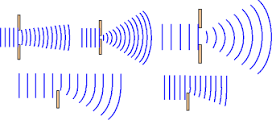
7.

You're in your room blasting music with the door shut, your mom opens your door. Now your music is heard throughout your home. This is an example of _______

a)

interference

b)

diffraction

c)

reflection

8.

When two waves overlap each other, this behavior is known as _______.

a)

interference

b)

refraction

c)

frequency

9.

If the amplitude increases during interference, this is __________

a)

destructive interference

b)

constructive interference

10.

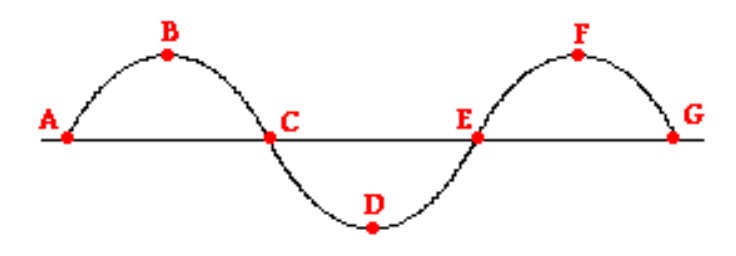
This is a high frequency wave. Which part of the wave is "B"

a)

crest/peak

b)

wavelength

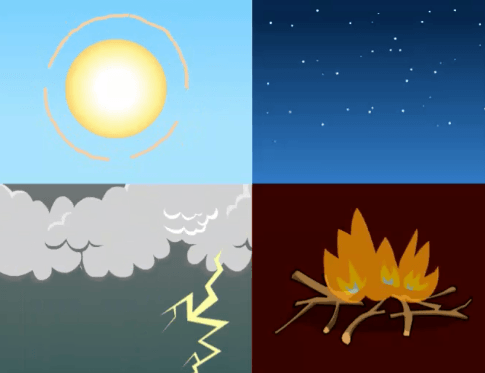
c)

trough

11.

Look at this wave. "A" is which part of a wave?

a)

Crest/Peak

b)

Wave Speed

c)

Resting Point

12.

Which wave has the longest wave length?

a)

top wave

b)

bottom wave

13.

Does this wave have a high frequency or low frequency?

a)

High

b)

Low

14.
Mechanical waves are created when a source of energy causes a medium to  _________________.
a)
vibrate
b)
expand
c)
move
d)
compress
15.
In what type of wave does the medium vibrate parallel to the direction of the wave?
a)
surface wave
b)
longitudinal wave
c)
transverse wave
d)
electromagnetic wave
16.
The three types of mechanical waves are transverse, surface, and _______________ waves
a)
medium
b)
water
c)
longitudinal
d)
crest
17.
What are the highest parts of a transverse wave called?
a)
amplitude
b)
trough
c)
resting point
d)
crest
18.
In longitudinal waves, the parts where the coils are spread apart are called what?
a)
rarefactions
b)
compressions
c)
mechanicals
d)
longitudes
19.
In what type of wave does the medium move perpendicular to the movement of the wave?
a)
Transverse
b)
Longitudinal
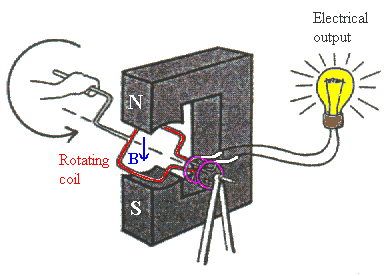
c)
Electromagnetic
d)
Radio
20.
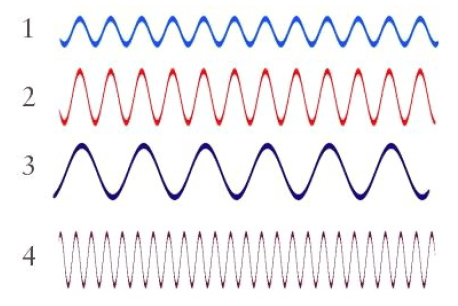
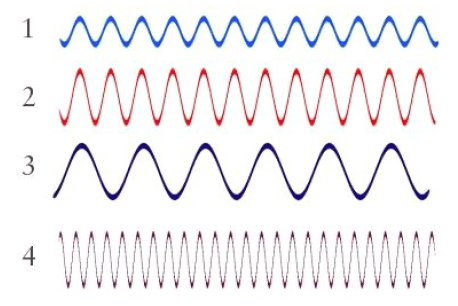
What number represents the wavelength?
a)
1
b)
2
c)
3
d)
4
21.
As the frequency of a wave increases, the __________________ decreases.
a)
amplitude
b)
resting point
c)
wavelength
d)
crest
22.
What number represents the amplitude?
a)
1
b)
2
c)
3
d)
4
23.
In a longitudinal wave, the parts where the coils are close together are called what?
a)
longitudes
b)
rarefactions
c)
compressions
d)
contractions
24.
Which travels faster, light or sound?
a)
light
b)
sound
25.

Which wave travels in outer space?

a)

light

b)

sound

26.
When you yell under water, what is the medium that sound travels through?
a)
air
b)
water
27.
A wave is a disturbance that transfers:
a)
matter
b)
energy
28.
The type of waves that require medium to pass:
a)
Mechanical Waves
b)
Electromagnetic Waves
29.
When the frequency of a wave increases, what happens to the wavelength?
a)
The wavelength is not directly affected by the frequency of a wave.
b)
The wavelength increases.
c)
The wavelength decreases.
d)
More specific information is needed to form a conclusion about the wavelength.
30.
A mechanical wave cannot travel through...
a)
a vacuum(empty space).
b)
water.
c)
air. 
d)
glass.
31.
Which letter(s) represent the trough of the wave?
a)
A
b)
B & D
c)
D
d)
C & G
32.
Which wave in the diagram has the greatest frequency?
a)
1
b)
2
c)
3
d)
4
33.
Which wave in the diagram has the greatest wavelength?
a)
1
b)
2
c)
3
d)
4
34.
Which of the following can sound travel through?
a)
solid
b)
liquid
c)
gas
d)
all of the above
35.
crest to crest or trough to trough
a)
crest
b)
trough
c)
amplitude
d)
wavelength
36.
Electromagnetic waves include the following except
a)
radio waves
b)
X-rays
c)
doing the wave at a football game
d)
microwaves
37.
which material does sound travel the fastest?
a)
solid 
b)
liquid 
c)
gases
38.
When a wave strikes and object and bounces off. (example echo)
a)
medium
b)
refraction
c)
reflection
d)
interference
39.
When a wave bends as it passes through at an angle from one medium to another.(example: pencil in a glass of water-)
a)
medium
b)
refraction
c)
reflection
d)
interference
40.
In a longitudinal wave, the particles move...?
a)
back and forth
b)
up and down
c)
vertically
d)
in the direction of the hertz
41.

Electromagnetic waves include the following except

a)

radio waves

b)

X-rays

c)

ocean waves

d)

microwaves

42.
What kind of wave is pictured below?
a)
compressional wave
b)
transverse wave
c)
sound wave
d)
mechanical wave
43.
Which type of wave is pictured here?
a)
Longitudinal
b)
Transverse
c)
Light 
d)
Electromagnetic
44.

Which type of wave moves parallel to the direction of the wave?

a)

transverse

b)

longitudinal

c)

surface

d)

electromagnetic

45.

It is the high pressure part of the wave where the particles are close together. It is part A on this picture.

a)

Compression

b)

Amplituide

c)

Rarefaction

d)

Wavelength

46.
When the sound source moves, the frequency changes
ex. police car siren sounding lower pitch after the car passes
a)
pitch
b)
frequency
c)
Doppler Effect
d)
medium
47.
Distance from an 'x' to an 'x' is a________
a)
wavelength
b)
amplitude
c)
rarefaction
d)
compression
48.
What is represented by the  letter 'y'?
a)
Compression
b)
Rarefaction
c)
Wavelength
d)
Amplitude
49.
What is represented by the letter 'x'?
a)
Crest
b)
Compression
c)
Rarefaction
d)
Wavelength
50.
Which answer best explains what causes a wave?
a)
Shaking
b)
Potential energy
c)
Light
d)
Vibrations
51.
What two factors effect the amount of energy a wave has?
a)
Frequency and wavelength
b)
Frequency and amplitude
c)
Amplitude and rest
d)
Wavelength and crest
52.
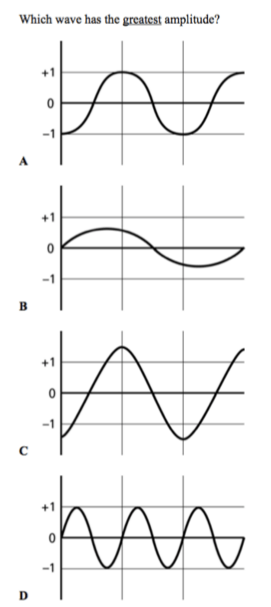
Which wave has the greatest amplitude?
a)
A
b)
B
c)
C
d)
D
53.
What kind of wave is pictured?
a)
Transverse
b)
Longitudinal
c)
surface
d)
none of the above
54.

Waves that can travel through a vacuum and do no require a medium are called?

a)

Transverse Waves

b)

S-Waves

c)

Mechanical Waves

d)

Electromagnetic Waves

55.

What is the visible light spectrum in order?

a)

red, orange, yellow, green, blue, indigo, violet

b)

orange, blue, green, yellow, red, violet, indigo

c)

red, green blue, orange, violet, yellow, indigo

d)

McDonald's is gross

56.

The wavelength of a sound wave is 20m. The frequency is 5 Hz. What is the wave speed?

a)

4 m/s

b)

100 m/s

c)

25 m/s

d)

15 m/s

57.

What causes the refraction of a wave?

a)

the density of the medium changes the speed

b)

the amount of the medium changes the direction

c)

the color of the medium changes the speed

d)

the type of wave changes the direction

58.

When a wave spreads out, it is called____________________?

a)

reflection

b)

refraction

c)

diffraction

d)

absorption

59.

Objects appear different in size and shape in a container of water due to ____________________________.

a)

transmission

b)

reflection

c)

absorption

d)

refraction

60.

The electromagnetic waves with the highest frequencies are called?

a)

radio waves

b)

gamma rays

c)

x-rays

d)

visible light

61.

The electromagnetic waves with the longest wavelengths are called?

a)

radio waves

b)

microwaves

c)

gamma rays

d)

x-rays

62.

How does a cell phone work?

a)

cell phones transmit and receive signals using high-frequency microwaves

b)

cell phones only receive signals from a cellular system

c)

cell phones use frequency modulation

d)

cell phones will use pulse modulation

63.

What does Amplitude Modulation mean?

a)

A method of broadcasting signals by changing the amplitude of a wave.

b)

A method of broadcasting signals by changing the frequency of a wave.

c)

A method of turning up the radio.

64.
A seismograph used to
a)
measures the weather
b)
takes a picture of the clouds
c)
used to detect and measure earthquake wave
d)
detects waves of the ocean
65.
A disturbance that transfers energy from place to place
a)
Energy
b)
Wave
c)
Force
d)
Motion
66.
Speed = wavelength x frequency
The speed of a wave on a rope is 50 cm/s and its wavelength is 10 cm. What is the wave's frequency?
a)
50 cm/s
b)
5 Hz
c)
10 cm
67.
The angle of incidence equals the angle of reflection
a)
Law of Conservation of reflection
b)
Law of Reflection
68.
a)
Reflection
b)
Refraction
69.
a)
Diffraction
b)
Interference
70.
a)
Refraction
b)
Reflection
71.
a)
Constructive Interference
b)
Destructive Interference
72.
What happens when you increase the amplitude of a sound?
a)
it makes the sound louder
b)
it makes the sound travel faster
c)
it increases the wavelength of the sound
d)
it increases the frequency of the sound
73.
What particles make up light?
a)
Photons
b)
Neutrons
c)
Protons
74.
Light behaves like both a particle and a ______.
a)
Mass
b)
Wave
c)
Current
75.
A light year is...
a)
The speed light travels
b)
How long it takes light to get to you from the sun
c)
The distance light can travel in a year
d)
How many years it takes light to be emitted
76.
What color has the shortest wavelength, or the highest frequency?
a)
yellow
b)
blue
c)
red
d)
violet
77.

Why does light refract?

a)

speeds up

b)

gets hot

c)

slows down

d)

gains energy

78.

Light travels through an object during

a)

absorption

b)

reflection

c)

transmission

d)

diffraction

79.
The full spectrum of light energy is called the__________
a)
broad spectrum
b)
electromagnetic spectrum
c)
helium spectrum 
d)
natural light spectrum
80.

What is the earth's primary source of light energy?

a)

moon

b)

sun

c)

waves

d)

fire

81.
EM waves have the same speed but different:
a)
frequency & medium 
b)
wavelength & frequency
c)
medium & wavelength
d)
color & medium
82.
4 is 
a)
radio
b)
UV 
c)
Visible Light
d)
X-ray
83.
When the surface of a mirror curves inward, like the inside of a bowl, it is called a
a)
Plane Mirror
b)
Convex Mirror
c)
Concave Mirror
d)
Diffuse Mirror
84.
Which wavelength of visible light has the lowest energy?
a)
Red
b)
Yellow
c)
Orange
d)
Blue
85.
Which of the following types of radiation has the shortest wavelength and the highest frequency?
a)
Radio Waves
b)
Infrared
c)
Visible
d)
X-Rays
86.
Which of these are examples of NATURAL sources of light?
a)
Sun 
b)
Stars
c)
Lightning
d)
ALL of them
87.
The three primary colors of light are
a)
Red, Blue, Yellow
b)
Pink, Green, Blue
c)
Violet, Green, Red
d)
Blue, Green, Red
88.
Why does an apple appear red?
a)
All colors are absorbed & none are reflected
b)
All colors are absorbed except for blue, which is reflected
c)
All colors are reflected and none are absorbed
d)
All colors are absorbed except for red, which is reflected
89.
How does light travel
a)
It curves around corners
b)
Really slow
c)
In a straight line
d)
In circles
90.
Which color reflects the least light?
a)
Black
b)
White 
c)
Blue
d)
Red
91.
Sunlight is
a)
not light at all
b)
red light
c)
yellow light
d)
white light
92.
Which of the following is the best reflector of light?
a)
Lens
b)
Microscope
c)
Mirror
d)
Prism
93.
Humans can see colors because of these photo receptor cells in the Retina called 
a)
rods
b)
optic cells
c)
cones
d)
sclera
94.
Objects that reflect ALL colors will appear _____?
a)
Black
b)
White
c)
Gray
d)
Multi-colored
95.
If you are using a green color filter, what color will you only see?
a)
blue
b)
green
c)
white
d)
red
96.
What happens when light hits an object you can see?
a)
The light turns corners.
b)
The light curves around the object.
c)
The object reflects the light.
d)
The light and the object do not form a shadow.
97.
What is a property of a transparent object?
a)
Almost all of the light rays that reach it are scattered.
b)
Almost all of the light rays that reach it are absorbed.
c)
Almost all of the light rays that reach it are reflected.
d)
Almost all of the light rays that reach it pass through it.
98.
Which is translucent?
a)
tissue paper
b)
air
c)
wood
d)
clear plastic
99.
If you wanted a gift to be a surprise, what kind of container would you put it in?
a)
transparent
b)
thick
c)
opaque
d)
translucent
100.
The moon is a source of light.
a)
True
b)
False
101.
A convex lens curves ____________.
a)
outward
b)
inward
c)
opaque
d)
refracts
102.
A concave lens curves _____________.
a)
outward
b)
inward
c)
opaque
103.
What is a prism?
a)
a transparent object that separates white light
b)
an opaque object that appears black
c)
a translucent object
104.
A particle that carries a negative electric charge is called a(n) ______.
a)
neutron
b)
atom
c)
proton
d)
electron
105.
When you charge an electroscope by touching it with a charged balloon, the process is called _____.
a)
friction
b)
conduction
c)
induction
d)
grounding
106.
The potential difference that causes charges to move in a circuit is ___.
a)
voltage
b)
resistance
c)
current
d)
electric discharge
107.
An example of a voltage source is a _____.
a)
voltmeter
b)
battery
c)
resistance
d)
switch
108.
A circuit that is connected to Earth is said to be _____.
a)
series
b)
parallel
c)
grounded
d)
discharged
109.
A neutral object becomes negatively charged when it loses electrons.
a)
true
b)
false
110.
Conduction is the process of charging an object without touching it.
a)
true
b)
false
111.
Electrical resistance is low in a good conductor.
a)
true
b)
false
112.
A circuit breaker contains a thin strip of metal that melts if too much current passes through it.
a)
true
b)
false
113.
Which best describes a parallel circuit?
a)
Electricity flows along one pathway.
b)
The flow of electricity comes from one source. 
c)
Electricity flows along more than one pathway. 
d)
The flow of electricity comes from more than one source. 
114.
Which best describes a series circuit? 
a)
It has two light bulbs. 
b)
The same current flows through both light bulbs. 
c)
It uses a single battery.
d)
The current is divided between the light bulbs. 
115.
What is one problem with using a series circuit? 
a)
It has a lot of series. 
b)
If one goes down, they all go down! 
c)
It doesn't work properly.
d)
There are no problems. 
116.
What is one benefits of using a parallel circuit?  
a)
It gets confusing.
b)
There are no problems.
c)
If one goes down, it does not affect the others. 
d)
Porque es para llelio. 
117.
This is an example of a _______ circuit
a)
open
b)
series
c)
parallel
d)
square
118.
What kind of circuit is this?
a)
Series
b)
Consecutive
c)
Parallel
d)
Training
119.
In an electrical circuit, electrons move from the __________.
a)
Negative pole to negative pole
b)
Negative pole to positive pole
c)
Positive pole to positive pole
120.
What will happen if one light bulb is removed from this circuit?
a)
the other bulbs will go out
b)
the other bulbs will get dimmer
c)
the other bulbs will get brighter
d)
the battery will become stronger
121.
The flow of electricity in a circuit-
a)
current
b)
flow
c)
circuit
122.
Electricity that flows in a closed path is called a
a)
path
b)
current
c)
circuit
123.
Two batteries in a circuit make the lights in the circuit brighter than one battery.
a)
true
b)
false
124.
When socks get stuck to towels in your dryer, this is an example of________________
a)
current electricity
b)
static electricity
125.
A material in which electrons are not able to move easily 
a)
Circuit 
b)
Insulator 
c)
Resistance 
d)
Conductor
126.
A material in which electrons are able to move easily
a)
Circuit
b)
Insulator 
c)
Resistance 
d)
Conductor 
127.
The process of transferring charge by touching or rubbing 
a)
Induction 
b)
Conduction 
c)
Friction 
d)
Conductor 
128.
The rearrangement of electrons on a neutral object caused by a nearby charged object 
a)
Induction 
b)
Conduction 
c)
Friction 
d)
Conductor 
129.
Electric current that flows in only one direction. 
a)
Voltage 
b)
Direct Current 
c)
Alternating Current
d)
Series Circuit 
130.
Electric current that reverses its direction of flow in a regular pattern  
a)
Voltage 
b)
Direct Current 
c)
Alternating Current 
d)
Parallel Circuit 
131.
The tendency for a material to oppose the flow of electrons, changing electrical energy into thermal energy and light.
a)
Voltage
b)
Current
c)
Resistance
d)
Circuit 
132.
According to this law, the current in a circuit equals the voltage difference divided by the resistance. 
a)
Law of Conservation of Energy 
b)
Ohm's Law 
c)
Law of Conservation of Charges
d)
Newton's First Law 
133.
The unit for current is the 
a)
Volt
b)
Ohm
c)
Electron
d)
Amp
134.
What is the unit for resistance?
a)
Volts
b)
Amperes
c)
Ohms
135.
If the battery produced 12.6 Volts and what would be the current flow be for a 6 Ohm resistor
a)
2.1 Amps
b)
2.4 Amps
c)
1.71 Amps
d)
15 Amps
136.
What voltage is needed to cause a 2A current flow through a 10Ω resistor?
a)
5V
b)
0.2V
c)
20V
d)
200V
137.
What resistance is needed to cause a 20A current flow because of a 100V battery?
a)
0.2Ώ
b)
2000Ώ
c)
120Ώ
d)
138.
As the resistance in a circuit increases, the electric current __________.
a)
increases
b)
decreases
c)
stays the same
139.
Which formulas represents Ohm's law?
a)
V=IR
b)
R=IV
c)
I=RV
140.
What will happen when these magnets are brought close together?
a)
They will attract each other.
b)
They will repel each other.
c)
Both magnets will turn to the left
d)
Both magnets will turn to the right
141.
Iron, Nickel and cobalt are all __________________ materials
a)
Shiny
b)
poles
c)
magnetic
d)
cold
142.

A device that uses a free-moving magnetic needle to show direction is a:

a)

Ruler

b)

magnet

c)

compass

d)

magnetic field

143.
Earth acts like a giant magnet because its center is made up MOSTLY of
a)
granite
b)
limestone
c)
iron
d)
nickel
144.
How is a permanent magnet DIFFERENT from a temporary magnet?
a)
A permanent magnet attracts materials made of iron.
b)
A permanent magnet has poles.
c)
A permanent magnet has a magnetic field.
d)
A permanent magnet keeps its magnetism for a long time.
145.
Where is the force of attraction the strongest on a magnet?
a)
at the poles
b)
in the middle
c)
above the magnet
d)
below the magnet
146.
Why does a compass needle point north?
a)
The compass is a bar magnet
b)
Because north is up
c)
Because it's magic
d)
It lines up with the Earth's magnetic field
147.
The magnet's shown will
a)
not move
b)
attract
c)
repel
d)
all of the above
148.
What do the lines around this magnet represent?
a)
North Pole
b)
South Pole
c)
Magnetic Declination
d)
Magnetic Field
149.
If you cut a magnet in half, what happens to the poles?
a)
One half gets the North Pole, the other half gets the South Pole
b)
Both halves get only a North Pole
c)
Both halves get only a South Pole
d)
Both halves get a North pole and a South Pole
150.
A refrigerator magnet is an example of a:
a)
magnetic material
b)
permanent magnet
c)
horseshoe magnet
d)
temporary magnet
151.
Magnetism is generated by moving
a)
protons.
b)
electrons.
c)
neutrons.
d)
elements.
152.
What do the lines around this magnet represent?
a)
North Pole
b)
South Pole
c)
Magnetic Declination
d)
Magnetic Field
153.
A paper clip is an example of a:
a)
magnetic material
b)
permanent magnet
c)
bar magnet
d)
insulator
154.
In un-magnetized materials the domains are __________ aligned.
a)
super
b)
slightly
c)
randomly
d)
always
155.
Electric motors are devices that convert _____ energy into  _____ energy.
a)
electrical; mechanical
b)
mechanical; electrical
c)
chemical; potential
d)
mechanical; kinetic
156.
What kind of magnet can be turned on and off?
a)
refridgerator magnet
b)
electromagnet
c)
magnetite
d)
iron
157.
A simple electromagnet can be made with which of the following?
a)
an electric current
b)
a turbine and nail
c)
a nail, a wire, and a battery
d)
a compass and a battery
158.

Magnetism is a force of ____________________________ that occurs between two _____________ objects.

a)

attraction or repulsion, magnetic

b)

external or internal, magnetic

c)

external or repulsion, electronic

d)

attraction or internal, electronic

159.

In magnetic materials, all of the ________ are pointing in the same direction.

a)

doors

b)

electrons

c)

domains

d)

orbits

160.

A permanent magnet is a material that produces a ___________________ field without any ___________________ magnetic field being present.

a)

electronic, internal

b)

magnetic, internal

c)

magnetic, external

d)

electronic, external

161.
An electromagnet's poles may be reversed by:
a)
decreasing the voltage of the coil
b)
increasing the number of coils
c)
changing the direction of current flow
d)
altering the material used to make the coils
162.
As the distance between two magnets increases (they get farther apart), the force between them:
a)
Increases
b)
Decreases
c)
Stays the Same
163.
What would we call a nail that can pick up a paperclip because it is touching a magnet?
a)
temporary magnet
b)
poles
c)
force
d)
detector
164.
What is the transfer of electricity in a generator?
a)
Mechanical to Electrical 
b)
Physical to Potential 
c)
Electrical to Mechanical
d)
Yogurt to Light