
 Worksheets
Chemistry C4-Revision
Total questions: 162
Worksheet time: 2hrs 47mins
___________ electrode is an inert electrode.
Copper
Iron
Carbon
Zinc
Ionic compounds do not conduct electricity when they are solid because,
their electrons are not free to move
their ions are free to move
their ions are not free to move
their electrons are free to move
When a metal is reduced by reaction with carbon, which element is removed from the compound?
Carbon
Oxygen
Hydrogen
Silver
What type of compound can undergo electrolysis?
Metallic
Giant covalent
Simple covalent
Ionic
Which electrode do the negatively charged ions move to?
Left
Cathode
Anode
Right
When you electrolyse a molten ionic compound, the product at the cathode is…
a metal
a non-metal
a mixture
a compound
What test and result shows that hydrogen has been produced?
Limewater turns cloudy
A glowing splint relights
It burns with a squeaky pop
Damp blue litmus paper turns red
When an electric current is passed through an electrolyte, the ions move to…
the magnets
the poles
the electrodes
the pipettes
What is made when an acid reacts with a base?
A salt and water only
A salt and carbon dioxide only
A salt and hydrogen only
A salt, hydrogen and carbon dioxide
Oxidation is the… (Higher Tier Question)
loss of electrons
gain of electrons
loss of protons
gain of protons
Most metals are found in the earth as…
elements
mixtures
compounds
atoms
What is an alkali?
An alkali is an acid by another name
An alkali is a base that is soluble in water
An alkali is a type of rock
An alkali is a base that is not soluble in water
Titration is a technique that is used to find the concentrations of…
metals and non-metals
acids and alkalis
acids and metals
alkalis and metals
Oxides are produced when a metal or a non-metal reacts with…
carbon
nitrogen
oxygen
hydrogen
What is special about an ionic compound when it is liquid or in solution?
The ions can move freely
The ions vibrate in a fixed position
The ions move backwards and forwards
The ions cannot move
Substances with a pH between 8 and 14 are…
metallic
alkaline
acidic
neutral
The special word for the positively charged electrode is…
the negative electrode
the cathode
the anode
the positive electrode
What equation is used to find out the concentration of a substance?
m is mass
c is concentration
m = c ∕ v
v = m × c
c = m ∕ v
c = v ∕ m
When a strong acid is in aqueous solution it is completely…
(Higher Tier Question)
electrolysed
ionised
reacted
harmful
What type of salt would you get in a reaction between an oxide and nitric acid?
A sulfate
A nitrate
A chloride
A carbonate
What ions are released by all alkalis and bases when they react with acids?
Hydrogen ion, 1+ charge
Hydrogen ion, 1- charge
Hydroxide ion, 1+ charge
Hydroxide ion, 1- charge
What is the name of the type of reaction between alkalis and acids?
Neutralisation
Deodorisation
Destruction
Fizzy
As pH decreases by 1 unit, the H+ ion concentration increases by a factor of…
(Higher Tier Question)
1
5
10
0
As an acid becomes stronger…
(Higher Tier Question)
More H+ ions disassociate
More OH- ions disassociate
The acid doubles
The H+ and OH- balance
Metals less reactive than carbon are extracted by…
reduction
electrolysis
distillation
cracking
When you electrolyse a molten ionic compound, the product at the anode is…
a metal
a non-metal
a mixture
a compound
Why is an indicator used in an acid/alkali titration reaction?
To show when pH7 is reached
To show the pH of the acid
To show the pH of the alkali
To see the colour change
Electrolysis is used as a method of purifying a metal when the metal is more reactive than…
oxygen
carbon
hydrogen
silver
The special word for ionic compounds that are able to conduct electricity is…
conductors
electrolytes
insulators
solutions
The special word for the negatively charged electrode is…
the negative electrode
the cathode
the anode
the positive electrode
When H+ ions react with OH- ions they produce…
air
oxygen
hydrogen
water
Substances with a pH between 1 and 6 are…
metallic
alkaline
acidic
neutral
For electrolysis to work the ionic compound must…
be a solid
be melted or dissolved in water
have a large surface area
be easy to separate
What type of salt would you get in a reaction between an oxide and sulfuric acid?
A sulfate
A nitrate
A chloride
A carbonate
In a neutralisation reaction, an acid's H+ ions react with…
OH+
OH-
H+
H-
Which electrode do the positively charged ions move to?
Left
Cathode
Anode
Right
Hydrochloric acid plus magnesium react to make…
magnesium oxide
magnesium chloride and water
magnesium chloride and hydrogen
hydrogen and water
Reduction is the…
(Higher Tier Question)
loss of electrons
gain of electrons
loss of protons
gain of protons
Which extraction method for purifying metals involves the use of electricity?
Reduction
Electrolysis
Distillation
Cracking
Substances with a pH of 7 are…
metallic
alkaline
acidic
neutral
When acids are neutralised by metal carbonates, what are the products?
A salt and water only
A salt, water and carbon dioxide
A salt and hydrogen only
A salt, hydrogen and carbon dioxide
What do you need to do in order to get solid salt crystals from a solution of a soluble salt?
Dilute the solution
Shake the solution
Filter the solution
Heat the solution gently
A soluble salt is…
a salt that dissolves in water
a salt that reacts with water
a salt that doesn’t dissolve in water
a salt that turns purple
Which extraction method for purifying metals involves the use of carbon?
Reduction
Electrolysis
Distillation
Cracking
What salt would you get if you added sodium hydroxide to hydrochloric acid?
Sodium sulfate
Sodium nitrate
Sodium chloride
Sodium and water
When metals are reduced by reaction with carbon, the products are a metal and…
oxygen
hydrogen
water
carbon dioxide
What are the products when an acid reacts with a metal?
A salt and water
A salt, water and carbon dioxide
A salt and hydrogen
A salt, hydrogen and carbon dioxide
The charges on the ions in copper(II) oxide are…
(Higher Tier Question)
Cu is 2+, O is 2−
Cu is 2−, O is 2+
Cu is 1+, O is 1−
Cu is 1-, O is 1+
What type of salt would you get in a reaction between an oxide and hydrochloric acid?
A sulfate
A nitrate
A chloride
A carbonate
An example of a strong acid is…
(Higher Tier Question)
hydrochloric acid
ethanoic acid
carbonic acid
benzoic acid
Complete the following word equation:
Metal + Acid -->
Salt + water
Salt + hydrogen
Salt + Water + Carbon dioxide
Complete the following word equation:
Metalcarbonate + acid -->
Salt + Hydrogen
Salt + Water + Carbon Dioxide
Salt + Water
What colour does the solution turn when sulfuric acid is added to copper carbonate?
Blue
Green
Clear
Purple
How do you remove the water to leave solid copper sulfate crystals?
Filter
Evaporate
Distill
What does the word insoluble mean?
Does dissolve
Doesn't dissolve
Is part of a solid
What type of reaction produced an insoluble salt?
Neutralisation reaction
Precipitation reaction
Titration reaction
Insoluble reaction
What is the test for Hydrogen gas?
Squeaky pop
Lime water turning cloudy
Add pH paper
What is the test for Carbon Dioxide?
Add Litmus paper
Lime water turning milky
Squeaky pop


Which salt would be formed by reacting cobalt carbonate and hydrochloric acid?
Cobalt sulfate
Cobalt chloride
Cobalt hydroxide
Cobalt sulfide
When a soluble salt is formed from an acid and an insoluble base, how do you know when an excess of a base has been added?
When bubbles of gas appear
When the reactant all dissolves
When some of the reactant is left unreacted/undissolved
When a colour change happens
Why do you add excess of the insoluble reactant when making a soluble salt?
To make sure all the acid is used up
To separate the solid from the solution
To make sure a reaction occurs
To have the reaction happen faster
How do you separate an excess insoluble reactant from a solution?
Filtration
Precipitation
Crystalisation
Evaporation
Which two chemicals could you react to make only potassium chloride and water?
Potassium and hydrochloric acid
Potassium hydroxide and hydrochloric acid
Potassium oxide and sulfuric acid
Potassium and sulfuric acid
When producing a soluble salt in a reaction between an acid and an alkali, how can you prepare dry solid crystals from the solution?
Filtration
Neutralisation
Condensation
Evaporation/crystallisation
How do you remove the water to leave solid copper sulfate crystals?
Filter
Evaporate
Distill
What does the word insoluble mean?
Does dissolve
Doesn't dissolve
Is part of a solid
Filtration is used to separate a ______ from a liquid.
undissolved solid
dissolved solid
dissolved gas
undissolved gas
Crystallisation is used to separate ____ from a liquid.
undissolved liquid
dissolved liquid
undissolved solid
dissolved solid
what two pieces of equipment are required for filtration?
filter and evaporating dish
filter and funnel
evaporating dish and bunsen burner
funnel and stirring rod
What piece of equipment is required for crystallisation?
filter paper
funnel
petri dish
evaporating dish
What is the correct order for making a salt?
dissolve metal oxide in acid -> evaporate -> filter
dissolve metal oxide in acid -> filter -> evaporate
filter -> dissolve metal oxide in acid -> evaporate
filter -> evaporate -> dissolve metal oxide in acid
(a) is the gain of oxygen atoms.
(a) is the loss of oxygen atoms.
What is the best way to extract metals that are less reactive than carbon?
Bioleaching
Electrolysis
Phytomining
Reduction reaction
Is this an oxidation or reduction reaction?
water → hydrogen + oxygen
Oxidation
Reduction
Is this an oxidation or reduction reaction?
carbon + oxygen → carbon dioxide
Oxidation
Reduction
Which of these metals do not form an ore?
Copper
Gold
Iron
Magnesium
Which element has been oxidised?
iron oxide + lithium → iron + lithium oxide
iron
lithium
oxide
lithium oxide
Which element has been reduced?
iron oxide + lithium → iron + lithium oxide
iron
lithium
oxide
iron oxide
Balance the following displacement reaction.
Li2O + (a) K → K2O + 2Li
In the following reaction, which element has been oxidised and which has been reduced?
copper oxide + iron → iron oxide + copper
Copper has been oxidised, iron has been reduced
Iron has been oxidised, copper has been reduced
breaking down of a compound using a current
making a compound using a current
The negatively charged ions (anions) are attracted to the ________.
anode
cathode
What ions are present in molten aluminium oxide?
Al3+, O2-, H+, OH-
Al3+, O2-
Al3+, OH-
Positive ions (cations) move towards the cathode (-) where they will discharge by....
Breaking apart
Losing electrons
Clumping together.
Gaining electrons

An electrical circuit is set up using copper wire.
Which process takes place in the copper wire?
Electrons move along the wire to the negative terminal, positive ions stay in position.
Electrons move along the wire to the positive terminal, positive ions move to the negative terminal.
Electrons move along the wire to the positive terminal, positive ions stay in position.
Negative ions move along the wire to the positive terminal, positive ions move to the negative terminal.

Which apparatus could be used to electroplate an iron nail with copper?
A
B
C
D

Aluminium is extracted from its oxide by electrolysis. Which words correctly complete the spaces? The oxide is dissolved in ……1…… cryolite and aluminium is deposited at the ……2……
A
B
C
D
What is an ore?
a solid metal
a rock containing a metal combined with other elements, often oxygen
an element
an object used to row a boat
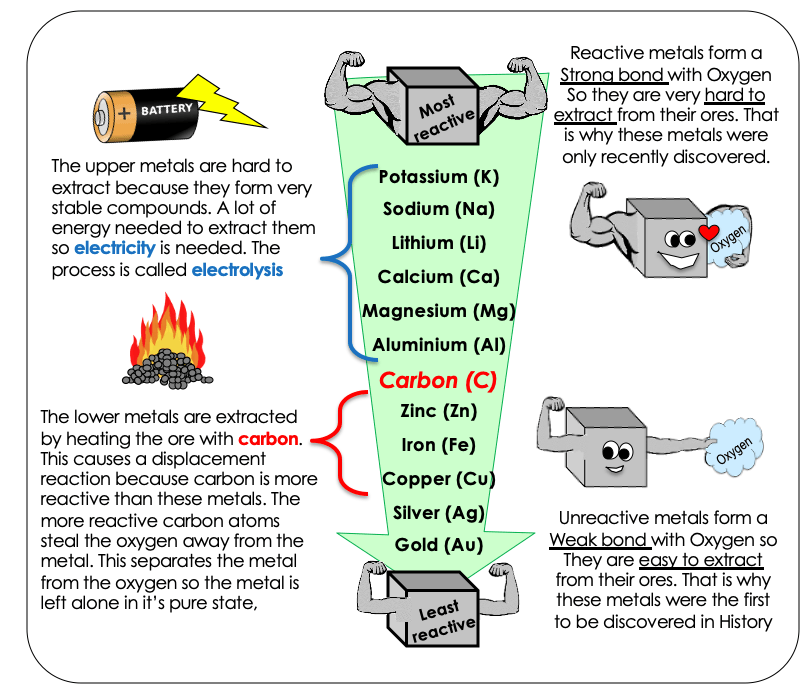
Which element cannot be extracted from its ore by reduction with carbon?
iron
aluminium
copper
zinc
Which of these metals was the last to be discovered?
Potassium
Copper
Silver
Platinum
Which of these metals requires the most energy to be separated from its ore?
copper
silver
potassium
aluminium
If an aqueous solution of copper (II) sulphate is electrolysed what will be the product at the cathode?
hydrogen gas
sulphur
copper metal
water
At the anode if OH- ions and Cl ions are present what will be formed ?
(Halides are group 7 (Cl-, Br- I- ions)
hyddrogen
oxygen gass and water
chlorine gas
Complete the diagram with the following labels:
Aluminum ions are attracted to the
anode
cathode
The anode has to be replaced frequently because
The oxygen reacts with the carbon anode to form carbon dioxide
Aluminum reacts with the carbon to form aluminum carbide
The anode gets impurities that impact the extraction
The anode is too hot and it will reduce their electrical conductivity
Label the diagram
The extraction of aluminium by electrolysis is very hot as the aluminium oxide is dissolved in cryolite. The oxygen produced at the anode reacts with the graphite to form what gas?
Carbon
Carbon dioxide
Hydrogen
Oxygen
What ions are present in molten aluminium oxide?
Al3+, O2-, H+, OH-
Al3+, O2-
Al3+, OH-
The electrodes in electrolysis of aluminium are made of
Steel
Anodes
Graphite
Plastic
What is the ore of aluminium called? (a)
Oxidation is the _________ of electrons.
loss
gain
sharing
transfer
Reduction is the (a) of electrons.
Choose the half-equation that shows the discharge of aluminium ion.
Al3+ - 3e- → Al
Al2+ + 3e- → Al
Al3+ + 3e- → Al
Al3+ → Al + 3e-

What are the reactants for the reaction of magnesium with oxygen
Magnesium + oxygen --> Magnesium oxide
Magnesium
Oxygen
Magnesium oxide
Magnesium and oxygen
Sulphuric acid + sodium carbonate
-->
Hydrochloric acid + magnesium hydroxide -->
How do we test for hydrogen?
Squeaky pop test
Hydrogen extinguishes a lit splint
Bubbling through lime water
Hydrogen makes a glowing splint relight
Calcium carbonate + hydrochloric acid -->
Calcium chloride + hydrogen
Calcium choride + water
Calcium chloride + carbon dioxide + water
Calcium sulfate + carbon dioxide + water
Copper carbonate + hydrochloric acid -->
Copper chloride + hydrogen
Copper chloride + water
Copper chloride + water + hydrogen
Copper chloride + water + carbondioxide


Hydrochloric acid reacts to form ........ salts.
chloride
hydrochloride
nitrate
sulfate
Nitric acid reacts to form ........ salts.
chloride
nitrite
nitrate
sulfate
Sulfuric acid reacts to form ........ salts.
chloride
nitrite
sulfite
sulfate
acid + base -> salt + ............
carbon dioxide
hydrogen
ammonia
water
acid + metal -> salt + ............
carbon dioxide + water
hydrogen
ammonia + water
water
Which acid reacts with potassium hydroxide to form potassium sulfate?
chloric acid
hydrochloric acid
nitric acid
sulfuric acid
Which acid reacts with calcium hydroxide to form calcium nitrate?
chloric acid
hydrochloric acid
nitric acid
sulfuric acid
Oxides and hydroxides are
bases
carbonates
acids
metals
What are the products formed when zinc + ethanoic acid react?
magnesium chloride and water
aluminium chloride and hydrogen gas
aluminium chloride and water
zinc ethanoate and hydrogen gas

Which of the following describes a precipitate?
a liquid forms when a block of metal is heated
a solid forms when one liquid is poured into another
a gas forms when a solid is placed in a liquid
bubbles form when an acid is poured on a rock
What is the difference between base and alkali
Alkalis are water insoluble bases
Alkalis are water soluble bases
Both are same
Alkali react with acids while bases don't.

