

wayground logo

Free Printable Worksheets

Font size

S
M
L
XL
Worksheets

Earth Science Spring 2025 Final Question Pool

Total questions: 160

Worksheet time: 4hrs 0mins
Name
Class
Date
1.
About what percentage of Earth's surface is covered by water?
a)
45%
b)
51%
c)
71%
d)
85%
2.
Which of the world's oceans is the largest and deepest?
a)
Arctic Ocean
b)
Atlantic Ocean
c)
Indian Ocean
d)
Pacific Ocean
3.
Which of these features isn't found on the ocean floor?
a)
Mountain
b)
Volcano
c)
River
d)
Plain
4.
Which of the following is not one of the three main regions of the ocean floor?
a)
Ocean floor basin
b)
Continental margin
c)
Continental rock
d)
Mid-ocean ridge
5.
Trenches form at sites where
a)
one plate descends beneath another.
b)
erosion cuts into the continental shelf.
c)
two plates diverge under the sea.
d)
the tops of undersea volcanoes collapse.
6.
Abyssal plains are very flat features that form when
a)
volcanoes spread lava on the ocean bottom.
b)
turbidity currents deposit sediments on the ocean floor.
c)
ocean water flood plains on land.
d)
plates diverge on the ocean floor, causing seafloor spreading.
7.
Which of the following forms at mid-ocean ridges?
a)
Island arcs
b)
Deep-sea trenches
c)
Guyots
d)
New ocean floor
8.
The three types of ocean floor sediments are classified according to their
a)
color.
b)
origin.
c)
particle size.
d)
hardness.
9.
Terrigenous sediment consists primarily of mineral grains eroded from
a)
mid-ocean ridges.
b)
marine animal shells.
c)
continental rocks.
d)
undersea minerals.
10.
From which type of material does biogenous sediment form?
a)
Once-living organisms
b)
Manganese nodules
c)
Rocks on land
d)
Cooled magma
11.
Hydrogenous sediment is made up of
a)
cinders and rock from undersea volcanoes.
b)
parts of once-living organisms.
c)
eroded continental rock.
d)
minerals that crystallize directly from ocean waters.
12.
What are the two major energy sources obtained from the ocean floor?
a)
Oil and manganese
b)
Calcium carbonate and halite
c)
Natural gas and coal
d)
Oil and natural gas
13.
Most oceanic gas hydrates form when
a)
bacteria break down organic matter in seafloor sediments.
b)
plant matter breaks down to form peat.
c)
petroleum deposits seep into the ocean floor sediments.
d)
chemical in ocean water precipitate out of solution.
14.
Gas hydrates are compact chemical structures made of natural gas and
a)
halite.
b)
water.
c)
manganese.
d)
petroleum.
15.
Which offshore resources are second only to petroleum in economic value?
a)
Salts and gypsum
b)
Manganese nodules and halite
c)
Calcium carbonate and copper
d)
Sand and gravel
16.
Manganese nodules are
a)
manganese salts that concentrate when seawater evaporate.
b)
lumps of manganese and other metals found on the ocean floor.
c)
deposits of magnanese and iron deep under the ocean floor.
d)
chunks of pure manganese.
17.
The world ocean can be divided into how many main basins?
a)
4
b)
1
c)
2
d)
3
e)
5
18.
What does sonar use to detect distances?
a)
Sound
b)
Light
c)
Magic
d)
Water
e)
Electricity
19.
In general, as you move the continental shelf toward the deep-ocean floor, the sediments become
a)
coarser.
b)
finer.
c)
smoother.
d)
bigger.
20.
Thick, common biogenous sediment formed from dissolving calcium carbonate shells is called what?
a)
Calcareous ooze
b)
Calcium ooze
c)
Gas hydrate
d)
Siliceous ooze
21.
Describe the transfer efficiency between trophic levels.
a)
Very inefficient, as little as 2%.
b)
Somewhat efficient, roughly 50%
c)
Very efficient, as high as 90%
d)
Perfectly efficient at 100%
22.
What limits primary productivity in tropical oceans? Why?
a)
The availability of nutrients since nutrients are trapped in deeper water because the permanent thermocline prevents mixing.
b)
Sunlight since tropical oceans experience several months of constant sunlight for part of the year and several months of constant darkness for part of the year.
c)
Salinity since tropical oceans have a lower salinity than most organisms can tolerate.
d)
The time of year since tropical oceans have their surface temperatures change due to changes in amount of sunlight, which is needed for photosynthesis. Sunlight also influences how strong a thermocline is, affecting the amount of upwelling of nutrients from deeper ocean waters if waters mix.
23.
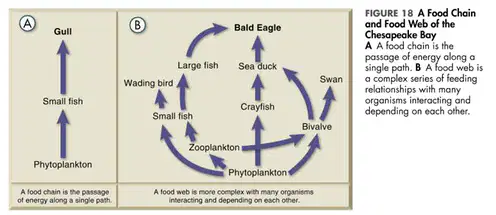
Based on the information in the food web, what eats crayfish?
a)
Sea duck
b)
Phytoplankton
c)
Bivalve
d)
Zooplankton
e)
Bald eagle
24.
The process by which certain microorganisms use chemical energy to produce food is called what?
a)
Chemosynthesis
b)
Photosynthesis
c)
Nucleosynthesis
d)
Foodsynthesis
25.
The forms of marine life that live on or in the ocean bottom are called
a)
Benthos
b)
Plankton
c)
Nekton
d)
Fish
26.
The proportion of dissolved substances in seawater is usually expressed in
a)
parts per thousand.
b)
parts per hundred.
c)
parts per ten thousand.
d)
parts per million.
27.
Which of the following is a source of dissolved substances in the ocean?
a)
Chemical weathering of rocks
b)
Evaporation of water from the seas and ocean
c)
Excretions from marine organisms
d)
Melting icebergs and sea ice
28.
How do elements such as chlorine, bromine, sulfur, and boron get into the ocean?
a)
Runoff from rivers and streams
b)
Excretions from marine organisms
c)
Volcanic eruptions
d)
Chemical weathering of rocks
29.
Differing amounts of solar radiation across Earth's latitude affect the ocean's
a)
salinity in the thermocline.
b)
density at the surface.
c)
temperature at the surface.
d)
density in the thermocline.
30.
Which of the following occurs when the ocean's salinity increases?
a)
Density increases.
b)
Density decreases.
c)
Temperature increases.
d)
Temperature decreases.
31.
Which of the following is the most important factor affecting surface seawater density?
a)
Chemical weathering
b)
Solar radiation
c)
Temperature
d)
Latitude
32.
At least 80% of ocean water is included in the
a)
transition zone.
b)
thermocline.
c)
surface mixed zone.
d)
deep zone.
33.
The three-layered structure of the open ocean doesn't exist
a)
in the middle latitudes.
b)
in high latitudes.
c)
in low latitudes.
d)
at the equator.
34.
Marine organisms can be classified (in the ways that we talked about) according to
a)
where they live.
b)
what they eat.
c)
their specific body parts.
d)
how they reproduce.
35.
One of the main differences between plankton and nekton is that plankton
a)
live on the ocean floor.
b)
are much larger than nekton.
c)
drift with ocean currents.
d)
cannot photosynthesize.
36.
Where would you most likely find benthos organisms?
a)
In the surface mixed zone
b)
In the pycnocline
c)
On or in the ocean bottom
d)
Traveling in ocean currents
37.
Which of the following is a characteristic of life at the abyssal zone?
a)
Many seaweeds are attached to seafloor.
b)
No photosynthesis occurs.
c)
No food can be found here.
d)
Warm-water organisms are plentiful.
38.
Which of the following characteristics is NOT used to divide the ocean into marine life zones?
a)
Availability of sunlight
b)
Distance from the shore
c)
Water depth
d)
Salinity
39.
Phytoplankton are usually found in the
a)
benthic zone.
b)
photic zone.
c)
abyssal zone.
d)
aphotic zone.
40.
What causes ocean surface currents?
a)
Gravity
b)
Friction between the ocean and the wind on its surface
c)
Ocean movements associated with earthquakes
d)
Changes in water density
41.
Currents affect climate by
a)
making ocean water evaporate.
b)
transferring heat and cold between the tropics and polar regions.
c)
changing the density of water in the tropics.
d)
transferring heat from the polar regions to the tropics.
42.
What is the importance of upwelling?
a)
It brings warm water from the tropics to the poles.
b)
It decreases winds along exposed coastlines.
c)
It helps warm the North Atlantic gyre.
d)
It brings dissolved nutrients to the ocean's surface.
43.
A decrease in seawater temperature or an increase in salinity causes
a)
upwelling along tropical coasts.
b)
an increase in seawater density.
c)
the circulation of ocean gyres.
d)
a decrease in seawater density.
44.
Most ocean waves get their energy from
a)
the sun.
b)
plate movement.
c)
the moon's gravity.
d)
the wind.
45.
Which of the following factors does not help determine the height, length, and period of a wave?
a)
Wind speed
b)
Fetch
c)
Temperature
d)
How long the wind blows
46.
When waves grow so tall they topple over, they form ocean breakers called
a)
whitecaps.
b)
fetch.
c)
tsunamis.
d)
crests.
47.
Energy moves through ocean waves in a(n)
a)
convection current.
b)
circular motion.
c)
oscillating motion.
d)
straight line.
48.
What is the vertical distance between a trough and a crest?
a)
Wave height
b)
Wavelength
c)
Wave speed
d)
Wave period
49.
The force that produces tides is
a)
gravity.
b)
friction.
c)
centripetal force.
d)
acceleration.
50.
Ocean tides results largely from the gravitational attraction of the
a)
sun.
b)
core of Earth.
c)
closest neighboring planets.
d)
moon.
51.
Which processes carve shoreline features?
a)
Erosion and abrasion
b)
Transportation and condensation
c)
Deposition and sedimentation
d)
Abrasion and evaporation
52.
How does refraction cause wave crests to move when the waves approach shore?
a)
At right angles to shore
b)
About 80 degrees relative to shore
c)
Nearly parallel to the shoreline
d)
About 45 degrees relative to shore
53.
Longshore currents move sediment as they
a)
move parallel to shore.
b)
run along the ocean bottom.
c)
pound against coastal headlands.
d)
flow in circular patterns in ocean basins.
54.
Which of the following is NOT a depositional shoreline feature?
a)
Wave-cut platform
b)
Spit
c)
Tombolo
d)
Barrier island
55.
Because of the Coriolis effect, surface currents in the Northern Hemisphere are deflected
a)
to the left.
b)
north.
c)
to the right.
d)
south.
56.

How many gyres are there?

(a)  

57.
Which of the following is not a type of tidal pattern?
a)
Diurnal
b)
Semidiurnal
c)
Mixed
d)
Triurnal
58.
Which of the following results from wave refraction?
a)
Wave energy is concentrated on headlands projecting into the water.
b)
Wave energy is concentrated in the recessed areas between headlands.
c)
Wave energy is largely dissipated before waves reach the shore.
d)
Headlands are enlarged because sediment is deposited on their seaward side.
59.
What is beach nourishment?
a)
Adding large quantities of sand to the beach system to stabilize the shoreline
b)
Adding large quantities of ice to the beach system to stabilize the shoreline
c)
Blocking waves from reaching the beach system to stabilize the shoreline
d)
Blocking quantities of sand being added to the beach system, in order to stabilize the shoreline
60.
Which of the following is an example of climate?
a)
A sudden snowstorm resulted in subzero temperatures and 30 cm of new snow.
b)
In southern California, temperatures are generally mild, and rainfall is low.
c)
Record-breaking low temperatures caused a sudden freeze one day in Des Moines.
d)
A week of rain caused widespread flooding in Seattle.
61.
Most of Earth's dry air is made up of
a)
carbon dioxide and oxygen.
b)
nitrogen and argon.
c)
nitrogen and oxygen.
d)
oxygen and argon.
62.
What percentage of water vapor is found in the air?
a)
0% to 1%
b)
0% to 4%
c)
0% to 8%
d)
0% to 10%
63.
In which level of the atmosphere is ozone concentrated?
a)
Troposphere
b)
Stratosphere
c)
Mesosphere
d)
Thermosphere
64.
Seasonal changes occur because of
a)
Earth's tilt.
b)
Earth's shape.
c)
the distance between Earth and the moon.
d)
time of year.
65.
Which of the following results when there is a temperature difference between two objects?
a)
One object will always have more thermal energy than the other object.
b)
Both objects will gain more and more thermal energy.
c)
Heat transfer occurs from one object to the other.
d)
The temperature of both objects increases.
66.
The average kinetic energy of the atoms or molecules in a particular substance is known as
a)
temperature.
b)
heat.
c)
conduction.
d)
convection.
67.
Because of convection, the warmest air in a room
a)
spreads out in all directions.
b)
rises toward the ceiling.
c)
transfers thermal energy to the walls.
d)
sinks towards the floor.
68.
Which of the following is an example of radiation?
a)
A metal spoon becomes warm after being set in a pot of boiling water.
b)
Warm water rises because it is less dense than cool water.
c)
Pancake batter cooks quickly after being spooned onto a hot griddle.
d)
Our atmosphere is constantly being heated by the sun.
69.
Which of the following is NOT true about radiation?
a)
Radiation cannot travel through a vacuum.
b)
The hottest radiating bodies produce the shortest wavelengths.
c)
All objects emit radiant energy.
d)
Objects that absorb radiation well emit radiation equally as well.
70.
The blue color of the sky is the result of
a)
conduction.
b)
scattering.
c)
reflection.
d)
absorption.
71.
Which of the following is NOT a factor that controls temperature?
a)
Cloud cover
b)
Proximity to the ocean (and its currents)
c)
Longitude
d)
Altitude
72.
What causes clouds to reflect a portion of sunlight back to space?
a)
The amount of oxygen in the atmosphere
b)
Evaporation from the land
c)
Temperature differences between the land and the atmosphere
d)
A characteristic known as albedo
73.
Clouds absorb outgoing radiation emitted by Earth and reradiate a portion of it back to the surface during
a)
nightime.
b)
daytime.
c)
summer.
d)
times of heavy rainfall.
74.
What does conduction do in the atmosphere?
a)
Thermal energy from lower layers is transferred to upper layers.
b)
Thermal energy is transferred between Earth's surface (land and sea) to the atmosphere.
c)
Thermal energy is transformed from radiant energy transmitted from the sun to be absorbed, transmitted further, or scattered.
d)
Nothing
75.
Dark-colored objects tend to absorb more radiation than light-colored objects. Would dark-colored objects or light-colored objects on Earth's surface be a better radiator of thermal energy?
a)
Dark-colored objects
b)
Light-colored objects
76.
On a map showing temperature distributions, what are the lines of connecting points of equal temperature called?
a)
Equitherm
b)
Isotherm
c)
Equiheat
d)
Isoheat
77.
Enbarr is near the ocean and Fhirdiad is in the middle of the continent. They're similar otherwise. Which has more consistent and milder temperatures?
a)
Enbarr
b)
Fhirdiad
78.
Edascity has an altitude of 100 m above sea level, and Discity has an altitude 10 km above sea level. They're similar otherwise. Which would have lower temperatures on average?
a)
Edascity
b)
Discity
79.
Tallon and Phendrana share the same continent, which is in the Southern Hemisphere; Tallon is north of Phendrana. They're similar otherwise. Which will be colder on average?
a)
Tallon
b)
Phendrana
80.
Which gas is most important for understanding the processes that take place in the atmosphere?
a)
Nitrogen
b)
Oxygen
c)
Carbon dioxide
d)
Water vapor
81.
To cause a change in state, energy must be transferred in the form of
a)
motion.
b)
heat.
c)
moisture.
d)
light.
82.
What do we call the process that causes a gas to change into a liquid?
a)
Condensation
b)
Sublimation
c)
Infiltration
d)
Vaporization
83.
What does stable air refer to?
a)
Air that resists changes in its vertical position.
b)
Air that happily accepts changes in its vertical position.
c)
Air that resists changes in its horizontal position.
d)
Air that happily accepts changes in its horizontal position.
84.
A layer of limited depth in the atmosphere where the temperature increases rather than decreases with height is called a what?
a)
Temperature inversion
b)
Temperature reversal
c)
Temperature contradiction
d)
Temperature turnabout
85.
When the temperature of air falls, the amount of water needed for saturation
a)
increases.
b)
decreases.
c)
stays the same.
86.
When air gets compressed, it
a)
cools down.
b)
has more water vapor.
c)
warms up.
d)
becomes heavier.
87.

When unequal heating of the Earth causes parcels of air to rise is called

a)

Orographic lifting

b)

Convergence

c)

Frontal wedging

d)

Localized convective lifting

88.

When two similar air masses moving at each other collide, causing air to lift is called

a)

Orographic lifting

b)

Convergence

c)

Frontal wedging

d)

Localized convective lifting

89.

When a mass of warm rises above a mass of cool air

a)

Orographic lifting

b)

Convergence

c)

Frontal wedging

d)

Localized convective lifting

90.

When the terrain acts as a barrier to air flow, which forces air to ascend

a)

Orographic lifting

b)

Convergence

c)

Frontal wedging

d)

Localized convective lifting

91.
When is air most likely to rise?
a)
When it's unstable
b)
When it's cooling
c)
When it's dry
d)
When it's stable
92.
The classification of clouds is based on their
a)
color and form.
b)
density and color.
c)
form and height.
d)
height and density.
93.
Fog is a cloud that has
a)
a small vertical extent (tallness).
b)
no ability to produce rain.
c)
particles made of ice crystals.
d)
its base at or near the ground.
94.
Which form of precipitation falls as small ice pellets that grow by collecting supercooled water droplets as they fall? These can grow larger as updrafts blow them upwards, and they fall through supercooled portions of clouds.
a)
Rain
b)
Snow
c)
Sleet
d)
Glaze
e)
Hail
95.
A cloud is white, thin, and rather wispy (or fibrous). Identify the cloud.
a)
Cirrus
b)
Stratocumulus
c)
Stratus
d)
Cirrostratus
e)
Nimbostratus
96.
This cloud is towering and associated with thunderstorms. Identify the cloud.
a)
Cumulonimbus
b)
Cirrus
c)
Cirrostratus
d)
Cirrocumulus
e)
Cumulus
97.
This cloud is a gray cloud layer with a uniform base that did produce drizzle. The sun is still visible as an outline. Identify this cloud.
a)
Stratus
b)
Cirrocumulus
c)
Cirrostratus
d)
Cirrus
e)
Stratocumulus
98.
Which of the following is not one of the three basic cloud forms?
a)
Cumulus
b)
Stratus
c)
Cirrus
d)
Nimbostratus
99.
What does a low dew point tell us about the humidity of the air?
a)
The air is pretty dry.
b)
The air is close to saturation.
c)
The air is saturated.
d)
Nothing at all.
100.
Which of the following is true about air pressure acting on an object?
a)
The amount pushing down on the object will gradually decrease with time.
b)
The amount pushing up on the object will gradually increase with time.
c)
There is more air pressure pushing up on the object than there is pushing down.
d)
There is just as much air pressure pushing up as there is pushing down on the object.
101.
In a mercury barometer, when air pressure increases, the mercury in the tube
a)
rises.
b)
falls.
c)
rises, then falls.
d)
falls, then rises.
102.
What is the ultimate source of energy for most wind?
a)
Air pressure
b)
Solar radiation
c)
Changes in humidity
d)
Air temperature
103.
The pressure differences that make wind happen are caused
a)
by a sudden drop in humidity.
b)
when water vapor in the air rises then falls.
c)
by accumulations of clouds in different areas.
d)
by the unequal heating of Earth's surface.
104.
Pressure decreases from the outer isobars towards the center in
a)
cyclones.
b)
anticyclones.
c)
polar fronts.
d)
jet streams.
105.
Because of the Coriolis effect, wind in the Northern Hemisphere
a)
is deflected to the left.
b)
rises higher into the atmosphere.
c)
is deflected to the right.
d)
sinks lower into the atmosphere.
106.
What are the most prominent features of airflow above the friction layer?
a)
Jet streams
b)
Vertically moving winds
c)
Right-deflected winds
d)
Left-deflected winds
107.
On a weather with isobars, what do isobars placed close together tell us?
a)
A steep pressure gradient
b)
A weak pressure gradient
c)
High (strong) winds
d)
Weak (slow) winds
108.

In the Northern hemisphere, the winds around a cyclone

a)

blow clockwise inwards.

b)

blow clockwise outwards.

c)

blow counterclockwise inwards.

d)

blow counterclockwise outwards.

109.

In the Northern hemisphere, the winds around an anticyclone

a)

blow clockwise inwards.

b)

blow clockwise outwards.

c)

blow counterclockwise inwards.

d)

blow counterclockwise outwards.

110.
The net inward movement of air in a surface low-pressure system that causes the air mass to shrink is called
a)
vertical convergence.
b)
vertical divergence.
c)
horizontal convergence.
d)
horizontal divergence.
111.
The atmosphere balance the unequal heating of Earth's surface by moving
a)
cool air towards polar regions and warm air towards the equator.
b)
warm air towards polar regions and cool air towards the equator.
c)
cool air towards the east and warm air towards the west.
d)
cool air towards the west and warm air towards the east.
112.
Local winds are caused by either topographic effects or by variations in
a)
temperature.
b)
surface composition--land and water.
c)
air pressure.
d)
the Coriolis effect.
113.
Weather in the United Sates is moved by the westerlies in a(n)
a)
east to west direction across the continent.
b)
north to south direction across the continent.
c)
west to east direction across the continent.
d)
southeast to northwest direction across the continent.
114.
What is an instrument commonly used to measure wind speed?
a)
Aneroid barometer
b)
Mercury barometer
c)
Wind vane
d)
Anemometer
115.
Jet streams will flow parallel to isobars. Why is that?
a)
Jet streams encounter zero friction, so the Coriolis effect will cause them to flow parallel to isobars.
b)
Jet streams encounter some friction, so the Coriolis effect will cause them to flow parallel to isobars.
c)
Jet streams encounter zero friction, so the Coriolis effect is lessened, causing them to flow parallel to isobars.
d)
Jet streams encounter some friction, so the Coriolis effect is lessened, causing them to flow parallel to isobars.
116.
Two belts of winds that blow almost constantly from easterly directions and are located on the north and south sides of the subtropical highs are called what?
a)
Trade winds
b)
Westerlies
c)
Polar easterlies
d)
Monsoons
117.
Suppose you are near a large lake. What breeze do you expect during the day?
a)
Sea breeze
b)
Land breeze
c)
Valley breeze
d)
Mountain breeze
118.
The name given to the periodic warming of the ocean that occurs in the central and eastern Pacific is
a)
Prevailing wind
b)
Anemometer
c)
El Niño
d)
La Niña
119.
An episode of strong trade winds and unusually low sea-surface temperatures in the central and eastern Pacific is called
a)
Prevailing wind
b)
Anemometer
c)
El Niño
d)
La Niña
120.
An air mass is a large body of air with uniform temperature and
a)
uniform thickness.
b)
uniform moisture.
c)
abundant condensation nuclei.
d)
low pressure throughout.
121.
Which air masses influence much of the weather in North America, especially east of the Rockies?
a)
maritime tropical (mT) and continental polar (cP)
b)
maritime polar (mP) and continental polar (cP)
c)
continental polar (cP) and continental tropical (cT)
d)
maritime polar (mP) and maritime tropical (mT)
122.
What causes most of the precipitation in the eastern 2/3 of the United States?
a)
Maritime polar (mP) air masses
b)
Continental polar (cP) air masses
c)
Continental tropical (cT) air masses
d)
Maritime tropical (mT) air masses
123.
Continental tropical (cT) air masses centered over northern Mexico have little influence on weather in the United States because they
a)
are too high in altitude.
b)
rarely move outside their source region.
c)
only move toward the equator.
d)
never influence weather.
124.
An air mass changes
a)
the weather of the area over which it moves.
b)
the elevation of underlying areas.
c)
the rotation direction of cyclones.
d)
weather that is hundreds of kilometers away from it.
125.
What forms at the boundary between two different air masses of different properties?
a)
A temperature inversion
b)
A front
c)
A hurricane eyewall
d)
A storm surge
126.

A front along which a cold air mass thrusts beneath a warm air mass

a)

Cold front

b)

Warm front

c)

Occluded front

d)

Stationary front

127.

A front formed when a cold front overtakes a warm front

a)

Cold front

b)

Occluded front

c)

Warm front

d)

Stationary front

128.

A front in which two air masses come together but neither displaces the other

a)

Cold front

b)

Occluded front

c)

Warm front

d)

Stationary front

129.

A front along which a warm air mass overrides a retreating mass of cooler air

a)

Cold front

b)

Occluded front

c)

Warm front

d)

Stationary front

130.
There was a thunderstorm the previous day, and you notice that the temperatures have dropped compared to previously. What kind of front likely passed?
a)
Warm front
b)
Cold front
c)
Occluded front
d)
Stationary front
131.
What are middle-latitude cyclones?
a)
Fast-moving cold fronts
b)
Heavy snowstorms that form on the leeward sides of lakes
c)
Low-pressure systems that generally cause stormy weather
d)
Warm air masses that move across the middle of the United States
132.
What must be true for a cyclone to fuel itself?
a)
Surface convergence <= Divergence aloft
b)
Surface divergence <= Convergence aloft
c)
Surface convergence <= Convergence aloft
d)
Surface divergence <= Divergence aloft
133.
A storm that produces lightning and thunder is a
a)
thunderstorm.
b)
middle-latitude anticyclone.
c)
nor'easter.
d)
cumulonimbus storm.
134.
A violent windstorm that forms a rotating column of air called a vortex is a
a)
hurricane.
b)
thunderstorm.
c)
nor'easter.
d)
tornado.
135.
When a hurricane reaches land, its intensity decreases as a result of
a)
increase in pressure and temperature.
b)
lack of cold, dry air to fuel the storm.
c)
successive updrafts into the eye wall.
d)
friction and lack of warm, moist air.
136.
The eye of a hurricane
a)
has the greatest wind speeds.
b)
is warmer than the rest of the storm.
c)
experiences high pressures.
d)
is responsible for heavy precipitation.
137.
The abnormal rise of the sea along a shore as a result of strong winds is called what?
a)
Storm surge
b)
Tidal wave
c)
Tsunami
d)
Water plume
138.
How do thunderstorms form?
a)
When warm, humid air rises in an unstable environment
b)
When cold, humid air rises in an unstable environment
c)
When warm, dry air rises in an unstable environment
d)
When cold, dry air rises in an unstable environment
139.
What object is thought to generally forms before a tornado does?
a)
Mesocyclone
b)
Thermocyclone
c)
Tropocyclone
d)
Exocyclone
e)
Stratocyclone
140.

This planet lacks an atmosphere due to its close proximity to the Sun and solar winds.

(a)  

141.

This planet has the fastest orbit around the Sun at approximately 88 Earth days.

(a)  

142.

This terrestrial planet rotates "backwards" compared to Earth's rotation.

(a)  

143.

This planet's atmosphere is full of carbon dioxide, trapping heat. That makes it the hottest planet in the solar system.

(a)  

144.

You live on this planet.

(a)  

145.

This is the only planet that is known to currently support life.

(a)  

146.

This planet has two moons: Phobos and Deimos, named after the sons of the Greek war god Ares.

(a)  

147.

This planet is reddish-brown due to the iron oxide dust and rocks on the surface.

(a)  

148.

This gas giant in the solar system is the largest planet with a bright red storm that is constantly active.

(a)  

149.

This gas giant has 95 moons officially recognized. Most notably, the Galilean moons of Europa, Io, Ganymede and Callisto orbit this planet.

(a)  

150.

This gas giant is famous for its set of rings, and also has a density of 0.687 g/cm^3. That would allow this planet to float on the ocean, if that were physically possible.

(a)  

151.

This gas giant has the biggest orbit of the two gas giants.

(a)  

152.

This ice giant is tilted about 98 degrees compared to its orbital plane.

(a)  

153.

This planet's moons are named after characters in Shakespeare (and Alexander Pope) plays.

(a)  

154.

This ice giant has the largest orbit in the solar system.

(a)  

155.

This planet was the first planet to be found not through observation but mathematical calculations first. (Observations then confirmed its existence though.)

(a)  

156.

This dwarf planet was classified as a dwarf planet in 2006.

(a)  

157.

This dwarf planet has a tilted orbital plane (compared to the planets') and causes "wobbles" in the two ice giants' orbits.

(a)  

158.

Identify the plankton.

a)

Spongebob Squarepants

b)

Patrick Star

c)

Eugene Krabs

d)

Squidward Tentacles

e)

Sheldon J. Plankton

159.

Identify the benthos.

a)

Spongebob Squarepants

b)

Patrick Star

c)

Eugene Krabs

d)

Squidward Tentacles

e)

Sheldon J. Plankton

160.

Identify the nekton.

a)

Spongebob Squarepants

b)

Patrick Star

c)

Eugene Krabs

d)

Squidward Tentacles

e)

Sheldon J. Plankton
