
NEW
Font size
S
M
L
XL
 Worksheets
Mapping and Physical Geography
Total questions: 68
Worksheet time: 3hrs 30mins
Name
Class
Date
1.
This force causes the movement of glaciers
a)
pressure
b)
ice age
c)
gravity
d)
firn
2.
A valley glacier generally forms in mountainous areas
a)
true
b)
false
3.
Valley glaciers generally carve sharp, rugged features
a)
true
b)
false
4.

Define the word GLACIER.
a)
A small mass of ice that moves.
b)
Cold water that moves.
c)
A big mass of ice that moves.
5.
Glaciers form when _____.
a)
less snow falls than melts
b)
more snow falls than melts
c)
less rain falls than freezes
d)
more rain falls than freezes
6.
When a glacier is experiencing more melting than snow accumulation it is said to be in a period of _____.
a)
glacial drift
b)
glacial retreat
c)
glacial advance
d)
o glacial outburst
7.
What type of glacier forms over large, flat, land masses and is shaped like a dome?
a)
an iceburg
b)
a crevasse
c)
a continental glacier
d)
an alpine glacier
8.
The fact that water is freezing later in the year indicates that Earth is experiencing global cooling.
a)
True
b)
False
9.
the breaking down of rocks into smaller pieces called sediments
a)
canyon
b)
weathering
c)
agents of erosion
d)
erosion
10.
process that moves sediments from one place to another
a)
weathering
b)
landform
c)
erosion
d)
glacier
11.
when sediments are deposited or dropped off
a)
deposition
b)
mouth of a river
c)
landform
d)
weathering
12.
The type of plate boundary where two plates come together is a .....
a)
Convergent Boundary
b)
Divergent Boundary
c)
Transform Boundary
d)
Plate Boundary
13.
Which of the following causes Earth's tectonic plates to move?
a)
Energy from the Sun
b)
Magnetic Pole Reversal
c)
Convection currents in the mantle
d)
Faults in Mountain Ranges
14.
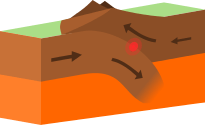
What type of plate boundary is this?
a)
Plate
b)
Divergent
c)
Convergent
d)
Transform
15.

What type of event will occur at this boundary?
a)
Earthquake
b)
Volcano Eruption
c)
Tornado
d)
Mountain Building
16.
A divergent boundary occurs when plates ....
a)
Pull apart
b)
Come together
c)
Slide past each other
d)
subducting
17.
Which of the following is the name of the ancient supercontinent formed 28 Million Years ago.
a)
Pangea
b)
Gondwanda
c)
Laurasia
d)
Neverland
18.
Which of the following is NOT evidence to support the theory of plate tectonics?
a)
Fossils
b)
Mountains
c)
Glaciers
d)
Sand Erosion
19.
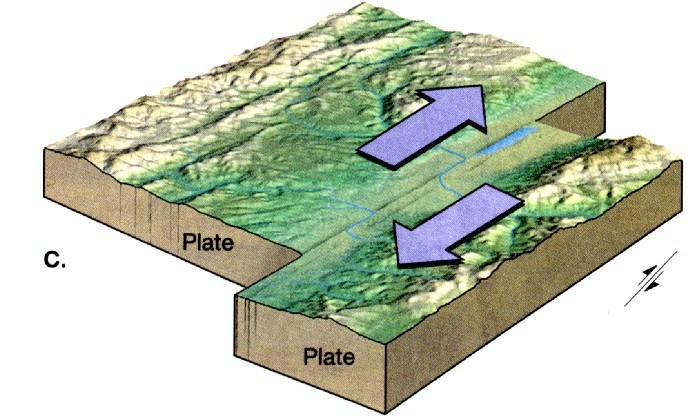
What type of plate boundary is this?
a)
Transform
b)
Convergent
c)
Divergent
d)
Plate
20.
The theory that says Earth's continents once made up an ancient supercontinent, and have been drifting apart ever since, is called the theory of...
a)
Pangea
b)
Plate Tectonics
c)
Natural Selection
d)
Gravity
21.
Oceanic Trenches are formed by _______ plate boundaries
a)
Convergent
b)
Transform
c)
Plate
d)
Divergent
22.
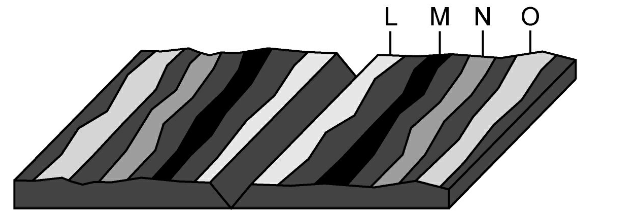
Where would the oldest rock be found?
a)
L
b)
M
c)
N
d)
O
23.
How is it possible for new crust to be formed without increasing the surface area of the Earth?
a)
Crust is destroyed at the same time it is created
b)
New crust is underwater where it sinks
c)
New crust breaks more easily than old crust
24.
Mountains are created when....
a)
Two continental plates collide
b)
Two oceanic plates pull apart
c)
An Oceanic plate subducts under a Continental Plate
d)
Two continental plates pull apart
25.
A _______ maybe created when an earthquake happens under the sea.
a)
Hurricane
b)
Tsunami
c)
Tornado
d)
Sea Level Rising
26.
A(n)_________ is a sudden and violent movement in the Earth's crust
a)
Earthquake
b)
Volcano
c)
Tsunami
d)
Fault
27.
The place inside the earth where an earthquake happens
a)
Epicenter
b)
Shock Wave
c)
Focus
d)
Surface Wave
28.
The _______ is the point on the earth's surface directly above where an earthquake occurs
a)
Epicenter
b)
Shock Wave
c)
Focus
d)
Surface Wave
29.
Intrusions that form when magma cools and solidifies beneath the surface
a)
Igneous
b)
Metamorphic
c)
Sedimentary
30.
Fast moving hot gas and rock that move rapidly away from a volcano.
a)
Ash Cloud
b)
Lava Flow
c)
Pyroclastic Flow
d)
Volcanic Bomb
31.
The Hawaiian Islands were formed by what type of geologic activity
a)
Divergent Boundary
b)
Hot Spot
c)
Convergent Boundary
d)
Transform Boundary
32.
Which type of volcano is the largest?
a)
Cinder Cone
b)
Compsite
c)
Shield Volcano
d)
Lava Dome
33.
The place where 2 plates move apart is called a
a)
Convergent Boundary
b)
Transform Boundary
c)
Hot Spot
d)
Divergent Boundary
34.
What happens where oceanic plate material meets continental plate material?
a)
The contnental plate is pushed down
b)
The oceanic plate is pushed down
c)
The oceanic plate is pushed up
d)
Both plates are pushed up
35.
Which type of rock forms from extreme heat and pressure?
a)
Igneous
b)
Sedimentary
c)
Organic
d)
Metamorphic
36.
Wind, water, and ice breaking down rock is called
a)
Erosion
b)
Deposition
c)
Compaction
d)
Weathering
37.
What is the MAIN way rocks are classified?
a)
Their color and shapes
b)
How they form
c)
Mineral bands
d)
Where they form
38.
True/False: Igneous rocks can only turn into metamorphic rocks.
a)
True
b)
False
39.
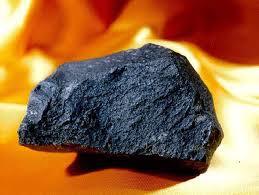
This rock was found near the mouth of a volcano. What type of rock is this?
a)
Sedimentary
b)
Igneous
c)
Metamorphic
40.
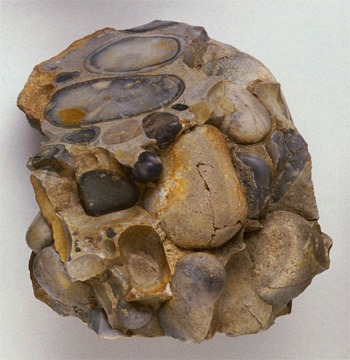
This rock was formed by smaller pieces of rock that settled at the bottom of a lake millions of years ago. What type of rock is this?
a)
Sedimentary
b)
Igneous
c)
Metamorphic
41.

Each rock type can follow only one pathway of the rock cycle.
a)
True
b)
False
42.
Fossils are often found in ____________ because it is formed from the remains of once living things.
a)
metamorphic
b)
magma
c)
igneous
d)
sedimentary
43.

This rock was formed by lots of fossils that settled on top of each other over time. What type of rock is this?
a)
Sedimentary
b)
Igneous
c)
Metamorphic
44.

The thin outer shell of the earth is called the
a)
Crust
b)
Core
c)
Mantle
45.

Name the two kinds of crust
a)
Mantle and Crust
b)
Inner Core and Outer Core
c)
Oceanic and Continental Crust
46.

The white of a hard boiled egg is like earth's:
a)
Mantle
b)
Core
c)
Crust
47.

What two layers of the earth make up the lithosphere?
a)
Inner and Outer Core
b)
Crust and Mantle
c)
Oceanic and Continental
48.

The outer core is mostly:
a)
Silicon
b)
Calcium
c)
Liquid Iron
49.

The temperature of the inner core is
a)
5,000 degrees
b)
1,000 degrees
c)
2,900 degrees
50.
Lines of longitude are called this.
a)
meridian
b)
parallel
c)
equator
d)
longitude
51.
The 0 degree latitude line that divides the Northern and Southern Hemispheres.
a)
Prime Meridian
b)
time zone
c)
equator
d)
International Dateline
52.
What map feature can help you determine the approximate distance between two locations?
a)
map scale
b)
key
c)
title
d)
distance calculator
53.
Lines of latitude are called this.
a)
tropic zone
b)
parallel
c)
polar zone
d)
meridian
54.
What is the measure of how far north or south a place is from the Equator called?
a)
Latitude
b)
Longitude
c)
Prime Meridian
55.

What is this object known as?
a)
map symbol
b)
map key
c)
map scale
d)
compass rose
56.
What is the measure of how far east or west a place is from the Prime Meridian called?
a)
Latitude
b)
Longitude
c)
Equator
57.
The 0 degree mark of longitude is known as the ___________ ______________ measure from Greenwich England.
a)
Equator
b)
Prime Meridian
c)
International Date Line
d)
Contour Line
58.
This the study and description of the shape of the land and surface features.
a)
Biology
b)
Topography
c)
Geology
d)
Oceanography
59.
To locate exact places on the earth, one must look at
a)
the intersecting lines of latitude and longitude
b)
the lines of latitude only
c)
the lines of longitude only
d)
a neighboring area to describe the location
60.
An area's height above sea level is called...
a)
topography
b)
relief
c)
elevation
d)
GIS
61.
Which of the following terms describes the shape of the Earth?
a)
sphere
b)
cone
c)
big
62.
A flat drawing that shows all or part of the Earth's surface
a)
map
b)
latitude
c)
globe
63.
a map feature that explains the meaning of colors and symbols used on the map
a)
Map Key
b)
Map Conents
c)
Map Glossary
d)
Map Index
64.
How many parts does the equator divide the earth into?
a)
4
b)
2
c)
6
d)
8
65.
The line of longitude 180 East or 180 West of the Prime Meridian is known as the _____________ ____ ____.
a)
Equator
b)
Latitude
c)
International Date Line
d)
International Hot Line
66.
There are a total of ______ time zones on Earth.
a)
12
b)
6
c)
48
d)
24
67.
divides the Earth into the Eastern and Western Hemispheres
a)
Equator
b)
North Pole
c)
South Pole
d)
Prime Meridian
68.
Latitude and Longitude are measured in ________.
a)
inches
b)
feet
c)
degrees
d)
grams
Reset

