wayground logo

Free Printable Worksheets

Font size

S
M
L
XL
Worksheets

Weather1

Total questions: 100

Worksheet time: 2hrs 32mins

Name
Class
Date
1.

When a warm air mass stretches over a cold air mass.

a)

cold front

b)

warm front

2.

Lightning, thunder and tornadoes may occur

a)

cold front

b)

warm front

3.

Causes heavy rainfall.

a)

cold front

b)

warm front

4.

Causes light rain or drizzle.

a)

cold front

b)

warm front

5.

When a cold air mass pushes the warm air mass upward.

a)

cold front

b)

warm front

6.
Rain, snow, sleet, and hail are all forms of _____.
a)
precipitation
b)
condensation
c)
evaporation
d)
climate
7.
A violently rotating column of air called a _____ when it comes in contact with the ground.
a)
hurrican
b)
tornado
c)
trade wind
d)
local wind
8.

A(n) _____ is a large body of air that has properties similar to the part of Earth's surface over which it depends.

a)

tornado

b)

pressure system

c)

front

d)

air mass

9.
When two air masses meet, there is a _____, or boundary.
a)
thunderstorm
b)
watch
c)
front
d)
cloud
10.
A _____ is a large, swirling, low-pressure system that forms over the Atlantic Ocean.
a)
blizzard
b)
cold front
c)
tornado 
d)
hurricane
11.

What kind of pressure predicts good weather?

a)

high

b)

low

c)

cold

d)

stationary

12.

Name this front

a)

warm front

b)

cold front

c)

stationary front

d)

occluded front

13.

Name this front

a)

warm front

b)

cold front

c)

stationary front

d)

occluded front

14.
Which condition usually means cloudy, stormy weather?
a)
high pressure
b)
low pressure
15.
What part of the illustration shows Evaporation? 
a)
1
b)
2
c)
3
d)
4
16.
Which number illustrates Condensation?
a)
1
b)
2
c)
3
d)
4
17.
What kind of weather is usually associated with a high pressure system?
a)
Sunny weather
b)
Precipitation (rain, snow, etc.)
18.
What does this symbol on a weather map indicate? 
a)
High pressure system
b)
Low pressure system
c)
Cold front
d)
Warm front
19.
What role do oceans play in hurricane formation?
a)
they provide cool, dense water
b)
warm water supplies energy to hurricanes
c)
warm ocean water slows hurricane formation
d)
cold ocean water supplies energy to hurricanes
20.
Where the warm and cold air meet and stall, clouds and fog form, and it may rain or snow.  It could bring many days of clouds and precipitation.  
a)
Warm Front
b)
Cold Front
c)
Occluded Front 
d)
Stationary Front 
21.

A gyre is

a)

A great river of air

b)

a circular rotation of water in an ocean basin that is driven by the winds.

c)

When warm surface water is replaced by deep cold water

d)

when plants sweat

22.
This is the symbol for a... 
a)
Stationary Front
b)
Occluded Front
c)
Cold Front
d)
Warm Front
23.
Identify the type of front that is shown in the image.
a)
Occluded Front
b)
Cold Front
c)
Stationary Front
d)
Warm Front
24.

Formed over land

a)

Continental

b)

Maritime

c)

Tropical

d)

Polar

25.

Formed over the tropics (near the equator)

a)

Polar

b)

Continental

c)

Maritime

d)

Tropical

26.

Formed near the poles (north and south poles)

a)

Maritime

b)

Polar

c)

Continental

d)

Tropical

27.

Formed over water

a)

Polar

b)

Continental

c)

Tropical

d)

Maritime

28.

Where do hurricanes form?

a)

Land

b)

Over the ocean

c)

Tornado

d)

At one of the poles

29.

What causes a thunderstorm?

a)

Warm front

b)

Occluded front

c)

Stationary front

d)

Cold front

30.

Do hurricanes move on land?

a)

True

b)

False

31.

Where does a warm air mass go when a cold air mass comes in?

a)

Up

b)

Down

c)

Middle

d)

Left

32.
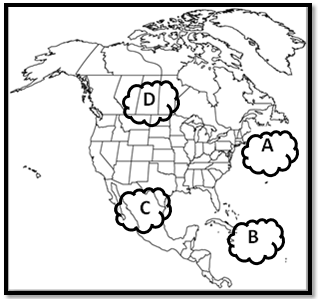
Which type of air would you find at air mass D?
a)
cold, dry
b)
warm, humid
c)
warm, dry
d)
cold, humid
33.
Where would you find a tropical maritime air mass?
a)
over the ocean, near the equator
b)
over the ocean, near the poles
c)
over a continent, near the equator
d)
over a continent, near the poles
34.
A cold front is approaching Minneapolis. What will happen to the air temperature?
a)
stay the same
b)
increase
c)
decrease
35.
True or False: Changes in wind speed and direction can indicate a storm or change of temperature
a)
True
b)
False
36.
a)
High Air Pressure
b)
High Temperatures
c)
Heavy Rain
d)
Hail
37.

Which city is currently experiencing a snow storm?

a)

Seattle

b)

Los Angeles

c)

Chicago

d)

New York

38.

Which city has the highest temperature?

a)

Dallas

b)

Chicago

c)

Los Angeles

d)

Miami

39.
After a cold front passes through, what type of weather will there be?   
a)
Rainy or stormy, and cloudy
b)
Clear, dry, and sunny
40.

An anemometer measures...

a)

Humidity

b)

Air pressure

c)

Wind speed

d)

Wind direction

41.

Which tool measures air pressure?

a)

Anemometer

b)

Barometer

c)

Hygrometer

d)

Wind Vane

42.

Where might maritime tropical air mass come from?

a)

Northern Canada

b)

Oceans by Hawaii

c)

Ocean by New York state

d)

Mexico

43.

Cold fronts move in what directions?

a)

North to south

b)

Northeast to southwest

c)

Northwest to southeast

d)

any direction

44.

In the water cycle, water changes from a gas to a liquid during...

a)

condensation

b)

evaporation

c)

precipitation

d)

transpiration

45.
This type of front results in the same weather for several days
a)
warm
b)
cold
c)
stationary
d)
occluded
46.
How many fronts are there?
a)
2
b)
6
c)
4
d)
0
47.
Yesterday was stormy. Today it is clear, cooler, and windy. This is most likely the result of a(n)
a)
cold front
b)
warm front
c)
stationary front
48.
__________ can be produced by thunderstorm.
a)
tornadoes
b)
volcanoes
c)
Tsunamis
d)
Stationary fronts
49.
It has been rainy for nearly a week. This is most likely the result of a(n)
a)
cold front
b)
stationary front
c)
occluded front
d)
warm front
50.
Winds always move from areas of
a)
high pressure to low pressure
b)
low pressure to high pressure
51.
What is the percentage of oxygen in Earth's atmosphere?
a)
1%
b)
21%
c)
78%
d)
90%
52.
Which gas in our atmosphere is most abundant?
a)
Argon
b)
Oxygen
c)
Nitrogen
d)
Carbon Dioxide
53.
What is the percentage of nitrogen in Earth's atmosphere?
a)
1%
b)
21%
c)
78%
d)
90%
54.
In which layer of the atmosphere does weather occur?
a)
Mesosphere
b)
Thermosphere
c)
Stratosphere
d)
Troposphere
55.
Based on the information provided in the weather map, which city shown most recently saw a drop in temperature? 
a)
Boise
b)
Denver
c)
Louisville
d)
Shreveport
56.
Which of the following is the best conclusion that can be made from this graph?
a)
atmospheric carbon dioxide levels have been decreasing since 1960
b)
Hawaii has a lot of carbon dioxide
c)
humans have been working hard to decrease carbon dioxide levels
d)
atmospheric carbon dioxide levels have increased steadily since 1960
57.
Warm air rises and the cool air sinks demonstrates this type of heat transfer. 
a)
conduction
b)
convection
c)
radiation
d)
Insolation 
58.
True Or False:The Earth's Tilt On Its Axis Creates Different Seasons.
a)
True
b)
False
59.

When moving objects are deflected to the right In the Northern Hemisphere?

a)

Gravity Effect

b)

Wind Effect

c)

Coriolis Effect

d)

Green House Effect

60.

Gravity pulls objects To the right In The Northern hemisphere and to the left in the Southern hemisphere.

a)

true

b)

false

61.
If you are sitting on the beach during the day enjoying a cool breeze, which way will it be blowing?
a)
from sea to land
b)
from land to sea
c)
from north to south
d)
from east to west
62.
All energy on earth begins
a)
with the heat produced by pressure inside the earth
b)
photosynthesis by producers
c)
with the sun
d)
with the magma inside the earth
63.
Wind is created when the 
a)
sun heats the Earth evenly
b)
sun heats the Earth unevenly
64.
Warm air ______ .
a)
rises
b)
sinks
65.
Which heats and cools  the fastest?
a)
land
b)
sea
c)
both are the same rate
d)
air
66.
If an air mass is sinking, it must be
a)
cold and less dense
b)
cold and more dense
c)
warm and more dense
d)
warm and less dense
67.
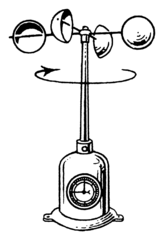
This weather instrument is an...
a)
wind vane
b)
anemometer
c)
barometer
d)
thermometer
68.
The temperature at which air is saturated and condensation forms is the:
a)
dew point
b)
rain point
c)
wind point
d)
relative humidity
69.
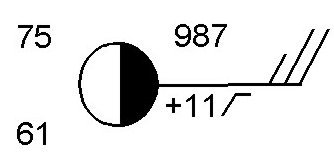
What is the temperature at this station
a)
75 degrees
b)
61 degrees
c)
987 degrees
d)
11 degrees
70.
What is the wind speed at this station
a)
3 knots
b)
15 knots
c)
25 knots
d)
30 knots
71.

What is the wind direction

a)

Northeast

b)

Northwest

c)

Southeast

d)

Southwest

72.
The scale on a thermometer may be ___________
a)
Celsius, Fahrenheit, or both
b)
Heat
c)
Inches
d)
Grams
73.
Clouds form when _________ condenses.
a)
air
b)
dust
c)
water vapor
74.
Weather is 
a)
temperature and air conditions over time
b)
temperature and atmospheric conditions at a specific place and time
c)
weather over time
d)
measured using a sling psychrometer
75.
Climate is 
a)
weather over time
b)
the wet stuff outside
c)
temperature and atmospheric conditions at a specific time
76.
Surface currents are a result of
a)
Global Wind Patterns
b)
Earth's Rotation
c)
Density
d)
All of the above
77.
Deep Ocean currents are a result of
a)
Global Wind Patterns
b)
Earth's Rotation
c)
Density
d)
All of the above
78.

The Gulf Stream carries _____________ water from the east coast of the United States to the west coast of Europe.

a)

Cold

b)

Warm

c)

Freezing

d)

Fresh

79.
What happens to a current when it comes in contact with a continent or landmass?
a)
It continues over the continent
b)
It stops
c)
It changes direction
d)
It is absorbed by the land
80.
Warm ocean currents generally come from
a)
The North Pole
b)
The South Pole
c)
The Equator
d)
Both A and B
81.
Cold ocean currents generally come from
a)
The North Pole 
b)
The South Pole
c)
The Equator
d)
Both A and B
82.

The California Current (west coast) carries _________ water from the North.

a)

Cold

b)

Warm

c)

Freezing

d)

Fresh

83.
Two types of water currents are
a)
local and global
b)
sea and land
c)
surface and deep
d)
warm and cold
84.

Ocean currents have an affect on which two things?

a)

climate and weather

b)

temperature and density

c)

land and sea

d)

the equator and the poles

85.
A horizontal movement of ocean water that is caused by wind and that occurs at or near the ocean's surface.
a)
Gulf Stream
b)
Global Conveyor Belt
c)
Surface Current
d)
Gyre
86.
What process brings the deep cold ocean currents up to the surface?
a)
Conduction
b)
Global Wind Patterns
c)
Convection Currents
d)
Temperature and salinity
87.

What is the name of the steady global winds that flow from west to east between latitudes 30N - 60N and 30S - 60S?

a)

trade winds

b)

land breeze

c)

westerlies

d)

jet stream

88.
Which statement correctly defines wind?
a)
Wind is the movement of air from areas of low pressure to areas of high pressure
b)
Wind is the movement of air to a colder area in the atmosphere.
c)
Wind is the movement of air from areas of high pressure to areas of low pressure.
d)
Wind is the movement of air pushed around and bouncing off Earth's surface.
89.
Where does the initial source of energy come from that creates winds?
a)
the moon
b)
the Sun
c)
the Earth's surface
d)
the rotation of the Earth
90.
What causes global winds and convection in the atmosphere? 
a)
continental deflection
b)
the rotation of the Earth
c)
Moon's gravity
d)
unequal heating of the Earth by the Sun
91.
The Coriolis effect causes ___________.
a)
the Earth to rotate on its axis
b)
continental deflection
c)
global winds and surface currents to move in a curved path instead of a straight line
d)
global winds and deep ocean currents to move in a curved path instead of a straight line.
92.
Which statement correctly describes the properties of cold air?
a)
less dense and less pressure than warm air
b)
more dense and more pressure than warm air
c)
more dense and less pressure than warm air
d)
less dense and more pressure than warm air
93.
Near the top of the troposphere is a narrow band of high speed winds called the______.
a)
westerlies
b)
jet stream
c)
trade winds
d)
local winds
94.
Why does warm air rise?
a)
Warm air is more dense than cooler air.
b)
Warm air has more pressure than cooler air.
c)
Warm air is less dense than cooler air.
d)
Warm air has a higher dew point than cooler air.
95.
Which global winds have the greatest impact on the weather in the US?
a)
trade winds
b)
prevailing westerlies
c)
doldrums
d)
polar easterlies
96.
Winds are created by differences in ______
a)
air temperature
b)
 air pressure 
c)
altitude
d)
humidity 
97.
At the poles, cold air ________
a)
rises
b)
evaporates
c)
spins in a circle
d)
sinks
98.
Which term best describes how the earth's atmosphere is heated?
a)
Spirally
b)
Unevenly
c)
Circularly
d)
Kinetically
99.
True or False:
Land heats and cools faster than water causing wind and weather.

a)
True
b)
False
100.
What are cold winds that blow from east to west in the polar regions?
a)
polar easterlies
b)
trade winds
c)
prevailing westerlies
d)
jet streams