
 Worksheets
9 Week Chemistry Review
Total questions: 60
Worksheet time: 1hrs 24mins

In which family is this element found?
Boron Group (13) because it has 3 protons
Halogens (17) because it has a mass of 7
Alkali Metals (1) because it has 1 valence electron
There are ____ magnesium atoms and _____ chlorine atoms are in 3MgCl2?
3, 6
5, 2
3, 2
2, 3

Each element on the Periodic Table has its own different (unique) ____ based on the number of ____ it has.
Family; protons
Atom; protons
Period; protons
Metalloid; protons

The vertical columns on the Periodic Table are called ______ and have similar ______.
Periods, reactivity/properties
Families/Groups; reactivity/properties
periods; energy levels
families/groups; energy levels
Which molecule has the greatest number of elements?
H2SO4
H2O
Fe2O3
NH3
Which molecule has the greatest number of atoms?
H2SO4
H2O
Fe2O3
NH3

This model best represents
C2H3
CH
C4H4
CH4

What does the following equation tell us?
Products are always greater than reactants
New substances are formed after a chemical reaction
The equation is unbalanced
Matter is always created and destroyed

Selects all statements that are true about the process shown?
The equation represents the Law of Conservation of Mass
Hydrogen peroxide can be broken down into water and oxygen
Water and Oxygen combine to produce hydrogen peroxide
The reactants are composed of 2 elements and 6 atoms

Which picture best represents the Law of Conservation of Mass?
1
2
3
A newly discovered substance has 14 protons and a mass of 28.086 AMUs. How many neutrons does it have?
14
15
28
there is no way to know
Which of the following is not evidence a chemical reaction has taken place?
Changing size
Unexpected color change
A gas being formed
Formation of a precipitate
Solid particles that form when two liquids chemically react is called a(n)
sublimation
condensation
exothermic reaction
precipitate
What happens in ALL chemical reactions?
Change in state of matter
A new substance is formed
Bubbles are produced
An explosion
Which of the following is evidence a chemical change may have occurred?
dissolving
mixing
condensing
Unexpected change in color
The horizontal rows columns on the Periodic Table are ______ and have the same number of ______.
Periods, valence electrons
Families/Groups; valence electrons
periods; energy levels
families/groups; energy levels

Identify the neutral element in the picture
carbon
nitrogen
helium
magnesium
An element with five valence electrons and 3 energy levels
indium
nitrogen

Which section of the Periodic Table has elements that are shiny, good conductors, and highly reactive?
dark blue
light blue
purple
pink
Which of the following subatomic particles are not matched correctly?
Proton-nucleus-positive
neutrons-nucleus-no charge
electrons-electron cloud-negative
neutrons-nucleus-negative
When trying to identify an unknown element, a scientist determines what other elements reacts with chemically. Which property of the unknown element determines the other element it reacts with?
The total number of neutrons in the unknown element
The total number of particles in the nucleus of the unknown element
The number of protons in the nucleus of the unknown element
The number of valence electrons in the unknown element
Which equation represents the Law of Conservation of Mass? (Check ALL answers)
PbO2 + 2H2 --> H2O +2Pb
Which coefficient belongs in front of the molecule HCl to balance this equation? Mg + __HCl ---> MgCl2 + H2
In a chemical reaction...
The atoms of the reactants always stay together to form the products
The atoms of the reactants unbond, rearrange, and then rebond to form the products
New atoms are created which combine to make the products
Some atoms destroyed while others multiply to form the products
In the chemical reaction CH4 + 2O2 → CO2 + 2H2O, how many atoms of each element are in the reactants?
4 carbon atoms, 4 hydrogen atoms, and 2 oxygen atoms
1 carbon atom, 4 hydrogen atoms, and 2 oxygen atoms
1 carbon atom, 4 hydrogen atoms, and 4 oxygen atoms
4 carbon atoms, 4 hydrogen atoms, and 4 oxygen atoms

Using the image above determine if a physical or chemical change has occurred in Model B.
A chemical change has occurred because the molecules have just rearranged.
A chemical change has occurred because a bond (black line) has formed between the green and blue molecule and new light pink/light blue molecules have formed
A physical change has occurred because the molecules have just rearranged.
A physical change has occurred because a bond (black line) has formed between the green and blue molecule and new light pink/light blue molecules have formed.
You know that a chemical reaction has occurred if
there is a precipitate (new solid)
there is a color change.
there is a temperature change.
All of these answers are evidence.
Which of the following is an example of a physical change but NOT a chemical change?
A log give off heat and light as it burns.
A tree stores energy from the Sun in its fruit.
A penny lost in the grass slowly changes color.
A water pipe freezes and cracks on a cold night.

What is the mass of this atom?
1
3
4
7
Select all statements which are true about the carbon family
The mass of each element increases as you move down the family
They all have four valence electrons and react similarly
They are all metals
They're valence shells are full
Select all true statements about the alkali family (group1A)
They have 1 valence electrons
They are found on the right side of the periodic table
They have 1 energy level
They are all metals (except for H)
Which process is an example of a physical change?
Cutting Carrots into pieces and mixed in a salad
A peanut butter and jelly sandwich being digested
Sodium metal and water combining to form a compound and a gas
Sodium metal and chlorine gas combined to form table salt
Paper is burned and the mass of the ash is less than the mass of the original paper. Which is true?
The ash has less volume than the paper
Some of the matter is destroyed during the reaction
The mass of the ash cannot be accurately determined
Some of the products of the reaction were given off as a gas

According to the law of conservation of mass, matter cannot be created or destroyed. Which of the following is true?
a
b
c
d
Select all of the following which are examples of a Chemical Change
Iron Rusting
Gas Burning
Breaking a glass
Boiling water
Burning Wood
A teacher is demonstrating physical and chemical changes to her class. Which action should they use to demonstrate a chemical change?
Cutting a piece of paper with scissors.
Folding a piece of paper into an airplane.
Ripping a piece of paper with their hands.
Burning a piece of paper with a match.
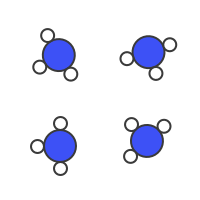
Which of the following molecules could be represented by this diagram?
2AlF2
4NH3
2H3
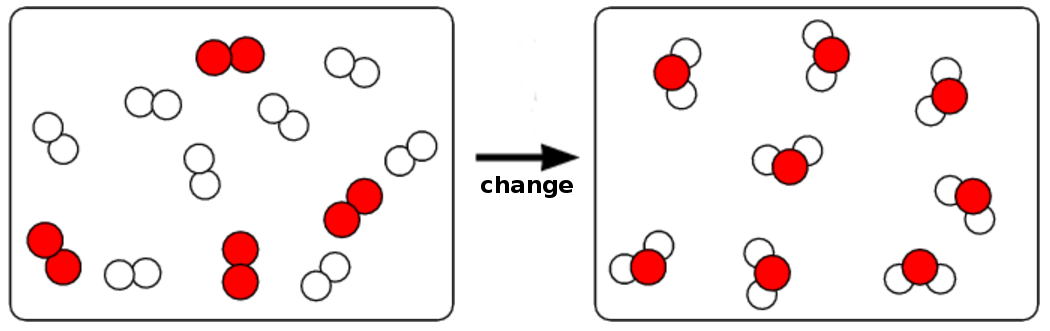
Which of the following best describes the change shown in this diagram?
Physical change because a new substance was created.
Physical change because no new substance was created.
Chemical change because a new substance was created.
Chemical change because no new substance was created.
Select all of the following which are evidence of a chemical change
liquid nitrogen boiling
cells producing energy
water freezing
vinegar and baking soda fizzing

Which diagram represents a physical change, only?


Which part of an atom determines its reactivity?
Which element has similar chemical properties as sodium but has 7 energy levels?
Francium (Fr)
Cesium (Cs)
Rubidium (Rb)
Potassium (K)
Why does the atomic radius increase down a group?
There are more electrons and energy levels.
There are fewer electrons and energy levels.
There are more protons that need more energy levels.
There are more neutrons that need more energy levels.
What family on the periodic table contains metals, nonmetals, AND metalloids, and all of those elements are solid at room temperature?
Group 1A
Group 13 (3A)
Group 14 (4A)
Group 17 (7A)

Which group has the most reactive metals?
alkali metals
1A
noble gases
8A
transition metals
3-12
halogens
7A
Sellect all statements which are true about ALL of the elements in Group 18 OR Group 8A?
They ALL have 6 valence electrons
They ALL are gases at room temperature
They are the least reactive family of elements
They ALL nonmetals
What is the charge of the atom's nucleus?
+1
+3
-4
4
Which of the following molecules is composed of 5 atoms and 2 elements?
H2SO4
2H2O
Fe2O3
NH3
Fe + O2 -> Fe2O3
(Check ALL answers)

For an investigation a student poured a blue solution of CuSO4 into a beaker. The student placed a shiny, silver-colored strip of zinc metal in the solution and wrote down the changes. Which change shows that a CHEMICAL REACTION took place?
A dark solid (precipitate) formed on the zinc metal.
The zinc metal stayed silver-colored and shiny
The CuSO4 solution evaporated after the zinc metal was added.
None of these
A teacher writes the equation representing the chemical reaction between hydrochloric acid and sodium on the board.
2HCl + 2Na → NaCl + H2
The teacher states that the equation has not been balanced. Which of these correctly shows the products of this reaction after the equation has been balanced?

Data collected during a lab is displayed in the graph. Which statements represent the information in the graph.
Results from the lab show the temperature decreased over time
Results from the lab show the temperature increased over time
The lab results display a chemical change since a new substance was produced
The lab resulted in a physical change, because no new substance was produced

Students performed a lab in class and graphed the results as follows. Which of the following can be inferred from the graph?
A chemical reaction took place because a precipitate is formed
A chemical reaction took place because hydrochloric acid dissolved the magnesium
A chemical reaction took place because the temperature unexpectedly decreased

The three atoms are all forms of Carbon called isotopes. Which of the statements is true of all three atoms?
All the carbon atoms have 6 protons, 7 neutrons, and a mass of 12
All the carbon atoms have a different number of protons but the same number of neutrons
All the carbon atoms have 6 protons, but they have different numbers of neutrons and atomic masses

