Wayground logo

Free Printable Worksheets

Font size

S
M
L
XL
Worksheets

AP Bio Speciation & Cladograms

Total questions: 30

Worksheet time: 26mins

Name
Class
Date
1.
A horse and a donkey can successfully mate to produce offspring known as a mule.  Mules are sterile .  Would mules be classified as a species?
a)
Yes, mules have enough of their own traits to be considered a species.
b)
Yes, the fact that have different number of chromosomes makes them a different species
c)
No, mules are too similar to the parent species
d)
No, due to their inability to reproduce successfully.
2.
A newly identified organism has four limbs and amniotic eggs with shells.  Which organism do they most likely share a common ancestor with?
a)
ray-finned fish
b)
birds
c)
rodents
d)
amphibians
3.
Using the cladogram:  a common ancestor of amphibians and ray-finned fish would have
a)
a bony skeleton
b)
four limbs
c)
scaly skin
d)
eggs with shells
4.
The wing of a bat and a humans' arm have different functions and appear very different.  Yet, the underlying anatomy is basically the same.  therefore, these structures are examples of
a)
geographic isolation
b)
analogous structures
c)
homology
d)
reproductive isolation
5.
A farmer uses triazine herbicide to control pigweed in his field. For the first few years, the triazine works well and almost all the pigweed dies; but after several years, the farmer sees more and more pigweed. Which of these explanations best explains what happened?
a)
The herbicide company lost its triazine formula and started selling poor-quality triazine.
b)
Natural selection caused the pigweed to mutate, creating a new triazine-resistant species.
c)
Triazine-resistant pigweed has less-efficient photosynthesis metabolism.
d)
Triazine-resistant weeds were more likely to survive and reproduce.
6.
Which statement represents the best explanation for the observation that the nuclear DNA of wolves and domestic dogs has a very high degree of sequence homology?
Dogs and wolves...
a)
have very similar morphologies.
b)
belong to the same order.
c)
are both members of the order Carnivora.
d)
share a very recent common ancestor.
7.

A common ancestor for both A and E could be at position __.

a)

1

b)

2

c)

3

d)

4

8.
On the cladogram, which number represents the common ancestor of organisms B & D?
a)
1
b)
2
c)
3
d)
A
9.
A table of arachnid and insect characteristics is shown. Which characteristic could be used to distinguish between
arachnids and insects?
a)
Jointed legs
b)
Body segments
c)
Presence of eyes
d)
Presence of antennae
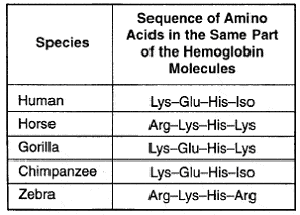
10.
You look at two species and see very similar amino acid sequences. What does this likely tell you?
a)
These are the same animal.
b)
These animals have a common ancestor.
c)
These animals are not likely related.
d)
These animals are likely becoming one species.
11.

The two species that are closely related to each other are __.

a)

A and B

b)

B and C

c)

C and D

d)

D and E

12.

How long ago was common ancestor in this phylogenetic tree alive?

a)

53.7-54.1 mya

b)

61.5-61.9 mya

c)

50.7-54.9 mya

d)

37.9-46.5 mya

13.

What number is the common ancestor of C and D

a)

1

b)

2

c)

3

d)

4

14.

What is the common ancestor of Letters A, B, C, D, E?

a)

1

b)

2

c)

3

d)

4

15.

Which group of animals on this tree are most closely related to birds?

a)

Saurischian dinosaurs

b)

Ornithischian dinosaurs

c)

Crocodiles

d)

None of these are related to birds

16.
Based on the phylogenic tree, which of these shows a correct ancestral lineage?
a)
E is an ancestor to F and G
b)
C is an ancestor to D and E
c)
B is an ancestor to A
d)
E is an ancestor to H and I
17.
 Reproductive isolation results in...
a)
reduction of gene flow
b)
adaptation
c)
natural selection
d)
mutation
18.

Which is true about allopatric and/or sympatric speciation?

a)

In allopatric speciation, members of the population live in the same land

b)

In sympatric speciation, members of the population live in the same land

c)

Speciation takes longer in allopatric situations

d)

There are very few examples of sympatric speciation

19.

All of these are pre-zygotic barriers EXCEPT

a)

Behavioral

b)

Temporal

c)

Mechanical

d)

Hybrid Breakdown

e)

Gametic

20.

One species of flower blooms in the spring, the other blooms in the fall. They can not interbreed because of

a)

Behavioral isolation

b)

Temporal isolation

c)

Mechanical isolation

d)

Habitat isolation

e)

Gametic isolation

21.

The wing of a bat and a human's arm have different functions and appear very different. Yet, the underlying anatomy is basically the same. Therefore, these structures are examples of

a)

convergent evolution

b)

analogous structures

c)

homologous structures

d)

vestigial structures

22.

The differences in sparrow songs among sympatric species of sparrows are examples of

a)

geographic isolation

b)

temporal isolation

c)

behavioral isolation

d)

mechanical isolation

23.
The Tasmanian devil is a marsupial that resembles the North America wolf, which is a placental mammal.
a)
adaptive radiation
b)
divergent evolution
c)
founder effect
d)
convergent evolution
24.
What is speciation?
a)
combining of tow species to form one with different traits
b)
isolation that affects mating behaviors
c)
timing of mating that prevents normal sexual selection
d)
divergence of two or more species from an existing one
25.
Which of the following statements is correct based on the information shown in this cladogram?
a)
the turtle and the frog are more similar to each other than the turtle and the bass
b)
frogs have existed for a longer time that bass
c)
the frog is more closely related to the bass than to the leopard
d)
the bass is exinct
26.
Which statement correctly explains how resistance to penicillin appeared after a few years of its widespread use to fight bacterial infection? 
a)
in order to survive exposure to penicillin, bacteria developed a resistance to the drug 
b)
a few bacteria became resistant to penicillin, and through sexual reproduction , most bacteria acquired the resistance
c)
penicillin never really successfully wiped out populations of bacteria, scientist did not use proper controls in their studies
d)
some bacteria were resistant to penicillin and their population spread rapidly, without competition from bacteria that were killed by penicillin
27.
What is a species?
a)
A group of organisms that can mate with each other and produce fertile offspring. 
b)
A group of organisms that genetically are very different from each other. 
c)
A group of organisms that can mate and produce offspring even if those offspring are infertile.
d)
Indivual organisms that live in the same environment. 
28.
What type of speciation involves geographic isolation?
a)
Allopatric
b)
Sympatric
c)
Both
29.
Which of the following conclusions is best supported by the cladogram above?
a)
Species P and Q are equally related to species T.
b)
Species P and T do not share a common ancestor.
c)
Species S evolved from species R.
d)
Species S is more closely related to species T than to species R.
30.
On island chains like the one shown below, animal populations that spread from the main island to the other islands can evolve into separate species. Which of the following best explains why speciation is favored in such a situation? 
a)
Predators on the main island can easily migrate to follow the populations to the other islands.
b)
The physical separation of the islands from the main island limits gene flow and interbreeding between the populations.
c)
Lack of disease on the other island enables the populations to grow and change without limits.
d)
The climatic conditions of the islands allow the populations to breed all year long and produce several generations.