wayground logo

Free Printable Worksheets

NEW

Font size

S
M
L
XL
Worksheets

Ecology 2025

Total questions: 68

Worksheet time: 2hrs 31mins

Name
Class
Date
1.
What does every food chain start with? (Even if it's not drawn or written there!)
a)
producers
b)
sun
c)
consumer
d)
decomposers
2.
An organism that needs to eat other organisms to obtain energy is known as a:
a)
Autotroph
b)
Producer
c)
Consumer
d)
Mutualist
3.
relationship in which two species live closely together
a)
resource
b)
mutualism
c)
succession
d)
symbiosis
4.
What are plants called in a food chain?
a)
Producers
b)
Consumers
c)
Decomposers
d)
Scavengers
5.
Where an organism lives
a)
habitat
b)
niche 
c)
heterotrogh
d)
biosphere
6.
The rabbit in this food web would be considered a:
a)
Decomposer
b)
Producer
c)
Secondary Consumer
d)
Primary Consumer
7.
In this Food Web Pyramid Which type of consumer gets only 10% of the energy stored in plants?
a)
Herbivore
b)
Carnivore
c)
Omnivore
d)
Secondary Consumer
8.
What is the term for each step in the transfer of energy and matter within a biological community?
a)
energy path
b)
food web
c)
trophic level
d)
food pyramid
9.
The amount of energy that usually transfers from one trophic level to the next...
a)
10%
b)
20%
c)
80%
d)
50%
10.
The nonliving aspects of an ecosystem.
a)
Abiotic factors
b)
Biotic factors
11.
The living portions of the ecosystem.
a)
Biotic factors
b)
Abiotic factors
12.
A graphic illustration that shows each trophic level and the amount of useable energy contained within.
a)
Food chain
b)
Food web
c)
Energy Pyramid
d)
All of these
13.
A collection of organisms that make up a community as well as all of the nonliving aspects of the environment.
a)
Population
b)
Community
c)
Habitat
d)
Ecosystem
14.
As you move upward, from level to level, in an energy pyramid, energy _____.
a)
increases
b)
decreases
c)
stays the same
d)
increases exponentially
15.
 plants that convert energy from the sun
a)
decomposer
b)
primary consumer
c)
secondary consumer
d)
producer
16.
What do you call an animal that is hunted by another animal?
a)
prey
b)
predator
c)
producer
d)
herbivore
17.
What do you call an animal that eats both plants and animals?
a)
vegetarian
b)
herbivore
c)
omnivore
d)
carnivore
18.
Cattle egrets forage (feed) in fields among cattle. The egret gets easy access to flying insects stirred up by the cattle, and the cattle don't care if they are there or not.
a)
mutualism
b)
commensalism
c)
competition
d)
parasitism
19.
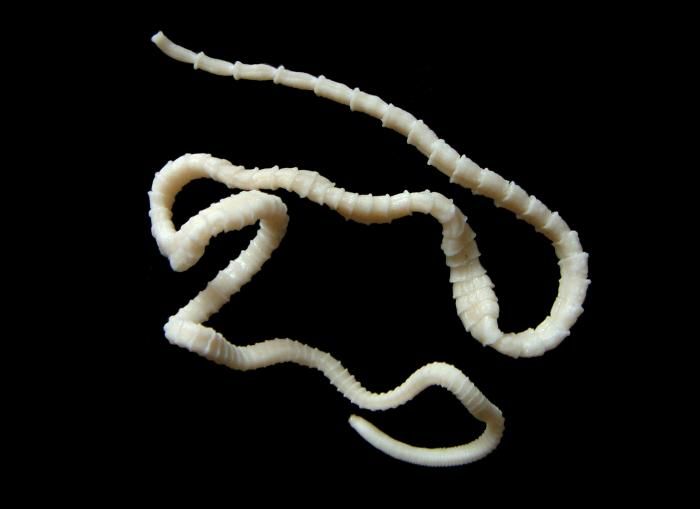
A tapeworm and a cat have this type of relationship.
a)
mutualism
b)
parasitism
c)
commensalism
d)
competition
20.
What type of symbiosis?
*
The plover picks and eats scraps of meat from the crocodile’s teeth.
*
The crocodile gets a free teeth-cleaning!
a)
commensalism
b)
mutualism
c)
parasitism
d)
predation
21.
Coyotes and Foxes both live in Maryland and both eat rabbits and mice
a)
Parasitism
b)
Commensalism
c)
Mutualism
d)
Competition
22.
A boxer crab carries a pair of small anemones in its claws. When approached by a predator, the crab waves the stinging tentacles of the anemones to deter the predator. The anemones benefits from the small particles of food dropped by the crab during the feeding.
a)
Mutualism
b)
Commensalism
c)
Parasitism
23.
Largest number of individuals of a population that the environment can support...  
a)
carrying capacity
b)
population crash
c)
lag phase
d)
mutualism
24.
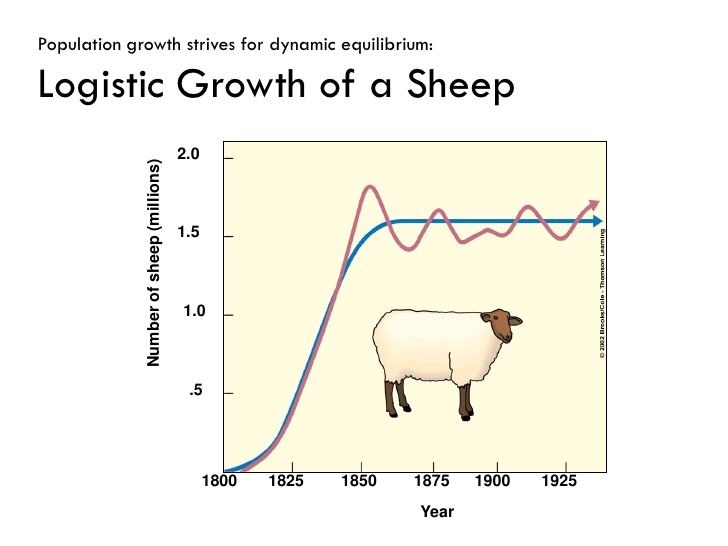
What is the carrying capacity for this sheep population?
a)
1.8 million
b)
1.25 million
c)
1.6 million
d)
1.o million
25.
type of growth shown here:
a)
exponential growth
b)
logistical growth
26.
What type of graph is this?
a)
exponential growth
b)
logistical growth
27.
Building proteins and DNA is the reason organisms need what substance?
a)
Water
b)
Carbon
c)
Nitrogen
d)
Calcium
28.
How do  animals get nitrogen?
a)
the atmosphere 
b)
eating other organisms
c)
bacteria
d)
lightning 
29.
Bacteria fix nitrogen on plant roots. Plant roots provide sugar to bacteria. This is an example of _______.
a)
mutualism
b)
parasitism
c)
commensalism
d)
competition
30.
Organisms that break down dead plants & animals and release nitrogen back into atmosphere...
a)
bacteria
b)
plants
c)
animals
d)
producers
31.
What is it called when plants give off water vapor?
a)
condensation
b)
evaporation
c)
sublimation
d)
transpiration
32.
Which of the following removes carbon from the atmosphere?
a)
Combustion
b)
Respiration
c)
Photosynthesis
d)
Death
33.
Where does nitrogen move?
a)
In human bodies
b)
In buildings
c)
Between animals, bacteria, plants, and the atmosphere. 
d)
only in the air
34.
What happens when organisms die and decay? 
a)
Their bodies are lifted up
b)
Their nitrogen returns to the soil
c)
they keep their nitrogen
d)
They stay on earth forever
35.
Which one of these does not add CO2 to the atmosphere?
a)
cooking with gas
b)
planting trees
c)
burning wood
d)
riding in a bus
36.
What does not produce carbon dioxide?
a)
Photosynthesis
b)
Burning Fossil Fuels
c)
Animal respiration
d)
Plants decaying
37.
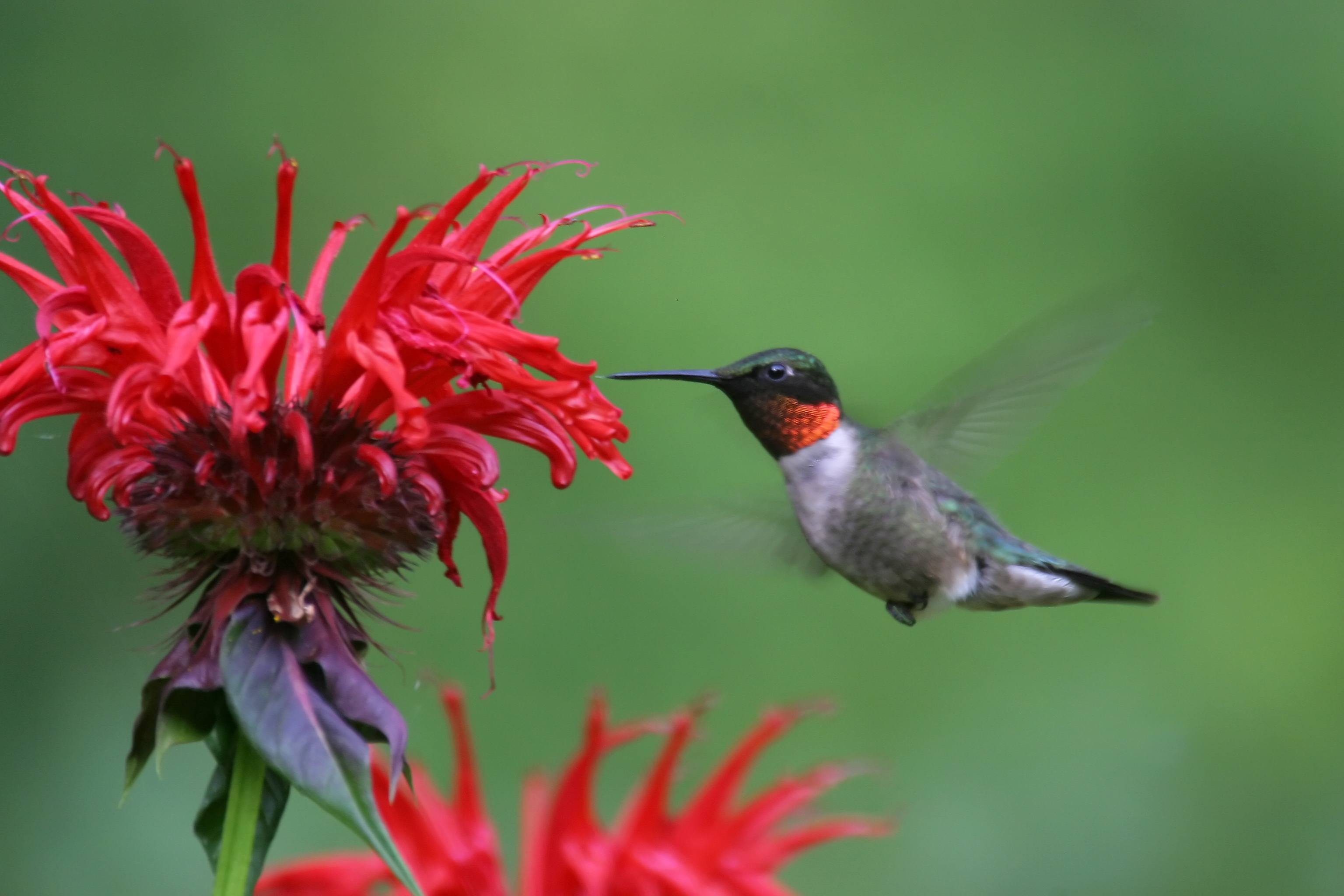
What type of symbiosis?  Hummingbirds feed on nectar from flowers.  The flowers are pollinated by hummingbirds as they move from flower to flower.
a)
commensalism
b)
mutualism
c)
parasitism
d)
predation
38.
The largest group of organisms found in a food web would be:
a)
Primary Consumers
b)
Producers
c)
Decomposers
d)
Tertiary Consumers
39.
According to the graph, What is causing the deer population to decrease
a)
They Got sick
b)
The wolf population is decreasing
c)
The wolf population increased
d)
Nothing it's a coincidence
40.
Succession that occurs in an area with NO SOIL
a)
ecological succession 
b)
primary succession 
c)
secondary succession
d)
pioneer speciles
41.
The first organisms that appear in an ecological community
a)
ecological succession 
b)
primary succession 
c)
secondary succession
d)
pioneer speciles
42.
Natural disasters such as flooding and tornadoes are linked to ________________.
a)
primary
b)
secondary
c)
old field
d)
ecosystem
43.
The final stable community of plants and animals is called:
a)
pioneer community
b)
farmland
c)
climax community
d)
old field
44.
A drought has hit this grassland biome. How will this effect the rabbit population?
a)
The rabbits will increase in number.
b)
The rabbit population will stay the same.
c)
The rabbit population will decrease.
d)
The rabbit population will become extinct immediately.
45.
Which type of consumer is always a first consumer?
a)
Herbivore
b)
Omnivore
c)
Carnivore
d)
Producer
46.
Which is the correct food chain order?
a)
Plant-->1st Consumer--> 2nd Consumer 
b)
Plant <-- 1st Consumer <-- 2nd Consumer
c)
2nd consumer     --> 1st consumer  --> Plant
d)
1st Consumer      --> 2nd consumer --> Plant
47.
What are the organisms that break down dead stuff?
a)
Producers
b)
Consumers
c)
Decomposers
d)
Organisms
48.
Which of these organisms would receive energy from the snake?
a)
Plant
b)
Rabbit
c)
Mouse
d)
Hawk
49.
If an area has all the wolves that it can support, the wolf population has reached its _______________________.
a)
limiting factor
b)
carrying capacity
c)
emmigration
d)
immigration
50.
What factor describes when populations increase because animals are moving into a population?
a)
Emigration
b)
Limiting Factors
c)
Immigration
d)
Exponential Growth
51.
This occurs when organisms move out of an ecosystem that is in chaos.
a)
Immigration
b)
Emmigration
c)
Birth Rate
d)
Death Rate
52.

Forms the basis of all organic compounds

a)

Carbon

b)

Nitrogen

c)

Oxygen

d)

Hydrogen

53.

This is an image of...

a)

Phosphorous Cycle

b)

Water Cycle

c)

Nitrogen Cycle

d)

Carbon Cycle

54.

__________ are all organisms that break down dead/dying matter, and release carbon, nitrogen, phosphorous, etc. into their surroundings

a)

Bacteria

b)

Decomposers

c)

Fungi

d)

Microbes

55.

When bacteria convert nitrogen into different usable forms, this is called nitrogen...

a)

Conversion

b)

Nitrification

c)

Conversion

d)

Fixation

56.

Why do plants and animals need nitrogen?

a)

To produce proteins

b)

To store energy

c)

To digest food

d)

To conduct photosynthesis

57.

When a consumer dies, it will likely get consumed by _________. (nature's recyclers)

a)

wolves and bears

b)

mice and rabbits

c)

foxes and coyotes

d)

bacteria and fungi

58.

Which cycle is shown in the picture?

a)

The Water Cycle

b)

The Nitrogen Cycle

c)

The Carbon Cycle

d)

The Cell Cycle

59.
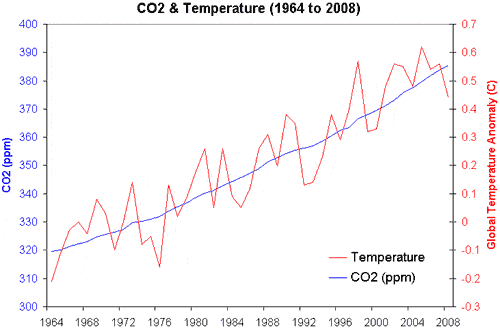
The graph below shows CO2 emissions and temperatures from 1909 to 1949.  What conclusion is best supported by the graph?
a)
There is no relationship between carbon dioxide concentrations and temperatures
b)
As carbon dioxide concentrations increase, temperatures increase
c)
As carbon dioxide concentrations increase, temperatures decrease
d)
As carbon dioxide concentrations decrease, temperatures increase
60.
What are the two most common greenhouse gases?
a)
Water Vapor (H2O) and Methane (CH4)
b)
Carbon Dioxide COand Methane (CH4)
c)
Water Vapor (H2O) and Carbon Dioxide CO2
d)
Water Vapor (H2O) and Nitrous oxide (N2O)
61.
What is the greenhouse effect?
a)
The warming of a planet due to trapped radiation.
b)
The cooling of Earth due to air pollution.
c)
The heating of a solid, such as a rock.
62.
Which of the following statements is true of the phosphorus cycle?
a)
Phosphorus enters the atmosphere as phosphates.
b)
The phosphorus cycle utilizes the processes of erosion, and weathering.
c)
Phosphates are used in carbohydrate and glucose storage.
d)
The phosphorus cycle utilizes bacteria to breakdown phosphates and make them available for plants.
63.
What role do decomposers play in the phosphorous cycle?
a)
absorb phosphorous 
b)
release phosphorous into atmosphere
c)
return phosphorous into the soil
d)
combustion
64.

This is released by the weathering of rocks.

a)

Carbonate

b)

Phosphate

c)

Phosphorus

d)

Nitrogen

65.

All living organisms are mainly composed of what elements?

a)

Oxygen, Carbon, Hydrogen, Nitrogen

b)

Carbon, Phosphorus, Nitrogen, Oxygen

c)

Sodium, Carbon, Nitrogen, Hydrogen

d)

Calcium, Phosphorus, Nitrogen, Oxygen

66.

Which organism in the food web shown to the right would

contain the lowest concentration of chemical pollutants?

a)

producers

b)

primary consumers

c)

secondary consumers

d)

tertiary consumers

67.

The phenomenon by which toxins concentrate in the organisms at higher trophic levels within an ecosystem is known as...

a)

Biotoxicity

b)

Biomagnification

c)

Eutrophication

d)

Predation

68.

Which organism in the food web shown to the right would

contain the lowest concentration of chemical pollutants?

a)

producers

b)

primary consumers

c)

secondary consumers

d)

tertiary consumers