
 Worksheets
Kinetics, Thermodynamics & Equilibrium (focus on Le Chatlier's)
Total questions: 70
Worksheet time: 2hrs 49mins
an in Increase temperature will...
SO2 + O2 <−> SO3
If the concentration of SO2 is increased, the equilibrium of the reaction will shift ___________.

When you increase the pressure on an equilibrium system the system will shift to the side with ______.
least amount of heat
least moles of gas
least moles
Use the reaction below to answer question:
N2O4(g) ⇌ 2NO2 (g) ΔH = + 92 KJ
Which way will the reaction shift if pressure is increased?
Left
Right
No shift
2 SO2 (g) + O2 (g) ⇌ 2 SO3 (g)
Removing O2 (g) will
shift equilibrium right
shift equilibrium left
decrease temperature
have no change
2 SO2 (g) + O2 (g) ⇌ 2 SO3 (g)
Adding SO2 (g) will
shift equilibrium right
shift equilibrium left
increase rate of reaction
have no change
2 SO2 (g) + O2 (g) ⇌ 2 SO3 (g)
Removing SO3 (g) will
shift equilibrium right
shift equilibrium left
increase pressure
have no change
2 SO2 (g) + O2 (g) ⇌ 2 SO3 (g) is an exothermic reaction.
An increase in temperature will...
shift equilibrium toward the right
shift equilibrium toward the left
increase pressure
have no change
heat + N2(g) + O2(g) <−> 2NO(g)
If the heat is removed to the chemical system, the equilibrium will _______.
N2 (g) + 3 H2 (g) <−> 2 NH3 (g)
If the pressure in the system is increased, the reaction will __________________.
If CH4(g) is increased in the reaction:
CH4(g) + 2O2(g) <--> CO2(g) + 2H2O(l)
How will equilibrium shift?
Towards the reactants
Towards the products
If CO2(g) is increased in the reaction:
CH4(g) + 2O2(g) <--> CO2(g) + 2H2O(l)
How will equilibrium shift?
Towards the reactants
Towards the products
If heat energy is increased in the reaction:
CH4(g) + 2O2(g) <--> CO2(g) + 2H2O(l) + heat
How will equilibrium shift?
Towards the reactants
Towards the products
If heat energy is removed in the reaction:
CH4(g) + 2O2(g) <--> CO2(g) + 2H2O(l) + heat
How will equilibrium shift?
Towards the reactants
Towards the products
Use the equation:
C(s) + O2(g) <--> CO2(g) + heat
If a catalyst were to be added to this system what would happen?
Shift towards reactants
Shift towards products
No shift
Use the equation:
C(s) + O2(g) <--> CO2(g) + heat
If temperature in this closed system decreased how would equilibrium shift?
Shift towards reactants
Shift towards products
No shift
Use the equation:
C(s) + O2(g) <--> CO2(g) + heat
If temperature in this closed system increased how would equilibrium shift?
Shift towards reactants
Shift towards products
No shift
Use the equation:
C(s) + O2(g) <--> CO2(g) + heat
If carbon dioxide gas concentration in this closed system increased how would equilibrium shift?
Shift towards reactants
Shift towards products
No shift
Use the equation:
C(s) + O2(g) <--> CO2(g) + heat
If carbon dioxide gas concentration in this closed system decreased how would equilibrium shift?
Shift towards reactants
Shift towards products
No shift
Use the equation:
C(s) + O2(g) <--> CO2(g) + heat
If the solid carbon concentration in this closed system decreased how would equilibrium shift?
Shift towards reactants
Shift towards products
No shift
Use the equation:
C(s) + O2(g) <--> CO2(g) + heat
If the solid carbon concentration in this closed system increased how would equilibrium shift?
Shift towards reactants
Shift towards products
No shift
What is true about chemical equilibrium? Check all that apply.
The rate of the forward reaction is equal to the rate of the reverse reaction
A double arrow, <-->, is used
It occurs in a closed system
The rate of bonds breaking is equal to the rate of bonds forming
What is true about chemical equilibrium? Check all that apply.
The rate of the forward reaction is equal to the rate of the reverse reaction
A double arrow, <-->, is used
It occurs in a closed system
The rate of bonds breaking is equal to the rate of bonds forming
What is true about chemical equilibrium? Check all that apply.
The rate of the forward reaction is equal to the rate of the reverse reaction
A double arrow, <-->, is used
It occurs in a closed system
The rate of bonds breaking is equal to the rate of bonds forming
What is true about chemical equilibrium? Check all that apply.
The rate of the forward reaction is equal to the rate of the reverse reaction
A double arrow, <-->, is used
It occurs in a closed system
The rate of bonds breaking is equal to the rate of bonds forming
What is true about chemical equilibrium? Check all that apply.
The rate of the forward reaction is equal to the rate of the reverse reaction
A double arrow, <-->, is used
It occurs in a closed system
The rate of bonds breaking is equal to the rate of bonds forming
Is the following reaction endo or exothermic? USE TABLE I
4Al(s) + 3O2(g) <--> 2Al2O3(s)
Endothermic
Exothermic
Is the following reaction endo or exothermic? USE TABLE I
H2(g) + I2(g) <--> 2HI
Endothermic
Exothermic
Is the following reaction endo or exothermic? USE TABLE I
2C(s) + 2H2(g) <--> C2H4(g)
Endothermic
Exothermic
Is the following reaction endo or exothermic? USE TABLE I
LiBr(s) <-H2O-> Li+(aq) + Br-(aq)
Endothermic
Exothermic
2Mg(s) + O2 (g) −> 2MgO(s).
The reaction begins because the reactants
Compared to the rate of inorganic reactions, the rate of organic reactions generally is
slower because organic particles are ions
slower because organic particles contain covalent bonds which take a long time to break
faster because organic particles are ions
faster because organic particles contain covalent bonds

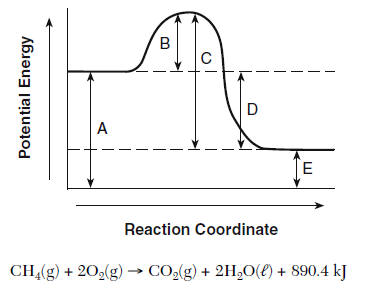
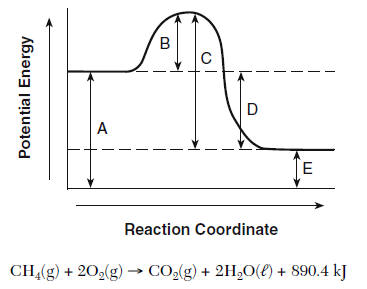
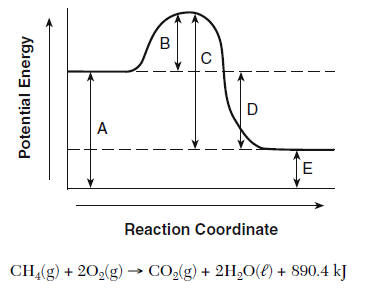
Given the reaction:
CH4(g) + 2 O2(g) --> 2 H2O(g) + CO2(g)
What is the overall result when CH4(g) burns according to this reaction?
Energy is absorbed and H is negative.Δ
Energy is absorbed and ΔH is positive.
Energy is released and ΔH is negative.
Energy is released and ΔH is positive

In table I the reaction of hydrogen and oxygen to form water is best described as
exothermic, because energy is released
endothermic, because energy is released
exothermic, because energy is absorbed
endothermic, because energy is absorbed
Temperature is a measure of average ________ energy of individual atoms.
heat
potential
mechanical
kinetic
Given the equation representing a reaction at equilibrium:
N2(g) + 3H2(g) --> 2NH3(g) + energy
Which change causes the equilibrium to shift to the right?
decreasing the concentration of H2(g)
decreasing the pressure
increasing the concentration of N2(g)
increasing the temperature
Which change will not affect the equilibrium concentrations of A(g), B(g), and A2B3(g)?
The formation of ammonia is favored by
Which statement is true for a saturated solution at equilibrium?
It must be a concentrated solution.
It must be a diluted solution.
Neither dissolving nor crystallizing is occurring.
The rate of dissolving equals the rate of crystallizing.
N2(g) + 3H2(g) ↔ 2NH3(g)
Increasing the concentration of N2(g) will increase the foward reaction rate due to
N2(g) + O2(g) ↔ 2NO(g)
As the concentration of N2(g) increases, the concentration of O2(g) will
N2O4 (g) <--> 2NO2 (g)
The measurable quantities of the gases at equilibrium must be

Check all of the following that can increase the rate of a chemical reaction:
less surface area
lower temperature
increasing pressure
increased concentration

