wayground logo

Free Printable Worksheets

Font size

S
M
L
XL
Worksheets

Bio 101 Midterm 2nd Semester

Total questions: 65

Worksheet time: 2hrs 35mins

Name
Class
Date
1.

Which hormones are responsible for male and female sex characteristics?

a)

Calcitonin

b)

Estrogen

c)

Progesterone

d)

Testosterone

e)

Oxytocin

2.

Which two glands work together to regulate blood calcium levels?

a)

Thyroid

b)

Parathyroid

c)

Adrenal

d)

Pancreas

e)

Liver

3.

When blood sugar is too high, this gland will release insulin to the liver

a)

Pancreas

b)

Ovaries

c)

Parathyroid

d)

Thymus

4.

What are all the differences between positive feedback and negative feedback?

a)

Positive will bring an imbalance back to homeostasis; negative will increase the imbalance

b)

Positive feedback is not as common in nature; negative feedback is more common in nature

c)

positive feedback amplifies the imbalance; negative feedback returns the imbalance back to homeostasis

d)

positive feedback is seen in labor and delivery; negative feedback is seen in blood glucose regulation

5.

What is the function of the pineal gland's hormone melatonin?

a)

cause people to feel sleepy

b)

protect skin from ultraviolet ray damage

c)

regulate he menstrual cycle

d)

increase body growth during adolescence

6.

What hormone secreted by the pancreas causes glycogen stored in the liver to be converted into glucose and released into the bloodstream?

a)

calcitonin

b)

prolactin

c)

glucagon

d)

insulin

7.

If the hormone ADH is released, where are the target cells located?

a)

In the liver

b)

In the stomach

c)

In the kidneys

d)

In the bladder

8.
What hormone is responsible for the "fight or flight" response released by the adrenal medulla? 
a)
Testosterone
b)
Cortisol
c)
Epinephrine
d)
Parathyroid Hormone
9.

Someone with Acromegaly or Dwarfism would have a problem with this gland

a)

thyroid

b)

pancreas

c)

adrenal

d)

pituitary

10.
What is the correct feedback loop for ADH?
a)
Hypothalamus->Pituitary->bloodstream->Liver->Hypothalamus->Pituitary
b)
Hypothalamus->Pituitary->bloodstream->kidneys->hypothalamus->pituitary
c)
Pancreas->kidneys->Pancreas
d)
Pancreas->liver->Pancreas
11.
What is the problem in our body that initiates the release of hGH?
a)
blood glucose is low from cells using up sugar from active growth
b)
blood glucose is low from not eating
c)
blood glucose is too high from eating
d)
blood glucose it too high from fat blocking cells
12.
What is the overall goal of the endocrine system?
a)
to work with nervous system to control our circulation of blood
b)
to use ductless glands that secrete hormones directly into the bloodstream that travel to target cells to deliver a message
c)
to respond to high levels of hormones by dilating veins to allow blood flow to increase
d)
to make our bodies alert and aware of our surroundings 
13.
Which is the correct order?
a)
C,D, B, A, F, E
b)
D,A,F,C,E,B
c)
B,E,C,F,A,D
d)
C,B,D,A E,F
14.
The division of the cytoplasm following mitosis ...
a)
cytoplasm
b)
cytokinesis
c)
telophase
d)
mitosis
15.
In the diagram, in which structure(s) are homologous pairs of chromosomes normally be present?
a)
Sperm only
b)
Egg only
c)
Zygote only
d)
Sperm and Egg
16.
What phase of mitosis is pictured?
a)
Prophase
b)
metaphase
c)
anaphase
d)
telephase
17.
How many daughter cells are produced in mitosis?
a)
4 new cells
b)
2 new cells
c)
One new cell
d)
none of these
18.

The cells produced via meiosis are called:

a)

gametes

b)

somatic cells

c)

body cells

d)

skin cells

e)

diploid cells

19.

This process produces cells that will allow the next generation to have the same chromosome number as parents

a)

mitosis

b)

meiosis

20.
This produces cells for growth and repair.
a)
mitosis
b)
meiosis
21.
The end of meiosis results in  ________ to each other.
a)
2 cells that are identical
b)
4 cells that are identical
c)
2 cells that are not identical
d)
4 cells that are not identical
22.

Why is DNA the shape that it is?

a)

the double helix allows DNA to be condensed by coiling and supercoiling to fit inside a small space

b)

the ladder shape allows DNA to hold base pairs together

c)

The amino acid chains super coil together to fit in the cell

d)

the single helix will twist and condense to fit inside the nucleus
23.
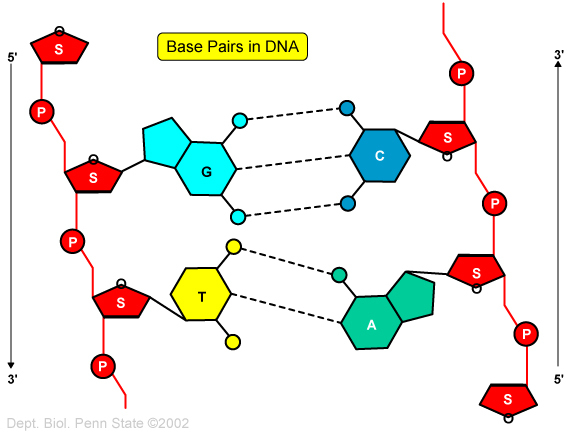
Which 2 molecules form the sides (backbone) of the DNA ladder?
a)
deoxyribose sugar and adenine
b)
deoxyribose sugar and a hydrogen bond
c)
deoxyribose sugar and the nucleus
d)
deoxyribose sugar and phosphate
24.
Nitrogenous bases are joined by which type of bond?
a)
polar bonds
b)
ionic bonds
c)
covalent bonds
d)
hydrogen bonds
25.
What are the three components of a nucleotide?
a)
sugar, hydrogen, nitrogen base
b)
sugar, oxygen, nitrogen base
c)
sugar, phosphate, nitrogen base
d)
sugar, phosphate, protein
26.
Which organelle is DNA usually found in?
a)
cell membrane
b)
vacuole
c)
ribosome
d)
nucleus
27.

What is the complement to the DNA strand written below (not in the picture):

5'-ATGCCAT-3

a)

5'-TACGGTA-3'

b)

3'-TACGGTA-5'

c)

3'-ATGGCAT-5'

d)

5'-ATGGCAT-3'

28.
What is the significance of the sequence (order) of the Nitrogen Bases in DNA?
a)
The order of the Nitrogen Bases determines the number of chromosomes present in an organism.
b)
The order of the Nitrogen Bases determines the traits that an organism will possess (have).
c)
The order of the Nitrogen Bases determines the gender of an organism.
d)
The order of the Nitrogen Bases determines whether an organism is abiotic biotic.
29.
Assume that you have straight hair and your sibling has curly hair. What accounts for this difference?
a)
You have DNA and your sibling does not.
b)
The your sequence of nitrogen bases is different than your sibling.
c)
Your sibling has a weave. 
d)
Your sibling has a genetic mutation. 
30.
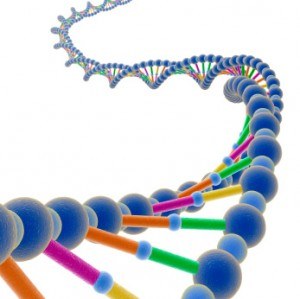
Who is responsible for producing this image?
a)
Francis Crick
b)
James Watson
c)
Rosalind Franklin
d)
Watson and Crick
31.
What did Erwin Chargaff conclude from his experiments?
a)
Nitrogen bases are held together by peptide bonds
b)
A and T, C and G always occur in equal amounts
c)
Proteins are the carriers of genetic information
d)
C and G rarely occur in eukaryotic organisms
32.
What was Watson and Crick's main scientific accomplishment?
a)
Building the first accurate model of DNA
b)
Isolating strains of pneumonia causing bacteria
c)
Determining base pairing rules
d)
Discovering the process of genetic transformation
33.

What was the conclusion of Hershey and Chase's bacteriophage experiment?

a)

DNA, not protein, is the molecule of inheritance

b)

Protein, not DNA is the molecule of inheritance

c)

There is a 1:1 ratio of A&T and a 1:1 ratio of C&G for bases in the DNA molecule

d)

The transforming principle

34.

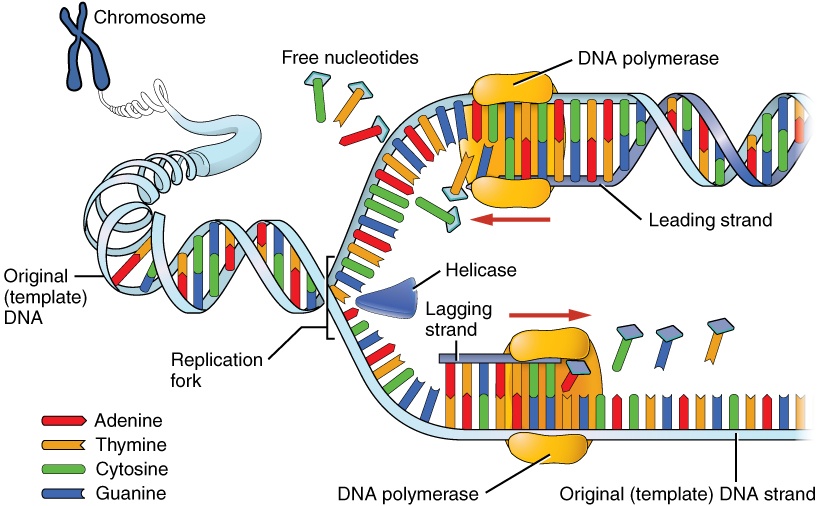
This enzyme is capable of breaking Hydrogen bonds found between the bases of DNA

a)

Topoisomerase

b)

DNA Helicase

c)

DNA Polymerase

d)

Exonuclease

35.
Which enzyme seals okazaki fragments together on the lagging strand?
a)
Topoisomerase
b)
Helicase
c)
Polymerase
d)
Ligase
36.
What do we call DNA replication since new DNA has 1 parent strand and 1 new strand?
a)
Conservative 
b)
Semiconservative 
c)
Dispersive
37.
Which enzyme is responsible for adding nucleotides?
a)
Topoisomerase
b)
DNA Polymerase
c)
Ligase
d)
Primase
38.

Which enzyme is responsible for checking DNA for errors, and fixing it?

a)

DNA Polymerase

b)

DNA Primase

c)

DNA Helicase

d)

RNA Polymerase

39.

In what direction does the Leading strand run?

a)

3' ----> 5'

b)

5' -----> 3'

c)

It doesn't matter

d)

Both directions

40.
Which sequence of DNA bases would pair with this partial strand
CAT TCA CTG
a)
ATG TGA CAG
b)
TAC ACT GTC
c)
GTA AGT GAC
d)
CAT TCA CTG
41.
Which of the following units are repeatedly joined together to form a strand of DNA?
a)
amino acids
b)
nucleotides
c)
fatty acids
d)
polysaccharides
42.
order of replication
a)
3, 4, 2, 1
b)
3, 1, 4, 2
c)
2, 1, 4, 3
d)
3, 4, 1, 2
43.

Why does DNA replicate?

a)

To give instructions to a new cell when an organism grows and makes more cells

b)

To create a duplicate copy in case the original gets damaged

c)

To create a new copy to replace the damaged original DNA

d)

To provide new cells with the same instructions when they replace old or damaged cells

44.
Which stem cells have the most potency?
a)
Multipotent
b)
Pluripotent
c)
Totipotent
d)
Unipotent
45.
Stem cells are
a)
cells that grow uncontrollably
b)
undifferentiated and can be any type of cell
c)
never go through cell division
d)
only found in embryos
46.
Which is true about Adult Stem Cells.
a)
They no longer do mitosis, their cell type is set and can not change
b)
They are limited to the type of  cell they can become.
c)
They can become any cell type in the body
d)
They are found in embryos
47.

In your body, how is the DNA of a nerve cell different from the DNA of a muscle cell?

a)

The DNA is the same but each cell contains different genes

b)

The DNA is the same but different genes are turned on and turned off in each cell

c)

The DNA is different, but the same genes are turned on and off in each cell

d)

The DNA is different, but each cell contains the same genes

48.
Why is stem cell research an ethical issue?
a)
 if stem cells are extracted from an embryo, the embryo dies
b)
it is totally right to do stem cell research
c)
it is totally wrong to do stem cell research
d)
stem cells extracted from adults do not harm the adult at all
49.
How can all of the cells in your body have the SAME DNA but have so many different jobs?
a)
the DNA is just interpreted differently in all the cells
b)
all the cells don't have the same DNA. That is how they are all different.
c)
the DNA is changed in the different kind of cells
d)
all the cells use different parts of the DNA. Different genes are expressed
50.

Why do we need mitosis?

a)

for our cells to get bigger

b)

to grow in the number of cells in our body

c)

to produce sex cells

d)

to repair damaged tissue

51.

What MUST happen in interphase in order for mitosis to be successful?

a)

the cell has to mature

b)

the cell has to divide

c)

the nucleus has to break down

d)

the genetic material has to be copied

52.

What could be the solution to the ethical controversy over embryonic stem cell use?

a)

use adult stem cells and change them into induced pluripotent stem cells

b)

arrest every one who uses embryos for research

c)

use embryonic cells from animals, like pigs

d)

stop using stem cells all together

53.
The process of crossing over occurs in what phase of meiosis?
a)
anaphase 1
b)
prophase 1
c)
prophase 2
d)
telophase 1
54.

If an egg cell with an extra chromosome was fertilized by a normal sperm cell, what chromosome abnormality could the resulting zygote have?

a)

Down Syndrome

b)

monosomy

c)

diploid syndrome

d)

trisomy

e)

Turner's Syndrome

55.
In a molecule of double-stranded DNA, the amount of Adenine present is always equal to the amount of
a)
cytosine
b)
guanine
c)
thymine
d)
uracil
56.

What is the correct order of DNA replication steps?

1) DNA polymerase adds new nucleotides to the exposed bases

2) Helicase unwinds DNA

3) Ligase glues together Okazaki fragments

4) Primase marks where DNA replication should begin

a)

1, 2, 3, 4

b)

2, 3, 4, 1

c)

2, 4, 1, 3

d)

4, 3, 2, 1

57.

Using the picture, If green is dominant over purple, then what is the genotype for this individual?

a)

Purple

b)

Green

c)

GG

d)

gg

58.
Another word for homozygous is...
a)
purebred
b)
hybrid
c)
heterozygous
d)
dominant
59.
Gregor Mendel's "P" generation consisted of purple flower plants crossed with white flower plants. What were the results of this cross?
a)
All purple flower offspring
b)
All white flower offspring
c)
Some purple flowers and some white flowers
60.
A __________ is a segment of DNA that codes for a particular protein, which leads to a particular trait.
a)
Gene
b)
Allele
c)
Codon
d)
Nucleotide
61.

What is the predicted percentage of homozygous recessive offspring in this cross?

a)

0%

b)

25%

c)

50%

d)

75%

62.
Two brown eyed parents (Bb) have a baby. What is the chance the baby is blue eyed?
a)
0 %
b)
25%
c)
50%
d)
75%
63.

Law of segregation states:

a)

the two alleles for each trait separate during meiosis

b)

the two alleles for each trait separate during mitosis

c)

a random distribution of alleles occur during gamete formation

d)

a ordered distribution of alleles occur during gamete formation

64.
What gamete possibilities could come from this parent's genotype?
a)
AB, AB, aB, aB
b)
Ab, AB, Ab, ab
c)
Ab, Ab, Ab, Ab
d)
AB, aB, ab, aB
65.

Cross Two Homozygous plants

(RRYY x rryy)

R = round seeds, r = wrinkled seeds Y = yellow seeds, y = green seeds

What percent will have Round and Yellow seeds?

a)

0%

b)

25%

c)

50%

d)

100%