wayground logo

Free Printable Worksheets

NEW

Font size

S
M
L
XL
Worksheets

Ms. Spence's Newton's Laws Quiz

Total questions: 48

Worksheet time: 35mins

Name
Class
Date
1.

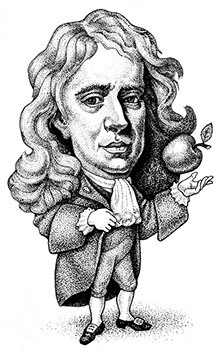
Who was Sir Isaac Newton?

a)

Famous British scientist who studied motion, gravity, and much more.

b)

Famous American scientist who studied ecology.

c)

German scientist that studied electricity.

d)

Chinese physicist that studied things.

2.

What is inertia?

a)

Newton's 2nd Law of motion

b)

tendency of objects to keep doing what they're doing

c)

Newton's third law of motion

d)

something falling

3.

What is Newton's First Law?

a)

An object in motion stays in motion with the same velocity unless acted upon by an unbalanced force

b)

F=ma

c)

For every action force there is an equal and opposite reaction force

d)

what goes up must come down

4.

What is Newton's Second Law?

a)

An object in motion stays in motion with the same velocity unless acted upon by an unbalanced force

b)

F=ma

c)

For every action force there is an equal and opposite reaction force

d)

what goes up must come down

5.

What is Newton's third Law?

a)

An object in motion stays in motion with the same velocity unless acted upon by an unbalanced force

b)

F=ma

c)

For every action force there is an equal and opposite reaction force

d)

what goes up must come down

6.

When an object resists change, like a body in a turning car, it is called ________________.

a)

inertia

b)

force

c)

friction

d)

drag force

7.
a push and/or a pull.
a)
force
b)
net force
c)
normal force
d)
drag force
8.
A force that results from two objects rubbing past each other.
a)
Gravity
b)
Friction
c)
Inertia
d)
Force
9.
 What is the unit called that measures force?
a)
Isaac
b)
Yee
c)
Newton
d)
kilogram
10.
The scientist who is most famous for developing the Laws of Motion is _____.
a)
Albert Einstein
b)
Stephen Hawking
c)
Sir Isaac Newton
d)
Galileo Galilei
11.
If two people are pulling against each other with forces of 500 N and 600 N, there is a/an
a)
balanced force
b)
unbalanced force
c)
weak force 
d)
universal force
12.
The tendency of matter to remain in constant motion unless acted on by an outside, unbalancedforce is called
a)
inertia
b)
acceleration
c)
momentum 
d)
force
13.
If you push on a wall with a force of 10 Newtons, the force acting on you is
a)
0 Newtons
b)
10 Newtons
c)
20 Newtons
d)
30 Newtons
14.
Which law explains why when you put a book on a table the table pushes on the book
a)
3rd law
b)
4th law
c)
1st law
d)
2nd law
15.
Forces always act in equal and opposite pairs.
a)
Newton's 1st Law
b)
Newton's 3rd Law
c)
Newton's second law
16.
What kind(s) of objects have inertia?
a)
all objects with mass
b)
only objects at rest
c)
only objects in motion
d)
only objects whose motion is being changed
17.
Friction is a force that acts 
a)
in the same direction as the force
b)
opposite to the direction of the force
c)
with the force
d)
towards the direction of the force
18.
Speed in a direction is called
a)
Momentum
b)
Velocity
c)
Speed
d)
Inertia
19.
Which of the following is not a type of friction?
a)
Sliding
b)
Rolling
c)
Static
d)
Gravity
20.
Which is the longest?
a)
meter
b)
kilometer
c)
centimeter
d)
milimeter
21.
gram and kilogram measures
a)
capacity
b)
length
c)
time
d)
mass
22.
What is the length of the screw?
a)
5cm
b)
6cm
c)
5mm
d)
6m
23.
The basic metric unit for distance is the _.
a)
gram
b)
meter
c)
liter
24.
"For every action, there is an equal and opposite reaction."
a)
Newton's 1st Law
b)
Newton's 2nd Law
c)
Newton's 3rd Law
d)
Newton's 4th Law
25.
Force = Mass x Acceleration
a)
Newton's 1st Law
b)
Newton's 2nd Law
c)
Newton's 3rd Law
d)
Newton's 4th Law
26.
"An object in motion (or at rest) will to stay in motion (or at rest) until an outside force acts upon it."
a)
Newton's 1st Law
b)
Newton's 2nd Law
c)
Newton's 3rd Law
d)
Newton's 4th Law
27.
The tendency of an object to resist changes in its motion is...
a)
inertia
b)
force
c)
acceleration
d)
velocity
28.
The tendency of a moving object to resist changes in its motion is...
a)
momentum
b)
force
c)
acceleration
d)
velocity
29.
Any push or pull on an object.
a)
force
b)
velocity 
c)
inertia
d)
momentum
30.
The force that opposes motion between two surfaces in contact with each other.
a)
inertia
b)
friction
c)
momentum
d)
gravity
31.
The force of attraction between all matter.
a)
inertia
b)
friction
c)
net force
d)
gravity
32.
A force that opposes motion between a surface in contact with the atmosphere.
a)
air resistance
b)
gravity
c)
momentum
d)
terminal velocity
33.
A Newton is a unit of...
a)
force
b)
inertia
c)
acceleration
d)
velocity
34.
When all the forces on an object are equal and opposite, & the net force is zero, that's...
a)
balanced forces
b)
unbalanced forces
c)
terminal velocity
d)
reaction forces
35.
The combination of all the forces acting on an object is the...
a)
net force
b)
action force
c)
reaction force
d)
balance force
36.
An archer pulls the bowstring back, then releases the string and the arrow flies forward. Pulling the string back is the...
a)
action force
b)
reaction force
c)
net force
d)
inertia
37.
An archer pulls the bowstring back, then releases the string and the arrow flies forward. The arrow flying forward is the...
a)
action force
b)
reaction force
c)
net force
d)
inertia
38.
A cannonball with a mass of 0.5 kg is flying at an acceleration of 10 m/sec/sec. What is it's force?
a)
50 Newtons
b)
5 Newtons
c)
20 Newtons
d)
9.5 Newtons
39.
A cannonball with a mass of 10 kg is flying at an acceleration of 5 m/sec/sec. What is it's force?
a)
50 Newtons
b)
5 Newtons
c)
20 Newtons
d)
9.5 Newtons
40.
The net force on a ball thrown in outer space is... (you are no longer touching the ball)
a)
there is none
b)
forward
c)
down and backward
d)
forward and down
41.
The net force on a ball thrown on Earth is... (you are no longer touching the ball)
a)
there is none
b)
forward
c)
down and backward
d)
forward and down
42.
When a moving object strikes another object, it will transfer this to the object it hits.
a)
force
b)
momentum
c)
gravity
d)
friction
43.
Gravity is increased with...
a)
greater mass & shorter distance
b)
greater mass & farther distance
c)
lower mass & shorter distance
d)
lower mass & farther distance
44.
Mass x acceleration = ?
a)
force
b)
inertia
c)
momentum
d)
velocity
45.
A 10 lb. bowling ball hits a stationary 20 lb. bowling ball. Which of the following is not true about the 2nd ball?
a)
will have unbalanced forces acting on it
b)
move twice as fast as the original ball
c)
not move unless there is enough force to overcome its inertia
d)
take on the momentum of the original ball
46.
In the picture, the blocks are flying out of the truck based on which of Newton's laws?
a)
Newton's 1st Law
b)
Newton's 2nd Law
c)
Newton's 3rd Law
d)
Newton's 6th Law
47.
In the picture, the vehicle will move because of...
a)
Newton's 1st Law
b)
Newton's 2nd Law
c)
Newton's 3rd Law
d)
Newton's 9th Law
48.
To compare the two pictures would require...
a)
Newton's 1st Law
b)
Newton's 2nd Law
c)
Newton's 3rd Law
d)
Newton's 11th Law